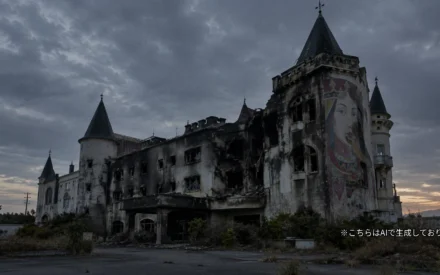
Sightseeing in Mito: Plums, a Domain School, a Castle and a Lake in the Tokugawa Legacy
Supervised by Suzuking. (KARASU CHANNEL / Occult & horror reporting, 7 years)
Contents
Places to visit in this town (north to south)
Numbers follow the order in the article, from north to south. Select a pin to see its name. Positions are approximate.
- Ibaraki Prefectural Museum of History (茨城県立歴史館) A prefectural history museum and archive just north of Kairakuen, with a Meiji-era pseudo-Western school building and Important Cultural Property materials of the Hitotsubashi Tokugawa family.
- Kodokan (弘道館) The domain school Tokugawa Nariaki opened in 1841; a National Special Historic Site whose main hall, Shizendo and main gate are Important Cultural Properties, with bullet holes still visible in the gate.
- Tokiwa Shrine (常磐神社) A shrine beside the Kairakuen grounds enshrining Tokugawa Mitsukuni and Tokugawa Nariaki, founded by former Mito retainers in the early Meiji era.
- Kairakuen (偕楽園) One of Japan's Three Great Gardens, opened by Tokugawa Nariaki to be enjoyed with the people, known for about 3,000 plum trees of some 100 varieties, Kobuntei and a yin-and-yang garden design.
- Mito Castle Ruins (水戸城跡) The site of the Mito Tokugawa family's hilltop castle, where a yakuimon gate and the reconstructed Otemon and second-bailey corner turret convey the modest look of a castle without a keep.
- Lake Senba (千波湖) A gourd-shaped lake below the cliff of Kairakuen and a symbol of Mito, where waterbirds gather in winter and endangered fish live in the surrounding springs.
- Ogushi Shell Mound (大串貝塚) A National Historic Site and early Jomon shell mound, said to be the oldest Jomon midden recorded in an ancient text, where it appears in a giant legend.
Show basic information about this town (location, last checked, notes)
- Location
- Mito, Ibaraki Prefecture, Japan
- Last checked
- 2026.10.05
- Please note
- Opening hours, prices and closing days change often, so we do not list them. Please check each facility's official site before you go.
What Kind of Town Is Mito?
Mito is the capital of Ibaraki Prefecture and a castle town tied to the Mito Tokugawa family, one of the Three Branch Houses (Gosanke) of the Tokugawa clan. It is widely known through Tokugawa Mitsukuni (the “Mito Komon” of television fame) and Kairakuen Garden, and the seasons bring a steady run of festivals: the Plum Festival in February, the Komon Festival in August and the Bush Clover Festival in September. The city’s name is said to come from a river port that flourished on boat traffic along the Naka River and was regarded as the “door” (to) of the waterway. Mito became a city in 1889, one of the first 31 cities established in Japan.
This article introduces the sights in order of latitude, from north to south. We start with the history museum beside Kairakuen, then move through the plum garden and shrine, the domain school, the castle ruins and the lake, and finally head south to a Jomon shell mound in the southeast of the city. Most of the city sits on a plateau, with lowlands only around the Naka River. Look past the showy famous spots, too, to the feelings and history of the people behind them.

A mini tripod for stabilizing a phone while recording or filming at a haunted spot.
Manfrotto Mini Tripod & Hand Grip for Smartphones 'PIXI MII Smart', with MCLAMP Adapter, Fits Phones up to 8.35cm Wide, 1kg Load Capacity MKPIXICLMII-BK
We may earn a referral fee on purchases made through these links.
1. Ibaraki Prefectural Museum of History (茨城県立歴史館)
The Ibaraki Prefectural Museum of History stands just north of Kairakuen. It is a prefectural history museum that also serves as an archive for old documents. It opened in 1974 on the grounds of the former Prefectural Mito Agricultural High School, and the school’s original main building still survives on the site.
The grounds also hold the former Mitsukaido Elementary School main building, moved here from Mitsukaido. Built in 1881 (Meiji 14) with donations from wealthy merchants, it is a two-story wooden building in the pseudo-Western style, topped with a tower, and is designated a prefectural tangible cultural property. Inside are teaching materials from the Meiji era through the prewar Showa years, along with a grand piano made in 1865, said to be one of the oldest in Japan.
The collection includes materials of the Hitotsubashi Tokugawa family, designated Important Cultural Properties, numbering in the thousands and ranging from documents and records to paintings, calligraphy and objects. Items excavated from the Sanmaizuka Tumulus, also an Important Cultural Property, include a gilt-bronze openwork crown with horse-shaped ornaments that has no parallel elsewhere. In the 2011 Great East Japan Earthquake, a shaking of upper 6 on the Japanese scale scattered documents and materials and brought down interior walls of the old Mitsukaido school building, but the museum reopened in April of that year and the school building in July. It is a quiet place, a short step away from the crowds of plum season.
2. Kodokan (弘道館)
Kodokan was the domain school completed in 1841 in the third bailey of Mito Castle by Tokugawa Nariaki, the ninth lord of the Mito domain. Its grounds cover roughly 105,000 square meters, making it the largest domain school in the country. The former Kodokan is a National Special Historic Site, and its main hall (Seicho), Shizendo and main gate are Important Cultural Properties. Where Kairakuen was a place to rest body and mind, Kodokan was a place to study, and the two were created as a pair.
Students are said to have studied Confucianism and National Learning, as well as martial arts, medicine and astronomy. There was no concept of graduation: learning was considered a lifelong pursuit, and young and old studied side by side. The “Kodokan-ki,” which sets out the school’s founding principles, was drafted by Fujita Toko, and Nariaki himself wrote it out in brush and had it carved on a stone monument.
In the final years of the shogunate, the domain split into the reformist Tengu Party and the conservative Shosei Party, and Kodokan itself became a battlefield. In 1868 the Shosei Party barricaded themselves inside, fighting broke out with the Tengu Party and others, and many buildings burned. Bullet holes believed to have been fired from the castle side at that time can still be seen in the pillars of the main gate. The grounds are also planted with about 800 plum trees of roughly 60 varieties, making it a quiet plum-viewing spot quite different from Kairakuen. The monument bearing the Kodokan-ki, which collapsed in the 2011 earthquake, was restored in 2013.
3. Tokiwa Shrine (常磐神社)
Tokiwa Shrine enshrines Tokugawa Mitsukuni (Lord Gi’ko), the second lord of the Mito domain, and Tokugawa Nariaki (Lord Retsuko), the ninth. In the early Meiji period, former retainers who revered the virtue of the two men built a small memorial hall within Kairakuen, which was the start of the shrine. In 1873 the shrine’s name and the deities’ titles were fixed, and in 1874 the main hall was built on its present site. In 1882 it was ranked as a Bekkaku Kanpeisha, a special-status state shrine.
Within the precincts are Toko Shrine, dedicated to Fujita Toko, who drafted the Kodokan-ki, and Miki Shrine, dedicated to Miki Yukitsugu and others, who raised Mitsukuni. The national flag establishment commemoration ritual refers to Nariaki’s designation of the Hinomaru as Japan’s national flag. The grounds also hold facilities such as the Giretsukan and a Noh stage.
What makes this shrine interesting is that it arose from a movement, spreading across the country from the late Edo period into the Meiji era, of revering a domain’s founder by enshrining former lords as deities. In this site’s view, the fact that a place of prayer, built by retainers remembering their lord, stands right next to Kairakuen, so brightly celebrated as a plum-blossom destination, quietly tells you something about the character of Mito. Because this is an active shrine, please visit quietly and with respect for the faith practiced here.
4. Kairakuen (偕楽園)
Kairakuen is a garden opened in 1842 by Tokugawa Nariaki, the ninth lord of the Mito domain, and ranks as one of Japan’s Three Great Gardens alongside Korakuen in Okayama and Kenrokuen in Kanazawa. It is designated a National Historic Site and Place of Scenic Beauty under the name “Tokiwa Park.” The name “Kairaku” comes from an old Chinese classic and the idea of enjoying things together with others. Nariaki conceived the garden as a place of rest for the retainers studying at the Kodokan domain school and as a place to enjoy with his subjects, and it is said to have been opened to the public on days ending in three or eight each month.
The main garden holds about 3,000 plum trees of some 100 varieties, and in early spring crowds come to see the blossoms. Kobuntei, the villa facing the plum grove, was designed by Nariaki himself and has a wooden pulley-driven lift for carrying goods to the third floor. It burned in the Mito air raid of 1945 and was restored in 1958, then its inner residence was lost to a lightning strike in 1969 and rebuilt in 1972.
The garden is also said to be laid out so that visitors walk through a world of yin and yang. Entering by the front gate, you pass through a dark grove of cedar and bamboo, then come out into a bright plum grove with a view over Lake Senba. This is our conjecture, but perhaps Nariaki built that walk from darkness into light into the garden’s design as he set out to create a place to enjoy with the people. The moso bamboo was brought from Kyoto at Nariaki’s order as material for bows, and the garden also has the Sakon cherry tree, the Togyokusen spring and the Taro cedar, estimated to be 800 years old. The Plum Festival usually runs from mid-February to late March, though the timing of the blossoms varies from year to year.
5. Mito Castle Ruins (水戸城跡)
Mito Castle was a hilltop castle of the linear (renkaku) type that served as the residence of the Mito Tokugawa family in the Edo period. It is said to have been built by Baba Sukemoto between the late Heian and early Kamakura periods, and in the Sengoku period it became the seat of the Edo clan and later the Satake clan. In 1609 Tokugawa Yorifusa entered the castle, making it the Mito Tokugawa family’s castle, and it remained so until the Meiji era. Protected by the Naka River to the north and Lake Senba to the south, it had its main, second and third baileys lined up along the edge of the plateau.
The Mito Tokugawa family did not take part in the alternate-attendance system and lived permanently in Edo, so the lords seldom stayed at the castle and its buildings were modest. No castle keep was built; a three-tier turret that looked three stories from outside and had five floors inside served in its place. The turret escaped demolition in the Meiji era but burned in the Mito air raid of August 2, 1945, and has not been rebuilt.
Today the area around the former third bailey is preserved as a castle site, with earthen ramparts and a dry moat still in place. On the grounds of the high school in the former main bailey stands a yakuimon gate, moved there and regarded as the oldest surviving building of Mito Castle. In recent years the Otemon main gate was reconstructed in wood and opened in 2020, followed by the corner turret of the second bailey in 2021. Much of the castle site lies within school grounds and many areas are closed to visitors, so please stay within the areas open to the public. In this site’s view, a modest castle with no keep expresses well the family tradition of valuing scholarship that marked Mito.
6. Lake Senba (千波湖)
Lake Senba is a shallow, gourd-shaped lake about 3 kilometers around and roughly one meter deep on average, right beside central Mito. Kairakuen sits atop the cliff on the lake’s northwest shore, and the view up to Kairakuen from the lake and the view down to the lake from the garden are among Mito’s signature landscapes.
The lake began as a marsh formed 5,000 to 3,000 years ago, when sediment from the ancient Naka River dammed the water. When the Mito domain laid out its castle town, the banks were built up and the lake took its present form. At that time it was about three times its current size and served as a natural outer moat for Mito Castle. Its eastern side was filled in from the late Taisho era through the first half of the Showa era, giving it the shape it has today.
From autumn into winter, wintering birds such as ducks, swans and geese arrive. In the spring-fed wetlands around the lake lives the endangered Japanese stone loach (Lefua echigonia), despite the closeness of the urban center, and the area has been chosen as an Important Wetland by the Ministry of the Environment. On the other hand, there are water quality problems such as large summer algae blooms, and measures to bring in water from the Naka River are under way. “Senko Bosetsu” (Evening Snow at the Immortal Lake), one of the Eight Views of Mito chosen by Nariaki, depicts this lake in a snowy dusk. The path around the shore is used for walks and jogging, and is part of everyday life for local people.
7. Ogushi Shell Mound (大串貝塚)
The Ogushi Shell Mound, in Shiozaki-cho, Mito, is an early Jomon period shell midden. The section of the slope with its shell layers is a National Historic Site and has been developed as Ogushi Kaizuka Fureai Park. It lies on the tip of a plateau on the north side of the Hinuma River, a tributary of the Naka River, and the Hinuma River is thought to have spread out like an inlet in Jomon times.
The shells excavated include Asian clam (yamato-shijimi), hard clam, short-necked clam, oyster, abalone and turban shell, and the mix of freshwater and sea shells suggests this was a place where a river ran into an inlet. The 1985 excavation turned up stone arrowheads, shell rings, fishhooks and other tools of bone and shell, along with the bones of sea bass, sea bream and pufferfish, and of wild boar and deer.
This mound is thought to correspond to “Okushi no Oka” in the Nara-period Hitachi no Kuni Fudoki (gazetteer of Hitachi Province). The Fudoki says that long ago a giant lived there, who dug up huge clams from the shore while standing on the hill and ate them, and that the piled-up shells became the hill. It is considered the oldest example of a Jomon shell mound recorded in an ancient text, and Matsumoto Seicho wrote the novel “Kyojin no Iso” (The Giant’s Shore) based on the legend. This is our conjecture, but perhaps people of ancient times told of the traces of the lives of people far earlier than themselves as the leftovers of a giant’s meals.
Local Specialties: Food and Drink
Mito’s best-known specialty is natto (fermented soybeans). One tradition about its origins says that Minamoto no Yoshiie, on his way to Oshu during the Later Three Years’ War, stayed at the home of a wealthy local at Watari in Mito, and boiled beans meant as horse feed fermented into natto. Farmers here had long made and eaten natto at home, and in 1889 (Meiji 22) natto production began in Sakumachi, spreading as a modern food industry. It is characterized by small-bean soybeans, and sales at Mito Station made it known as a souvenir as well. In 2022 the city council passed an ordinance designating July 10 as “Natto Day.”
Plums are also essential to Mito’s flavors. Tokugawa Nariaki wrote on a stone monument that he planted plums not only to enjoy the blossoms but also with the idea of making the fruit into pickled plums (umeboshi) to help in time of war. At Kairakuen, plum fruits are distributed every June.
Another topic is ramen. Tokugawa Mitsukuni is said to have been the first person in Japan to eat ramen and gyoza, and every autumn Senba Park now hosts a ramen festival.
Rare Wildlife and Nature
The stars of Mito’s nature are plums and water. The main garden of Kairakuen holds about 3,000 plum trees of some 100 varieties, and Kodokan has about 800 trees of roughly 60 varieties. Wintering birds visit Lake Senba, and the endangered Japanese stone loach lives in the spring-fed wetlands around it.
Kairakuen also has the Taro cedar, estimated at 800 years old, and a grove of several thousand moso bamboo. On the cliff south of the garden are scattered caves where Kanzaki stone was quarried for the stone aqueduct pipes, some running about 50 meters deep. The city is also home to the Kusukawa Dam, said to be Japan’s first dam built solely for a water supply.
Other Notable Things About This Town
In the Mito domain, the second lord Mitsukuni began compiling the “Dai Nihon Shi” (Great History of Japan), and from that came Mito learning (Mitogaku). In the final years of the shogunate, people influenced by Mito learning played major roles on the political stage, while the domain itself split into the Tengu and Shosei parties and fought bitterly. In 1864 the Tengu Party rose in revolt at Mount Tsukuba, and in 1868 fighting broke out within the castle town.
Kodokan and Kairakuen are included among the component cultural properties of the Japan Heritage story “Educational Heritage of Early Modern Japan,” certified by the Agency for Cultural Affairs. In the Mito air raid of August 1 to 2, 1945, the city suffered heavy damage, and Kobuntei and the three-story turret were among the buildings lost. When you look at the restored buildings, it is worth keeping that history in mind.
Mito became a city in 1889, one of the first 31 cities in Japan. The name of the prefecture, Ibaraki, comes from the prefectural office having been placed in Mito in Ibaraki District. Mito is also a town that has lived alongside the boat traffic of the Naka River.
Uketsu's horror mystery that reads dread out of small oddities hidden in a map — a reference for our analysis pieces.
The Strange Map (Uketsu / Futabasha)
We may earn a referral fee on purchases made through these links.
The Night Side: Ghost Stories and Haunted Spots of This Town
So far we have walked through Mito’s daytime face: a plum garden, a domain school, a castle, a lake and a Jomon shell mound. Every one of these places carries layers of time in which people studied, prayed, fought and bore great pain.
Late-Edo Mito was a town where people inside the domain split in two and fought each other. The bullet holes in the Kodokan main gate, and the record that the culprit was never caught in the 1872 arson of a corner turret of the main bailey, convey the tension of those years even now. There are also stories the land itself has handed down, such as the giant legend of the Ogushi Shell Mound.
In this site’s view, a ghost story is a kind of shadow cast on people’s hearts by a place’s history. At KARASU CHANNEL we record true ghost stories and haunted spots not so that people will go there, but so that they are remembered. Having come to know the daytime scenery, we hope you will also read the stories of the night.
Before You Go
Opening hours, fees, closing days and access change often, so they are not listed in this article. Before you set out, please check the latest information on each facility’s or local government’s official site. Some places may be restricted because of weather or disaster.
Frequently Asked Questions
Q. When are the plums at Kairakuen at their best?
A. Mito’s Plum Festival usually begins in mid-to-late February and runs until late March. The timing of the blossoms varies by year, so please check the latest flowering information before you go.
Q. Are there sights within walking distance of Mito Station?
A. The Mito Castle ruins are about an 8-minute walk from Mito Station, and Kodokan is in the same third bailey and also within walking distance. Kairakuen and Lake Senba are farther away, so you will need to plan on transport such as buses. Routes and schedules change, so please check official guides.
Q. What kind of natto is Mito natto?
A. It is characterized by natto made from small-bean soybeans and has long been produced around Mito. “Mito natto” is used as a general term, and several makers sell products under the same name.
Official sites and references consulted
https://ja.wikipedia.org/wiki/水戸市
https://ja.wikipedia.org/wiki/偕楽園
https://ja.wikipedia.org/wiki/弘道館
https://ja.wikipedia.org/wiki/水戸城
https://ja.wikipedia.org/wiki/常磐神社
https://ja.wikipedia.org/wiki/千波湖
https://ja.wikipedia.org/wiki/大串貝塚
https://ja.wikipedia.org/wiki/茨城県立歴史館
https://ja.wikipedia.org/wiki/水戸納豆
https://ibaraki-kairakuen.jp/
https://www.tour.ne.jp/j_spot/126804/

Supervised by Suzuking.
Affiliation: KARASU CHANNEL
Occult & horror reporting: 7 years (since 2020)
Followers: YouTube 5,000+ / X 25,000+
On-site investigations: 30+
Haunted locations near this town
Besides its daytime face, this land has a night side too. Read it as a record if you are curious. Some of these places are not safe or permitted to enter.