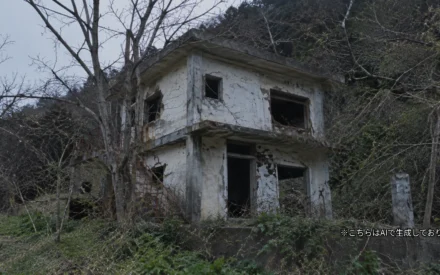
Nishikan Ward, Niigata: Mt. Kakuda, Tombs and a Lost Village
Supervised by Suzuking. (KARASU CHANNEL / Occult & horror reporting, 7 years)
Contents
Places to visit in this town (north to south)
Numbers follow the order in the article, from north to south. Select a pin to see its name. Positions are approximate.
- Mt. Kakuda (角田山) A mountain of about 482 meters, the northernmost of the massif running on from Mt. Yahiko. Loved as a mountain of flowers, it offers views over the Echigo Plain from its summit deck.
- Shobuzuka Kofun (菖蒲塚古墳) The northernmost early-style keyhole mound on the Sea of Japan side, at the eastern foot of Mt. Kakuda. A National Historic Site, said to be among the largest in the prefecture.
- Kakumihama (角海浜) A deserted seaside village west of Mt. Kakuda, in a land whose sand is stolen by waves. It is remembered as a home of traveling medicine peddlers.
- Iwamuro Onsen (岩室温泉) A hot-spring town that thrived as a post town on the Hokkoku Kaido road. A base for pilgrims to Yahiko Shrine, known for its salty black water and the prefecture's oldest geisha culture.
- Shugetsu-ji (種月寺) An old Soto Zen temple said to have been founded in the Muromachi period, one of the Four Training Halls of Echigo Soto Zen, with a main hall that is an Important Cultural Property.
Show basic information about this town (location, last checked, notes)
- Location
- Niigata, Niigata Prefecture, Japan
- Last checked
- 2026.10.06
- Please note
- Opening hours, prices and closing days change often, so we do not list them. Please check each facility's official site before you go.
What Kind of Place Is Nishikan Ward, Niigata?
Nishikan Ward (西蒲区) lies in the southwest of Niigata City and is the largest of the city’s eight wards. It is said to take up about a quarter of the city’s area, and it is made up of the former town of Maki and the former town of Nishikawa, the former village of Iwamuro, and the former towns of Katahigashi and Nakanokuchi. It was merged into Niigata City in 2005 and became a ward when the city became a designated city in 2007.
To the west, a mountain range running on from Mt. Yahiko presses close to the Sea of Japan, while to the east broad rice paddies spread out. Mountain, burial mounds, hot springs, coast and a village of old-time medicine peddlers: the range of sights is wide. This article introduces the ward’s sights in order from north to south.
A travel-size 200ml can of Saratect insect repellent with a cooling spray — compact enough to carry in your bag and use just before pushing into brush or tall grass at a ruin or haunted spot.
Earth Chemical Saratect Cool Insect Repellent Spray, Cooling & Dry Feel 200ml
We may earn a referral fee on purchases made through these links.
1. Mt. Kakuda (角田山)
Mt. Kakuda is a mountain 481.7 meters high, also called Chojabara-yama. It is the northernmost of the massif that runs on from Mt. Yahiko, and forms a part of Sado-Yahiko-Yoneyama Quasi-National Park. The southeast side is mostly planted with cedar, while the northwest side is covered with deciduous broadleaf forest of konara oak, Mongolian oak and azalea; the gentle slopes from the foot to the mid-mountain are used as persimmon orchards.
Seven hiking courses have been laid out, and the mountain is known as one that children and older people can climb with ease. The area near the summit is gentle, and from the observation deck in front of the Kannon-do hall you can look out over the Echigo Plain and, far off, the city of Niigata. Snow-cutter flowers (yukiwari-so) and dogtooth violets bloom in spring and lily and bugbane in summer, and the mountain has long been loved as a “mountain of flowers.”
Near the Hotaru-no-sato course, one of the trailheads, stands the Kakudayama Nature Museum (角田山自然館), a small exhibition hall opened in 1994 that introduces the trails and the mountain’s plants on panels. Trail conditions change with the weather and the season, so please check the official guide before you climb.
2. Shobuzuka Kofun (菖蒲塚古墳)
Shobuzuka Kofun is a keyhole-shaped burial mound in Takeno-machi, Nishikan Ward. It sits at the tip of a terrace on the eastern foot of Mt. Kakuda, within the grounds of Kinsen-ji temple. It measures about 53 meters in total length, with a rear circular section about 33 meters across, among the largest in the prefecture. It is regarded as the northernmost early-style keyhole mound, of the “handheld mirror” shape, on the Sea of Japan side, and was designated a National Historic Site in 1930.
On top of the mound a sutra mound (kyozuka) was also built, where scriptures were buried between the Heian and Muromachi periods. The bronze sutra cylinders, jars and bronze mirror found there are Important Cultural Properties of Japan. A book records that a mirror was dug up by grave robbers in the Edo period, and the “Dariyu mirror” (鼉龍鏡) said to be that mirror is a Tangible Cultural Property of the prefecture.
According to tradition, Shobu Gozen (菖蒲御前), the wife of Minamoto no Yorimasa, is buried in the mound, and the neighboring Hayatozuka Kofun was long said to be the grave of her retainer. This is only legend; the mounds are actually thought to be tombs of powerful local figures of the early Kofun period. Since the mound lies within temple grounds, please be quiet during your visit so as not to disturb the people of the precincts.
3. Kakumihama (角海浜)
Kakumihama is the site of a village along the Sea of Japan, in the mountain folds to the northwest of Mt. Kakuda. It was known as the home of the Echigo “dokukeshi” medicine, but today it is a deserted village. The coast is badly eroded and even getting down to the beach is said to be difficult, so it is a place to avoid forcing your way into and to be content with learning its history.
On this beach, coastal erosion known as “nami-kake” (also makuridashi), which comes once every few decades, repeated itself. In 1607 there were said to be about 250 houses, but by 1902 they had dropped to 92, and by 1969 to single digits. The shoreline is said to have retreated by more than 600 meters from where it once was.
With little farmland left, the villagers made their living from the late Edo period by peddling the all-purpose remedy “dokukeshi” (poison-dispelling medicine). From the Meiji era women also joined the peddling, and the sight of them traveling the whole country singing “Dokukesha iranka ne?” (“Won’t you buy some dokukeshi?”) became well known. The memory of people who survived on wit and peddling while facing the harshness of nature is carved into this beach.
4. Iwamuro Onsen (岩室温泉)
Iwamuro Onsen is a hot-spring town spreading out north of Yahiko Shrine, on the east side of Mt. Tahou. It is known for its “black water” (kuroyu), strongly salty and containing sulfur, and it grew as a post town on the Hokkoku Kaido road. The spa is said to have been opened in the middle of the Edo period, and is also said to date from before the Keicho era.
In the founding legend, a person found a wounded wild goose healing its injuries in this spring. For that reason it was once called “Reigan no Yu” (the spring of the spiritual goose), and later it flourished as a lodging town for pilgrims to Yahiko Shrine. In 1963, together with Yahiko Onsen, it was designated a National Recreational Hot Spring Resort.
The spa has also inherited a geisha culture. The Iwamuro geisha have the oldest history in the prefecture, older than the Furumachi geisha of the city of Niigata, and are said to have begun in the Edo period. At one time there were about 100 of them, but by 2024 the number is said to have fallen to four. The history of the waters and the post town still lingers in the air of the town.
5. Shugetsu-ji (種月寺)
Shugetsu-ji is a Soto Zen temple in Nishikan Ward. It is said to have been founded in 1446 by Uesugi Fusatomo, then the shugo (military governor) of Echigo Province, who invited the abbot of Koun-ji to establish it. Together with Koun-ji in Murakami, Undo-an in Minamiuonuma and Jiko-ji in Gosen, it is counted as one of the “Four Training Halls of Echigo Soto Zen.”
The main hall, built in the 12th year of Genroku (1699), is an Important Cultural Property of Japan. The temple preserves calligraphy and books of the monk connected with its founding as prefectural designated cultural properties, and the silver osmanthus in the grounds is a natural monument of the city. A history of flourishing as a place of training from the Muromachi to the Edo period remains in its buildings and trees.
It is an active temple, so when visiting please keep quiet so as not to disturb training or memorial services. Please follow the temple’s guidance on photography and other rules. It is a place where one should keep in mind that behind words like “sect” and “training hall” lies a long span of time in which people piled up prayer and study.
Local Specialties, Food and Drink
The ward’s taste of the land is the persimmon grown in Mineoka, in the western part of the Maki district. It is a production area of hachiya persimmons, said to rank with the Hamochi district of Sado as one of the prefecture’s two main areas, and is branded as “Koshi-o Okesa Persimmons.” Persimmon orchards also spread across the foot of Mt. Kakuda.
About half of the ward is rice paddy, making it one of the city’s leading granary areas. On the seaside at Echizenhama and Kakuda-hama, wine is also made, and several wineries gather in the area known as the “Wine Coast.” Local craft beer brewing is thriving too, and the variety of farming and food is a charm.
Rare Creatures and Nature
The core of the ward’s nature is Mt. Kakuda and the Sea of Japan. On the mountain, snow-cutter flowers and dogtooth violets bloom in spring and lilies in summer, and around Hotaru-no-sato, Genji fireflies fly from the second half of June into early July. On the coast there are also severe landscapes, such as Kakumihama, being eaten away by waves.
The broad paddy area is where lagoons such as Yoroi-gata once lay; large-scale reclamation began in the 1960s and was completed in 1968. The landscape of lagoons that lived with water has vanished, but today’s granary stands on top of that time.
Other Notable Things About This Town
The Minenoyama domain (三根山藩), which was based in Mineoka, is known for having sent one hundred bales of rice (“kome hyappyo”) to the Nagaoka domain, which was suffering after its defeat in the Boshin War at the end of the Edo period. The famous anecdote is that this rice was not eaten in Nagaoka but used for education. The history of a small domain reaching out a hand to its neighbor seems to reflect the character of the people of this ward.
The history of “dokukeshi” is also indispensable in talking about the ward. The all-purpose remedy born in Kakumihama spread in manufacture around Mt. Kakuda after the Meiji era, and reached the whole country through women peddlers. It declined after the war, and Kakumihama was made a planned site for a nuclear power plant and became deserted; the construction plan was later withdrawn, but the village remains uninhabited.
The ward has many seasonal events, such as the Maki Summer Festival and festivals at Iwamuro Onsen. The summer festival, held in time with the grand festival of Maki Shrine, has as its highlights a portable-shrine procession that has continued since the Edo period, yakata-kanto lantern floats and a fireworks display.

Blackout curtains that stick to the car windows with magnets. Waiting or napping in the car near a haunted spot late at night, they hide the interior from outside view for privacy and security.
SEIWA Easy Magnetic Car Curtains, 2-Piece Set, Blackout Fabric, Size L Z87
We may earn a referral fee on purchases made through these links.
The Night Side: Ghost Stories and Haunted Places of This Town
So far we have walked through the daytime face of Nishikan Ward: a mountain of flowers, burial mounds, a hot-spring town, an old temple and a seaside village eaten away by waves. In every place lie layered the years of people who faced the harshness of nature and carried on living through prayer and wit.
That depth connects to the night side as well. On Karasu Channel we record true ghost stories and haunted places not in order to go there, but in order to record them. In our view, a ghost story is like a shadow that a land’s history has cast on people’s hearts. The more one knows the memory of a land whose village was taken by waves and landslides, the less one feels like casually talking about a night seashore.
Having learned the daytime scenery, please read the tales of the night as well.
Before You Go
Opening hours, fees, closing days and access change easily, so they are not listed in this article. Before you go, please check the latest information on the official website of each facility or local government. Some places may be restricted from entry because of weather or disasters.
Frequently Asked Questions
Q. What is an efficient way to tour Nishikan Ward in Niigata?
A. This article introduces the sights from north to south. Mt. Kakuda, Shobuzuka Kofun and Iwamuro Onsen lie close together around the foot of Mt. Kakuda. The ward is large and travel takes time, so please check how to get around on the official guides of the city and the tourist association.
Q. Can I go to Kakumihama?
A. It is now a deserted village, the coast is badly eroded, and even getting down to the beach is said to be difficult. Because it is dangerous, please avoid forcing your way in. We recommend being content with learning its history.
Q. Can beginners climb Mt. Kakuda?
A. There are seven trails, and the mountain is described as easy to climb even for children and older people. However, conditions change with the weather and the season, so please prepare proper equipment and check the latest situation on official guides.
Official sites and references consulted
https://ja.wikipedia.org/wiki/西蒲区
https://ja.wikipedia.org/wiki/角田山
https://ja.wikipedia.org/wiki/菖蒲塚古墳
https://ja.wikipedia.org/wiki/角海浜
https://ja.wikipedia.org/wiki/岩室温泉
https://ja.wikipedia.org/wiki/種月寺
https://ja.wikipedia.org/wiki/三根山藩

Supervised by Suzuking.
Affiliation: KARASU CHANNEL
Occult & horror reporting: 7 years (since 2020)
Followers: YouTube 5,000+ / X 25,000+
On-site investigations: 30+
Haunted locations near this town
Besides its daytime face, this land has a night side too. Read it as a record if you are curious. Some of these places are not safe or permitted to enter.