Sightseeing in Ogano: Kabuki and Icicles Beneath a Sacred Mountain in a Mountain Town
Supervised by Suzuking. (KARASU CHANNEL / Occult & horror reporting, 7 years)
Contents
Places to visit in this town (north to south)
Numbers follow the order in the article, from north to south. Select a pin to see its name. Positions are approximate.
- Mount Futago (二子山) A twin-peaked limestone mountain north of town near the Gunma border, with Nishidake and Higashidake side by side, known for rocky ridge walking and climbing.
- Icicles of Onouchi Gorge (尾ノ内渓谷の氷柱) Huge icicles raised by human hands that appear only in winter in a gorge rising on Mount Ryokami, counted among the Three Great Icicle Sites of Chichibu.
- Washinoiwayasan Kannon-in Temple (鷲窟山観音院) Chichibu Pilgrimage Temple No. 31, with 296 stone steps leading to a giant rock wall, cliff-carved Buddhas and stone Nio statues said to be the largest in Japan.
- Mount Ryokami (両神山) A sacred mountain 1,723 meters high on the border of the town and Chichibu, one of Japan's 100 Famous Mountains and a center of mountain worship since ancient times.
- Yobake (ようばけ) A great outcrop where strata of the 17-million-year-old Paleo-Chichibu Bay form a cliff about 100 meters high, a National Natural Monument.
- Hannyayama Hosho-ji Temple (般若山法性寺) Chichibu Pilgrimage Temple No. 32, known for a stage-style Kannon hall on a sheer cliff and a strange ship-prow rock.
- Marugami Falls (丸神の滝) A three-tiered waterfall with a 76-meter drop, the only one in Saitama Prefecture chosen among Japan's 100 Best Waterfalls.
Show basic information about this town (location, last checked, notes)
- Location
- Ogano, Chichibu District, Saitama Prefecture, Japan
- Last checked
- 2026.10.05
- Please note
- Opening hours, prices and closing days change often, so we do not list them. Please check each facility's official site before you go.
What Kind of Town Is Ogano, Chichibu District?
Ogano is a mountain town in the southwest of Saitama Prefecture, with its town center near the middle of the Chichibu Basin. To the west rises Mount Ryokami, one of Japan’s 100 Famous Mountains, and the town’s landscapes are counted among those of Chichibu-Tama-Kai National Park and Japan’s 100 Best Waterfalls. No railway runs through the town; it is a quiet mountain village reached by bus or car from stations in Chichibu.
The present town was born in October 2005 from the merger of the former town of Ogano and Ryokami Village. This article introduces the town’s sights in order of latitude, from north to south. We begin with a limestone peak, then head south through a canyon of icicles, a sacred mountain, a temple on a rock wall, a waterfall and finally the strata of an ancient sea.

An inverter that plugs into the cigarette lighter socket and turns your car battery into a household AC100V outlet — for charging a laptop, spare camera or lighting batteries, or several phones at once during an all-night stakeout or long car-camping shoot.
meltec Car Inverter, DC12V, 1 Outlet 120W IP-150
We may earn a referral fee on purchases made through these links.
1. Mount Futago (二子山)
Mount Futago (Futagoyama) is a limestone peak in the north of Ogano, near the border with Kanna Town in Gunma Prefecture. It is a twin-peaked mountain with two summits side by side, Nishidake (about 1,166 meters) and Higashidake (about 1,122 meters), and that shape is thought to be the origin of its name (“futago” means twins).
It belongs to the same Chichibu Belt as Mount Buko in Chichibu, and the summits of Buko, Shiraiwa, Futago and Kano are said to line up in a straight row of limestone. This is an accretionary complex pressed together as an oceanic plate sank, and fossils of fusulinids and crinoids have been found even on Futagoyama. Memories of a Paleozoic sea some 250 to 320 million years ago are carved into the rock of the mountain.
The trail leads from the Sakamoto district on the south side, and on the ridge you walk along rocky crests. The rock faces are also used for climbing. This is a mountain with many places of poor footing, so equipment and experience are required. Please make a plan within your abilities and watch for changes in the weather.
2. The Icicles of Onouchi Gorge (尾ノ内渓谷の氷柱)
Onouchi Gorge is a canyon in Kawarasawa, Ogano, through which a stream rising on Mount Ryokami flows. What appears here every winter are the icicles called “Onouchi Hyakkei” (Onouchi’s Hundred Views). Counted as one of the Three Great Icicle Sites of the Chichibu region, they can be viewed from a suspension bridge from early January to mid-February or so.
These icicles are not simply left to form naturally. Their distinctive feature is that they are shaped into huge pillars of ice by the hands of local people. The bluish-white walls of ice glowing on a frozen morning are a view born from the effort of the local people combined with the cold of a Chichibu winter.
In this site’s view, the icicles are a small crystal of wisdom that turned a mountain village’s winter life into tourism. The period in which they can be seen varies with each year’s cold and with management decisions. Before you go, please check the latest official information. The path is icy, so we recommend visiting in non-slip shoes.
3. Washinoiwayasan Kannon-in Temple (鷲窟山観音院)
Washinoiwayasan Kannon-in is Temple No. 31 of the 34 Kannon Pilgrimage of Chichibu and is in Iida, Ogano. A flight of 296 stone steps leads up to the Kannon hall. Along the approach stand stone Nio guardian statues about 3 meters high, introduced as the largest in Japan.
The rock wall of the grounds is said to be sandstone about 17 million years old, and on it is a group of small cliff-carved Buddhas said to have been carved overnight by Kobo Daishi. These Washinoiwaya cliff Buddhas are designated a Saitama Prefecture historic site. There are also the Seijo Waterfall and a group of stone Buddhas known as the “108,000 Buddhas,” making this a precinct where giant rock and faith are one.
This is our conjecture, but the practice of carving Buddhas into rock caves probably grew from the sensibility of people who regarded the mountain’s rock itself as holy ground. It is a temple that pilgrims still visit today, so please pay your respects quietly. The stone steps are long and become slippery on rainy days.
4. Mount Ryokami (両神山)
Mount Ryokami (Ryokamisan) is a mountain 1,723 meters high on the border between Ogano and Chichibu. It is one of Japan’s 100 Famous Mountains and is also counted as one of the Three Mountains of Chichibu together with Mount Buko and Mount Mitsumine. There are various theories about the origin of its name: that it enshrines the two deities Izanagi and Izanami; that Yamato Takeru, on his eastern campaign, passed by this mountain in view of it for eight days; and that it is a corruption of a word meaning a mountain where a dragon god is worshipped.
It has long been a mountain of faith, and along the route to the summit from Hinata-Otani on the east side remain many stone Buddhas, monuments and distance markers. At the mountain’s shrines, wolf statues (yamainu, “mountain dogs”) stand where guardian lion-dogs would usually be placed, showing the influence of Mitsumine Shrine, which regards wolves as messengers of the gods. Most of the mountain is made of chert, a hard rock formed from fossil radiolarians that settled on the seabed hundreds of millions of years ago.
From late April to mid-May, akayashio (a red rhododendron) blooms across the summit area, and the mountain is also known for its beautiful autumn leaves. On the other hand, it has many chain-assisted sections and falls have occurred. When climbing, it is important to make a plan suited to the weather and your fitness and not to push yourself. A record also survives that in 1914, in an era when women were barred, a woman climbed for the first time as part of a group pilgrimage.
5. Yobake (ようばけ)
Yobake is a large cliff (outcrop) in Nagadome, Ogano, where strata appear on the surface. It has been chosen among Japan’s 100 Geological Sites and is introduced as about 100 meters high and 400 meters wide. Under Chichibu lie strata of the ancient sea known as the “Paleo-Chichibu Bay,” which formed about 17 million years ago and vanished about 15 million years ago, and this is a representative place to see them.
In March 2016, six outcrops of strata from this period in the Chichibu region and nine fossils of marine mammals were designated a National Natural Monument as the “Paleo-Chichibu Bay Deposits and Marine Mammal Fossils.” Designating multiple outcrops and fossils together is said to be a first in Japan. Yobake is one of the designated sites.
At the nearby Ogano Fossil Museum, you can see exhibits on fossils found in this area, such as Paleoparadoxia. The fact that a town surrounded by high mountains was once the bottom of a sea greatly changes how this land looks. There is a danger of falling rocks below the cliff, so please follow the guidance on entry.
6. Hannyayama Hosho-ji Temple (般若山法性寺)
Hannyayama Hosho-ji is Temple No. 32 of the 34 Kannon Pilgrimage of Chichibu and is in Hannya, Ogano. A Kannon hall in the stage (butai-zukuri) style stands on a cliff about 70 meters above the main hall, and from there you can look out over the Chichibu Basin. Among the Chichibu pilgrimage temples it is known for its fine views.
On the surrounding rock faces you can see landforms such as “tafoni,” holes formed by weathering of the rock, and “honeycomb” patterns with holes lined up like a beehive. The cliff that juts out like the prow of a ship is called “Ofune-iwa” (Ship Rock) and is made of sandstone. The inner sanctuary enshrining the Ofune Kannon takes about an hour round trip.
The temple preserves a document recording the ranking of the Chichibu pilgrimage temples in 1488 (Chokyo 2), which is one of the pieces of evidence thought to show that the Chichibu pilgrimage was already established in the late Muromachi period. The order at that time differed from today’s. It shows that this cliffside temple has been receiving pilgrims for more than five hundred years. When you visit, please be quiet and watch your step.
7. Marugami Falls (丸神の滝)
Marugami Falls is a three-tiered waterfall with a drop of about 76 meters in Komori, Ryokami, Ogano. Made up of a first tier of about 12 meters, a second of about 14 meters and a third of about 50 meters, it is the only waterfall in Saitama Prefecture chosen among Japan’s 100 Best Waterfalls.
It is not a fall where a great volume of water drops at once; its distinctive feature is a small amount of water running quietly down a rock slope, giving it a very refined appearance. Its geology is the Chichibu Paleozoic formation, and because it is little known to the general public and not many people visit, the surroundings are said to remain well preserved in their natural state.
A promenade has been prepared up to the falls, but because it is a mountain path, you need to watch your footing. The autumn colors at this fall are especially famous in the town, and the sight of trees turning red and yellow overlapping with the tall falls is said to be magnificent. After rain the volume of water and the footing change, so please visit within a range that does not push your limits.
Local Specialties: Food and Drink
Ogano’s signature specialty is “waraji katsudon.” A kind of sauce katsudon, it is characterized by a cutlet so large it spills over the bowl, and its name is said to come from its resemblance to a waraji (straw sandal). Each shop has its own approach to seasoning, so please check each shop’s information before you go.
The mountain town also has the famous spring water Bishamon-sui (one of the 100 Famous Waters of the Heisei Era). It is not hard to imagine that the quality of the water has supported its cooking and daily life.
Rare Wildlife and Nature
Ogano is a treasure house of mountain wildflowers. From early to late March, setsubunso (winter windflower), at the Dojo Setsubunso Habitat in Komori, Ryokami, bloom in what is said to be the largest area in Japan. In April, thousands of flowering peach trees can be seen over about a kilometer along the Hanamomo Kaido (Flowering Peach Road) in Iwadonosawa, and in May the akayashio of Mount Ryokami dye the mountain.
Winter sweet (robai) in early January, pheasant’s eye (fukujuso) in February, dogtooth violet (katakuri) from late March to April, Japanese iris in June, dahlias from August to October and autumn leaves in November: the flowers change with each season. The differences in elevation of the mountains have probably kept the flowering seasons long.
Other Notable Things About This Town
Essential to any account of Ogano is Ogano Kabuki. Said to have begun around the middle of the Edo period, it has a record of a performance in 1793. It declined from the 1950s onward, but a preservation society was formed in 1973 and in 1975 it was designated an Intangible Folk Cultural Property of Saitama Prefecture. About ten permanent stages remain in the town, and performances are given at local festivals, centered on the shrine parishioners.
The spring festival of Oga Shrine in April is counted as one of the Three Great Spring Festivals of Chichibu, and seasonal events continue, including the summer festival in July and the Teppo Matsuri (Gun Festival) on the second Sunday of December. Hoyoji Yakushido in the town is also said to be one of Japan’s Three Yakushi statues and is cherished as the “Eye Medicine Buddha,” designated a prefectural cultural property. In recent years the town has also continued its “town revitalization through motorcycles,” welcoming riders.

For bear safety while exploring a ruin or animal-trail-type spot in the mountains.
FUJIKON Bear Deterrent Spray, Wide-Spray Type, 100mL, Long-Range, 2% Capsaicin
We may earn a referral fee on purchases made through these links.
The Night Side: Ghost Stories and Haunted Spots of This Town
So far we have walked through Ogano’s daytime face: a sacred mountain, icicles, a pilgrimage temple in a cave-like rock wall and strata of an ancient sea. Every one of these places carries layers of time in which people prayed, protected and nurtured.
That depth connects to the town’s night side as well. In this site’s view, rumors of ghost stories and haunted places are a kind of shadow that a place’s history and terrain cast on people’s hearts. Once you know of mountain worship that saw wolves as messengers of the gods, and of the prayers of people who carved Buddhas into rock walls, the quiet of a mountain night takes on another meaning.
At KARASU CHANNEL we record true ghost stories and haunted spots not so that people will go there, but so that they are remembered. Having come to know the daytime scenery, we hope you will also read the stories of the night.
Before You Go
Opening hours, fees, closing days and access change often, so they are not listed in this article. Before you set out, please check the latest information on each facility’s or local government’s official site. Some places may be restricted because of weather or disaster.
Frequently Asked Questions
Q. In what order should I visit the sights in Ogano?
A. This article introduces them from north to south. The town spreads through the mountains and has no railway, so travel is mainly by car or route bus. It is easiest to group them by area: Mount Futago and Onouchi Gorge in the north, Mount Ryokami and Marugami Falls in the west, and the pilgrimage temples and Yobake in the east. Please check the latest transport information beforehand.
Q. What is Ogano known for?
A. Waraji katsudon is the best known. Other features of the town are Ogano Kabuki, wildflower spots and the icicles of winter. Offerings vary by shop, so please check the latest information before you go.
Q. Is it all right to visit in winter?
A. The icicles of Onouchi Gorge in winter are popular, but mountain roads can be icy or snowy. Please prepare tires and footwear, check the weather and road conditions, and make a plan that does not push your limits.
Official sites and references consulted
https://ja.wikipedia.org/wiki/小鹿野町
https://ja.wikipedia.org/wiki/両神山
https://ja.wikipedia.org/wiki/丸神の滝
https://ja.wikipedia.org/wiki/二子山_(埼玉県小鹿野町)
https://ja.wikipedia.org/wiki/尾ノ内渓谷
https://ja.wikipedia.org/wiki/古秩父湾堆積層及び海棲哺乳類化石群
https://ja.wikipedia.org/wiki/秩父札所三十四観音霊場
https://www.pref.saitama.lg.jp/b0112/kanko-tiiki-info/renta13.html
https://www.pref.saitama.lg.jp/b0112/kanko-tiiki-info/renta19.html
https://rurubu.jp/andmore/spot/80009121

Supervised by Suzuking.
Affiliation: KARASU CHANNEL
Occult & horror reporting: 7 years (since 2020)
Followers: YouTube 5,000+ / X 25,000+
On-site investigations: 30+
Haunted locations near this town
Besides its daytime face, this land has a night side too. Read it as a record if you are curious. Some of these places are not safe or permitted to enter.
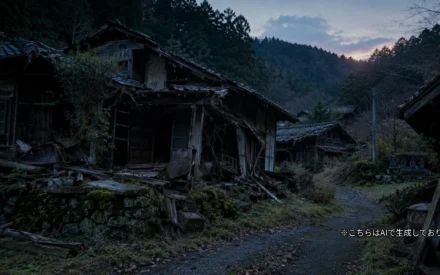
Take Settlement (Chichibu)
Take Settlement, an abandoned mountain village in Chichibu, Saitama, is said to be a model for Hanuda Village in the horror game SIREN.
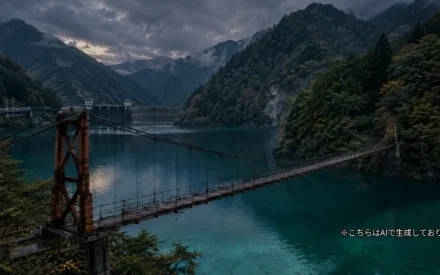
Lake Chichibu, Futase Dam and the Suspension Bridge (Chichibu City)
Lake Chichibu, formed by Futase Dam, and its suspension bridge in Chichibu, Saitama. Jump rumors and orbs are told; we do not recommend visits.