Sightseeing in Shiki: A Small River Town of Port Memories, a Fuji-zuka and Kappa Tales
Supervised by Suzuking. (KARASU CHANNEL / Occult & horror reporting, 7 years)
Contents
Places to visit in this town (north to south)
Numbers follow the order in the article, from north to south. Select a pin to see its name. Positions are approximate.
- Hanekura Bridge and the Site of the Hanekura Ferry (羽根倉橋と羽根倉の渡し跡) At the foot of a long bridge over the Arakawa, two eras overlap: an Edo-period river port and ferry crossing, and the setting of a medieval battle.
- Akigase Intake Weir (秋ヶ瀬取水堰) The weir closest to the mouth of the Arakawa, standing at the boundary of tidal sea water and river water, known for the tsunami and the seal that once reached it.
- Shiki City Local History Museum (志木市立郷土資料館) A museum in a renovated late-Edo-period building, with a waterway siphon pipe dug from the riverbed quietly displayed in its garden.
- Former Murayama Kaitsudo (旧村山快哉堂) An early-Meiji earthen-walled shop storehouse, relocated opposite City Hall, a city-designated cultural property that preserves the look of a river-port merchant house.
- Iroha Waterside Park, Hikimata River Port and the Iroha Toi (いろは親水公園と引又河岸・いろは樋) Beside the Shingashi River, the scenes once drawn by the river port and the wooden aqueduct overlap, with a cherry-lined path in the riverside park.
- Shikishima Shrine and Tagoyama Fuji-zuka (敷島神社と田子山富士塚) A nationally designated Fuji-zuka built of piled earth in the early Meiji era, where the pilgrimage rites up to the summit shrine are still carried on.
- Chosho-in Hatazakura (長勝院旗桜) An old cherry tree about 400 years old standing on a former temple site, said to be a variety found nowhere else in the world, and a city natural monument.
- Hodo-ji Temple (宝幢寺) A Shingon temple in Kashiwa-cho, said to have been visited by Tokugawa Iemitsu for a rest during falconry, and known for its kappa legend.
Show basic information about this town (location, last checked, notes)
- Location
- Shiki, Saitama Prefecture, Japan
- Last checked
- 2026.10.06
- Please note
- Opening hours, prices and closing days change often, so we do not list them. Please check each facility's official site before you go.
What Is Shiki Like?
Shiki is a small city in southwestern Saitama Prefecture, on the west bank of the Arakawa River. Said to be the sixth-smallest city in Japan by area, it is where the Shingashi River and the Yanase River meet. Low ground hemmed in by rivers sits alongside high ground at the edge of the Musashino Plateau, and that difference in elevation has shaped the town’s history.
In the Edo period (1603–1868) Shiki prospered as a river-port town on the Shingashi River’s boat trade, and after the Taisho era began (1912) it grew as a crossroads of people and goods with the opening of the Tobu Tojo Line. Today it is known as a commuter suburb of Tokyo, yet traces of river transport, irrigation channels and Mt. Fuji worship remain firmly underfoot. This article walks through the city’s sights from north to south, in descending order of latitude.

A small, IP67 dust- and waterproof Bluetooth speaker — play an audio guide or video sound on the way to a ruin or in the car, or share audio with the group during a multi-person exploration.
JBL GO4 Bluetooth Speaker, USB-C Charging, IP67 Dust/Waterproof, App-Compatible, Passive Radiator, Portable, Black JBLGO4BLK
We may earn a referral fee on purchases made through these links.
1. Hanekura Bridge and the Site of the Hanekura Ferry
Hanekura Bridge links the Muneoka district of Shiki with Sakura Ward in Saitama City, spanning the Arakawa River and the Arakawa No. 1 Retarding Basin. About 860 meters long, it carries National Route 463 and a prefectural road and serves as a major artery. On clear days Mt. Fuji is famously visible straight ahead along the road running from the Saitama City side toward Tokorozawa.
The bridge takes its name from the river landing of Hanekura-gashi, established around the second year of Kanbun (1662) in the early Edo period. A ferry operated there too, making it an important river hub where goods and people gathered. The landing lost its role in the river improvement work of 1919, and the ferry disappeared when the bridge was built in 1938. Going back further still, the Battle of Hanekura is recorded here in 1351 (the second year of Kan’o), when forces loyal to Ashikaga Takauji and those loyal to Ashikaga Tadayoshi clashed in this area.
Today it is a bridge most people simply drive across, but this is our own speculation: that both people and battles gathered at the place where a river could be crossed was probably a matter of geography then as now. The riverbank at the foot of the bridge is wide and used for cycling and strolling. Because it lies within reach of floodwaters, please keep an eye on the weather and water levels.
2. Akigase Intake Weir
The Akigase Intake Weir is a movable weir on the Arakawa River, straddling Sakura Ward in Saitama City and Shiki. Completed in 1964, it takes in water drawn from the Tone River and sends it on to water purification plants in the Tokyo metropolitan area. It is the farthest downstream of the weirs on the Arakawa, about 35 kilometers from the river mouth.
Below this weir the Arakawa becomes brackish, affected by the ebb and flow of the sea. During the Great East Japan Earthquake in 2011, the tsunami traveled up the river as far as this weir. That a tsunami reached a weir this far inland reminds us that a river is a single road connected to the sea.
In autumn of that same year, a spotted seal appeared downstream of the weir and drew crowds of onlookers. Shiki City issued the seal a special resident registration under the name “Shiki Ara-chan,” and the town was abuzz. There are restricted areas, closed to entry, both upstream and downstream of the weir. Please enjoy the view from designated spots and watch the movement of the water.
3. Shiki City Local History Museum
The Shiki City Local History Museum opened in April 1979 together with the library, and presents the city’s history and daily life. The building is a late-Edo-period structure donated by a citizen and then renovated, and it houses archaeological, historical and folk materials.
On the grounds is displayed a section of the “senkan” (siphon pipe), part of the underground waterway that succeeded the Iroha Toi. It was dug up from the bed of the Yanase River during river improvement work in 1978. Seeing the real thing makes it easy to grasp how the ingenuity of moving water evolved, from the wooden flumes of Edo to the iron pipes of the Meiji era.
It is a small city’s museum, yet it traces the whole framework of the town’s history, from the river-port trade and irrigation systems to Fuji-zuka worship. Anyone planning to explore the city will find that visiting here first adds a great deal to what they can see. Opening days and exhibits change, so please check the city’s information before you visit.
4. Former Murayama Kaitsudo
The Former Murayama Kaitsudo is a two-story wooden building in the plastered earthen-walled kura style, built in 1877 (Meiji 10). It originally stood in Hon-machi 3-chome and served as the shop storehouse of a pharmacy that made and sold medicines handed down in the family. It was dismantled in 1995, then relocated in 2001 to a site opposite Shiki City Hall, and is now designated a Tangible Cultural Property of Shiki City.
The kura style, with its heavy tiled roof and thick earthen walls, is the very wisdom of merchant houses in an age of frequent fires. This is our own speculation: amid the bustle of the Hikimata river port, merchants probably kept shop storehouses like this. Think of it that way and the old streetscape comes to life before your eyes.
It is now open to the public as a city cultural property. Even in relocated form, it is an attempt to hand the town’s memory on to the next generation, building and all, and it lets you imagine an age when the winds of commerce blew through the river town. Public opening days are limited, so it is wise to check the city’s information beforehand.
5. Iroha Waterside Park, Hikimata River Port and the Iroha Toi
The stretch of the Shingashi River near City Hall is where the “Hikimata-gashi” river port was opened in the 20th year of Kan’ei (1643) in the Edo period. As a relay point for boat traffic linking Kawagoe and Edo, it bustled enough to hold a market. But when railways opened from the Meiji to Taisho eras, the boat trade declined, and the port ended its role with the 1931 order halting river navigation.
This river had another famous feature. In the second year of Kanbun (1662), a wooden aqueduct called the “Iroha Toi” was built to carry water from the Nogoshi Canal across the river to the Muneoka district on the far bank. Said to be roughly 260 meters long, it moved water across the river using the principle of the siphon, a bold idea for its time. It was repaired again and again as the wood decayed, was replaced by iron pipe in the Meiji era, and ended its service in 1965 when the canal became a sewer.
Today, at the top of Ichiba-zaka in Hon-machi, a small masu measuring box, a large masu and a scale model are on display so that you can learn how it worked. The nearby “Iroha Waterside Park” has a landscaped riverside promenade and a path lined with cherry trees, and was renewed in 2022. The story of water crossing the river to nourish the fields and support people’s lives is a quietly proud one.
6. Shikishima Shrine and Tagoyama Fuji-zuka
Tagoyama Fuji-zuka is a Fuji-zuka within the grounds of Shikishima Shrine. A Fuji-zuka is an artificial mound modeled on Mt. Fuji, built in many places from the Edo period onward, where people who could not travel to the real, distant mountain could fulfill their wish to make the pilgrimage. Tagoyama Fuji-zuka was begun with the piling up of earth in 1869 and completed in 1872 (Meiji 5). The name of Takasu Shokichi is handed down as one of its founders.
At the summit is an inner shrine, and a pair of stone monkeys, parent and child, sits partway up the slope. It was designated by Saitama Prefecture in 2006, and in March 2020 it became a nationally designated Important Tangible Folk Cultural Property. It is said to be the fifth Fuji-zuka in Japan and the first in Saitama Prefecture to receive this designation, valued for its good state of preservation and for the Shinto rites that continue to this day.
The shrine and its Fuji-zuka are still a place of local faith. When you visit, bow once before the torii gate, and follow the rules of the shrine and the preservation society regarding the days and manner of climbing the mound. If you remember that this is a place of prayer before it is a tourist site, you will feel all the more deeply the long span of time the mound holds.
7. Chosho-in Hatazakura (チョウショウインハタザクラ)
The Chosho-in Hatazakura is an old cherry tree standing on the site of Chosho-in in Kashiwa-cho 3-chome. Chosho-in was a temple that existed until the Showa era, and because the tree stood in its precincts it was once called “the cherry tree of Chosho-in.” The temple buildings are gone now, and only the cherry tree remains, quietly.
A relative of the mountain cherry, it is said to be about 400 years old, with a trunk circumference of about 3 meters and a height of about 11 meters. The “hata” (flag) in its name comes from the fact that some of its flowers have stamens that turn into flag-shaped petals. It was introduced in a specialist cherry journal published in 1998 as a new variety found nowhere else in the world, and that gave it its present name. It was designated a city cultural property in 1993.
It blooms from early to mid April, about a week later than the Somei-Yoshino. Citizen volunteers cultivate the parent tree and plant young trees, and descendants of the tree are growing at City Hall, at schools and in front of the station. In this site’s view, the fact that only the cherry tree has been kept alive by human hands even after the temple vanished is itself the pride of this town. The area gets crowded during the blooming season, so please be considerate of the neighboring homes.
8. Hodo-ji Temple
Hodo-ji is a temple of the Chizan school of Shingon Buddhism in Kashiwa-cho, Shiki, also known by the name Jizo-in. The year of its founding is unknown, but it is said that in the early Edo period Tokugawa Iemitsu rested in its precincts during a falconry outing in the area, and as a result of that connection the temple was granted a land holding.
The principal image is a hidden Jizo Bodhisattva, and tradition has it that the pedestal and the statue no longer match because, with each fire, people carried out only the Jizo statue to safety. The temple is said to have burned at least three times on record, and the mismatch of the pedestal may quietly preserve the feelings of people who tried to protect the Buddha image before anything else. In front of the temple stands a city-designated cultural property, a stone inscribed monument to Bato Kannon, the horse-headed Kannon.
The temple is also introduced as one of the places in the city where kappa legends survive. Given that Shiki is a river town, it is natural that tales of uncanny water creatures were passed down. Weeping cherry trees bloom here in spring too. It is a working temple, so please stay quiet within the grounds and observe the proper manners for worship.
Local Specialties, Food and Drink
Shiki’s local specialties include sweets and sake connected to the Chosho-in Hatazakura. Manju, monaka and Japanese sake bearing the Hatazakura name have been sold in the city. Born as part of efforts to revitalize the town, they are an example of the devotion of the people who protect the cherry tree spreading through the town in the form of flavor.
Shiki is also known for its mascot, “Kapal.” A character inspired by the city’s kappa legends, its name combines “kappa” with “Pal City,” the nickname of the Civic Hall. It is said to love cucumbers, and the playfulness of a town with kappa connections shows up all over the city.
Rare Wildlife and Nature
Symbolizing Shiki’s nature are the rows of cherry trees along the embankments of the Yanase and Shingashi Rivers. The Somei-Yoshino cherry trees along the Yanase River are a renowned cherry-blossom spot even among those along the Tobu Tojo Line, with a cherry blossom festival in spring and, at night, lantern light for evening blossom viewing.
In the Muneoka district near the Arakawa, wide farmland and riverbed stretch out, letting you feel the nature of the Arakawa up close. In 2011 a spotted seal appeared near the Akigase Intake Weir on the Arakawa and became a topic of conversation as “Shiki Ara-chan.” The appearance of a seal in a river so far from the sea reminds us of the connection between river and ocean.
Other Notable Things About This Town
The name Shiki comes from “Shiki-go,” a district in the ancient province of Musashi’s Niiza County. When the two villages of Hikimata and Tachi merged in 1874 (Meiji 7), there was a dispute over which name to use, so the prefecture proposed the old district name, and “Shiki” was settled on.
In 1914 the Tobu Tojo Line opened between Ikebukuro and Tamenzawa, and Shiki Station was established. This is said to have been the result of merchants who had prospered on the river trade inviting the railway. Note that Shiki Station itself is in neighboring Niiza City. The city is also known for its progressive approach to education, such as introducing its own small-class system for lower elementary grades from 2002.
In 2018, the city’s kappa character “Kapal” won the Yuru-Chara Grand Prix. And in April 1945, American aircraft carried out an air raid on the city, and people who had taken shelter in air-raid shelters died. We would like to keep in mind that such a history also lies beneath this quiet residential area.

A UV flashlight that lights up fluorescent reactions, stains, and writing invisible to the naked eye. Easy to introduce as a "verification" tool for finding old graffiti, notice traces, or fluorescent minerals left in a haunted spot or ruin, giving exploration a different angle from an ordinary light.
DARKBEAM Black Light UV Flashlight, 365nm UV LED Light, Anisakis Detection Light, USB-C Rechargeable
We may earn a referral fee on purchases made through these links.
The Night Side: Ghost Stories and Haunted Spots of This Town
So far we have walked Shiki’s daytime face: the river boat trade, the aqueduct for irrigation, Mt. Fuji worship and an old cherry tree. All of them grew out of a relationship that water and people wove together over a long time.
River towns tend to have strange stories about water. Shiki is said to preserve kappa legends and a tale known as the “cat apparition,” but their exact locations and origins have not been identified, and we do not recommend going out to search for them. In this site’s view, a ghost story is a fear that people have felt toward water and darkness, taking the form of a tale.
At KARASU CHANNEL, we present true ghost stories and haunted spots not so that you can visit them but so that they are recorded. Having learned the daytime scenery, please read the night-time tales as well.
Before You Go
Business hours, fees, closing days and access change easily, so they are not listed in this article. Before heading out, please check the latest information on the official website of each facility or local government. Some places may have restricted entry because of weather or disasters.
Frequently Asked Questions
Q. How should I tour Shiki?
A. This article introduces places from north to south. It is easier to cover the city in three groups: the north along the Arakawa, the area around City Hall along the Shingashi River, and the Kashiwa-cho area toward the Yanase River. Please check the city’s tourist information for the latest on distances and transportation.
Q. What are Shiki’s local specialties?
A. Manju, monaka and Japanese sake connected to the Chosho-in Hatazakura are best known. The kappa character “Kapal” is also the face of the city. What each shop carries changes, so please check the latest information before you go.
Q. Can I climb Tagoyama Fuji-zuka?
A. The Fuji-zuka is a place of worship, and the days and manner in which it can be climbed depend on the rules of the shrine and the preservation society. When visiting, please follow the on-site guidance and the official information from the city and the preservation society.
Official sites and references consulted
https://ja.wikipedia.org/wiki/志木市
https://ja.wikipedia.org/wiki/田子山富士塚
https://ja.wikipedia.org/wiki/チョウショウインハタザクラ
https://ja.wikipedia.org/wiki/いろは樋
https://ja.wikipedia.org/wiki/引又河岸
https://ja.wikipedia.org/wiki/秋ヶ瀬取水堰
https://ja.wikipedia.org/wiki/羽根倉橋
https://ja.wikipedia.org/wiki/宝幢寺_(志木市)
https://ja.wikipedia.org/wiki/村山快哉堂
https://ja.wikipedia.org/wiki/カパル

Supervised by Suzuking.
Affiliation: KARASU CHANNEL
Occult & horror reporting: 7 years (since 2020)
Followers: YouTube 5,000+ / X 25,000+
On-site investigations: 30+
Haunted locations near this town
Besides its daytime face, this land has a night side too. Read it as a record if you are curious. Some of these places are not safe or permitted to enter.
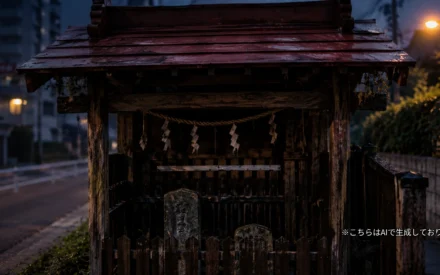
Daimon Park (Omiya Ward, Saitama City)
A park in Omiya, Saitama, tied by rumor to an Edo-era execution ground. Fireball and Chidori ghost tales persist; sources do not confirm them.
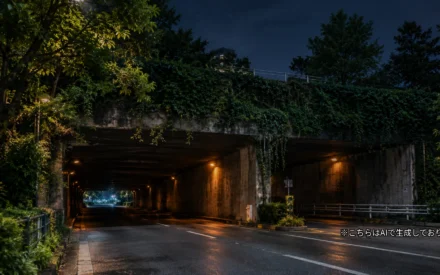
Sendagaya Tunnel (Shibuya Ward, Tokyo)
Sendagaya Tunnel in Shibuya runs under Senjuin cemetery and is still an active road. Night figures are told, but no official records exist.