Sightseeing in Shimada: Crossing the Oi River, the Obi Festival, a Cedar Temple and a Takeda Castle
Supervised by Suzuking. (KARASU CHANNEL / Occult & horror reporting, 7 years)
Contents
Places to visit in this town (north to south)
Numbers follow the order in the article, from north to south. Select a pin to see its name. Positions are approximate.
- Chimanji Temple (智満寺) A Tendai-sect temple in the mountains; its main hall is an Important Cultural Property and the grove of giant cedars in its precincts is a National Natural Monument.
- Oi Shrine (大井神社) A shrine to the spirit of the Oi River; every three years it holds the Shimada Grand Festival (Obi Matsuri), known for its feudal-lord-style and men's processions.
- Shimada-juku Oi River Kawagoshi Site (島田宿大井川川越遺跡) A National Historic Site conveying the Edo-period Tokaido custom of crossing the Oi River on porters' shoulders or platforms, with the river office and waiting lodges reconstructed.
- Suwahara Castle (諏訪原城) A National Historic Site and mountain castle at the tip of the Makinohara Plateau, built by the Takeda clan and later a Tokugawa castle, with round horse-out works and crescent moats surviving.
- Keiman Shrine (敬満神社) An ancient shrine listed as a Myojin Taisha in the Engishiki, whose deity is linked by one theory to immigrant clans, surrounded by a spread of ancient tombs.
Show basic information about this town (location, last checked, notes)
- Location
- Shimada, Shizuoka Prefecture, Japan
- Last checked
- 2026.10.06
- Please note
- Opening hours, prices and closing days change often, so we do not list them. Please check each facility's official site before you go.
What Kind of Town Is Shimada?
Shimada lies in the middle and lower reaches of the Oi River (大井川), which flows through central Shizuoka Prefecture. In the Edo period, when both bridges and ferries were forbidden on the Oi, Shimada thrived as a base for kawagoshi, the custom of crossing the river on the shoulders of porters or on carrying platforms. The Makinohara Plateau (牧之原台地) spreads to the south of the city, and the slope once counted among the hardest stretches of the Tokaido highway is still remembered as an old road.
This article introduces the city’s sights in order of latitude, from north to south. We begin at an old temple in the mountains, move down through the shrine of the river god and the town of the river crossing, and end at a castle and an ancient shrine on the plateau. We try to keep recorded history and our own site’s views apart as we write about the stories each place has kept.

A guide that reads Japan's classic ghost stories as culture, from the Nihon Shoki to Lafcadio Hearn — a reference for our analysis pieces.
Classic Ghost Stories as Culture: From the Nihon Shoki to Lafcadio Hearn (Yuki Yoshida / One Publishing)
We may earn a referral fee on purchases made through these links.
1. Chimanji Temple (智満寺)
Chimanji is a Tendai-sect temple in the mountains of Shimada and the third temple on the Suruga Thirty-Three Kannon Pilgrimage. According to the temple’s tradition, a monk described as a disciple of a disciple of Jianzhen (Ganjin, 鑑真) founded it in the late 8th century and received a thousand-armed Kannon and the temple name. After a later fire, it is said to have been rebuilt on the orders of Minamoto no Yoritomo by his retainer Chiba Tsunetane, and the mountain name “Chibayama” is said to date from that time.
From the Muromachi period it enjoyed the patronage of the Imagawa clan, and after the Imagawa fell, Tokugawa Ieyasu put the temple in order. The present main hall is said to have been built by Ieyasu and is an Important Cultural Property. The grove of giant cedars in the precincts is thought to be 800 to 1,000 years old and is a National Natural Monument under the name “the Ten Cedars of Chimanji.” Of the ten named trees, some, including the Kaizan (Founder) Cedar and the Yoritomo Cedar, are explained as having died and no longer standing.
In our view, the fact that fallen cedars were named after the founder and Yoritomo shows that the great trees carried the temple’s history itself. This is a working temple, so please observe the proper manners for visiting and pay your respects quietly.
2. Oi Shrine (大井神社)
Oi Shrine stands in Oi-cho, Shimada, and is known as the shrine of the spirit of the Oi River. Its three enshrined deities include a water god, but these were fixed in later times, and it is pointed out that the original faith worshipped the river itself as a god. There are more than 50 shrines of the same name along the river basin, and this one is regarded as the central shrine among them.
According to the shrine’s account, it was once enshrined upriver on the Oi, was swept away by a flood in 1276 and drifted ashore at Shimada, and has been worshipped here ever since. In the Edo period a broken embankment forced a temporary move elsewhere, and it later shifted to its present site as the post town grew. The shrine’s history speaks of both the blessings of the river and the terror of its floods.
Its festival is called the Shimada Grand Festival (島田大祭), popularly the “Obi Matsuri” (Obi Festival), and is said to have begun in 1695. Held every three years in October, its highlight is a procession in the style of a feudal lord’s retinue. In our view, the prayers of people who revered the raging river as a god and tried to calm it through festival lie at the root of today’s colorful procession. This is a working shrine, so please behave quietly and follow the guidance when you visit or watch.
3. Shimada-juku Oi River Kawagoshi Site (島田宿大井川川越遺跡)
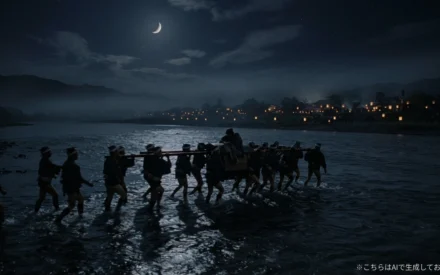
The Shimada-juku Oi River Kawagoshi Site is a nationally designated Historic Site that conveys the Edo-period system of kawagoshi, or river crossing by porter. After 1603, when Tokugawa Ieyasu became shogun, building bridges or crossing by boat on the Oi was forbidden in order to defend Edo, and travelers were required to cross on foot with the help of porters.
At first, travelers and porters negotiated the fee between themselves, but abuses spread in which porters deliberately chose deep spots to demand higher pay. In 1665 a notice board fixing fees by water depth was posted, and an official called the kawa-mokudai was appointed, and control of the crossing is said to have tightened step by step. The river office (kawa-kaisho) and the waiting lodges (ban-yado) where porters stood by have been reconstructed and are included in the site.
The system was abolished in 1870, when ferries and bridges on the river were permitted. This is our own conjecture, but travelers held up for days by the river must have stayed long in Shimada’s inns, and that probably fed the post town’s prosperity. The anxiety and frustration of people stranded by the swollen river are also part of this town’s memory. For visiting conditions and opening status, please check the city’s official guide.
4. Suwahara Castle (諏訪原城)
Suwahara Castle is a Sengoku-period mountain castle built at the tip of the Makinohara Plateau in Kanaya, Shimada, and is a nationally designated Historic Site. The Tokaido ran just south of the castle: the slope to the east leads down across the Oi River into Suruga, and the slope to the west leads over Sayo-no-Nakayama to Kakegawa, which made this a vital crossing point. No buildings survive, but the moats, baileys and the defensive structures called umadashi (horse-out works) remain clearly.
After the Imagawa fell, Suruga came under the Takeda and Totomi under the Tokugawa, and the two soon began to fight. Takeda Katsuyori is said to have had this castle built in 1573 as a foothold into Totomi. In 1575 it fell to the Tokugawa side, and it was a Tokugawa castle thereafter. The name is said to come from the god of Suwa enshrined within the castle.
In our view, the way Takeda and Tokugawa building styles survive overlapping here, such as the crescent-shaped moats and the round umadashi, suggests that the castle was used again and again on the border between the two powers. This is a historic site, so please check the entry rules on site before you walk it, and do not go too close to the cliffs of the plateau.
5. Keiman Shrine (敬満神社)
Keiman Shrine stands in Sakamoto, Shimada, and is an ancient shrine of high rank, listed as a “Myojin Taisha” in the Heian-period Engishiki. Tradition places its founding as far back as before the Common Era, but nothing is known for certain. A 9th-century record is said to list the rank bestowed on its deity as the highest in all of Totomi Province.
One theory links the enshrined deity “Keiman” to the name of a man regarded as an ancestor of the Hata clan (秦氏), powerful immigrant lords. Around the shrine, indeed, spreads a group of late Kofun-period tombs that began to be built suddenly around the middle of the 6th century, and archaeology also points to the possibility that an outside group settled here.
This is our own conjecture, but the story of people who came to an unfamiliar land and enshrined their ancestral god at the edge of this plateau shows how the history of a place has been layered by the movement of people. This is a working shrine, so please pay your respects quietly and with courtesy.
Local Specialties: Food and Drink
Shimada is known as a tea-producing area centered on the Makinohara Plateau. Tea fields spread across the city and are deeply tied to local life.
In our research, we could not confirm the origins of any particular local dish from reliable sources. If you are planning to eat your way around town, please check business days and offerings in advance with each shop or the city’s tourist information.
Rare Wildlife and Nature
Shimada is a town with three landscapes: the flow of the Oi River, the Makinohara Plateau spreading to the south, and the mountains to the north. In the days of kawagoshi, the Oi was also a hard barrier that held travelers back.
The cedars of Chimanji Temple are a National Natural Monument. When walking mountain paths or near the cliffs of the plateau, watch your footing and the weather, and make a plan that is not overly ambitious.
Other Notable Things About This Town
Shimada prospered in the Edo period as a post town on the Tokaido. The system of kawagoshi for crossing the Oi shaped the life of the post town.
Besides the Shimada Grand Festival held every three years, historic sites and old shrines remain across the area. Please act with consideration for working shrines and temples and for the daily life of local residents.

A mini tripod for stabilizing a phone while recording or filming at a haunted spot.
Manfrotto Mini Tripod & Hand Grip for Smartphones 'PIXI MII Smart', with MCLAMP Adapter, Fits Phones up to 8.35cm Wide, 1kg Load Capacity MKPIXICLMII-BK
We may earn a referral fee on purchases made through these links.
The Night Side: Ghost Stories and Haunted Spots of This Town
So far we have walked the daytime face of Shimada: an old temple of cedars, the shrine of the river god, the memory of an uncrossable river, a castle on a border, and an ancient god. Every one of these places holds layers of time in which people faced the river, prayed and fought.
That depth connects to the night side as well. In the darkness along the river and the stillness of the castle ruins, there is an atmosphere quite unlike the day. In our view, a ghost story is something like a shadow that a place’s history and terrain cast on the human heart.
At KARASU CHANNEL (鴉番組), we publish true ghost stories and haunted spots not for people to visit but to record them. Now that you know the daytime scenery, please read the night stories too.
Before You Go
Opening hours, fees, closing days and access change often, so they are not listed in this article. Before you set out, please check the latest information on each facility’s or local government’s official site. Some places may be restricted because of weather or disaster.
Frequently Asked Questions
Q. In what order should I visit the sights of Shimada?
A. This article introduces them from north to south. Chimanji is in the mountains, Oi Shrine and the Kawagoshi Site are in the town center, and Suwahara Castle and Keiman Shrine are on the plateau side in the south of the city. Grouping them by area makes the trip easier. Please check transport and travel times in the city’s official guide.
Q. When can I see the Shimada Grand Festival (Obi Matsuri)?
A. It is said to be held every three years in October. Please check the latest information, including the years it is held, the schedule and viewing rules, in the official guidance of the city or shrine, and follow that guidance when you watch.
Q. Can I visit Suwahara Castle freely?
A. It is a nationally designated Historic Site and has been developed as a park. Please check the entry rules and visiting conditions in the city’s official guide or on the signboards on site. Because it sits at the edge of a plateau, watch your step as well.
Official sites and references consulted
https://ja.wikipedia.org/wiki/島田市
https://ja.wikipedia.org/wiki/智満寺_(島田市)
https://ja.wikipedia.org/wiki/大井神社_(島田市)
https://ja.wikipedia.org/wiki/島田宿大井川川越遺跡
https://ja.wikipedia.org/wiki/諏訪原城
https://ja.wikipedia.org/wiki/敬満神社
https://www.city.shimada.shizuoka.jp/

Supervised by Suzuking.
Affiliation: KARASU CHANNEL
Occult & horror reporting: 7 years (since 2020)
Followers: YouTube 5,000+ / X 25,000+
On-site investigations: 30+
Ghost stories from this land
Besides its daytime face, this land has a night side too. Read it as a record if you are curious. Some of these places are not safe or permitted to enter.