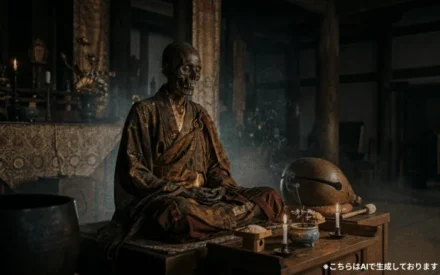
Sightseeing in Tsuruoka: Dewa Sanzan and the Shonai Castle Town, Walked North to South
Supervised by Suzuking. (KARASU CHANNEL / Occult & horror reporting, 7 years)
Contents
Places to visit in this town (north to south)
Numbers follow the order in the article, from north to south. Select a pin to see its name. Positions are approximate.
- Zenpo-ji Temple (善宝寺) An old Soto Zen temple in the north of the city with dragon-deity legends, visited from across the country by people praying for safe voyages and big catches.
- Kamo Aquarium (加茂水族館) A municipal aquarium at Kamo Port that went from the brink of closure to worldwide fame for its jellyfish displays.
- Tsuruoka Park and the Site of Tsurugaoka Castle (鶴岡公園と鶴ヶ岡城跡) The site of the Shonai Domain's castle, a cherry blossom spot and a place of rest for townspeople, dotted with Shonai Shrine and memorial museums.
- Chido Museum (致道博物館) A museum on the site of the castle's third enclosure, where the lord's retirement residence, a garden of scenic beauty and relocated Western-style buildings stand together.
- Tsuruoka Catholic Church (鶴岡カトリック教会天主堂) A wooden Romanesque-style church built in 1903, a nationally Important Cultural Property known for Japan's only Black Madonna.
- Chidokan (致道館) The domain school of the Shonai Domain, a national historic site and the only surviving domain school building in the Tohoku region, where an atmosphere of learning remains.
- The Cedar Avenue and Five-Story Pagoda of Mt. Haguro (羽黒山のスギ並木と五重塔) The approach of Mt. Haguro, one of the Three Mountains of Dewa, lined with a Special Natural Monument cedar avenue and a National Treasure five-story pagoda.
- Lake Otori (大鳥池) A mountain lake spreading at 966 meters in the Asahi Mountains, known for the legend of Takitaro, a phantom giant fish.
Show basic information about this town (location, last checked, notes)
- Location
- Tsuruoka, Yamagata Prefecture, Japan
- Last checked
- 2026.10.05
- Please note
- Opening hours, prices and closing days change often, so we do not list them. Please check each facility's official site before you go.
What Is Tsuruoka Like?
Tsuruoka is a city on the Sea of Japan side of Yamagata Prefecture, in the southern part of the Shonai region. The present city was born on October 1, 2005, from the merger of the former Tsuruoka City with the towns of Fujishima, Haguro and Kushibiki, the village of Asahi and the town of Atsumi. Its area is 1,311.51 square kilometers (as of 2009), the largest in the Tohoku region and among the largest in the whole country.
In the Edo period it prospered as the castle town of the Shonai Domain, and the castle ruins and the domain school still stand in the city center. At the same time, the city includes the Three Mountains of Dewa (Dewa Sanzan), Mt. Haguro, Mt. Gassan and Mt. Yudono, known as mountains of Shugendo, so a samurai town and mountains of mountain worship share one city. This article introduces the sights from north to south, in descending order of latitude. The route starts at a seaside temple and an aquarium, then moves on to the castle town, Mt. Haguro and finally a lake deep in the southern mountains.

A quick-dry cooling towel for bringing down body heat fast during midsummer ruin exploration or a haunted-spot tour. Just wet it and give it a shake for a lasting cool feeling, and it folds compact with a carry pouch so it won't take up much space in your bag.
LOGOS Quick-Dry Cooling Towel 81690140, Camping/Outdoor, Absorbent & Fast-Drying
We may earn a referral fee on purchases made through these links.
1. Zenpo-ji Temple
Zenpo-ji is a Soto Zen temple in northern Tsuruoka, with the mountain name Ryutaku-zan. Together with Myogon-ji and Saijo-ji, it is counted as one of the three great prayer sites of the Soto school. It is said to have begun when the Tendai priest Myodatsu built a thatched hermitage between about 938 and 957 in the Heian period, and it was then called Ryuge-ji. In the Eikyo era (1429–1441) of the Muromachi period its halls were restored, and the temple name is said to have been changed to Zenpo-ji.
The temple preserves legends of dragon deities. According to one story, two dragon deities who appeared bestowed the temple’s name and then hid themselves in the temple pond. As a temple of dragon-deity worship, it has drawn the faith of shipping people praying for safe voyages and fishing people praying for big catches, and worshippers come from all over the country. It is a place where the life of Shonai, facing the Sea of Japan, overlaps with prayers to the sea.
In the Edo period, with the efforts of the Shonai lord Sakai Tadayori among others, its position as a branch temple of the head temples is said to have been established. It is a temple where faith continues today, so please worship quietly and follow the guidance within the grounds.
2. Kamo Aquarium
The Kamo Aquarium is a municipal aquarium at Kamo Port in Tsuruoka, the only aquarium in Yamagata Prefecture. Its predecessor was the Yamagata Prefecture Aquarium, opened in 1930 with funds from local people. By 1997, falling visitor numbers had put its survival in doubt, but it found a way forward in displaying jellyfish and recovered.
In 2000 it had the largest number of jellyfish species on display in Japan, and in 2005 the most in the world. Its displays now exceed 50 species, and in 2012 it was certified by Guinness World Records for the number of species. It is also known for advanced techniques for keeping and breeding jellyfish, and the “Kamo-style tank,” which circulates water while reducing the strength of the flow, has drawn attention from aquariums around the world.
One highlight is a large tank 5 meters in diameter in which about 10,000 moon jellyfish drift. Their movement as they catch the light is a quiet and mysterious sight. How an aquarium at a small fishing port overcame the crisis of closure and came to be known worldwide seems to reflect the tenacity of the people of Shonai.
3. Tsuruoka Park and the Site of Tsurugaoka Castle
Tsuruoka Park is a park on the site of the main and second enclosures of Tsurugaoka Castle, the seat of the Shonai Domain government in the Edo period. It has been selected as one of Japan’s 100 Best Cherry Blossom Spots. Like other castles in Tohoku, Tsurugaoka Castle is said to have made much use of earthen ramparts and to have used stone walls only in its main sections.
The castle had no keep. The two-story corner turret “Okado Yagura” at the northwest corner of the main enclosure is said to have served in place of the keep. Its roof was originally shingled, and tile roofing is said to have been adopted in the Bunsei era (1818–1830), when tiles resistant to cold were improved.
On the site of the main enclosure stands Shonai Shrine, founded in 1877 at the petition of the domain’s former subjects, which enshrines the ancestors of the Sakai family, the lords of Shonai. The park also has the Fujisawa Shuhei Memorial Museum and the Taihokan, which introduces local figures. It is a place that makes you feel that the castle lives on in people’s affection even after the domain’s fall.
4. Chido Museum
The Chido Museum stands on the site of the third enclosure of Tsurugaoka Castle. Its name comes from “Chidokan,” the domain school of the Shonai Domain. It began in 1950 when Sakai Tadayoshi, head of the former lord’s family, donated land, buildings and cultural properties.
At the center of the grounds is part of the Goinkyoden, the lord’s retirement residence. Built in 1863 by dismantling and relocating a palace from the Shonai Domain’s Edo residence, it served as the retirement home of Sakai Tadaaki, the ninth lord, after he returned home. From its inner rooms you can look out on the Sakai Family Garden, designated a national place of scenic beauty. The garden is described as having the character of shoin-zukuri style.
On the broad grounds also stand historic buildings moved from other sites, such as the former Nishitagawa District Office, the former Tsuruoka Police Station building and the former Shibuya family residence. The collection includes a National Treasure sword, as well as about 5,000 Important Tangible Folk Cultural Properties that convey Shonai daily life, such as tools for fishing on the Mogami River and tools for rice growing. The elegance of the samurai and the ingenuity of common people’s lives stand side by side on a single site.
5. Tsuruoka Catholic Church
Tsuruoka Catholic Church is a wooden Romanesque-style church built in 1903. It is said to have been designed by the French priest Father Papinot, with a Japanese carpenter, Soma Tomitaro, as master builder. It is 23.7 meters high, said to be the oldest building in this style in the Tohoku region, and has been designated a nationally Important Cultural Property since 1979.
On the altar is the “Black Madonna,” a gift from a French monastery to commemorate the church’s completion. Made as a copy of the black statue of the Virgin in a cathedral in Normandy, France, it is said to be the only Black Madonna in Japan.
Another feature is its windows. Instead of stained glass, it uses “picture windows” in which transparent paper with painted images is sandwiched between two sheets of glass, and this building is said to be the only one in Japan with windows of this kind. It is a church still used as a place of prayer, so please be quiet during a visit and follow the guidance given.
6. Chidokan
Chidokan was the domain school of the Shonai Domain. It began as a place of study founded in 1805 by the seventh lord, Sakai Tadanori, at that time located in present-day Hiyoshi-cho, Tsuruoka. In 1816 the eighth lord, Sakai Tadakata, moved it into the third enclosure of Tsurugaoka Castle. It was a place of learning for the children of domain retainers until it closed in 1873.
It is the only domain school building surviving in the Tohoku region, and the whole site, including the sacred hall enshrining Confucius, the lecture hall, the Oirima and the front gate, is designated a national historic site. Restoration work began in 1965, and it has been open to the public since 1972.
In April 2024 a prefectural combined junior and senior high school that took this domain school’s name for its own also opened. The name of a place of learning begun more than two hundred years ago has been passed on to a school of today. Standing in the lecture hall, you can quietly picture the daily scenes of the retainers’ children studying.
7. The Cedar Avenue and Five-Story Pagoda of Mt. Haguro
Mt. Haguro, 414 meters high, is a mountain of mountain worship centered on Shugendo. Together with Mt. Gassan and Mt. Yudono it is called the Three Mountains of Dewa, and there is a view that the three mountains represent the past, present and future respectively, with Mt. Haguro positioned as the mountain of the present world. At the summit of Mt. Haguro stands Dewa Shrine, with the Sanshin Gosaiden, a hall enshrining the deities of all three mountains together. It is said to have been opened in 593 by Prince Hachiko.
The main approach from the Zuijin-mon gate at the foot of the mountain to the summit has 2,446 stone steps, with an elevation difference of about 300 meters and a one-way distance of about 1.7 kilometers. On both sides stand giant cedars estimated to be 350 to more than 500 years old. The number of trees is given as 585 and also as more than 400, with various accounts. This cedar avenue was designated a national Special Natural Monument in 1955.
Near the entrance to the approach is a National Treasure five-story pagoda. It is said to have been founded by Taira no Masakado and is considered the oldest pagoda in the Tohoku region. The present pagoda was rebuilt around the 15th century. The Jijisugi (Old Man Cedar) beside it is said to be more than 1,000 years old; the Babasugi (Old Woman Cedar) once stood next to it but was lost in a typhoon in 1902. It is still a mountain of training and faith, so when walking the approach, watch your step and pass quietly.
8. Lake Otori
Lake Otori is a mountain lake in the Asahi Mountains along the border between Yamagata and Niigata Prefectures, at the southern end of Tsuruoka. Its elevation is about 966 meters, and it lies at the northern foot of Mt. Ito. It is a dammed lake formed when a river was blocked, surrounded by beech forest.
The lake is said to have been discovered in 736 by the priest Gyoki, and since ancient times it has been known as a mysterious lake that at times brought divine calamity. In old times it was also a place closed to women. Full-scale academic research took place in 1926. A professor at the old-system Yamagata Higher School investigated and confirmed that it is a lake in a granite region, unusual in Japan, and that it is a dammed lake rather than a fault lake.
There is a legend that a giant fish called Takitaro lives in this lake. Survey coverage by television stations and others has been carried out, and although there were results suggesting the existence of a huge fish, the real thing has not been confirmed; it is, so to speak, an unidentified creature. In this site’s view, that so long-lived a tale of a fish arose in deep mountains that people cannot easily approach may be an expression of the heart that reveres the mystery of the mountains. Getting there requires mountain-walking gear and stamina, and at some weather conditions or seasons entry to the mountain is not possible.
Local Specialties, Food and Drink
When it comes to Tsuruoka’s flavors, first comes dadacha-mame. This edamame, a specialty of the Shonai region, is thought to have been selected and nurtured from a variety brought from Echigo in the Edo period. With brown hairs on its pods, sweetness, rich flavor and strong aroma, it has been called a “phantom bean” because its harvest period is short and it is hard to store.
Atsumi turnips, Mita eggplant and Shonai persimmons are also products that have been carefully grown in this land. Atsumi turnips are a traditional vegetable grown by slash-and-burn farming, and a record of pickles presented to the shogun in 1785 is said to survive. As a winter delicacy of the Sea of Japan there is also kan-dara (winter cod), known for the “Sea of Japan Kandara Festival” held in January.
In 2014 Tsuruoka became the first city in Japan to be certified a UNESCO Creative City of Gastronomy. A representative food culture is “Tsuruoka traditional sweets,” including the sweets made for the Doll Festival. Surrounded by the rice-growing Shonai Plain, it is a rich food town where seasonal ingredients are tied to seasonal events.
Rare Wildlife and Nature
Tsuruoka’s nature is represented by the mountains of the Three Mountains of Dewa and Mt. Haguro’s cedar avenue. The Jijisugi of Mt. Haguro is an old cedar more than 1,000 years old, designated a national natural monument. Cedar avenues designated as national Special Natural Monuments are said to exist in only two places: Mt. Haguro and Nikko in Tochigi Prefecture.
In the Asahi Mountains to the south lies Lake Otori, surrounded by beech forest. On the seaside to the west, fishing grounds nurtured by the rough waves of the Sea of Japan spread out, and the fishing industry thrives. Sea, plain and mountains: the nature of Shonai fits into one city, which is the fascination of Tsuruoka’s geography.
Other Notable Things About This Town
Tsuruoka is said to be the northern limit of true silk-producing regions in Japan, and the only region where the whole process from sericulture through reeling, weaving, scouring and sewing can be carried out in the same area. Behind this lies the history of land reclamation in the early Meiji era. After the Boshin War, about 3,000 former Shonai Domain retainers cleared land at the foot of Mt. Gassan from 1872 and created mulberry fields and silkworm houses. The Matsugaoka Reclamation Site in Haguro was designated a national historic site in 1989.
The Three Mountains of Dewa and the silk history of Matsugaoka are each also component cultural properties of Japan Heritage stories. Two faces, mountain worship and the pioneering history of samurai who swapped swords for hoes, remain in one city.
The city has many other topics worth telling, such as the Fujisawa Shuhei memorial museum and its reputation as the birthplace of school lunches. It is a town built up over time by people who have long studied, worked and prayed.

A mite-repellent spray with no synthetic insecticide, for spraying directly onto tatami, carpet, or bedding — use it to prevent mite-related skin trouble when you sit down to set up gear or explore a dusty tatami room inside a ruin.
Earth Chemical Pyrepara Earth Mite Repellent Spray 300mL
We may earn a referral fee on purchases made through these links.
The Night Side: Ghost Stories and Haunted Spots of This Town
So far we have walked Tsuruoka’s daytime face: a dragon-deity temple, a jellyfish aquarium, a castle without a keep, a Meiji church, a cedar-lined approach and a lake deep in the mountains. In every place, time overlaps the time when people prayed, studied and at times were forced to make great decisions.
That depth leads on to the night side as well. Tsuruoka has several places spoken of with awe, such as Lake Otori, which has been passed down as a “mysterious lake,” and Mt. Haguro, which has drawn faith as a mountain of ascetic practice. In this site’s view, a ghost story is something left as a tale from the history of a place and from people’s awe. These places remain objects of faith and mountain climbing today, and are not places to enter at night out of idle curiosity.
At KARASU CHANNEL, we present true ghost stories and haunted spots not so that you can visit them but so that they are recorded. Having learned the daytime scenery, please read the night-time tales as well.
Before You Go
Business hours, fees, closing days and access change easily, so they are not listed in this article. Before heading out, please check the latest information on the official website of each facility or local government. Some places may have restricted entry because of weather or disasters.
Frequently Asked Questions
Q. In what order should I tour Tsuruoka to be efficient?
A. This article introduces places from north to south. Tsuruoka Park, the Chido Museum, Chidokan and Tsuruoka Catholic Church are within walking distance in the city center. It is easier to group the rest by direction: Zenpo-ji and the Kamo Aquarium on the northern sea side, Mt. Haguro on the eastern mountain side and Lake Otori deep in the southern mountains. The city area is very large, so check transportation and seasonal service in official information.
Q. How far do you walk on the stone steps of Mt. Haguro?
A. From the Zuijin-mon gate at the foot of the mountain to the summit, 2,446 stone steps continue, with a one-way distance of about 1.7 kilometers and an elevation difference of about 300 meters. Ease of walking varies greatly with underfoot conditions and weather, so wear comfortable shoes and plan with time to spare.
Q. Can I go to Lake Otori casually?
A. Lake Otori is a mountain lake deep in the Asahi Mountains, and mountain-walking gear and stamina are needed. There are periods when entry is not possible because of snow or weather, so be sure to check the latest climbing information.
Official sites and references consulted
https://ja.wikipedia.org/wiki/鶴岡市
https://ja.wikipedia.org/wiki/善寳寺
https://ja.wikipedia.org/wiki/鶴岡市立加茂水族館
https://ja.wikipedia.org/wiki/鶴ヶ岡城
https://ja.wikipedia.org/wiki/荘内神社
https://ja.wikipedia.org/wiki/致道博物館
https://ja.wikipedia.org/wiki/鶴岡カトリック教会天主堂
https://ja.wikipedia.org/wiki/致道館
https://ja.wikipedia.org/wiki/羽黒山_(山形県)
https://ja.wikipedia.org/wiki/羽黒山のスギ並木
https://ja.wikipedia.org/wiki/出羽神社
https://ja.wikipedia.org/wiki/大鳥池
https://ja.wikipedia.org/wiki/だだちゃ豆
https://ja.wikipedia.org/wiki/温海かぶ

Supervised by Suzuking.
Affiliation: KARASU CHANNEL
Occult & horror reporting: 7 years (since 2020)
Followers: YouTube 5,000+ / X 25,000+
On-site investigations: 30+
Haunted locations near this town
Besides its daytime face, this land has a night side too. Read it as a record if you are curious. Some of these places are not safe or permitted to enter.
Ghost stories from this land
Besides its daytime face, this land has a night side too. Read it as a record if you are curious. Some of these places are not safe or permitted to enter.