Mikozawa Tunnel (Tsuruoka)
Supervised by Suzuking. (KARASU CHANNEL / Occult & horror reporting, 7 years)
Contents
View basic details of this location (address, history, status, etc.)
- Location
- Tsuruoka City, Yamagata Prefecture (near the former Yudo settlement, along a prefectural road)
- Built
- Unknown (date of the old road's construction not confirmed)
- Closed / Decommissioned
- Not applicable — remains in use as an active local road tunnel
- First Rumored
- Unknown (known through a local oral tradition)
- Current State
- In active use as a road tunnel
- Access
- Open — active road tunnel
- Last Verified
- 2026.09.23
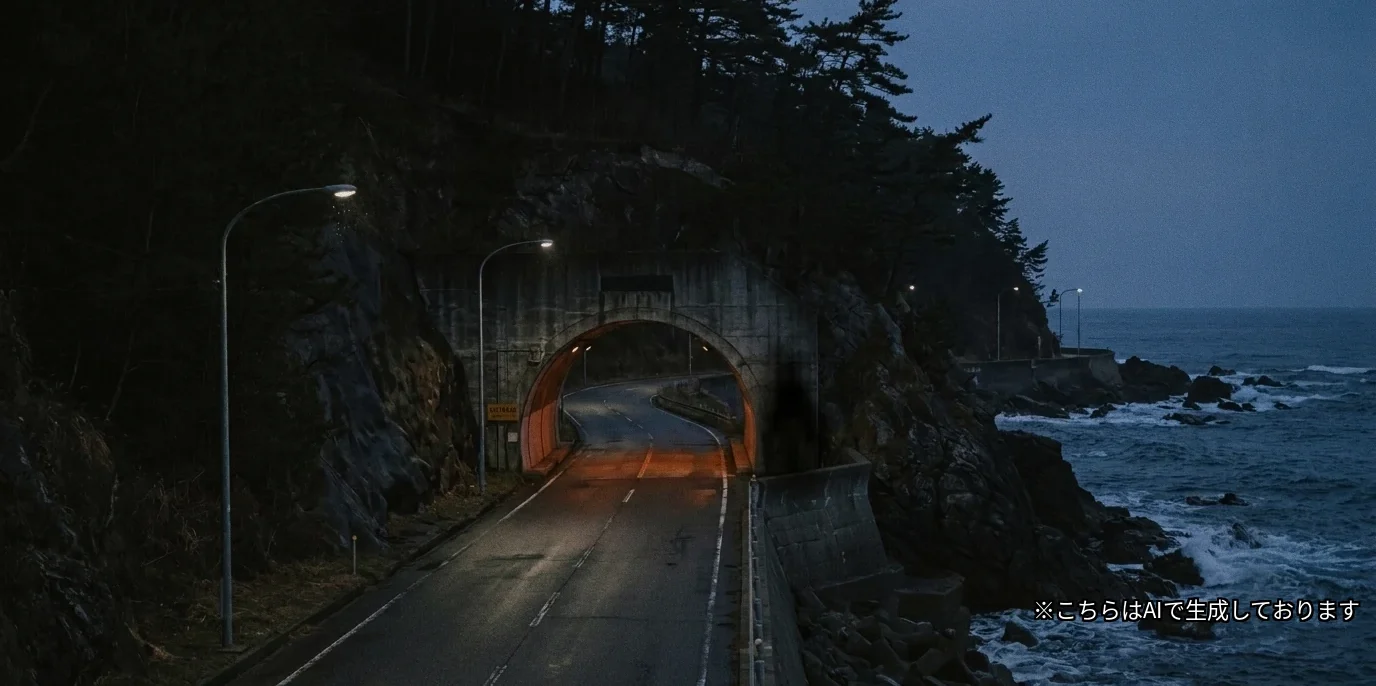
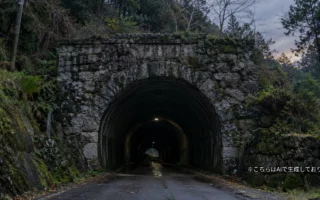
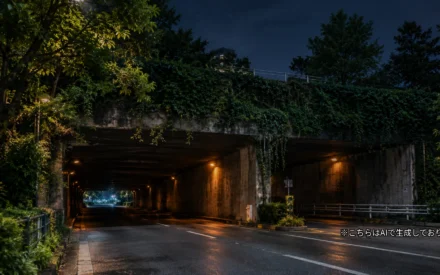
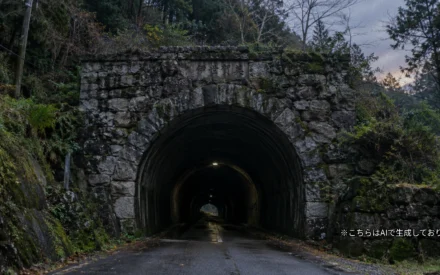
In Tsuruoka City, Yamagata Prefecture, a city road called the Takenoura–Mikozawa–Aburato Line links the small seaside community of Aburato with the Takenoura area on the inland side of the hills. Where the road passes beneath the ridge, it runs through the Mikozawa Tunnel (Mikozawa Zuidō), about 309 meters long. Locals often simply call it the “Aburato Tunnel,” and when it is introduced as one of Tsuruoka’s haunted spots it is sometimes labeled the “Old Aburato Tunnel.” It was originally dug as a private road for a coal mine in Aburato, and after the mine closed, the city rebuilt it as a public road. It remains an active tunnel managed by Tsuruoka City, and local cars pass through an interior too narrow for two vehicles to pass each other.
What People Say
Tracing haunted-spot websites and posts by local residents, the rumors most often told about the Mikozawa Tunnel fall into two groups. One is that the ghosts of workers killed in a cave-in during the tunnel’s construction appear inside the tunnel or near the memorial stone at its entrance. The other consists of the kind of stories heard at tunnels all over Japan: a female ghost, a white hand reaching out from the wall, the feeling of being watched, or something appearing if you sound your horn inside.
A blog by a local who worked as a shuttle driver records one such experience: just after entering the tunnel at night, one woman among the passengers cried out that someone was coming toward them, yet no one else saw anything at all. A figure standing ahead on a narrow, one-lane road, visible to only one person — stories of this type sit at the heart of the tunnel’s reputation. However, we found no official record or news report for any of these rumors, and it is not known when they first began to circulate.
Getting to a haunted spot over mountain roads or unpaved surfaces makes a gravel- or nail-caused flat more likely. A compact compressor that runs off the cigarette lighter socket lets you top up air on the spot, and doubles for a spare tire, a bicycle, or a ball.
BAL (Ohashi Sangyo) Air Compressor No.498, DC12V, 450kPa, Lightweight, Emergency Tire Inflator, with Bicycle Valve & Ball Needle Leisure Adapters
We may earn a referral fee on purchases made through these links.
What the Record Shows
Apart from the rumors, the tunnel’s own history can be confirmed in public documents. According to Tsuruoka City’s long-term repair plan for its road tunnels and snow sheds, the Mikozawa Tunnel belongs to the city road Takenoura–Mikozawa–Aburato Line, runs between the Nishime and Aburato areas of the city, is 309 meters long and 4.0 meters wide, and was built in 1947.
Its origins are inseparable from the history of the Aburato coal mine. Test digging for coal at Aburato began in the early Meiji era, and in 1879 it became a state-run mine tasked with supplying fuel for the Sado mines. It then passed back and forth between private hands and state control, until in 1896 it was sold to Mitsubishi together with the Sado mines. The mine was shut down during the slump of the Taisho era, but in 1947, amid the postwar drive to boost coal output, Mitsubishi Mining set out to redevelop it. The Mikozawa route, cutting through the hills from Aburato to Takenoura, was opened at that time as the mine’s private road. A coal loading facility was built at Takenoura, and in 1950 a private railway line to Uzen-Ōyama Station was also completed.
Yet less than ten years after reopening, in February 1957, the Aburato mine closed — said to be the first closure of a coal mine run by a major company. The former private tunnel was then rebuilt with Tsuruoka City as the project owner. A construction monument at the Takenoura-side entrance records that work began in October 1957 and was completed in July 1958.
Beside the monument stand a memorial stone and a Buddhist statue, said to honor those who died in an accident during construction. However, sources disagree on when the accident happened and how many lives were lost, and we have not been able to confirm either. As for its current condition, the city’s 2023 inspection judged that “measures should be taken at an early stage,” and the city plans a major renewal in the future.
The Land of Aburato, and Its Two “Aburato Tunnels”
Aburato sits at the northern foot of Mt. Arakura: a small community with a fishing port, hemmed in by mountains on three sides and open only to the Sea of Japan on the west. It is linked to Kamo in the north and Yura in the south by a coastal prefectural road, but the shore on either side of the village is a line of sheer cliffs, and the road gets past them with short tunnels and snow sheds (roofed sections that shield the road from snow and sea spray). Although the center of Tsuruoka is only about ten kilometers away, the mountains behind the village made travel difficult. The Mikozawa Tunnel cuts through those mountains to Takenoura inland — the village’s back door, so to speak.
What makes things confusing is the name “Aburato Tunnel.” Right beside the current Aburato Tunnel on the coastal road (completed in 1973), there is an older tunnel dug in 1941 and retired in 1973, whose nameplate reads “Aburato Zuidō.” It, too, is called the “Old Aburato Tunnel,” and haunted-spot write-ups have often mixed it up with the Mikozawa Tunnel in the hills, blending their rumors together. Locals usually mean the Mikozawa Tunnel when they say “Aburato Tunnel,” and that is the tunnel this article covers. The old coastal tunnel is a decommissioned structure with its portal filled in, and it cannot be entered.
Our Reflection — A Road Through the Mountain That Kept Lives Connected
Among the rumors surrounding the Mikozawa Tunnel, the story of the ghosts of construction victims has solid ground beneath it. With a memorial standing at the entrance, the fact that people died here is something local people simply know. It is natural to think the rumor grew from there.
What we want to draw attention to is that this is a road that was dug twice. The first time, to carry the coal that fueled postwar recovery. The second time, after the mountain closed again only ten years later, so that a community that had lost its livelihood could keep a road to the city. Whichever project the accident happened in, this is our speculation, but we suspect the weight of the lives recorded on the memorial is the other side of the weight of the hopes of people determined to go on living on this stretch of coast.
The 4-meter-wide interior, where two cars cannot pass, still preserves the limits of the technology and budget of its time. In our view, the reason stories of “a figure only one person can see” gather around this tunnel is not just that it is narrow and dark. It is a one-lane passage where, if a car comes the other way, one of you must back out. A structure that constantly makes you think about “someone” coming toward you may be exactly what sharpens the senses to a presence that isn’t there.
This tunnel still supports local daily life, and the memorial at its entrance is a place for people to put their hands together in prayer, not a stage for a test of courage. We’d like to present this place as a record of a road whose history runs back to the coal-mining era, and of the lives that were lost building it.
A Nearby Recommendation — Yura Coast
Come out of the tunnel on the Aburato side and head south along the coastal road, and you reach the Yura Coast (Yura Kaigan), selected as one of Japan’s “100 Best Shorelines.” Known for its gently sloping shore, calm waves, and white sand, it is busy with swimmers in summer. Inns at Yura Onsen dot the area, and the bright seaside scenery stands in sharp contrast to the tunnel’s dim atmosphere.
Field Notes
As an active city road tunnel, simply passing through poses no problem. However, the interior is too narrow for vehicles to pass each other and has no sidewalk, so stopping inside the tunnel or near its entrances is dangerous. If you want to look around or take photos, park somewhere that won’t obstruct traffic. On the Aburato side the road runs through the narrow lanes of the village, so please avoid loud, late-night visits. Please view the memorial beside the entrance quietly. The location on the map shows the approximate midpoint of the tunnel.
An essay collecting strange stories tied to food — an easy reference to introduce alongside our kaidan columns.
Scary Foods (Tanishi Matsubara / Futami Shobo)
We may earn a referral fee on purchases made through these links.
Frequently Asked Questions
Q. Can you still drive through the Mikozawa Tunnel today?
A. Yes. It is an active city road tunnel managed by Tsuruoka City, and driving through is not a problem. However, the interior is too narrow for two vehicles to pass, so watch for oncoming cars and avoid stopping inside the tunnel or near its entrances. If you want to look around or take photos, choose a spot that won’t obstruct traffic.
Q. How do you pronounce the tunnel’s name?
A. It is read “Mikozawa,” so the tunnel’s Japanese name, 神子沢隧道, is pronounced “Mikozawa Zuidō.” The district where it is located, 油戸, is read “Aburato.”
Q. Is the “Old Aburato Tunnel” a different tunnel?
A. The name is used for two different places. Locally, “Aburato Tunnel” usually means this Mikozawa Tunnel through the hills, and it is sometimes written as the “Old Aburato Tunnel.” Meanwhile, beside the current Aburato Tunnel on the coastal prefectural road there is an older tunnel (Aburato Zuidō), dug in 1941 and retired in 1973, which is also called the “Old Aburato Tunnel.” That decommissioned tunnel’s portal has been filled in, and it cannot be entered.
Q. Is it true that people have seen figures at night?
A. Such experiences are told as personal accounts, but we found no official record or news report confirming them, and we could not pin down when the rumor first began.
Q. What is the memorial at the tunnel entrance for?
A. It stands beside the construction monument at the Takenoura-side entrance and is said to honor those who died in an accident during the tunnel’s construction. Sources disagree on when the accident happened and how many lives were lost, and we have not been able to confirm either.
Q. Has KARASU CHANNEL filmed on location at the Mikozawa Tunnel?
A. No, we have not filmed there yet; a visit is currently under consideration. Location footage for other haunted spots and kaidan stories can be viewed on KARASU CHANNEL (YouTube).

Supervised by Suzuking.
Affiliation: KARASU CHANNEL
Occult & horror reporting: 7 years (since 2020)
Followers: YouTube 5,000+ / X 25,000+
On-site investigations: 30+
If this appeared in your dream
What it means to dream of something from this story, read through psychology and folklore in our Dream Dictionary.
- Dreaming of a TunnelA symbol of transition or trial. Seeing light at the end means a hard time is nearly over.
Kaidan Tales from This Area
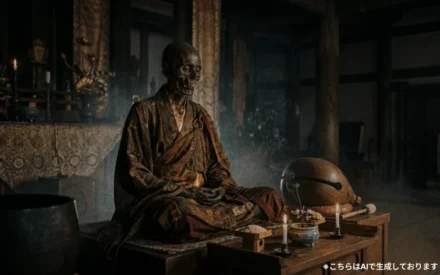
Which haunted location do you find the scariest?
If you think this location is the scariest, press the button below. One vote site-wide — you can change your vote for a different location anytime.
Was this article helpful?
Add this to your favorites to find it again anytime from your My Page.

Comments