Sightseeing in Sumida: Rivers, Downtown Streets and a Tower East of the Sumida River
Supervised by Suzuking. (KARASU CHANNEL / Occult & horror reporting, 7 years)
Contents
Places to visit in this town (north to south)
Numbers follow the order in the article, from north to south. Select a pin to see its name. Positions are approximate.
- Mukojima-Hyakkaen Garden (向島百花園) A garden raised by Edo literati who brought their plants to grow, where the bush clover tunnel and 29 haiku monuments convey the elegance of downtown Tokyo.
- Ushijima Shrine (牛嶋神社) An old shrine worshipped as the chief guardian of Honjo, notable for its rare Mitsutorii, a combination of three torii.
- Sumida Park and the Cherry Trees of Bokutei (隅田公園と墨堤の桜) One of Tokyo's finest cherry blossom spots on both banks of the Sumida River, where the embankment's cherry trees planted at a shogun's order have lasted about 300 years.
- Tokyo Skytree (東京スカイツリー) A 634-meter radio tower raised on the site of a freight station, whose highlights are its earthquake-damping structure and observation decks.
- Yokoamicho Park and the Tokyo Memorial Hall (横網町公園と東京都慰霊堂) A park mourning the victims of the Great Kanto Earthquake and the Great Tokyo Air Raid, whose memorial hall with a three-story pagoda is a quiet place of prayer.
- Kyu-Yasuda Garden (旧安田庭園) A quiet stroll garden in Ryogoku that began as an Edo daimyo garden, with a pond that once drew in the tides of the Sumida River.
- Ryogoku Kokugikan (両国国技館) The hall where grand sumo tournaments are held; the first one was built within Ekoin's grounds and had a great roof called the "Daitetsusan."
- Sumida Hokusai Museum (すみだ北斎美術館) A museum in Honjo, where the ukiyo-e artist Katsushika Hokusai spent most of his life, with a silver exterior that reflects the surroundings.
- Ekoin Temple (回向院) A temple opened to mourn the victims of the Great Fire of Meireki in 1657, which became a stage for subscription sumo and has many memorial towers for animals.
Show basic information about this town (location, last checked, notes)
- Location
- Sumida, Tokyo, Japan
- Last checked
- 2026.10.05
- Please note
- Opening hours, prices and closing days change often, so we do not list them. Please check each facility's official site before you go.
What Is Sumida Like?
Sumida is a long, narrow ward in the east of Tokyo’s 23 wards, bounded by the Sumida River on the west and the Arakawa River and the old Nakagawa River on the east. The present ward was born in 1947 (Showa 22) from the merger of the former Honjo Ward and the former Mukojima Ward. The eastern part of the ward is low-lying land, and it has the face of a downtown (shitamachi) district that has always lived with rivers.
The city of Edo is said to have spread east of the Sumida River after the Great Fire of Meireki in 1657. Since then, samurai residences, temples and shrines, artisan quarters and even a radio tower have piled up in the same ward, each age leaving a different scene. This article introduces the sights from north to south, in descending order of latitude. The route begins with a garden and cherry blossoms, then heads south through a tower, Hokusai, a place of mourning, sumo and an old temple.
A disaster-prep item that covers information, a flashlight, and phone charging in one unit, for a powerless ruin or a mountain haunted spot with poor reception.
Greeshow Disaster-Prep Radio, Multi-Function Flashlight, Hand-Crank Radio, Solar/Phone Charging, Emergency Use, Compact XLN-383 Gray, FM/AM/SW Reception, 3-Way Charging, SOS Siren, IPX3 Waterproof
We may earn a referral fee on purchases made through these links.
1. Mukojima-Hyakkaen Garden
Mukojima-Hyakkaen is a garden that quietly survives in the residential streets of Higashi-Mukojima. It was opened by Sahara Kikyu, an antiques dealer who came to Edo from Sendai, around 1804 (around Bunka 1), though one theory puts the opening in Bunka 2. At its opening, more than 360 plum trees are said to have been contributed by literati of the day such as Ota Nanpo, Sakai Hoitsu and Tani Buncho.
The garden is characterized by a simple design in which seasonal plants and flowers take the lead. In late September, the “bush clover tunnel,” in which Japanese bush clover (hagi) is trained over a bamboo-woven frame about 30 meters long, reaches its peak bloom. The tunnel was donated by local volunteers in 1949. Within the garden are 29 monuments inscribed with haiku by Matsuo Basho and others, so that flowers and haiku share the same garden.
The garden was donated to Tokyo City in 1939 and burned completely in the 1945 air raids, but it was restored and reopened in 1949. In 1978 it was redesignated a national historic site and place of scenic beauty. In this site’s view, the fact that it is a garden that was rebuilt after burning seems to be the strength beneath the calm that drifts through the place.
2. Ushijima Shrine
Ushijima Shrine stands on the east bank of the Sumida River, in a corner of Sumida Park. As for its founding, a tradition says that in the Jogan era (859–877) the priest Jikaku Daishi Ennin visited the area, received an oracle from an old man who was an incarnation of Susanoo-no-Mikoto, and established it. Before the Meiji era it was called “Ushigozen-sha” and was beloved as the chief guardian shrine of Honjo.
The Mitsutorii, the three-part torii standing before the main hall, takes the unusual form of three torii combined into one, and is considered relatively rare. It is said that a large votive painting by Katsushika Hokusai, “Susanoo-no-Mikoto Subduing the Plague God,” was dedicated to the shrine, suggesting how deeply Hokusai was tied to this town.
It was damaged in the Great Kanto Earthquake of 1923 and moved to its present location in connection with the 1932 widening of the Sumida embankment. That an old place of faith continues quietly right beside the riverside cherry trees seems to symbolize the depth of the land that is Sumida. It is a working shrine, so please walk quietly when visiting.
3. Sumida Park and the Cherry Trees of Bokutei
Sumida Park straddles the Sumida River, lying in both Taito Ward and Sumida Ward. It was developed as part of the recovery projects after the Great Kanto Earthquake, under the leadership of Goto Shimpei, together with Hamacho Park and Kinshi Park. It has about 700 cherry trees and is counted among Japan’s 100 Best Cherry Blossom Spots.
The riverside rows of cherry trees are said to have been planted at the initiative of the eighth shogun, Tokugawa Yoshimune. This was around 1717, and it is said that in that same year a sweet made with cherry leaves was put on sale in front of the nearby Chomei-ji temple. You can see the flow: the embankment’s cherry trees drew blossom-viewers, the viewers produced a local specialty, and the town grew.
On the Sumida Ward side of the park once stood “Koume-tei,” a lower residence of the Mito Tokugawa family, and a Japanese garden making use of its remains has also been developed. It is also known that Tokugawa Yoshinobu, the last shogun of the Edo shogunate, photographed this residence and its surroundings with a camera. In 1985 Sakura Bridge was built, joining the paths on both banks. Viewing cherry blossoms while crossing the river is a pleasure special to this place.
4. Tokyo Skytree
Tokyo Skytree is a 634-meter radio tower standing in Oshiage. Construction began on July 14, 2008, and it opened on May 22, 2012, and it is said to be the tallest tower in the world. It stands on the site of the freight platform of Tobu Railway’s Narihirabashi Station and the like, a place where a downtown logistics hub became a symbol of a new age.
The number 634 meters also connects to a wordplay on “Musashi,” the old name of the province. The original plan was 610.6 meters, but in 2009 it was announced that the aim would be 634 meters. The observation decks come in two tiers: the Tembo Deck at 350 meters above the ground and the Tembo Galleria at 450 meters.
At the center of the tower rises a reinforced-concrete cylinder, structurally separated from the steel frame outside and tasked with damping earthquake shaking. This system is called “shimbashira” (central pillar) vibration control, but it is explained as an application of modern vibration-damping technology rather than the very technique of a five-story pagoda. In an experiment using this tower it was also confirmed that at a height of 450 meters above the ground, time runs faster by about one 45-billionth of a second per day. Above the old downtown, in other words, stands the scale of cutting-edge science.
5. Yokoamicho Park and the Tokyo Memorial Hall
Yokoamicho Park was originally the site of the Army Clothing Depot, and after the Army moved out in 1922, Tokyo City had been preparing it as a park. During that construction, the Great Kanto Earthquake struck on September 1, 1923, and a firestorm is said to have swept over the people who had taken refuge in this vacant lot, killing about 38,000.
The Tokyo Memorial Hall within the park was completed in 1930, designed by the architect Ito Chuta. The ossuary, which has a three-story pagoda, enshrined the remains of about 58,000 victims of the Great Kanto Earthquake. It was later renamed the Tokyo Memorial Hall, and the remains of unidentified people who died in the Great Tokyo Air Raid are enshrined together there. Memorial services are held every year on September 1 and March 10. The Reconstruction Memorial Museum in the park, opened in 1931, conveys the history of the earthquake and the reconstruction, and materials on wartime destruction.
This is a place of prayer before it is a tourist attraction. When visiting as a tourist, walk in the spirit of quietly putting your hands together, and do not forget to be considerate of other worshippers when taking photographs. In 2001 a monument was also erected to mourn the victims of the Tokyo air raids and to pray for peace.
6. Kyu-Yasuda Garden (Former Yasuda Garden)
Kyu-Yasuda Garden is a stroll-style Japanese garden that survives in the middle of Ryogoku in central Tokyo. It was originally a daimyo garden built in the Genroku era (1688–1704) of the Edo period as a lower residence of the Honjo clan, and it is said to have later been developed as a tidal garden (shioiri), drawing in water from the Sumida River so that the rise and fall of the tide could be enjoyed.
In the Meiji era the land passed into the hands of Yasuda Zenjiro, founder of the Yasuda financial group, who bought it in 1879. It was donated to Tokyo City according to Zenjiro’s will, but in the Great Kanto Earthquake of the following year, 1923, it lost nearly all its form, and after restoration it opened in 1927 as a citizens’ garden. In 1967 it was transferred to Sumida Ward, and a full renovation was completed in 1971.
Small islands float in the pond, and snow-viewing lanterns and old trees line the strolling path. A characteristic of the garden today is that it artificially reproduces the rise and fall of the tide by circulating water from an underground storage tank. Even though cut off from the river, the effort to preserve the former tidal charm shows the feelings of the people who treasure this garden.
7. Ryogoku Kokugikan
Ryogoku Kokugikan is a venue for grand sumo tournaments owned by the Japan Sumo Association. The present building is the second, in use since the January 1985 tournament, and was built on the site of the former Ryogoku Freight Station. The construction cost is said to have been entirely the Association’s own funds.
The first Kokugikan was built in 1909 within the grounds of Ekoin temple. It was designed by Tatsuno Kingo, known for Tokyo Station and others, and its large steel-framed dome looked like a giant umbrella, earning it the nickname “Daitetsusan” (great iron umbrella). The name “Kokugikan” is said to have been decided just before the opening ceremony, prompted by a line in the address written for it, “Sumo is the national sport of Japan.”
The first building burned repeatedly in fires and earthquakes, was requisitioned by the Army in 1944 during World War II and turned into a balloon-bomb factory, and was also destroyed in the Great Tokyo Air Raid of March 10, 1945. The history of this hall of sumo, wounded again and again by the rough waves of the times and each time continuing sumo, speaks to the tenacity of this town.
8. Sumida Hokusai Museum
The Sumida Hokusai Museum, opened on November 22, 2016, is a museum devoted to the works of Katsushika Hokusai. Hokusai was born in the Honjo area, corresponding to present-day Sumida Ward, and is said to have spent most of his life in this town. Kamezawa, where the museum stands, is a place with deep ties to him.
It was designed by the architectural office of Kazuyo Sejima, and its aluminum panel exterior reflects the surrounding scenery so that it seems to blend into the neighborhood. Because it stands on low ground, it also incorporates flood-aware measures, such as placing the storage rooms that protect its precious collection on the second floor or above. The idea behind the architecture is tied to the terrain of this ward.
The collection includes about 600 works from the collection of Peter Morse, and masterpieces such as “The Great Wave off Kanagawa.” That the town Hokusai kept painting throughout his life has become the place that welcomes his works can be called a source of pride for the ward.
9. Ekoin Temple
Ekoin is a temple said to have begun as the Mannin-zuka, a mound of burial ordered by the shogunate to mourn the people, said to number 108,000, who died in the Great Fire of Meireki in 1657. The memory of the great fire that caused enormous damage to the streets of Edo lies at the origin of this temple.
Within the grounds, subscription sumo (kanjin-zumo) began to be held in 1768 and after. This led to today’s grand sumo, and in 1909 the old Kokugikan was built within the grounds. That Ryogoku Kokugikan and Ekoin are close together is no accident: it is an arrangement born of the history of sumo itself.
The temple has been run on the idea of making offerings for all living things: all sects, and not only people but animals. Within the grounds are many monuments mourning animals, such as a cat mound, memorial towers for dogs and cats, and memorial monuments for military dogs and horses, which also lets you feel how close Edo’s common people were to animals. It is also known for the grave of Nezumi Kozo Jirokichi. It is a working temple, so please observe the proper worship manners when you visit.
Local Specialties, Food and Drink
A Sumida specialty not to be missed is the Kanto-style sakura-mochi. In this form, a thin-baked batter of wheat flour and the like wraps sweet bean paste and is wrapped in a salted cherry leaf, and it is said to have begun in 1717 when it was put on sale in front of Chomei-ji. It is said to have been a sweet for entertaining people who came to visit graves, and the story goes that the idea of using cherry leaves that fell during cleaning of the grounds was the beginning.
Another food culture known around Ryogoku is chanko-nabe, which spread from the meals of sumo wrestlers. It is a flavor of a town lined with sumo stables, and the culture of gathering around the pot has taken root in the town’s life along with sumo.
Rare Wildlife and Nature
The stars of Sumida’s nature are the waterfront and the cherry blossoms. The rows of cherry trees along the Sumida River are said to have been planted by Yoshimune’s order about 300 years ago, and many people visit in spring. At Mukojima-Hyakkaen, bush clover blooms in autumn and seasonal flowers can be enjoyed throughout the year.
On the winter Sumida River, flocks of black-headed gulls can be seen. This bird is said to be the same species as the “miyakodori” (capital bird) that appears in the Azuma-kudari episode of The Tales of Ise, and is thought to be a bird that people of the capital have seen on the Sumida River since the Heian era. That a bird from the classics can still be seen on the same river today is one of this ward’s charms.
The eastern side of the ward is low-lying, spreading across the so-called zero-meter-above-sea-level zone. The terrain itself shows that this is a land whose way of life has been shaped by rivers and embankments.
Other Notable Things About This Town
Sumida is also a town of manufacturing. From 1909 to around 1937 the leather industry flourished, and in the Taisho era makers of soap and cosmetics gathered. Edo kiriko (cut glass) artisans are concentrated in the east of Tokyo, centered on Koto and Sumida wards, and Edo kiriko is said to have begun in 1834 when an Edo glass merchant carved patterns with emery. In 2002 it was designated a national traditional craft.
The Sumida River Fireworks Festival, held on the last Saturday of July every year, takes place around Asakusa in Taito Ward and Mukojima in Sumida Ward. As for its origin, the story that it “began to mourn victims of famine and plague” has been widely told, but recent research points out that this story was shaped between the Meiji and early Showa periods and cannot be called historical fact. In reality, its origin is said to be that fireworks makers launched them to advertise their own fireworks. It is an example that teaches the importance of checking a famous story rather than believing it as it is.
And in the Great Kanto Earthquake of 1923 and the Great Tokyo Air Raid of 1945, most of the ward burned. Even so, people rebuilt the town, and gardens, temples, towers and factories stood up again. Walking Sumida, you feel the strength of a town that rebuilds even after burning.
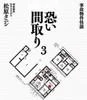
The third entry in the "Scary Floor Plans" series, a true-story report that also touches on how stigmatized properties have changed since the pandemic — a reference for our stigmatized-property articles.
Stigmatized Property Ghost Stories: Scary Floor Plans 3 (Tanishi Matsubara / Futami Shobo)
We may earn a referral fee on purchases made through these links.
The Night Side: Ghost Stories and Haunted Spots of This Town
So far we have walked Sumida’s daytime face: a temple mourning the victims of the Great Fire of Meireki, places of prayer for the Great Kanto Earthquake and the air raids, and sumo and gardens that continued despite burning many times. This ward is land where a history of rivers, fire and rebirth has piled up.
That depth leads on to the night side as well. The “Seven Wonders of Honjo,” told since the Edo period, is a collection of strange tales connected with Honjo, such as the Okiborii (the Moat Left Behind) and the Okuri-chochin (Escorting Lantern); the tales are said to swap in and out depending on the tradition, with more than eight stories in all. These are only old tales, and we do not recommend searching for specific places. In this site’s view, a ghost story is like a shadow that a place’s history and terrain cast on the human heart.
At KARASU CHANNEL, we present true ghost stories and haunted spots not so that you can visit them but so that they are recorded. Having learned the daytime scenery, please read the night-time tales as well.
Before You Go
Business hours, fees, closing days and access change easily, so they are not listed in this article. Before heading out, please check the latest information on the official website of each facility or local government. Some places may have restricted entry because of weather or disasters.
Frequently Asked Questions
Q. In what order should I tour Sumida to be efficient?
A. This article introduces places from north to south. It is easier to group them by area: the north with Mukojima-Hyakkaen and the Bokutei cherry trees, the Skytree area, and the south with the temples, shrines and memorial park of Ryogoku. Opening hours and event dates change, so check each facility’s official information.
Q. What are Sumida’s local specialties?
A. Kanto-style sakura-mochi, chanko-nabe known around Ryogoku, and the traditional craft of Edo kiriko are famous. What each shop offers changes, so check the latest information before you go.
Q. Is there anything to keep in mind when visiting places of mourning?
A. The Memorial Hall in Yokoamicho Park and Ekoin are places where prayer continues to this day. Walk quietly, take care not to disturb memorial services or worshippers, and follow on-site guidance on whether photography is allowed.
Official sites and references consulted
https://ja.wikipedia.org/wiki/墨田区
https://ja.wikipedia.org/wiki/東京スカイツリー
https://ja.wikipedia.org/wiki/向島百花園
https://ja.wikipedia.org/wiki/横網町公園
https://ja.wikipedia.org/wiki/すみだ北斎美術館
https://ja.wikipedia.org/wiki/旧安田庭園
https://ja.wikipedia.org/wiki/牛嶋神社
https://ja.wikipedia.org/wiki/回向院
https://ja.wikipedia.org/wiki/隅田公園
https://ja.wikipedia.org/wiki/両国国技館
https://ja.wikipedia.org/wiki/隅田川花火大会
https://ja.wikipedia.org/wiki/桜餅
https://ja.wikipedia.org/wiki/江戸切子
https://ja.wikipedia.org/wiki/本所七不思議

Supervised by Suzuking.
Affiliation: KARASU CHANNEL
Occult & horror reporting: 7 years (since 2020)
Followers: YouTube 5,000+ / X 25,000+
On-site investigations: 30+
Haunted locations near this town
Besides its daytime face, this land has a night side too. Read it as a record if you are curious. Some of these places are not safe or permitted to enter.
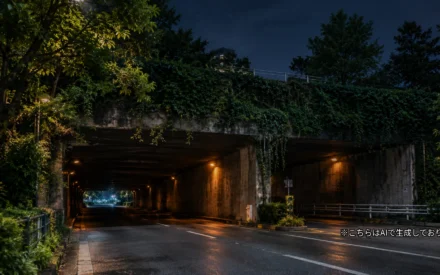
Sendagaya Tunnel (Shibuya Ward, Tokyo)
Sendagaya Tunnel in Shibuya runs under Senjuin cemetery and is still an active road. Night figures are told, but no official records exist.
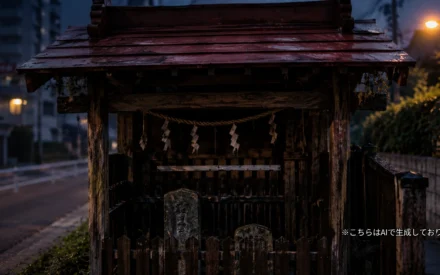
Daimon Park (Omiya Ward, Saitama City)
A park in Omiya, Saitama, tied by rumor to an Edo-era execution ground. Fireball and Chidori ghost tales persist; sources do not confirm them.