Sokushinbutsu — The Monk Who Entered the Earth Alive at 96, in a Year of Famine
Supervised by Suzuking. (KARASU CHANNEL / Occult & horror reporting, 7 years)
Contents
View sources and last-checked date
- Source
- Yudonosan Sohonji Dainichibo official website https://www.dainichibou.or.jp/sokushinbutu/
- Source 2
- Wikipedia, "Sokushinbutsu" https://ja.wikipedia.org/wiki/即身仏
- Last verified
- 2026-09-16
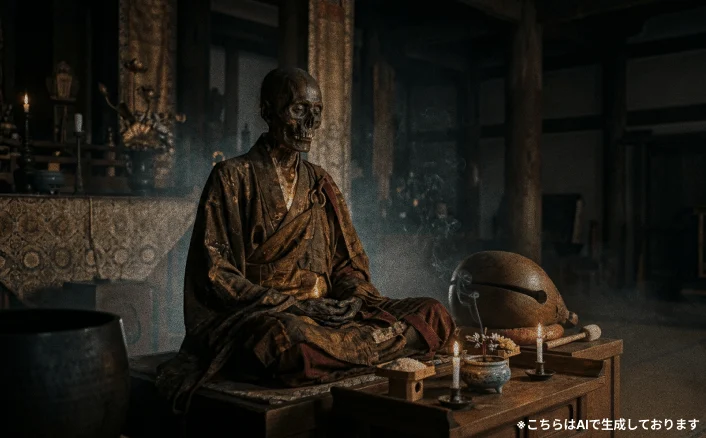
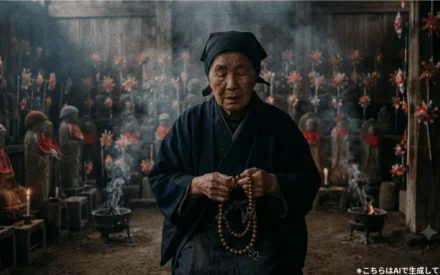
Dainichibo Temple, head temple of Mount Yudono (Yudono-san) in Tsuruoka, Yamagata Prefecture. In its main hall, the body of a monk who, during the Edo period, fasted of his own will for years and became a living mummy is still enshrined today, seated as though still in meditation. Known as a “sokushinbutsu” (self-mummified Buddha), this is, put simply, the body of a monk who chose to become a mummy — not one mummified by accident or illness. It is the product of an almost unimaginable ascetic practice: reshaping one’s own body little by little over decades, and finally passing away in the earth while chanting sutras.
Origins — A Death Chosen at 96, in a Year of Famine
The sokushinbutsu enshrined at Dainichibo belonged to a monk named Shinnyokai Shōnin. He is said to have been born in what is now the Etchūyama area of the Asahi district in Tsuruoka, and to have entered the priesthood young, undertaking severe ascetic training for more than seventy years. Then, in the third year of Tenmei (1783), at the age of 96, he carried out the final practice known as “nyūjō” — entering the earth alive and passing away while chanting sutras. That year fell in the depths of the Great Tenmei Famine, one of the worst crop failures of the Edo period, in which hundreds of thousands are said to have starved to death in the Tōhoku region alone. Shinnyokai Shōnin is said to have vowed to “transform an unequal, dog-eat-dog society into a Buddhist paradise and save its people,” and this brutal act of nyūjō is thought to have been less the capstone of a personal ascetic career than a choice made by a man who saw his own fate bound up with those suffering hunger and death around him.
Mokujikigyō — The Practice of Becoming a Mummy While Still Alive
The training undertaken to become a sokushinbutsu is called “mokujikigyō,” literally “tree-eating practice.” Over many years, it gradually brings the living body closer to a state in which it will mummify naturally. The practice begins with “gokoku-dachi,” abstaining from grains such as rice, wheat, and millet, then progresses to “jikkoku-dachi,” giving up beans and other foods as well, until the monk finally lives on nothing but nuts and tree bark. This slowly strips the body of fat and moisture, bringing it closer to a state resistant to decay after death. As a final step, he is said to have drunk tea infused with lacquer sap, preserving the body from within. At the very end, he entered a stone chamber dug into the earth — alive, with only a bamboo tube left as a breathing hole — and waited to quietly pass away while ringing a hand-bell and continuing to chant sutras. The chamber was opened roughly three years later; if the body had mummified, it was enshrined as a sokushinbutsu, an object of veneration in its own right, and if not, it was simply given an ordinary burial and memorial rites.
Ultra-lightweight (22g) safety glasses with an anti-fog, scratch-resistant coating. Unlike the cut-resistant gloves (item #132) or dust masks covered elsewhere, these protect the eyes from falling ceiling debris, flying glass, and dust inside abandoned buildings.
TRUSCO Ultra-Lightweight Safety Glasses, Clear Lens SS936
Why Sokushinbutsu Are Concentrated Around Mount Yudono
Sokushinbutsu appear scattered in records across Japan, but they survive in unusual concentration at temples connected to Mount Yudono, in the Shōnai region of Yamagata Prefecture. The reason lies in a core belief of Yudono faith: “sokushin-jōbutsu,” the idea that through sufficiently severe ascetic practice, one can attain the same enlightened state as Dainichi Nyorai (the central Buddha of esoteric teaching) in this very living body — a teaching of Shingon Esoteric Buddhism. Buddhism also holds beliefs such as that of Miroku Bosatsu (Maitreya), said to appear in the far future to save humanity; in contrast, the sokushinbutsu of Mount Yudono represent a more urgent, concrete form of faith, one aimed at saving all sentient beings (shujō) here and now, in this very body, without waiting for the future. The region was also home to many low-ranking mountain ascetics called “issei-gyōnin,” and it has been pointed out that for them, becoming a sokushinbutsu through extreme austerities was one of the few ways to earn the respect of others regardless of birth or social standing.
Natural rubber shoe covers that simply slip on over your shoes. Unlike the disposable covers mentioned elsewhere (item #71, a pack of 100 non-woven covers), these are a reusable, waterproof type with good grip — useful for keeping mud off in wet or dusty abandoned sites, or as a courtesy to staff at managed, visitable sites where outdoor shoes are not allowed.
Jefcom Waterproof Floor Shoe Cover, Size M, Gray KCW-30M-GY
A folklore-minded survey of strange legends — a reference for our legend articles.
The Folklore of Strange Legends (Morihiko Fujisawa / Kawade Shobo Shinsha)
We may earn a referral fee on purchases made through these links.
Our Take — How Should We Understand the Idea of Self-Sacrifice?
From here on, this is our own view, mixed with speculation. By modern standards, a practice of deliberate fasting unto death may look like self-harm, or even suicide itself, and we should be cautious about treating Shinnyokai Shōnin’s nyūjō as simply a heartwarming story. Still, what we find worth noting is the timing of his choice — precisely during the great famine. At a time when vast numbers of people were dying of starvation, the act of dying by taking on that same hunger himself may, in our view, have carried a kind of will toward solidarity: an attempt to escape the guilt of being the only one safe.
Today, Shinnyokai Shōnin’s sokushinbutsu continues to be carefully venerated as a “daijuku bosatsu” — a bodhisattva who takes on suffering in others’ place — with his robes ceremonially changed every six years. It is easy to be struck by the sheer strangeness of the mummified body itself, but the reason this practice has endured for nearly 270 years may lie not in fear, but in a kind of reverence: awe at how one nameless old monk, in an age when the fear of hunger and death was never far away, modeled a life of offering oneself up for others.
A Note on Visiting
Dainichibo is an active religious institution, and its sokushinbutsu is a real set of human remains, carefully enshrined today as an object of worship. Please do not visit it as a dare or a test of courage; follow the temple’s guidance on viewing fees and etiquette, and visit with respect. Whether viewing is available, and at what times, may vary by season, so confirm with the temple directly before visiting. This article is published to record this place, not to encourage going there.
This article touches on a practice of deliberate fasting unto death and on suicide, and it includes no graphic detail. If you are struggling right now, please don’t carry it alone. In Japan, the Yorisoi Hotline (0120-279-338, free, 24 hours, in Japanese) is available; if you are outside Japan, please reach out to a crisis line in your area.

A wireless lavalier mic for recording clear narration or on-site interviews during haunted-spot exploration. It clips right onto your phone, and its windscreen cuts down outdoor wind noise, making it well suited to shooting a YouTube verification video.
DJI Mic Mini Transmitter (Infinity Black), Wireless Microphone, Ultra-Lightweight, Clear Audio, Noise Cancelling, for Camera/iPhone/Android
We may earn a referral fee on purchases made through these links.
Frequently Asked Questions
Q. Can the sokushinbutsu still be viewed today?
A. Yes. It can be viewed in the main hall at Dainichibo Temple. We recommend confirming details such as the viewing fee and hours with the temple in advance.
Q. Why has the body survived as a mummy without decaying?
A. It is said to be the result of mokujikigyō stripping the body of fat and moisture to an extreme degree, preservation measures such as drinking lacquer-infused tea, and entering the earth alive to pass away there. Not every practitioner who attempted this became a sokushinbutsu — when a body failed to mummify, it is said to have received an ordinary funeral instead.
Q. Has KARASU CHANNEL filmed a report at Dainichibo?
A. No, we have not filmed there yet, though we are considering it. Other haunted-spot and kaidan field-report videos can be viewed on KARASU CHANNEL (YouTube).
Japanese horror 鴉番組

Supervised by Suzuking.
Affiliation: KARASU CHANNEL
Occult & horror reporting: 7 years (since 2020)
Followers: YouTube 5,000+ / X 25,000+
On-site investigations: 30+
Which story do you find the scariest?
If you think this story is the scariest, press the button below. One vote site-wide — you can change your vote for a different story anytime.
Was this article helpful?
Add this to your favorites to find it again anytime from your My Page.









Comments