Jofuku: The Man Who Sought Eternal Life at Hadasu
Supervised by Suzuking. (KARASU CHANNEL / Occult & horror reporting, 7 years)
Contents
View sources and last-checked date
- Source
- Records of the Grand Historian (original source, by Sima Qian)
- Source 2
- Wikipedia (Japanese), "Xu Fu" https://ja.wikipedia.org/wiki/徐福
- Source 3
- Kumano City Tourism Association, "Xu Fu's Village, Hatasu" (Japanese) https://kumano-kankou.com/?p=57
- Last verified
- 2026-09-16
Hadasu, a small fishing settlement in Kumano City, Mie Prefecture, is home to a legend about Jofuku, a traveler from China said to have been sent by Qin Shi Huang, China’s First Emperor, to find the elixir of eternal life — and who never returned home again. This isn’t just a local tale with nothing behind it: ancient Chinese coins from Jofuku’s own era have actually been unearthed here.
Origins — The Emperor’s Search for the Elixir of Eternal Life
Jofuku’s story is a relatively well-documented one, recorded in China’s Records of the Grand Historian (Shiji), the official history compiled by Sima Qian in the 1st century BCE. Qin Shi Huang, who first unified China, grew increasingly desperate for an elixir of eternal life in his later years. Jofuku, a fangshi (a scholar versed in the mystic arts and divination), told the emperor that immortals lived on an island far across the eastern sea, and that the elixir of eternal life could be found there. He set sail eastward with a great fleet, said to be carrying some three thousand young men and women, seeds of the five grains, and various craftsmen. According to the Shiji, however, Jofuku never returned with the elixir, and simply vanished.
Why Hadasu? — A Place Name and Unearthed Coins
Legends placing Jofuku’s landfall are scattered across Japan, but Hadasu in Kumano City is considered one of the strongest candidates. The place name “Hadasu” itself is said to derive from an older name, “Hatazumi,” meaning “the place where people of Qin settled.” What’s more, coins called “banryosen,” genuinely used during the Qin dynasty, have actually been excavated here. None of this alone proves that Jofuku himself came here, but it stands as one of the few pieces of physical evidence that this region had some kind of contact with mainland China from a remarkably early period.

A glow-in-the-dark spray paint that stores sunlight or fluorescent light and glows for 4–8 hours in the dark — apply it as a simple marker on a stair rail, breaker panel, or evacuation route inside a ruin to mark a meeting point or exit for your group.
Nippe Home Long-Lasting Glow-in-the-Dark Spray, Green 80ml HUQ004-80
We may earn a referral fee on purchases made through these links.
Current Conditions — The Jofuku Shrine and a Legacy of Skills
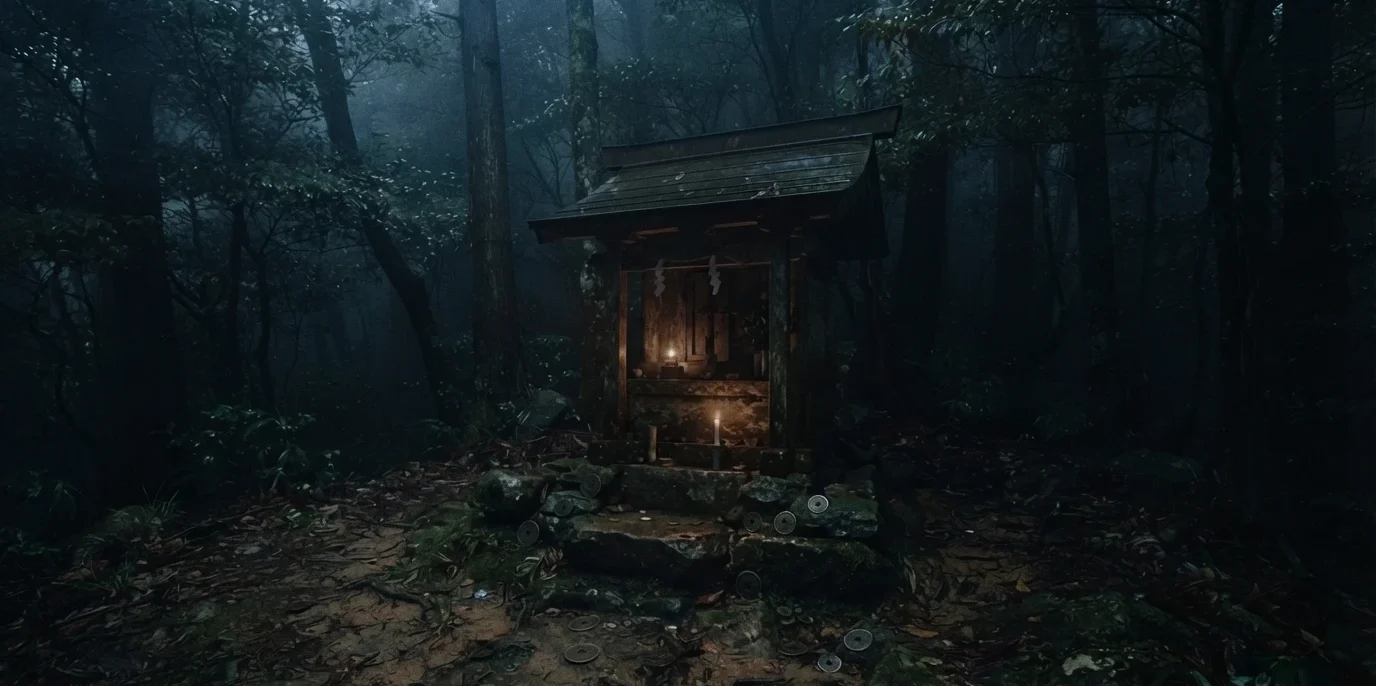
A small shrine known today as “Jofuku-no-Miya” still stands at Hadasu, carefully maintained by local residents. According to tradition, Jofuku and his group brought advanced Chinese knowledge of the time to this land — farming, fishing, papermaking, and medicine — and he has been remembered not merely as “the man who searched for eternal life,” but as someone who brought real benefit to the region. A common thread running through many Jofuku legends across Japan is that he is remembered not as a failure who couldn’t find the elixir, but as a man who settled a new land and helped its people.
Reflection — Perhaps What He Found Wasn’t “Eternal Life” but “A New Country”
Whether Jofuku really existed, and if so, whether he really came to Japan, remains an open academic question. What we find genuinely interesting, though, is why the ending — “he never brought the elixir back” — came to be told across the country not as a story of failure, but as a heroic one. This is only our speculation, but returning empty-handed before an absolute ruler like Qin Shi Huang, admitting “I could not find the elixir of eternal life,” would very likely have meant death for Jofuku. If that’s the case, his decision never to return home wasn’t an act of desperation after failing to find a cure — it may have been an entirely rational choice: never go back to a brutal dictator’s court. What Jofuku was really searching for may not have been the elixir of eternal life at all, but a genuinely “new country,” beyond the reach of the emperor’s rule, where he and the people he brought with him could live in peace. We suspect the legacy of skills still remembered at Hadasu has been passed down by locals not as a story about a man in flight, but as the story of a pioneer who opened up a new land.
This, too, is nothing more than our own imagining, but if Jofuku, in his relentless search for the elixir of eternal life, really had managed to bring back even a single success — the thought crosses our mind that he might still be living somewhere today, never aging at all. Among those who put their hands together in prayer at the Jofuku Shrine at Hadasu, we suspect some are offering not simply reverence for a heroic traveler from abroad, but an oddly uneasy prayer for someone who, unable to ever return home, wanders this land still — unable either to grow old or to die.
This is only our own speculation, but if Jofuku, having escaped the absolute power of Qin Shi Huang, was never again able to set foot in his homeland, then behind whatever peace he found at Hadasu there may have lingered an unresolved longing for home and family. A man who set out searching for eternal life, only to live and die in a foreign land, never once returning home — the irony of that ending, in our view, isn’t a story about gaining “eternal life” at all, but one about winning an “eternal parting” instead.

Rain gear for exploring a haunted spot or ruin in wet weather.
KiU Rain Poncho '2ND RAIN PONCHO', Waterproof/Water-Repellent, Rain Gear, Storage Pouch, Unisex, Japanese Brand, Khaki K405-906
We may earn a referral fee on purchases made through these links.
A Nearby Recommendation — The Kumano Kodo and Obuki Pass
Hadasu, where the elixir-seeking Jofuku is said to have landed, also lies along a stretch of the Iseji route of the World Heritage-listed Kumano Kodo, including the “Hadasu Path” and Obuki Pass. This old road, still lined with stone paving and shaded by trees, offers views of the Kumano Sea from the pass — a walking route where history and nature can be experienced together. After visiting the traces of a legend said to have drifted here from a foreign land over two thousand years ago, a short walk along the old road brings you face to face with the quiet scenery where Kumano’s mountains and sea meet.
A Note on Visiting
The Jofuku Shrine is a small shrine that local residents continue to maintain, set within a quiet residential area. Please visit with respect for the region’s history and faith rather than as a sightseeing curiosity. Visiting hours and the condition of nearby roads can change, so we recommend checking with Kumano City’s tourist information beforehand.
Frequently Asked Questions
Q. Was Jofuku a real person?
A. Because he’s recorded in China’s official history, the Shiji, it’s considered fairly likely that he existed, but it has not been academically proven that he actually traveled to Japan.
Q. What are the “banryosen” coins found at Hadasu?
A. They are coins used during the Qin dynasty. They don’t prove that Jofuku himself visited, but they’re considered one clue that this region had contact with mainland China from an early period.
Q. Has KARASU CHANNEL filmed on location at the Jofuku Shrine?
A. No, we have not filmed there yet; a visit is currently under consideration. Location footage for other haunted spots and kaidan stories can be viewed on KARASU CHANNEL (YouTube).

Supervised by Suzuking.
Affiliation: KARASU CHANNEL
Occult & horror reporting: 7 years (since 2020)
Followers: YouTube 5,000+ / X 25,000+
On-site investigations: 30+
Which story do you find the scariest?
If you think this story is the scariest, press the button below. One vote site-wide — you can change your vote for a different story anytime.
Was this article helpful?
Add this to your favorites to find it again anytime from your My Page.


Comments