What Are Lucky Directions? 1,300 Years of Fortune

Supervised by Ms.M
Affiliation: KARASU CHANNEL
Traditions studied: 12+ (Western astrology, Four Pillars of Destiny, Nine Star Ki, tarot, runes, palmistry & physiognomy, name numerology, numerology, feng shui, Vedic astrology / Zi Wei, Onmyodo, spiritual reading, and more)
Personal readings: by request via Contact,
currently booked years out
Contents
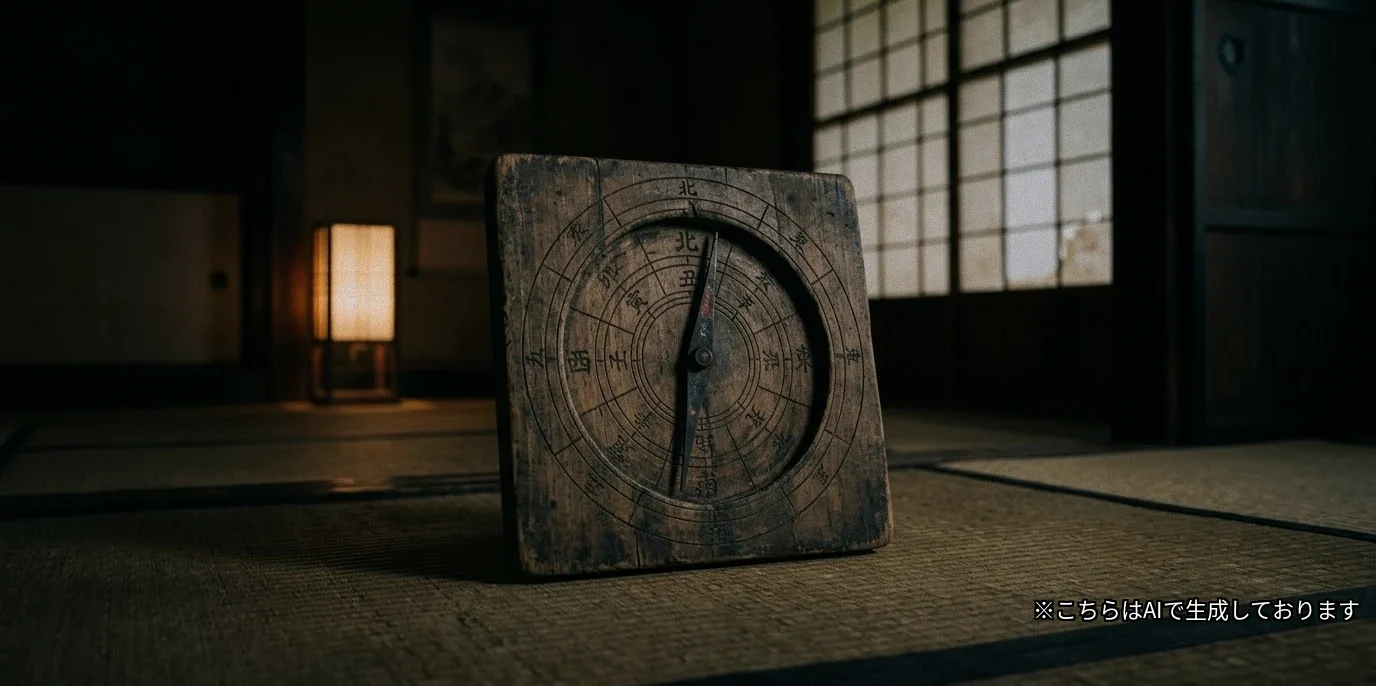
Before a move, someone told you “you’d better avoid the northeast.” When choosing a trip, you vaguely thought “let’s avoid the south this year.” Have you had such an experience? A divination that holds that your fortune changes with the direction you head in is what we call here direction fortune, or lucky-direction fortune-telling.
This idea was not born from a whim. Beginning with the battle tactics of ancient China, passing through the strange and earnest custom of the Heian aristocracy called “katatagae” (changing direction), it has soaked into Japanese life for over a thousand years, reaching house-building in the Edo period and Nine Star Ki in the modern age. Some of you may know that one corner of the northeast of the Kyoto Imperial Palace is oddly indented. That too is one of the devices of people who feared directions.
In our free “Direction Fortune (simple Nine Star Ki),” from your honmei star (the star decided by your birth year), your compatible directions, the directions to be careful about, and this year’s (Risshun-based) Goo-satsu and Anken-satsu are shown. A run of unfamiliar words appears, but in this article, each time a term appears I rephrase it with “Put simply” and unpack it one at a time. If it feels hard, it is fine to read only those quote boxes.
Key Points (a 3-Minute Summary)
- Direction fortune is the general name for divinations that look at good and bad by direction. In Japan, several streams overlap: Nine Star Ki, Qimen Dunjia, the direction gods of Onmyodo, house physiognomy (kaso), and more.
- Its origins lie in the yin-yang and five elements of ancient China and in Qimen Dunjia, spoken of as a battle-tactics art. Books of astronomy and dunjia reached Japan around the Asuka period, and in the Heian period the “katatagae” of Onmyodo governed the lives of aristocrats.
- Nine Star Ki is a divination that reads lucky and unlucky directions from your birth-year “honmei star” and the positions of the stars that travel around each year and month. Its present form is said to have been compiled by Sonoda Shinjiro and others from the end of the Meiji through the Taisho period (dates differ by source).
- The directions especially feared are “Goo-satsu” and its exact opposite, “Anken-satsu.” These are said to be unlucky directions common to everyone that year, regardless of honmei star. In 2026 (from Risshun until just before Risshun of 2027) Goo-satsu is south and Anken-satsu is north. Our site too switches the year at Risshun, as with the honmei star.
- Our result screen is a simplified version that finds directions from the compatibility with the five element of your honmei star. It shows Goo-satsu and Anken-satsu based on the yearly chart, but it does not include monthly or daily charts, honmei-satsu, saiha and so on, so please do not use it as the basis for a major decision.
- No scientific research has confirmed that directions have the power to change fortune. We recommend enjoying it lightly as a culture with a long history, and as a nudge (or a moment to stop) when you are undecided.
What Is Direction Fortune? Reading Fortune by “Which Way You Head”
Direction fortune assigns good and bad and a character to each of the eight directions, north, south, east and west and those between, and reads “when, and who, may head which way well (or badly).” Whereas an ordinary divination speaks of “what kind of person you are,” direction fortune speaks of “which way you should move.” It can be called a slightly unusual divination that looks not at the person but at the direction of movement.
What matters is the “starting point” from which directions are viewed. It is not that the world has absolute lucky directions; in many schools, you take “where you are now,” such as your home, as the center and see which direction the destination lies in. For example, even the same Kyoto is west when seen from Tokyo and northeast when seen from Osaka: change the starting point and the direction changes.
Put simply, direction fortune is “a divination that puts good and bad on the direction of a destination, centered on where you are.” It is not a story of which place on the map is auspicious, but the point is “which way it lies as seen from here.”
The techniques of reading directions in Japan can be divided broadly into the following streams. In reality they are mixed and cannot be neatly separated, but keeping them in mind as a guide makes it easier not to get lost when reading books and fortune sites.
- Nine Star Ki: reads good and bad from the nine star of your birth year and the arrangement of stars that travel around by year, month and day. It is currently the best-known direction art in Japan.
- Qimen Dunjia (kimon tonko): a direction art said to derive from the battle tactics of ancient China. A chart is made for each hour, and lucky directions are chosen from the arrangement of the eight “gates” and so on.
- The direction gods of Onmyodo: the idea of avoiding where gods who travel around the directions, such as Tenichijin, Daishogun and Konjin, are. The background of the Heian “katatagae.”
- House physiognomy (kaso) and feng shui: ways of judging a house’s layout and the positions of the entrance and water areas by the good and bad of directions.
Our site’s direction fortune is a very simple version of the Nine Star Ki way of thinking. A full Nine Star Ki reading is a complex system that overlays, in addition to the honmei star, charts (arrangement diagrams of stars) for each year, month and day. As an entrance to that, our site takes out only the compatibility between the five element of the honmei star and the directions.
The Origins of Direction Fortune: From the Luoshu Magic Square to the Katatagae of the Heian Aristocracy
The Foundation of Everything Is the 3×3 Magic Square Called the “Luoshu”
At the base of Nine Star Ki is a magic square called the Luoshu (Rakusho), in which the numbers 1 through 9 are arranged in 3×3 squares. It is arranged so that any three in a row, column or diagonal add up to 15. In the legend, when Yu, a king of Chinese legend, was working on flood control, the pattern on the shell of a mysterious turtle that appeared from the Luo River was the origin of this arrangement.
These nine numbers were later applied to the eight directions of the compass and the center, and came to be called the “Nine Palaces” (kyuugu). In books, the Han-dynasty apocryphal text “Yi Wei Qian Zao Du” and the “method of the Nine Palaces of Taiyi” in its commentary are said to be the origin of the Luoshu arrangement. That is, the “nine stars” of Nine Star Ki are, at root, a magic square of ancient numbers overlaid with directions and the five elements.
Put simply, the “nine stars” of Nine Star Ki are a special magic square of the numbers 1 to 9 (the Luoshu) with directions and the natures of wood, fire, earth, metal and water stuck onto it. Picture a number puzzle that, before anyone noticed, became a map of directions.
Qimen Dunjia: An Art of Direction and Time Honed on the Battlefield
Another old stream of techniques for reading directions is Qimen Dunjia. In legend, it is an art granted from heaven while the Yellow Emperor was fighting his enemy Chiyou. It is said that later Lu Shang of the Zhou (the so-called Taigong Wang) and Zhang Liang of the Former Han put the method of making the chart in order. The story that Zhuge Liang of the Three Kingdoms used it is also famous, but some sources handle it cautiously, saying it is closer to a tale than to a history book.
In Qimen Dunjia, a divination board (shikiban) on which the heavenly and earthly stems, the eight “gates” (opening gate, rest gate, life gate and so on), nine stars and eight gods are arranged is made for each hour. The eight gates are the most emphasized in judging good and bad. The “stars” here are not stars of the night sky but are like symbols placed on the board.
Its connection with Japan is old. The Nihon Shoki records that in the tenth year of Empress Suiko (602), the Baekje monk Kanroku brought books of dunjia alongside books of the calendar and of astronomy. It is also well known that the Nihon Shoki says of Emperor Tenmu that he “was skilled in astronomy and dunjia,” and that during the Jinshin War he himself took the shiki (the divination board) and divined the outlook. It is sometimes explained that it was later forbidden under the Yoro Code, but in the Sengoku period, it is explained, battlefield strategists called “gunbaisha” used a Qimen Dunjia reworked to suit Japan’s climate.
Put simply, Qimen Dunjia is an art honed by people who earnestly sought, on the battlefield, “when and which way to move to have the advantage.” Direction fortune was originally not “trying your luck” but “information for winning.”
Onmyodo of the Heian Period: To Avoid the Gods of Directions
Onmyodo is a technique that, based on the thought of yin-yang and the five elements, uses knowledge of astronomy and the calendar to divine the good and bad of dates, directions and human affairs. It came to Japan around the 5th to 6th centuries via the continent and the Korean Peninsula, and is said to have been carried at first by priests. In the latter half of the 7th century, lay onmyoji serving the court appeared, and under the ritsuryo system a government office called the “Onmyoryo” came to manage three divisions: divination (Onmyodo), astronomy and the calendar. From the 10th century on, it is explained, the Abe family of astronomy and the Kamo family of the calendar shared the specialties as the two head families.
The aristocrats of the Heian period earnestly cared about where the gods tied to directions were. Tenichijin, Taihakujin, Daishogun, Konjin, Oso, and so on. The positions of these gods changed by season, and if you headed in their direction or did construction in that direction, bad things were said to happen.
Put simply, for Heian aristocrats the direction gods were like “a weather forecast saying today there is someone to watch out for in this direction.” And it was a very practical forecast that had to be checked every time you went out.
Katatagae: How Do You Go in a Forbidden Direction?
So what do you do if the place you absolutely must go falls in the “bad direction” of that day? The device that arose was katatagae (changing direction). If the destination lies in a tabooed direction, you first move in a different direction, stay one night, and the next day head for the destination from there. By this reasoning, you have not “headed directly in the bad direction.”
For example, on a day when going home to the west is forbidden, you stay at an acquaintance’s house in the southwest, and the next morning return home from the northwest direction, so you avoid heading west. That not only a prohibition but even a workaround of detour is prepared is the fun of katatagae.
This custom also appears in literature. In the “Hahakigi” chapter of The Tale of Genji, Hikaru Genji stays at the residence of the Governor of Kii for katatagae and there meets Utsusemi. The rules of directions become the trigger that moves a love story.
Furthermore, a “shortcut” to reduce the troublesome katatagae was also devised. The idea is that if you decide a place other than your home to be a “temporary home” and consider directions with that as the reference, the number of katatagae can be reduced. There was also the way of spending a night at a temple and positioning it as your “home,” and as a result, it is explained that in the late Heian period temples used for such purposes were built and expanded one after another.
Put simply, katatagae is “a very dutiful detour art, for reaching your destination while keeping the promise of not heading directly in a bad direction.” It was Heian-period wisdom in which a prohibition and a way around were a set.
Kimon and Ura-kimon: Why the “Northeast” of the Capital Was Feared
Among directions, the one especially famous in Japan is kimon (the demon gate). Kimon is the northeast direction, and its exact opposite, the southwest, is ura-kimon. When directions are expressed by the twelve branches, the northeast lies “between Ushi (ox) and Tora (tiger),” so it is also called “ushitora.” It is sometimes said that demons are drawn with ox horns and wearing a tiger-skin loincloth because of the name of this direction (one of the folk explanations, and whether it can be called an established theory needs careful consideration).
The basis of the idea of kimon is in ancient Chinese books. The “Shanhaijing” records that in the sea there is a mountain called Dushuoshan with a great peach tree, and that the northeast direction between its branches is the gate through which all demons go in and out. The word “kimon” also appears in “Lunheng,” written by Wang Chong of the Later Han, and this is regarded as one of the oldest recorded examples.
In Japan, this thought reached even the design of cities. In Heian-kyo, it is explained, Enryaku-ji on Mount Hiei was placed in the kimon direction as seen from the Daidairi (the imperial palace), and Iwashimizu Hachimangu in the ura-kimon direction. In Edo too, Kan’ei-ji in Ueno (Toeizan) was placed in the direction of the kimon as seen from Edo Castle, and Zojo-ji (Sanenzan) in the direction of the ura-kimon. It is the idea of protecting the “dangerous corner” of the capital with the power of temples and shrines.
There were also devices not to “guard” the kimon but to “eliminate” it. At the northeast corner of the Kyoto Imperial Palace, the earthen wall is indented inward only at that part, and a wooden monkey is enshrined under the eaves. This place is called “Sarugatsuji.” The idea is to make the very “corner” of the northeast missing so that there is no place for demons to get in. (It is also sometimes explained that “saru” (monkey) sounds like “the demons leave.”)
On the other hand, in warrior castles there was also the completely opposite idea. It is explained that at many castles, such as Azuchi, Fukuchiyama, Okayama and Himeji, it was standard practice to deliberately put a privy (kawaya) in the kimon direction. Not fearing and avoiding the kimon but deliberately sitting on top of it is seen as an expression of a warlord’s resolve.
Put simply, the kimon is “the northeast entrance through which bad things come in.” In Japan there were various ways of facing it: protecting it by placing temples and shrines there, removing the entrance by indenting the corner, or pressing it down by deliberately placing a privy.
The Edo House-Physiognomy Boom: An Age When Floor Plans Were Divined
The thinking of Heian-period Onmyodo eventually extended to house-building. In books of the early Kamakura period there are statements to the effect that the hearth, gate, well and privy are the gods of the house, and the idea of scrutinizing the positions of these is said to have become one of the starting points of house physiognomy. House physiognomy has aspects similar to Chinese feng shui, but it is explained that in Japan it developed uniquely within a religious view of Shinto-Buddhist syncretism.
House physiognomy became something of the masses in the Edo period. From the Tenmei to the Kansei years, house-physiognomy books aimed at ordinary people increased sharply, and reached their peak around the Kyowa, Bunka and Bunsei years. In architectural history research, it is said that more than 100 house-physiognomy books can be confirmed, counting only those whose year of publication can be identified. In Edo-period house physiognomy, it is explained, there was even a method of assigning wood, fire, earth, metal and water to the number of tatami mats as well and judging by mutual production and mutual overcoming.
It is also known that Arai Hakuseki, a scholar of the mid-Edo period, wrote a book discussing the kimon (the way the title is given differs by source). Directions and house physiognomy were not only the superstitions of ordinary people but subjects earnestly discussed by the intellectuals of the time.
The Birth of Nine Star Ki: Japan from the End of Meiji to Taisho
Receiving the flow so far, Nine Star Ki came together in its present form. Based on an old direction art called Kyusei-jutsu (nine star art), what Sonoda Shinjiro (1876-1961) compiled as “Kigaku” is regarded as the starting point of today’s Nine Star Ki. The time of compilation differs by source, with one explanation saying Meiji 42 (1909) and another Taisho 13 (1924). In any case, it was an event from the end of Meiji into Taisho, and it is explained that from then on Kigaku spread among the public in Japan.
The greatest feature is that Nine Star Ki made the nine stars derived from the Luoshu correspond to nine “birth years of people.” Because a “honmei star” is decided for each birth year, the good and bad of directions became readable as your own. The direction gods of the Heian aristocracy embodied the idea that “the same direction is bad for everyone,” but Nine Star Ki added a personal way of reading: “the direction that is good for your star.”
Put simply, Nine Star Ki is “a divination that gave the nine numbers of the Luoshu to you as the star of your birth year, so that the good and bad of directions can be read for you.” To the Heian aristocrats’ “weather forecast common to everyone” was added “a weather forecast just for you.”
Nine Star Ki Basics, Part 1: The Nine Stars, Directions and the Five Elements
The nine stars are the following nine, from One White Water Star to Nine Purple Fire Star. Each has a five element and a basic position called the “kouten teii ban” (later-heaven fixed chart). The later-heaven fixed chart is the standard arrangement diagram, where the nine stars are normally placed.
- One White Water Star (Ippaku Suisei): five element water. Basic position: north.
- Two Black Earth Star (Jikoku Dosei): five element earth. Basic position: southwest.
- Three Jade Wood Star (Sanpeki Mokusei): five element wood. Basic position: east.
- Four Green Wood Star (Shiroku Mokusei): five element wood. Basic position: southeast.
- Five Yellow Earth Star (Goo Dosei): five element earth. Basic position: center. A special star that belongs to no direction.
- Six White Metal Star (Roppaku Kinsei): five element metal. Basic position: northwest.
- Seven Red Metal Star (Shichiseki Kinsei): five element metal. Basic position: west.
- Eight White Earth Star (Happaku Dosei): five element earth. Basic position: northeast.
- Nine Purple Fire Star (Kyushi Kasei): five element fire. Basic position: south.
The five elements are the five natures of wood, fire, earth, metal and water. It is an idea shared with Four Pillars and others: there is a “mutual production” (soshoo) relationship in which wood produces fire, fire produces earth, earth produces metal, metal produces water and water produces wood, and a “mutual overcoming” (sokoku) relationship in which wood restrains earth, earth restrains water, water restrains fire, fire restrains metal and metal restrains wood. In direction fortune, you compare the five element of your star with the five element of the star of a direction and judge compatibility.
Put simply, the nine stars are “9 types of personality,” each normally sitting in a set direction. The five elements are a compatibility chart for seeing whether they “cheer each other on (mutual production)” or “put the brakes on each other (mutual overcoming).”
Nine Star Ki Basics, Part 2: The Honmei Star Switches at “Risshun”
The honmei star is decided from the birth year. In our site’s calculation, you add up each digit of the birth year in the Gregorian calendar to a single digit, subtract that number from 11 (adding 9 if it is zero or less), and that gives it. For example, for 1990: 1+9+9+0=19, then 1+9=10, then 1+0=1. 11-1=10, and subtracting 9 gives 1, that is, the One White Water Star.
What to note here is that, as in Four Pillars, the year changes not on January 1 but at “Risshun” (the start of spring). Risshun is around February 4. Therefore people born from January 1 to around February 3 take the star of the previous year. Our tool finds the honmei star, and the yearly chart for Goo-satsu and Anken-satsu that appear later, on this Risshun basis.
Put simply, the “year” of Nine Star Ki starts at Risshun. Not at New Year, but on the day spring begins on the calendar. That is why people born in January or early February use the star of the previous year.
Nine Star Ki Basics, Part 3: The “Moving Stars” and the Yearly, Monthly and Daily Charts
The later-heaven fixed chart is the standard arrangement diagram. But in an actual reading, the star that enters the “center” of this chart is swapped by year, by month and by day, and as it moves, all the other stars shift their positions too. The arrangement diagram for each year is called the yearly chart (nenban), for each month the monthly chart (getsuban), and for each day the daily chart (nichiban).
For example, 2026 is a year in which the One White Water Star enters the center. The following year, 2027, is the Nine Purple Fire Star, and 2028 the Eight White Earth Star: the number of the center star goes down by one each year. When the stars move, the direction where the Five Yellow Earth Star sits also moves, and this becomes the change in the position of the “Goo-satsu” described later.
The switch of this yearly chart is also at Risshun, the same as the honmei star. For example, the chart of 2026 continues from the Risshun of 2026 until the day before Risshun of 2027. The chart does not change at New Year (January 1).
In a full Nine Star Ki reading, you combine this yearly, monthly and daily chart with which direction your honmei star has moved to and what relationship the star that has moved to that direction has to you, and decide the lucky directions. Our simplified version takes out of the yearly chart only “which direction the Five Yellow Earth Star moves to” and shows it as Goo-satsu and Anken-satsu, and finds lucky directions themselves using only the basic five element of the honmei star.
Put simply, the yearly, monthly and daily charts are maps rebuilt by rotating the standard arrangement diagram (the later-heaven fixed chart) for “this year,” “this month” and “today.” Because the stars move house, both good and bad directions change every year.
Nine Star Ki Basics, Part 4: Unlucky Directions to Avoid, Such as Goo-satsu and Anken-satsu
In Nine Star Ki, the following are cited as directions to be especially avoided (how they are organized differs slightly by school).
- Goo-satsu: the direction to which the Five Yellow Earth Star has moved that year. The Five Yellow Earth Star is a star said to hold strong power even among the nine stars, and its direction is regarded as one of the most avoided.
- Anken-satsu: the direction exactly opposite Goo-satsu. In years when the Five Yellow Earth Star enters the center, these two do not arise.
- Honmei-satsu: the direction to which your own honmei star has moved that year.
- Honmei-tekisatsu: the direction opposite honmei-satsu.
- Saiha: the direction opposite the twelve-branch of that year.
- Geppa: the direction opposite the twelve-branch of that month.
Among these, Goo-satsu and Anken-satsu are characterized as “unlucky directions common to everyone that year, regardless of honmei star.” Honmei-satsu and honmei-tekisatsu are things you can know only once your honmei star is decided. On our site’s result screen, only Goo-satsu and Anken-satsu are shown.
Put simply, Goo-satsu is “the direction where the strongest star sits this year,” and Anken-satsu is its “exact opposite.” It is not something that varies by person, but the kind of information that appears on calendars every year as “this year’s direction to watch, common to everyone.”
Nine Star Ki Basics, Part 5: “Yuki-dori,” Going to Lucky Directions
The practice of trying to receive the power of lucky directions is a custom called yuki-dori, or kippo-dori, or lucky-direction travel. The idea is that by going to a place that is a lucky direction as seen from your home and spending time or staying there, you receive the good ki of that direction.
What people wonder is “how far away and for how long must you stay for it to work,” but this differs quite a lot by school and commentator. For example, when using the yearly chart, some explanations take a period of two years or more and a move of 500 km or more as the guide, while others say three nights or more and 500 km or more. It is generally used differently by type of chart: 200 to 500 km for the monthly chart, and day trips within 200 km for the daily chart. As for when effects appear, it is sometimes told in intervals of “4, 7, 10, 13.” These are told as traditional interpretations and have not been confirmed empirically.
As for moving house, a use known is to choose so that the direction of the new home is a lucky direction. It recalls the “temporary home” shortcut of the old katatagae, but in actual life it is natural for real conditions such as commuting to work or school, rent and family circumstances to take priority.
Put simply, yuki-dori is a practice like “going on a slightly distant trip to a hot spring or shrine in a good direction, staying, and bringing back good ki.” However, the standards for distance and days differ by school, so it is not an absolute rule.

For checking an upper floor, a high spot, or the outside of a distant building at a ruin from a safe distance.
Vixen Binoculars 8x, 8x21, White, Compact & Lightweight 79491
We may earn a referral fee on purchases made through these links.
A Worked Example: Reading Ms. A’s Directions
Now that terms have lined up, let us look at a concrete example. Here we use a fictional “Ms. A” and explain with results actually calculated with our tool. Ms. A is set as born on January 1, 2000 (not a real person).
Ms. A was born on January 1, so before Risshun (around February 4, 2000). Therefore her honmei star is not that of 2000 but that of the previous year, 1999. Adding the digits of 1999 gives 1+9+9+9=28, then 2+8=10, then 1+0=1. 11-1=10, subtracting 9 gives 1, that is, the One White Water Star. Even among people born in 2000, those born by February 3 are the One White Water Star and those born from February 4 on are the Nine Purple Fire Star: the star splits here.
The five element of the One White Water Star is water. In our site’s direction fortune, directions are found as follows.
- Compatible directions: the direction of a star of the same water (One White Water Star = north), and the directions of stars of wood, which water produces (Three Jade Wood Star = east, Four Green Wood Star = southeast). That is, north, east and southeast.
- Directions to be careful about: the direction of a star of fire, which water restrains (Nine Purple Fire Star = south). That is, south.
Furthermore, from Risshun of 2026 until just before Risshun of 2027, Goo-satsu is shown as south and Anken-satsu as north. This is because 2026 is a year when the One White Water Star enters the center, and the Five Yellow Earth Star moves to the south position where the Nine Purple Fire Star sits in the standard arrangement diagram.
Note that even in the same 2026, if you open the tool from January 1 to before Risshun (until February 3), what is shown is the chart of the previous year (2025), with Goo-satsu at northeast and Anken-satsu at southwest. This is the case if you look on, for example, January 15, 2026. From here on, I proceed with the reading of Ms. A using the result seen after Risshun (from February 4, 2026).
Something interesting happens here. For Ms. A, south is both a “direction to be careful about” and also the Goo-satsu direction of 2026. That is, south is a direction to be doubly careful about. North, on the other hand, is in the “compatible directions” because it is the direction of a water star, but in 2026 it is Anken-satsu. It is a mismatch: compatible, yet also this year’s unlucky direction.
Our tool deliberately does not combine this mismatch into one answer, and shows the two side by side as they are. In our view, in such a case, rather than deciding “it’s a compatible direction, so it’s fine,” a gentle way of taking it, one that is realistic, is to bear in mind that this year it is the Anken-satsu direction, not choose it as the direction for a major decision (such as a move), and keep it to the level of everyday outings. This is our way of thinking and not an established theory of any school.
The remaining east and southeast are compatible and do not coincide with this year’s Goo-satsu or Anken-satsu. For Ms. A, the directions easy to choose in 2026 as “destinations for a change of mood” are east or southeast.
Put simply, Ms. A’s result is “north: compatible, but a caution this year,” “south: a caution both for compatibility and for this year,” and “east and southeast: compatible, and no problem this year either.” A result is read not in black and white but by how things overlap.
How to Read Our Site’s “Direction Fortune (Simple Nine Star Ki)”
I connect what we have covered to the items on the result screen. When you enter your date of birth, the following three are shown.
- Compatible directions: the directions of stars of the same five element as your honmei star, and of the five element that it produces.
- Directions to be careful about: the directions of stars of the five element that your honmei star’s five element restrains.
- Goo-satsu and Anken-satsu: the year of the chart is shown in the heading, like “Goo-satsu and Anken-satsu of 2026 (Risshun basis),” followed by the directions of “Goo-satsu (2026 chart)” and “Anken-satsu (2026 chart).” They are unlucky directions common to everyone that year, regardless of honmei star. Which year’s chart is used is decided by the date on which you open the tool. From January 1 until before Risshun the previous year’s chart is displayed, with a note to that effect. In years when the Five Yellow Earth Star enters the center (such as 2031), it is shown as a special year in which no direction arises.
To find directions, we use the later-heaven fixed chart (One White = north, Two Black = southwest, Three Jade = east, Four Green = southeast, Six White = northwest, Seven Red = west, Eight White = northeast, Nine Purple = south), and the Five Yellow Earth Star, being at the center with no direction, is excluded. Calculating the nine honmei stars by this method gives the following results.
- One White Water Star: compatible directions are north, east and southeast; direction to be careful about is south.
- Two Black Earth Star, Five Yellow Earth Star and Eight White Earth Star (earth stars): compatible directions are southwest, northwest, west and northeast; direction to be careful about is north.
- Three Jade Wood Star and Four Green Wood Star (wood stars): compatible directions are east, southeast and south; directions to be careful about are southwest and northeast.
- Six White Metal Star and Seven Red Metal Star (metal stars): compatible directions are north, northwest and west; directions to be careful about are east and southeast.
- Nine Purple Fire Star: compatible directions are southwest, northeast and south; directions to be careful about are northwest and west.
As the list shows, in this simplified version stars of the same five element give the same result. The nine stars in effect divide into only five patterns. This is a feature of the simplified version that uses only the five element of the honmei star, and differs greatly from a full Nine Star Ki, which makes finer judgments that differ from person to person by overlaying the yearly and monthly charts.
The switch of Goo-satsu and Anken-satsu is at Risshun, the same as the honmei star. For example, looking on January 15, 2026 gives the chart of 2025 (Goo-satsu northeast, Anken-satsu southwest), from February 4, 2026 on gives the chart of 2026 (Goo-satsu south, Anken-satsu north), and January 10, 2027 is still the chart of 2026. The switch is by date, and the new chart begins at 0:00 on the day of Risshun. Because the actual Risshun arrives at some point in the day, around February 3 to 5 depending on the year, for people born on the day of Risshun, or if you open the tool that day, it may be one day off from a calendar that looks at the time.
Our site’s result is a simplified version. It does not include the yearly, monthly and daily charts, honmei-satsu and honmei-tekisatsu, or saiha and geppa. Please take the result as one of many ways of reading, and use it as a playful hint when choosing a travel destination or the direction of a stroll.
Goo-satsu and Anken-satsu from 2026 to 2031 (Risshun basis, calculated with our tool)
- 2026 (One White Water Star at center): Goo-satsu is south, Anken-satsu is north.
- 2027 (Nine Purple Fire Star at center): Goo-satsu is north, Anken-satsu is south.
- 2028 (Eight White Earth Star at center): Goo-satsu is southwest, Anken-satsu is northeast.
- 2029 (Seven Red Metal Star at center): Goo-satsu is east, Anken-satsu is west.
- 2030 (Six White Metal Star at center): Goo-satsu is southeast, Anken-satsu is northwest.
- 2031 (Five Yellow Earth Star at center): no direction for either Goo-satsu or Anken-satsu.
Lining up several years, you can see Goo-satsu going around: south, north, southwest, east, southeast. It is easy to picture it as the Five Yellow Earth Star “passing through” a different direction each year on the standard arrangement diagram. Think of the direction to avoid moving one place every year. The chart of each year is used from Risshun of that year until just before Risshun of the next year. The chart of 2031 (no direction) continues from January 2032 until just before Risshun.
Put simply, Goo-satsu is “a star of concern that goes around, changing its address every year.” South this year, north next year: the direction changes in quick succession.
Direction Fortune Quick Glossary
Here are the terms from the article, each in a phrase. Use it as a dictionary when you are unsure.
- Honmei star: your nine star, decided from your birth year (Risshun basis).
- Nine stars: the nine stars from One White Water Star to Nine Purple Fire Star. Based on the numbers 1 to 9 of the Luoshu.
- Five elements (gogyo): the five natures of wood, fire, earth, metal and water.
- Mutual production and mutual overcoming: the “relationship of giving life” and the “relationship of restraining” among the five elements.
- Later-heaven fixed chart (kouten teii ban): the standard arrangement diagram of the nine stars.
- Yearly chart, monthly chart, daily chart: arrangement diagrams made by moving the stars for each year, month and day.
- Goo-satsu: the direction to which the Five Yellow Earth Star has moved that year. One of the most avoided directions.
- Anken-satsu: the direction exactly opposite Goo-satsu.
- Honmei-satsu and honmei-tekisatsu: the direction to which your own honmei star has moved, and the direction opposite it.
- Saiha and geppa: the direction opposite the twelve-branch of that year (month).
- Yuki-dori: a practice of going to a lucky direction to receive its good ki. Also called lucky-direction travel or kippo-dori.
- Kimon and ura-kimon: the northeast and its exact opposite, the southwest.
- Katatagae: a Heian-period custom of staying one night in another direction to change direction when heading for a tabooed one.
- Direction gods (houijin): gods said to move around the directions, such as Tenichijin, Daishogun and Konjin.
- Qimen Dunjia: a direction art said to derive from the battle tactics of ancient China.
- Luoshu (Rakusho): a magic square with the numbers 1 to 9 arranged in 3×3. The foundation of the nine stars.
- House physiognomy (kaso): a way of judging a house’s layout and the positions of its fixtures by the good and bad of directions.
- Risshun: the marker at which the honmei star and the yearly chart (Goo-satsu and Anken-satsu) switch. Around February 4.
How Lucky Directions Are Used Today
In present-day Japan too, not a few people care about directions. When moving, buying a house or building a new one, many people worry about the kimon and the position of water areas, and the custom of holding a groundbreaking ceremony (jichinsai) before construction also continues widely as respect for the land and a prayer for safety. Some also use lucky directions as a reference for travel destinations and for the opening date and location of a shop.
On the other hand, in modern life there are many conditions to prioritize beyond directions: commuting to work or school, family circumstances, budget, disaster risk and so on. For many people, direction is probably used less as “grounds for deciding” than as “a final nudge when undecided” or “a marker to close a matter in the heart.”
Note that at present we find no established research showing, statistically or scientifically, that directions change fortune. This site introduces this divination only as a culture with a long history and as a hint that adds a little playfulness to daily life.
Five Tips for Enjoying Direction Fortune
- Read as “tendency,” not “great luck or great misfortune”: “directions to be careful about” does not mean directions you must not go. Please take it only as a direction our site’s simple rule shows as “slightly less compatible in the five elements.”
- Do not decide big matters by direction alone: for major life decisions such as moving, changing jobs, school choice and buying real estate, give priority to realistic conditions other than direction, and decide after consulting specialists or people you trust.
- Try it in small everyday choices: bringing lucky directions into casual choices such as a holiday stroll, a drive or a day-trip destination is a comfortable way to enjoy it.
- Just “know” this year’s Goo-satsu and Anken-satsu: knowing them and lightly thinking “let’s avoid this direction this year” at the moment of a decision is about the right distance.
- Do not panic if results differ: lucky directions differ by site or fortune-teller because the school and the chart used (yearly, monthly, daily) differ. Comparing several is also one way to enjoy it.
Reflection: Why Have People Entrusted Their Fortune to “Which Way to Head”?
From here, rather than summarizing history and mechanism, I look at direction fortune in our own way. I should say in advance that what follows is our own speculation and hypothesis, not established theory.
Was Katatagae an Invention That Turned Anxiety into an “Institution”?
This is our speculation, but what is really interesting about katatagae is not the feeling of fearing directions itself but that it turned that fear into a “procedure.” There are directions you must not go. But there are also errands you must go on. At that time the Heian aristocrats did not make it a choice between “not going” and “going,” but created a third way: “stay one night, change direction, then go.”
Moreover, they even devised the shortcut of a “temporary home” to reduce the trouble, and as a result temples are said to have been set up as bases for katatagae. Though fear could not be wholly eliminated, the whole of society had worked out a way to keep daily life running while coexisting with fear.
In our view, whether a divination survives long may depend less on “does it hit” than on “does it turn anxiety into a form that can be put into action.” Katatagae seems to be one of its most refined examples. A divination that only stirs up anxiety stops people. A divination that adds a “way of doing” to the anxiety moves people.
Those Who Feared the Kimon, and the Warriors Who Sat on It
In how the kimon was faced, even for the same northeast direction there were large differences. In the court-noble society of Kyoto, they indented the corner of the palace and placed a monkey statue to erase the gap where demons might enter. There were also cities that strengthened their defense by placing temples and shrines. Yet at warrior castles, it is explained, there were many cases in which a privy was deliberately put in that kimon.
This is speculation, but might this difference have been less a difference in how much they believed in directions themselves than a difference in “how to live with anxiety”? For a warrior with unavoidable danger always around him, “putting on a straight face while stepping on the demon” may have mattered more as resolve than “avoiding the demon.” People who turn their backs on fear, and people who stand on top of fear and show it. The same kimon was showing entirely different faces.
This structure holds for us today too. Some people, hearing “a northeast entrance is not good,” worry and change the floor plan, and others decide “I don’t mind” and live there with confidence. It is not a matter of which is right; what attitude you take toward that direction expresses how that person lives.
Why Did Directions Revive in an Age When People Could Travel Far?
Nine Star Ki was put together in its present form from the end of Meiji into Taisho (dates differ by source). This is our speculation, but might the background of direction art spreading in a new form at that time have been the development of transport such as railways and the sudden widening of people’s range of movement?
Until the Edo period, for most people moving to a distant land in a lifetime was a rare event. But in the modern age, moving to cities, journeys to distant places and job transfers became options that could happen to ordinary people. When the range of choice widens, the question “which way to go” becomes urgent. When options increase, people seek a yardstick for choosing. Direction may have been an old-and-new yardstick for that.
In the same era, the Meiji government banned the notes of good and bad fortune written into calendars as “superstition.” Even so, interest in directions and calendar notes did not disappear. In our view, that direction art was repackaged as a “study” under the name “Kigaku” may also have been one device for direction art to survive in the modern age.
“Your Star” and “This Year’s Star for Everyone”: The Double Structure of Individual and Era
What set Nine Star Ki apart from the direction gods of the Heian aristocracy was that there was a “star just for you (honmei star).” Yet at the same time, “unlucky directions common to everyone that year,” such as Goo-satsu and Anken-satsu, also remain. That is, Nine Star Ki is a divination that reads two layers at once: “individual destiny” and “the turning of the times.”
As we saw in Ms. A’s example, these two sometimes diverge. A direction that should be good for you is this year’s unlucky direction for everyone. How should we take this mismatch?
In our view, this is where the interest of divination lies. “Yourself as an individual” and “the conditions you share with everyone living in the same era” often diverge in real life too. You are doing well but the economy is bad. You are doing poorly while the world has a tailwind. Nine Star Ki replaces that double structure with a visible form: direction. Not settling on a single answer may also be this divination’s honesty.
Nine Stars Shrink to “Five Patterns”: How to Take the Limits of the Simplified Version
As we saw earlier, in our site’s simplified version the nine honmei stars divide into only five effective results. Stars of the same five element get the same answer. One can see this as a weakness, but in our view it also teaches, in reverse, that “a divination result is not a tool for classifying people finely.”
One result applies to tens of millions of people. Even so, people who read it feel “that might be me” and begin to think about which way to turn their feet. The real role of divination may not be accurate prophecy but giving a chance to think. The roughness of the simplified version also serves as a fitting reminder to not forget that.
What Direction Fortune Is Asking: “Why Move” More Than “Where to Go”
Finally, this too is our speculation, but the reason direction fortune has drawn people for over a thousand years may lie in the weight of the act of “moving.” Moving house, setting out, changing jobs: anxiety always comes with moving. If you do not move, you do not fail, but nothing changes. If you move, something changes, but there is no guarantee it will go well.
At that anxious moment, direction fortune was something that gave a nudge with a single word: “today, this direction seems good.” More than whether it worked, people may have been saved by having one “reason to decide.” Looking at directions is, in the end, “borrowing the courage to move,” we think.

A wireless lavalier mic for recording clear narration or on-site interviews during haunted-spot exploration. It clips right onto your phone, and its windscreen cuts down outdoor wind noise, making it well suited to shooting a YouTube verification video.
DJI Mic Mini Transmitter (Infinity Black), Wireless Microphone, Ultra-Lightweight, Clear Audio, Noise Cancelling, for Camera/iPhone/Android
We may earn a referral fee on purchases made through these links.
Cautions When Engaging with This Fortune
This article and our site’s “Direction Fortune (Simple Nine Star Ki)” are provided as entertainment and as hints for self-understanding, and results are not guaranteed. They do not substitute for important decisions about medical care, law, investment, school, employment, moving house, buying real estate, construction and the like. Please make such decisions yourself after consulting specialists or people you trust.
If you are strongly stirred into anxiety with statements like “living in this direction will bring misfortune” or “if you don’t move right away something terrible will happen,” and are urged to buy expensive reading fees, purification rites, lucky goods or construction work, do not decide on the spot; take it home and think it over calmly. Excessive spending or conflict with your family on account of directions is not the original role of divination.
For evacuation in a disaster, and for actions related to health and safety, follow information from public agencies and the instructions of specialists, not directions. Please do not hesitate to take safety actions for reasons such as “the direction to evacuate is bad today.” Also, if you feel strong anxiety about a result and cannot sleep or your low mood continues, please consider consulting a medical institution or a public consultation service.
Prayers for warding off the kimon or averting directional misfortune, and groundbreaking ceremonies, are acts of faith still cherished at shrines and temples. This site has no intention of making light of them and introduces them as history and culture. If you actually wish to request such a prayer, please follow the guidance of each shrine or temple.
The statements about history in this article were compiled in our own words from multiple sources. There are various theories about the history of direction arts and Nine Star Ki, and descriptions differ by source, especially about figures and dates of old times and the time of formation. Parts marked “our view” or “speculation” are this site’s own reflections, not established theory.
Frequently Asked Questions
Q. What is direction fortune (lucky directions)?
A. It is the general name for divinations that assign good and bad to the eight directions and read “which way is good to head.” In Japan, streams such as Nine Star Ki, Qimen Dunjia, the direction gods of Onmyodo and house physiognomy overlap.
Q. What is Nine Star Ki?
A. It is a divination that reads lucky and unlucky directions from the nine stars decided by your birth year (One White Water Star to Nine Purple Fire Star) and the arrangement of stars that travel around each year, month and day. It is explained as having been compiled by Sonoda Shinjiro and others from the end of Meiji into the Taisho period.
Q. How is the honmei star decided?
A. It is decided from your birth year (Risshun basis). On our site, you add the digits of the Gregorian birth year to a single digit and subtract it from 11. People born from January 1 to around February 3 take the star of the previous year.
Q. What is Goo-satsu?
A. It is the direction to which the Five Yellow Earth Star has moved that year, and is regarded as one of the most avoided directions. It is an unlucky direction common to everyone that year, regardless of honmei star. From Risshun of 2026 until just before Risshun of 2027 it is south (our site switches the year at Risshun, not January 1).
Q. What is Anken-satsu?
A. It is the direction exactly opposite Goo-satsu. In 2026 Goo-satsu is south, so Anken-satsu is north. In years when the Five Yellow Earth Star enters the center (such as 2031), no direction arises for either Goo-satsu or Anken-satsu.
Q. What is the kimon?
A. It is the northeast direction, regarded as a gate through which demons go in and out. Its exact opposite, the southwest, is the ura-kimon. Derived from ancient Chinese books such as the Shanhaijing, it has also been kept in mind in Japan in the design of cities and the building of houses.
Q. What is katatagae?
A. It is a custom of the Heian aristocracy: a way of avoiding a taboo by, when the destination lies in a tabooed direction, first moving in another direction, staying one night, and heading for the destination anew the next day.
Q. How far away and how many nights should I stay for lucky-direction travel (yuki-dori)?
A. The standard differs by school, and there is no unified rule. A guide such as 500 km or more for the yearly chart, 200 to 500 km for the monthly chart, and within day-trip range for the daily chart is often told, but all are traditional interpretations and have not been verified.
Q. How does our site decide “compatible directions” and “directions to be careful about”?
A. It uses the five element of your honmei star. The directions of stars of the same five element and of the five element it produces are “compatible directions,” and the directions of stars of the five element it restrains are “directions to be careful about.” It is our site’s simple rule, separate from a full Nine Star Ki reading.
Q. Should I not go to a “direction to be careful about”?
A. It does not mean you must not go. It is a simple marker for a direction where the five-element compatibility is slightly less fitting. Unless it is a major decision, do not worry too much and feel free to enjoy it.
Q. What should I do if a compatible direction overlaps this year’s Goo-satsu or Anken-satsu?
A. Our tool shows the two side by side without combining them. In our view, a gentle way of taking it that is realistic is not to choose it as the direction for a major decision (such as a move) and to keep it to the level of everyday outings.
Q. May I decide the direction of a move by this divination alone?
A. We do not recommend it. Our site is a simplified version and does not include the yearly, monthly and other charts. For a move, give priority to real conditions such as commuting to work or school, cost and family circumstances, and decide after consulting specialists if needed.
Q. Why do lucky directions differ depending on the site or fortune-teller?
A. Because the chart used (yearly, monthly, daily), the school, and the criteria for judging good and bad differ. Our site is a simplified version using only the five element of the honmei star, so it is natural for results to differ from a detailed reading.
Q. Does direction fortune hit?
A. There is no established statistical or scientific research showing that it hits. This site introduces it as a culture with a long history and as a hint when you are undecided.
Q. Is our direction fortune free to use?
A. Yes, you can use it for free just by entering your date of birth. What you enter is calculated within your browser.
Related Fortunes Worth Trying
Direction fortune is one small part of Nine Star Ki taken out. If you want to know the character and fortune of Nine Star Ki itself, we recommend “Nine Star Ki,” and if you want to know lucky days on the calendar, “Lucky Day Fortune.” Reading them side by side, you can see the same “culture of Japanese calendars and directions” from yet another angle.
Explanatory Articles Too
If you want to read carefully in prose, here are also our explanatory articles.
Sources Consulted
This article was compiled in our own words with reference to the following sources (it is not a copy of their text). The honmei star, compatible directions and directions to be careful about for “Ms. A” in the article, and the Goo-satsu and Anken-satsu for 2026 to 2031, are results calculated with our “Direction Fortune (Simple Nine Star Ki)” tool.
- Nine Star Ki – Wikipedia (Japanese)
- Sonoda Shinjiro – Wikipedia (Japanese)
- Qimen Dunjia – Wikipedia (Japanese)
- Hetu and Luoshu – Wikipedia (Japanese)
- Katatagae – Wikipedia (Japanese)
- Kimon – Wikipedia (Japanese)
- House physiognomy (kaso) – Wikipedia (Japanese)
- Onmyodo – Wikipedia (Japanese)
At Karasu Channel we publish investigative videos on ghost stories and haunted places on KARASU CHANNEL (YouTube).
Supervised by Ms.M
Affiliation: KARASU CHANNEL
Traditions studied: 12+ (Western astrology, Four Pillars of Destiny, Nine Star Ki, tarot, runes, palmistry & physiognomy, name numerology, numerology, feng shui, Vedic astrology / Zi Wei, Onmyodo, spiritual reading, and more)
Personal readings: by request via Contact,
currently booked years out
Which story do you find the scariest?
If you think this story is the scariest, press the button below. One vote site-wide — you can change your vote for a different story anytime.
Was this article helpful?
Add this to your favorites to find it again anytime from your My Page.







Comments