Why Was Peering Through the Gap in Your Fingers, the Fox Window, Said to Reveal a Monster’s True Form?
Supervised by Suzuking. (KARASU CHANNEL / Occult & horror reporting, 7 years)
Contents
View sources and last-checked date
- Last verified
- 2026-09-30
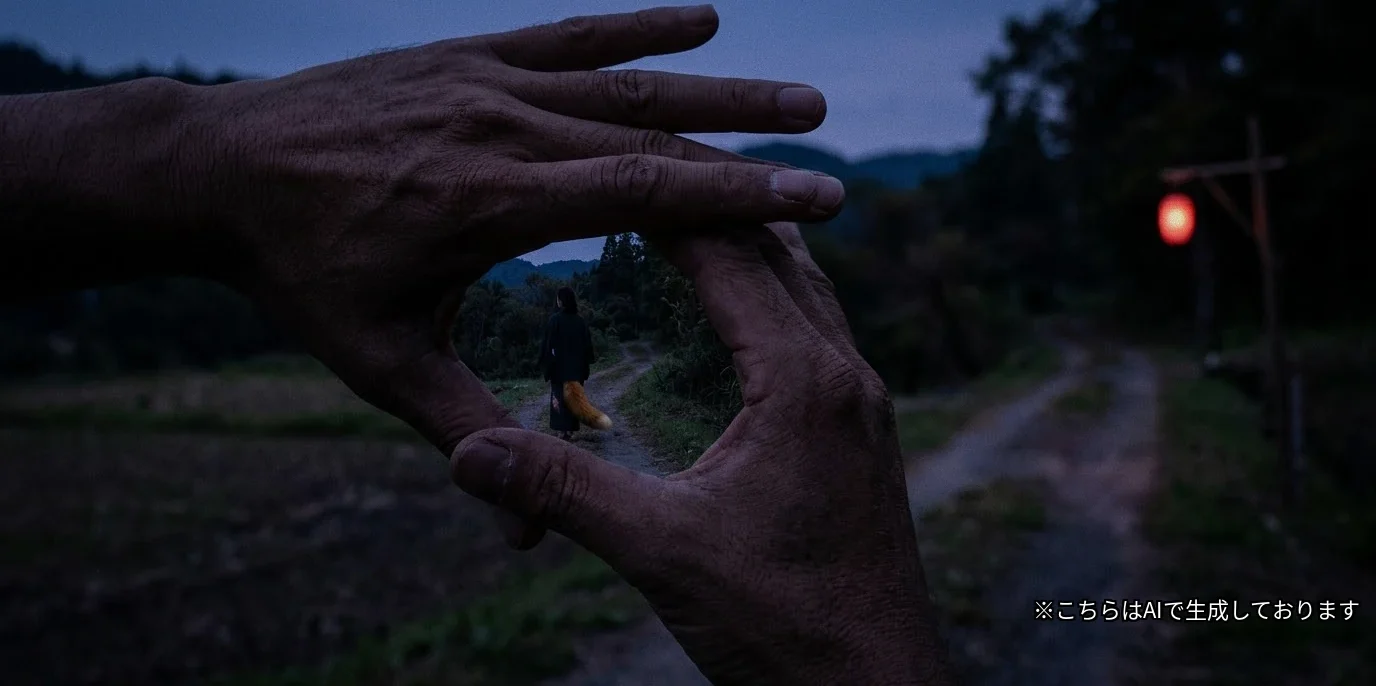
Make the shape of a fox’s face with the fingers of both hands and combine them intricately, and a small diamond-shaped gap opens between the fingers. Look through the gap and you can see the true form of a demon disguised as a person. This charm, called the “fox window” (kitsune no mado), is quietly handed down even now as a children’s game or as a slightly dangerous urban legend told online.
Usually, you see nothing when you peer through. But what would you do if you did see something? If something that should not be visible stood there? The fear of the fox window lies less in the monster itself than in “having seen.” In this article, following the old records of the fox window and the chants of various regions, we consider why people have wanted to peek at the “true form” of the world and have also feared doing so.
Origins: Edo Children’s Play and Charms of Various Regions
There are small differences in how to make the fox window, but the well-known form is roughly as follows. First, with both hands, put the middle and ring fingers against the thumb and raise the index and little fingers to make a fox face. Next, turn over one hand only and interlock the fingers that are the ears of the two foxes. Finally, spread the fingers and a small window forms between them. You peer through this window while reciting fixed words.
Finger play resembling the fox window already appears in Edo-period records. The late Edo scholarly essay Kiyu Shoran (1830) introduces a game in which children interlock fingers and peer, with a call. The folklorist Yanagita Kunio touched on “fox play,” in which one makes a ring with the fingers and peers, in Kodomo Fudoki, his collection of children’s games, and took it up in another piece under the name “fox window.” Around the same time, Minakata Kumagusu also mentioned this charm in his writings on fox tales. Later, Tsunemitsu Toru discussed the fox window in Shigusa no Minzokugaku as a magic embedded in human gesture. The fox window has been handed down moving between children’s harmless play and a charm that sees through demons.
The best-known chant is “Keshiyo no mono ka, mashiyo no mono ka, shotai o arawase.” “Keshiyo” is transformation, that is, something that has appeared by disguise, and “mashiyo” means of a demonic nature. “Are you a shape-shifter or a demon? Reveal your true form,” one recites three times while peering through the window.
Chants and methods varied by region. In Kanagawa Prefecture, a method was handed down in which one recites a long spell-like phrase three times and then pokes the window hole to drive off foxfire. In the Arida region of Wakayama Prefecture too, a Taisho-period record preserves the fox-window tradition. There are also other charms of similar idea: in Kochi Prefecture it was said that looking through a hunting rifle’s sight reveals a yokai’s true form, and in the Goto Islands of Nagasaki and Suo-Oshima in Yamaguchi, “matanozoki” (peering upside down between the legs) was used to tell whether a ship was a ghost ship.
The fox window also had meaning as a strange omen. In Aomori, Akita, Niigata and other places, it was said that when a small child made a window with fingers and peered, it was a sign the next child would be born. The window for seeing the true form of demons was also a window for looking at a life not yet come into this world.
Why Is It Said That the “True Form Can Be Seen”?
Why does peering through a gap in the fingers show a monster’s true form? One reason is largely that it borrows the form of a “fox.” In old Japan, the fox was a representative animal that bewitches people. It disguises itself as people and leads travelers astray, possesses people, and forms processions of fire on night mountains. One makes the form of the fox with the power to bewitch out of one’s own hand and borrows its eyes to look at the world. The reasoning is that seen with the eyes of the one who deceives, the true form of the deceived world can be known. One might call it fighting poison with poison.
Another is the meaning of “looking in an unusual way.” As the examples of matanozoki and the rifle sight show, many charms for seeing through disguise require looking at the world in an unusual posture or through a narrowly delimited field of vision. People of old probably thought that as long as they looked with ordinary eyes, they could not see through a monster’s disguise. By cutting out a small field of view or turning heaven and earth upside down, one breaks the conventions of how everyday things “look.” Only then does what was hidden show itself.
The custom of putting magical power into finger gestures is not limited to the fox window. Hiding one’s thumb when seeing a hearse, or making a ring with fingers and having it “cut” while saying “engacho” to a child who touched something dirty: many people still experienced such gestures in childhood. The human hand was the most familiar magical tool, one that can act on the world without any implement. The fox window is especially complicated among such hand gestures and takes some effort to learn. In our view, that effort was what mattered. Precisely because it is a window not easily made, the world seen through it becomes special. The time spent interlocking the fingers one by one was a small ritual for switching the mind from the everyday to the extraordinary.
The fox window is also told of as a way to see “fox weddings” (kitsune no yomeiri) on rainy days. On a day when rain falls from a clear sky, if you make a fox window and peer through, you can see the fox wedding procession invisible to human eyes. It is a window for seeing a procession that was originally not to be seen. The fox window sits exactly where the taboo against seeing and the desire to see intersect.
Present Day: From Textbook Fairy Tale to Internet Urban Legend
One occasion through which many modern Japanese meet the words “fox window” is probably the work Kitsune no Mado by children’s author Awa Naoko. In this story, which was also included in Japanese-language textbooks, when one makes a window with fingers dyed blue, there appear in it figures of people one can never meet again and lost scenery. There, the fox window is depicted not as a charm that exposes demons but as a poignant and beautiful window reflecting longing for what has been lost.
In the world of the internet, manga, and games, on the other hand, the fox window is often told as something you “must not do.” Experience-style stories are repeatedly posted: I looked and saw what should not be seen, our eyes met, something has followed me since I looked. The fox window has become a small tool for testing courage. A note “if you see something, undo your hands at once” is often attached. In recent years, this charm was also reportedly introduced in Korea under a name meaning “fox window” and became a topic on social media.
An old folk charm becomes a window of nostalgia in a fairy tale and again returns to a window of fear on the internet. The fox window lives on as an uncanny act doable with a single fingertip, showing a different face in each age.
Many adults, remembering the fox window they were taught as children, notice when they try to interlock their fingers that they cannot make it. A window whose method has been forgotten never opens again. A charm handed down as children’s play is also fragile knowledge that dies out unless taught directly from hand to hand. It is a slightly strange sight that internet videos and diagrams now serve as the new “hands” passing the fox window to the next generation.
KARASU CHANNEL’s Take: The One Who Peers Is Peered Back At
Reading about the fox window, what we are most caught on is the question of “what to do if you do see.” Many traditions teach the method of seeing through but say almost nothing about what comes after.
This is our own speculation, but the true fear of the fox window may lie in the fact that seeing is not one-way. If you can see outside from a window, you can also be seen from outside. When you peer at a monster’s true form, the monster too may notice you peering. Will a demon that knows its disguise has been seen simply walk away? That “our eyes met” is repeated in modern accounts captures this feeling well. The one who peers is at the same time one who is peered back at.
Another thing to consider is why people of old felt that “disguised things” were mixed in among those close to them and the scenery they knew. A stranger who spoke to them on a night road, a traveler drifting into the village, a family member behaving a little differently than usual. In our view, the fox window is also a charm that reflects a deep human distrust: whether the one in front of us really is what they appear to be. No one can peer into another’s heart. That may be why people entrusted to a small window made of fingers the wish to see the other’s “true form.” Yet knowing a true form is not necessarily happiness, because one may see even what one did not want to see.
The saying of the omen, that a small child peering through the window means the next child will be born, is also interesting from this viewpoint. Children have been thought closer than adults to the boundary between this world and the next. Beyond the window that child peers through waits not only monsters but also lives yet to be born. This too is our own speculation, but the fox window may originally have been a window for seeing “what is not yet on this world’s side,” good and bad alike.
Thinking so, we also feel deep meaning in the fact that what is reflected in the window in Awa Naoko’s story is the figures of the lost. People we can no longer meet, places we cannot return to: these too are now not on this world’s side. People may want to peer through the fox window not only to expose monsters but because they want to meet once more what has become invisible and precious. That is why the fox window tradition’s teaching to “undo your hands at once if you see” may be more than a simple warning against evil. If one keeps trying to see what cannot be seen, one loses one’s life on this world’s side. The window opens for just a moment and must always be closed. This too is our own speculation, but the final gesture of undoing the fingers may be the most important step of the fox window, the one that brings the person who peered back to this side.
The fear of seeing what should not be seen and the longing to meet those we cannot meet. The two quietly overlap within the small window of fingers.

A classic piece of ghost-hunting gear: an IC recorder for capturing on-site sound, also used for collecting EVP (electronic voice phenomena).
Sony IC Recorder 4GB, AAA Battery Compatible, ICD-PX240, USB 2.0
We may earn a referral fee on purchases made through these links.
Engaging With This Legend
The fox window is a saying with two sides: it has been handed down as children’s play and as a charm against evil. There is no need to fear trying it, but please refrain from frightening or unsettling others by saying “I saw something.” In particular, please avoid forcing small children or people who dislike scary stories to try it.
The fox is told of as a being that bewitches people, yet is still worshipped as the messenger of the Inari deity. When dealing with charms and sayings about foxes, please take care not to make light of such faith.
Trying the fox window as a test of courage on night mountains or in deserted places is dangerous. Please limit the enjoyment of the saying to bright and safe places.

A commercial-grade body warmer that runs hotter and lasts longer than standard ones — slip it into a pocket over your winter gear to endure hours of cold during a midwinter, late-night visit to a ruin or mountain haunted spot.
ST (Esute) On-Pax Adhesive-Free High-Temperature Body Warmers, Commercial Use, 10-Pack ST48034
We may earn a referral fee on purchases made through these links.
Frequently Asked Questions
Q. What is the fox window?
A. It is a charm in which you make the shape of a fox’s face with the fingers of both hands and, peering through the small gap formed when they are combined, are said to see the true form of a demon or yokai disguised as a person. There are records of it as children’s play already in the Edo period.
Q. What is the chant for the fox window?
A. The well-known one is “Keshiyo no mono ka, mashiyo no mono ka, shotai o arawase,” said to be recited three times. It means “Are you a shape-shifter or a demon? Show your true form.” Other, longer chants are also handed down in some regions.
Q. What is the fox window said to let you see?
A. The true form of foxes and demons disguised as people, and the procession of a fox wedding on a rainy day, are said to be visible. In some regions it was also said that when a small child made this gesture, it was a sign the next child would be born.
Q. Is the fox window game dangerous?
A. There is no basis that anything actually happens. On the internet, though, it is sometimes said to “undo your hands at once if you see something you shouldn’t,” and it is best not to push it on people who dislike scary stories.
Q. Why is the fox window said to be dangerous?
A. The danger comes mostly from the fear of “seeing something you should not.” Online, the game is passed along together with rules for staying safe, such as undoing your hands at once if you see anything, or not looking back afterwards, so a simple finger game began to feel like a ghost story. There is no evidence that anything actually happens. Trying it as a dare on a dark mountain path or in an empty place is risky for a plain reason, though: you stop watching your footing and your surroundings.
Q. How do you do the fox window (kitsune no mado) and what do you say?
A. Make a fox face with each hand, interlock the “ears,” and spread your fingers to open a small diamond-shaped gap. The classic chant is “Keshiyo no mono ka, mashiyo no mono ka, shotai o arawase” (Are you a shape-shifter or a demon? Show your true form), said three times. This is a folk charm and a children’s game, and it is best enjoyed in a bright, safe place.
Q. Does the fox window really work?
A. There is no scientific basis for seeing anything through it, and normally you see nothing at all. As folklore, it is understood as a precaution against being tricked by foxes, and as a sign of how badly people have wanted to confirm what is really in front of them.
Q. What kind of story is Awa Naoko’s fairy tale Kitsune no Mado?
A. It is a story in which, when you make a window with fingers dyed blue by a fox, you see in it the figures of people you can no longer meet and lost scenery, and it was included in Japanese textbooks. Unlike the folk charm, it is loved as a poignant work about longing for what has been lost.
This saying can also be looked up in KARASU CHANNEL’s Superstition and Omen Dictionary.
Q. Has KARASU CHANNEL researched or filmed the fox window on location?
A. No. We are not currently researching the fox window, though we are considering doing so. Videos of our research into other haunted spots and ghost stories can be viewed on KARASU CHANNEL (YouTube).

Supervised by Suzuking.
Affiliation: KARASU CHANNEL
Occult & horror reporting: 7 years (since 2020)
Followers: YouTube 5,000+ / X 25,000+
On-site investigations: 30+
If this appeared in your dream
What it means to dream of something from this story, read through psychology and folklore in our Dream Dictionary.
- Dreaming of a FoxA symbol of trickery and cunning; beware lies or too-good offers. As the messenger of Inari, it can also mean…
Which story do you find the scariest?
If you think this story is the scariest, press the button below. One vote site-wide — you can change your vote for a different story anytime.
Was this article helpful?
Add this to your favorites to find it again anytime from your My Page.








Comments