The White Rabbit of Inaba: How a Lie and the Right Treatment Divided Fortunes
Supervised by Suzuking. (KARASU CHANNEL / Occult & horror reporting, 7 years)

Contents
View sources and last-checked date
- Source
- Kojiki (original text)
- Source 2
- Wikipedia, "Inaba no Shirousagi" (Japanese)
- Last verified
- 2026-09-16
Along the Hakuto Coast in Tottori City, Tottori Prefecture, there are still places said to be the setting of “The White Rabbit of Inaba” (Inaba no Shirousagi), one of the best-known stories in Japanese mythology. A rabbit tricks a crocodile into helping it cross the sea, has its skin torn off, and lies weeping in pain until a kind god helps it. This is no mere animal fable. It is a legitimate myth recorded in the Kojiki, Japan’s oldest history book.
Origin — The Price of Tricking the Crocodiles
According to the Kojiki, a rabbit living on the island of Oki wanted to cross to the mainland of Inaba (the eastern part of present-day Tottori Prefecture). It proposed to the wani (“crocodiles”; the leading theory is that this means sharks) who lived in the sea: “Let’s count which is greater in number, my kin or yours.” The wani lined up all the way to the cape of Keta, and the rabbit hopped across their backs, pretending to count. When it was almost on land, the rabbit let slip, “You’ve all been fooled.” The last wani, furious, seized it and stripped off its entire coat of fur.
There is also debate over where all this takes place. The Kojiki names the setting “Inaba” (written 稲羽), but it never clearly states that this is the Inaba of present-day eastern Tottori; the place is said to have been identified with Inaba as a neighbor of Izumo because of how the story unfolds. The island of departure, “Oki,” is likewise taken by some to be the Oki Islands of Shimane Prefecture, while others hold that it is not a specific place but simply an “island out at sea.” At the Hakuto Coast in Tottori City, a small island about 150 meters offshore and the reefs that run out toward it in a row have long been told of as the wani lined up in the water.
The rabbit’s name also deserves attention. The Kojiki writes it as “the shiro-usagi of Inaba” using the character 素 (su), and Motoori Norinaga said that this character means wearing nothing and being dyed with nothing. In other words, rather than simply a “white rabbit,” the name may also carry the sense of a rabbit stripped of its skin and left bare. Near the end of the tale, the rabbit tells Okuninushi, “The Yaso-gami will not win Princess Yagami. You will,” and so it comes to pass. The rabbit is not merely a victim; it is also portrayed as a “rabbit god” who foretells the future.
Okuninushi’s Rescue — Japan’s Oldest Record of Medical Care
To the rabbit weeping in pain, the Yaso-gami (the many brother gods) who passed by first said, “Bathe in the sea water and let the wind dry you, and you will heal.” This was the wrong treatment: the dried salt soaked into the wounds, and the skin split open and became far worse. The last to come by was the kind-hearted Oonamuji no Kami (later Okuninushi), who taught the correct treatment: “Wash your body in fresh water, then lie down on the pollen of the cattail (gama) spikes spread out for you.” The rabbit made a full recovery. This description of using cattail pollen as medicine is regarded as one of the oldest records of medical knowledge in Japanese literature, and it is also the origin of Okuninushi later being worshipped as a god of medicine.
There are also readings that interpret the “washing the body” treatment through modern eyes. In this view, the “water gate” (minato) refers to a river mouth, and washing there means rinsing not in pure fresh water but in brackish water, close to a physiological saline solution. As for cattail pollen, it is called “homo” (蒲黄, hou in Chinese medicine) and still exists as an external remedy for wounds and burns in traditional Chinese-style herbal formulas. However, these are interpretations that lay later knowledge over the myth’s wording; they do not mean that medicine of that age was actually like this. If you are injured or ill, please do not rely on folk remedies of your own judgment, and consult a medical institution.

Spray it on a handkerchief or towel and the mist instantly turns icy, ready to cool overheated skin — a highly portable, on-the-spot cooling item for when your body temperature rises walking around a ruin or haunted spot in midsummer heat.
Icenon (Hakugen Earth) Instant Ice Spray 230mL
We may earn a referral fee on purchases made through these links.
Present Day — Hakuto Shrine and Faith in Matchmaking
Hakuto Shrine still stands on the Hakuto Coast, and together with the story of Okuninushi and Princess Yagami, whom he later wed, it is cherished as a shrine for matchmaking. The area around the coast is designated a national Place of Scenic Beauty, and it remains an active tourist destination and place of worship visited by many people.
Hakuto Shrine enshrines the Hakuto deity (the White Rabbit god) as its main deity, with Ukemochi no Kami enshrined alongside. It is worshipped as a deity with efficacy for skin ailments, and, as the one who brought Okuninushi and Princess Yagami together, it is also loved as a god of matchmaking and of medicine. Within the grounds is the “Onmi-arai Pond,” where the rabbit is said to have washed its body; its water level is said not to rise or fall even in drought or downpour, and it is also called the “pond that neither increases nor decreases.” The hill on which the shrine stands is “Mihoshi-yama,” where the rabbit is said to have dried its body. The shrine’s origins are unknown; it is said to have been destroyed by fire in wartime and rebuilt between the Sengoku period and the early Edo period. In Yazu Town, in inland Tottori, there is another tradition about a shrine to the white rabbit, which shows that the setting of the White Rabbit legend is not limited to a single place.
Reflection — A Story Built on a Pair: “the Lie” and “the Right Treatment”
What we find interesting is that this myth is built from two paired events: the rabbit’s failure through its “lie,” and the rescue through Okuninushi’s “correct knowledge.” The contrast between the Yaso-gami’s wrong treatment and Okuninushi’s right one can be read as more than a contrast of kindness and spite; it seems also to speak of the difference between “a superficial idea” and “knowledge that makes sense.” This is our speculation, but perhaps behind the long telling of this myth lies the fact that, for people of that age, whether or not one knew the right treatment was a pressing matter of life and death. In our view, it is precisely because Okuninushi is portrayed not only as a kind god but as a god with accurate knowledge that the myth has a depth beyond a simple tale of rewarding good and punishing evil.
This is merely our imagining, but the cries of the stripped rabbit may not have been just a scene in a myth. They may have been the very memory of the suffering of those without any cure, which people of that time had actually witnessed. The “right treatment” that Okuninushi shows implies, conversely, that there were many nameless people who lost their lives because they did not know it. That Hakuto Shrine is still loved as a matchmaking shrine may be not only because it is the setting of a love story, but because gratitude for lives saved by right knowledge has been handed down, changing form, across more than a thousand years.
This too is merely our imagining, but picture the rabbit, told by the Yaso-gami to bathe in sea water and stand in the wind, exposed to dried salt and strong wind until the skin all over its body split open, crying out on the beach, raw and bare. It is vivid to a degree hardly fitting for a myth. The tale of how it lined up the wani by trickery and was caught by the last one and skinned is also oddly concrete in its depiction of pain for a mere fable. If, when Okuninushi passed by, blood was still seeping from the rabbit’s wounds, then perhaps this story was, from the start, less a tale of salvation than a tale of a harsh punishment: the stripping of one’s skin.
The wounds the rabbit suffered were a punishment for deceiving the wani, and at the same time they were made deeper by the false advice of the Yaso-gami. In our view, this twofold suffering may be the core of the myth. There is the pain that comes from one’s own mistake, and the pain that comes from another’s “malice wearing the face of kindness.” The rabbit is made to bear both at once. And Okuninushi, blaming neither, simply teaches the “right treatment.” The gentleness of this myth lies in his appearing not as a god who punishes, but as a god who heals wounds.
This is our speculation, but we think it also means something that the Yaso-gami’s advice was the kind that “sounds as if it would surely work.” Bathe in sea water, stand in the wind. A treatment that sounds plausible actually makes the wound worse. This scene clearly depicts how much harm can be done by good intentions without sound knowledge, or by confident wrong advice. Even today, folk remedies and unreliable information can make people suffer. We feel a quiet astonishment that a story from more than 1,300 years ago can still be read as a warning that holds true.
Many folktales around the world follow a similar plot. In Siberia, a fox has seals line up and crosses on their backs; in Africa, a hare tricks crocodiles to cross a lake; in Indonesia, a mouse deer steps on the backs of crocodiles to cross a river. The pattern of crossing sea or river by deceiving larger beings through numbers is probably a story of the “wisdom of the weak” that humanity has shared. Yet only the Japanese tale does not end there, and goes on to depict the pain of the one who deceived and the salvation of being healed. We think it is in this second half that the particular depth of this myth lies.
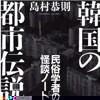
A folklorist reads through Korean urban legends in this book — a reference for our overseas urban-legend articles.
Urban Legends of Korea: A Folklorist's Ghost Story Notebook (Yasunori Shimamura / Chikuma Bunko)
We may earn a referral fee on purchases made through these links.
Everyday Face — The Scenery of Hakuto Coast and Hakuto Shrine
The Hakuto Coast, where the myth of the rabbit that lied and suffered for it is passed down, is known as one of the finest scenic spots in San’in, where the small island “Okino-shima” floating in the Sea of Japan and the white sand beach come together. Hakuto Shrine along the coast is known for its blessings of matchmaking, and its grounds are lined with stone rabbit statues associated with the “White Rabbit of Inaba.” At dusk, the sun sinking into the sea and the silhouette of the island are beautiful, and the coast is loved both as the stage of the myth and as one of Tottori’s signature coastal landscapes.
Notes for Visiting
Hakuto Shrine and the Hakuto Coast are an active tourist destination and place of worship, and not a dangerous place. When visiting for worship, please check the shrine’s guidance in advance regarding visiting hours and etiquette, and come with an attitude fitting a place of faith.
Frequently Asked Questions
Q. Is the “wani” really a crocodile?
A. The leading theory is that it does not mean the reptile we call a crocodile today, but sharks.
Q. Can Hakuto Shrine still be visited today?
A. Yes. Because of the story of Okuninushi and Princess Yagami, it remains a matchmaking shrine and many worshippers still visit.
Q. Has KARASU CHANNEL researched or filmed on location at Hakuto Shrine or the Hakuto Coast?
A. No, we are not currently researching it, and a visit is under consideration. Footage from our other haunted-spot and kaidan investigations can be viewed on KARASU CHANNEL (YouTube).

Supervised by Suzuking.
Affiliation: KARASU CHANNEL
Occult & horror reporting: 7 years (since 2020)
Followers: YouTube 5,000+ / X 25,000+
On-site investigations: 30+
If this appeared in your dream
What it means to dream of something from this story, read through psychology and folklore in our Dream Dictionary.
- Dreaming of the White Hare of InabaThe White Hare of Inaba: healing after a mistake and meeting a true helper, with a caution against small dece…
- Dreaming of a ShrineA symbol of protection, cleansing and wishes. Praying at a shrine hints your wish will be heard.
Which story do you find the scariest?
If you think this story is the scariest, press the button below. One vote site-wide — you can change your vote for a different story anytime.
Was this article helpful?
Add this to your favorites to find it again anytime from your My Page.








Comments