Ryokan Sugawara Bekkan (Morioka)
Supervised by Suzuking. (KARASU CHANNEL / Occult & horror reporting, 7 years)
Contents
View basic details of this location (address, history, status, etc.)
- Location
- Morioka City, Iwate Prefecture
- Built
- Unknown (operating as a long-established ryokan)
- Closed / Decommissioned
- Not applicable — still operating as a regular lodging facility
- First Rumored
- Unknown — long told as a zashiki-warashi legend
- Current State
- Currently operating as an active ryokan
- Access
- Open to the public (lodging facility, reservation required)
- Last Verified
- 2026.09.11
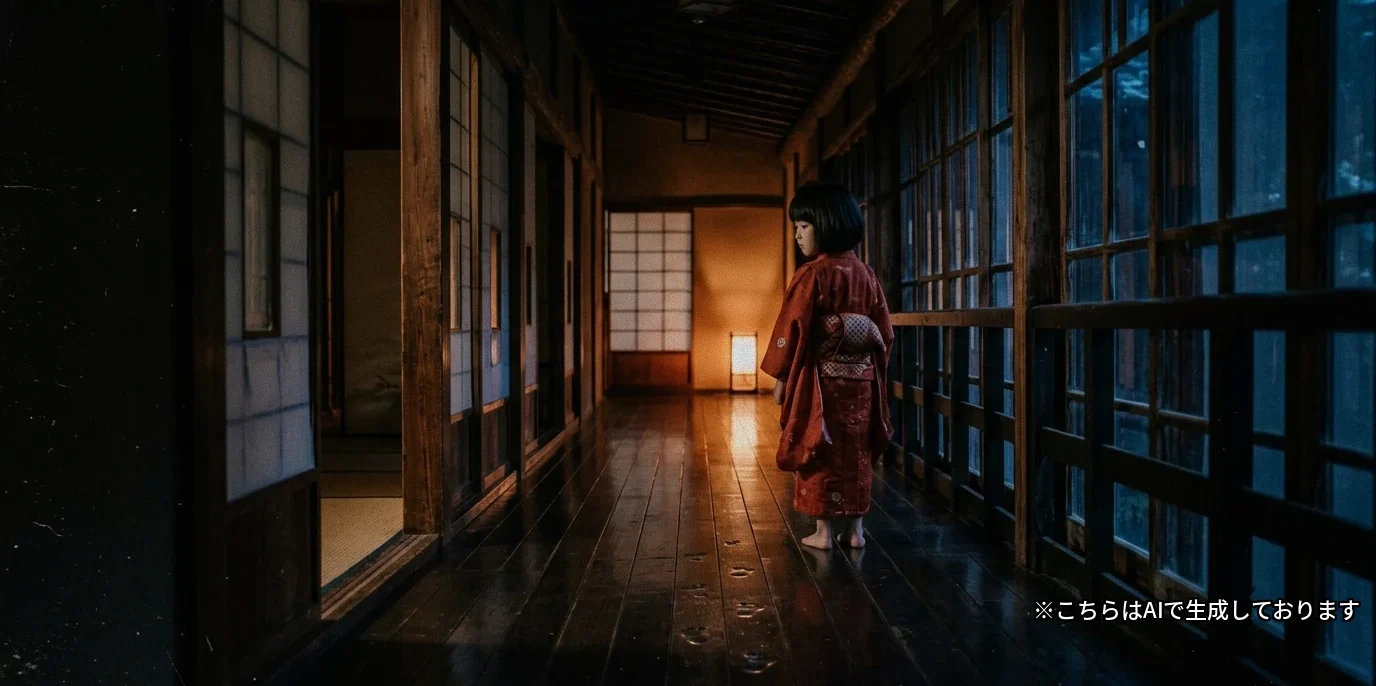
Ryokan Sugawara Bekkan (Sugawara Annex), a short walk from Morioka Tenmangu Shrine in the Tenjincho district of Morioka City, is a working inn known as a place where a zashiki-warashi appears. Nicknamed “the inn of career success,” it has become famous nationwide through TV, magazines and travel blogs, as guests describe hearing what sounded like a small child running through the rooms, or seeing a decoration in the tokonoma alcove begin to move with no draft at all. It is often mentioned alongside Ryokufuso at Kindaichi Onsen in Ninohe City, but the two are entirely separate inns. Rather than a haunted spot, most people see it as a place where Iwate folklore is still alive: “the inn where you might just meet a zashiki-warashi.”
The Zashiki-Warashi Legend and the Inn’s History
The zashiki-warashi is a household spirit told of mainly in Iwate Prefecture. It became known across Japan through The Legends of Tono (Tono Monogatari), which Kunio Yanagita compiled from tales told by Kizen Sasaki, a native of Tono, and published at his own expense in 1910. Tale 17 describes the zashiki-warashi as a god that lives in the houses of old families, usually in the form of a child of about twelve or thirteen, and says the house where it dwells will prosper. Tale 18 follows with the story of two girl spirits who left an old household, after which more than twenty members of that house, family and servants alike, died in a single day from poisonous mushrooms. It brings good fortune, yet when it leaves, the house falls. From the very beginning, the zashiki-warashi legend carried both light and darkness. Note that the image of a “red-faced child” comes from other local traditions in Iwate and is not how The Legends of Tono describes it.
The inn’s official website gives two origins for its zashiki-warashi. The first concerns the family home of the okami, the inn’s senior hostess. Her family had run an inn for over three hundred years since the Edo period, serving as a honjin, an official lodging for traveling lords, and inside the house a fire god was enshrined as the village’s guardian. That fire god, the inn says, was the zashiki-warashi. When a great fire in the Edo period burned down most of the village, the family home alone survived even though flames surrounded it. When the okami married, the zashiki-warashi came with her and began to show itself to guests at the inn in Morioka. That is the inn’s own account.
The second origin is a link to Japanese folklore studies. According to the inn, Kenkichi Ogasawara, an ancestor three generations back, knew both Kunio Yanagita and Kizen Sasaki from the Meiji to the Taisho era and passed on to them the old tales he had heard from his grandmother. Ogasawara (1879–1942) served as head of Kemoyama Village in Shiwa District, and the tales he passed on were published as Sasaki’s Shiwa-gun Mukashibanashi (Old Tales of Shiwa District, 1926) and as Iwate-ken Shiwa-gun Mukashibanashi-shu, edited by Yanagita from Ogasawara’s records. However, we have not been able to confirm the specifics of the inn’s claim that these tales influenced The Legends of Tono.
How It Differs from Iwate’s Other Zashiki-Warashi Inns
When people in Iwate talk about a “zashiki-warashi inn,” the first name that comes up is Ryokufuso at Kindaichi Onsen in Ninohe City. Ryokufuso traces its family history to a party from the Southern Court that fled to the area during the Nanboku-cho period, and it holds that a young boy named Kamemaro, who died on that journey, became the guardian spirit of the house. It is known for sightings in its inner parlor, the Enju-no-ma, and served as the model for Tetsuo Miura’s novel Yuta and His Mysterious Friends. A fire in October 2009 burned the building almost entirely, but the Kamemaro Shrine on the grounds survived, and the inn reopened in May 2016.
Compared with these, Sugawara Bekkan stands out in three ways. First, it is a small inn with only Japanese-style rooms, set in the middle of Morioka rather than in a hot spring town. Second, its zashiki-warashi is explained not as the spirit of a particular child but as a household fire god that moved here with a bride. Third, guest rooms carry their own names and traditions of good luck, such as “the Room of Success” and “the Room of Beginnings,” and guests have made a custom of bringing stuffed animals and sweets as gifts for the zashiki-warashi.
An encyclopedia of strange tales still told today — a reference for our kaidan and urban-legend articles.
Encyclopedia of Modern Japanese Strange Phenomena (Itsuki Asazato / Kasama Shoin)
We may earn a referral fee on purchases made through these links.
Current Conditions (Access & Visiting)
Sugawara Bekkan is still in business, and you can stay there if you book as a guest. Visits just to look around are not possible. Reservation methods and conditions may change, so please check the inn’s official website. If you take photos or share your experience online, please be considerate of other guests and the inn’s operations.
Analysis: Why Do Zashiki-Warashi Gather at Inns?
In The Legends of Tono, the zashiki-warashi was always a god of old family houses. It held the rise and fall of the house itself, and people prayed less to meet it than to keep it from leaving. The tale of the two girl spirits in Tale 18 speaks less of the blessings of a god of fortune than of the terror of a prosperous house vanishing overnight. In our view, the zashiki-warashi was an embodiment of good luck and, at the same time, the fear of a family’s ruin taking the shape of a child.
So why did it become tied to inns? This is our speculation, but the nature of an inn may explain a great deal. An inn is a home, yet every night it welcomes strangers into its rooms. Guests leave after a single night, and only the family and the building remain. And because guests are not members of the house, they do not carry the ruin that follows its departure. The inn carries that weight, while guests can take home only the bright side: “lucky if you meet it.” We believe the guardian of the old family house changed, at the inn, into a good-luck charm open to anyone.
What stands out in Sugawara Bekkan’s story is that the zashiki-warashi “came along with a bride.” In The Legends of Tono, a zashiki-warashi moving house meant the end of the house it left. In this inn’s story, however, the move is told not as a downfall but as a spirit following a young woman to protect her new life. For the okami, born into a honjin family and choosing the same trade, bringing her family’s fire god with her may have meant marrying while carrying her family’s memory and pride. This too is only speculation, but for anyone lodging guests in a town of closely packed wooden buildings, no guardian could have been more reassuring than “the god who saved the house from the flames.”
The stuffed animals and sweets that guests bring also carry a meaning worth noticing. Households with a zashiki-warashi were said to offer it red-bean rice, which was also a way of making sure it did not leave. Kizen Sasaki also suggested a connection between the zashiki-warashi and the spirits of children who died young. In our view, the scene today, in which guests hand toys to the spirit of a child they have never met, joins the wish for good fortune with a gentler impulse: to keep company with a child who has no one to play with. A zashiki-warashi inn is a place where fear, hope and tenderness share a single room.
A Word from KARASU CHANNEL
We see the zashiki-warashi legend not simply as an object of fear, but as a folk expression of gratitude toward, and quiet awe of, a home and the land it stands on. Rather than treating a working inn like Sugawara Bekkan as a mere “haunted spot” for entertainment, we’d like to introduce it with respect, as a living example of folklore still rooted in its community.
A 135g lightweight drone for aerial shots of a ruin or a sprawling haunted spot from angles you can't reach on foot. Built-in propeller guards make it relatively safe to fly indoors, and its subject-tracking feature can follow the exploration automatically, giving more range to the visuals in a YouTube verification video.
DJI Neo Drone with Camera, 4K UHD Camera, Compact Drone, Aircraft Only
We may earn a referral fee on purchases made through these links.
Everyday Life at the Inn
Day to day, Sugawara Bekkan is a small inn that makes a good base for exploring Morioka on foot. It sits in the city center, about twenty minutes by local bus from Morioka Station. According to its official website it serves no meals, and many guests pair their stay with local specialties such as wanko soba, Morioka reimen cold noodles and jajamen. The inn has no hot spring. If you want to add one to your trip, Morioka Tsunagi Onsen, on the western outskirts of the same city, is an option, but it is over ten kilometers from the inn’s neighborhood and about thirty minutes by bus even from Morioka Station.
Notes
Sugawara Bekkan is an active, privately run business. Please visit only through a proper reservation, and never engage in behavior that would interfere with its operation, such as entering the grounds without authorization or wandering the premises late at night. Please check the inn’s official website for the latest information on reservations.
*KARASU CHANNEL does not encourage entering haunted locations.
Frequently Asked Questions
Q. Can you still stay at Ryokan Sugawara Bekkan today?
A. Yes. It continues to operate as a ryokan, and you can stay there by booking as a guest. Reservation methods and conditions may change, so please check the inn’s official website.
Q. Are the zashiki-warashi sightings real?
A. No primary source identifying a specific witness or date has been confirmed. The accounts remain within the realm of the inn’s own legend and personal anecdotes shared by guests.
Q. Is Sugawara Bekkan the same inn as Ryokufuso in Ninohe?
A. No. Sugawara Bekkan is in Tenjincho, Morioka City, while Ryokufuso is a separate inn at Kindaichi Onsen in Ninohe City.
Q. Does Sugawara Bekkan have a hot spring or serve meals?
A. It has no hot spring. According to the official website, it is a room-only inn that serves no meals; because it is in central Morioka, guests eat at restaurants in the area.
Q. Has KARASU CHANNEL visited or filmed at Sugawara Bekkan?
A. No, we have not filmed there yet; a visit is currently under consideration. Location footage for other haunted spots can be viewed on KARASU CHANNEL (YouTube).

Supervised by Suzuking.
Affiliation: KARASU CHANNEL
Occult & horror reporting: 7 years (since 2020)
Followers: YouTube 5,000+ / X 25,000+
On-site investigations: 30+
Kaidan Tales from This Area
Which haunted location do you find the scariest?
If you think this location is the scariest, press the button below. One vote site-wide — you can change your vote for a different location anytime.
Was this article helpful?
Add this to your favorites to find it again anytime from your My Page.

Comments