Old Isegami Tunnel (Toyota City)
Supervised by Suzuking. (KARASU CHANNEL / Occult & horror reporting, 7 years)
Contents
View basic details of this location (address, history, status, etc.)
- Location
- Toyota City, Aichi Prefecture
- Built
- 1897 (Meiji 30)
- Closed / Decommissioned
- Not applicable (not closed to traffic; continues in use as an old road. Registered as a cultural property, a modern heritage structure)
- First Rumored
- Vanishing-hitchhiker-type rumors tied to construction deaths and the victims of the 1959 Isewan Typhoon (time of first appearance unknown)
- Current State
- A registered cultural property and modern civil-engineering heritage structure. Traffic has decreased since the new tunnel opened.
- Access
- Permitted (public road)
- Last Verified
- 2026.09.11
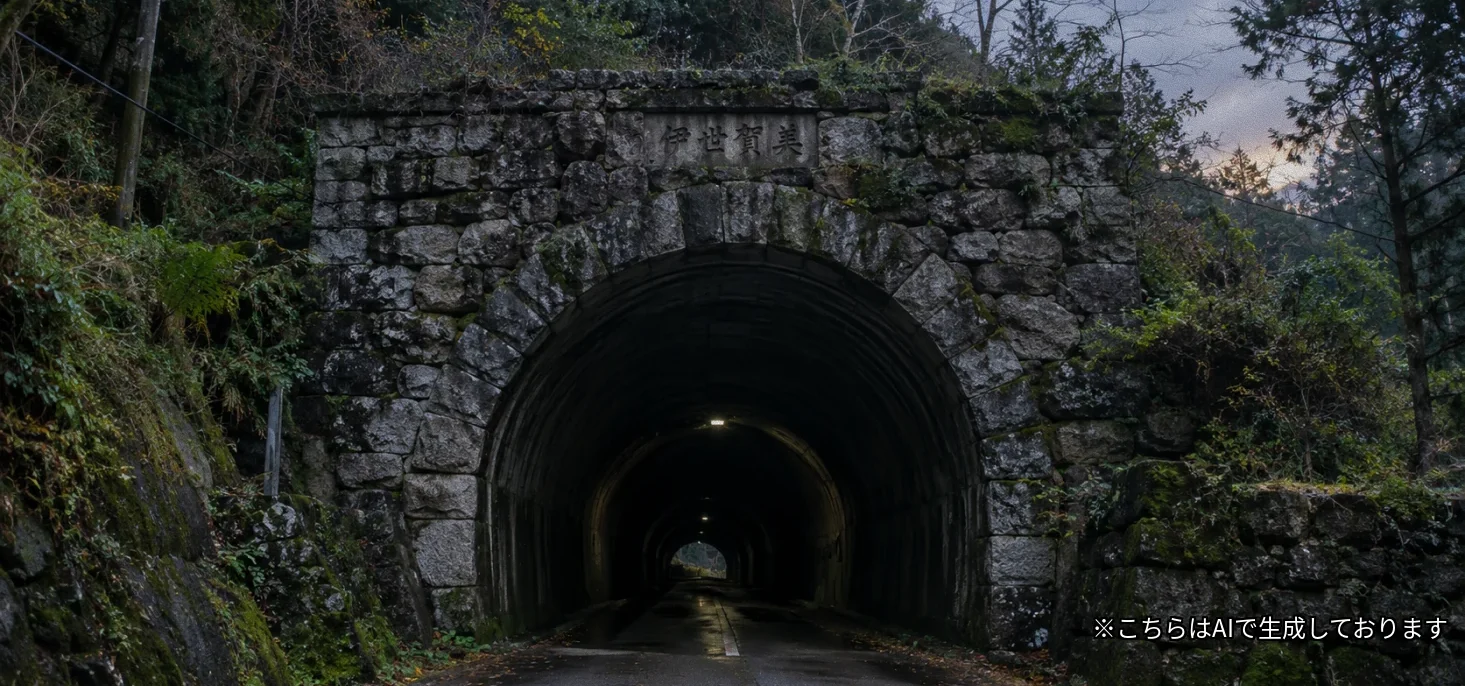
The Old Isegami Tunnel (Isegami Suido) in Toyota City, Aichi Prefecture, is a stone tunnel that opened in 1897 (Meiji 30). Today it has handed the main traffic over to the “New Isegami Tunnel,” but it is registered as a cultural property of modern civil engineering and remains a working structure that can still be driven through as a public road. It is sometimes called “one of the best-known haunted spots in the Tokai region,” and a local newspaper has even covered how the rumors came about.
Origins: A Stone Tunnel Built in the Meiji Era
The Old Isegami Tunnel was built in the Meiji era at Isegami Pass, a difficult stretch of the Iida Kaido that runs through the mountains of Toyota City. The Iida Kaido, also called the “salt road” or the Chuma Kaido, was an old and vital route linking Shinano Province with Owari and Mikawa. When it was completed in November 1897, traffic between Higashi-Kamo District and Kita-Shitara District grew busier, and goods are said to have shifted from being carried by pack horses to horse-drawn carts. The design of the stacked-stone portals is valued as evidence of the civil engineering of the day, and the tunnel became a nationally registered tangible cultural property in 2000 (September 26). Traffic has fallen sharply since the new tunnel opened, but it has not been closed and continues to be used as an old road.
According to documents, the tunnel is 308 meters long, about 3.3 meters high and about 3.15 meters wide, built just large enough for a horse-drawn carriage to pass. The size of the cross-section is also said to have been based on the requirement that army cannon be able to pass through. Its elevation is about 705 meters, and the even older pass road is said to have run along the ridge at a higher point (about 780 meters), so the path of the road that once crossed the horse’s back, then moved into a tunnel in Meiji and into another, lower tunnel in Showa, remains in the terrain as it was.
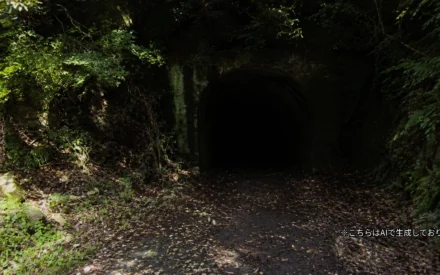
The structure is built of stacked granite, with a double horseshoe-shaped arch set on pillars of roughly finished stone. The original plan was brick, but it is said to have been changed to stone because the local strata and spring water risked collapse, and the toil of the craftsmen who cut and stacked the stone by hand gives the tunnel its outline. Only two stone tunnels completed in the Meiji era remain in the four Tokai prefectures: this tunnel and the Amagisan Tunnel, which opened in 1905.
The pass is said to be named after a shrine for worshipping Ise Shrine from afar built there in 1864, at the end of the Edo period, and before that it was reportedly called Ishigami Pass. For the people who passed through carrying loads on their backs or leading oxen and horses, a hole through the mountain was literally a road for daily life. In the age of motorization in the 1950s, trucks loaded with cargo could not pass through this narrow tunnel and had to unload before getting through, and route buses are said to have lowered their height with weights to pass. In 1960 (Showa 35), the current tunnel (the second one), 1,245 meters long, opened nearby, and the old tunnel ended its role as a trunk route. After the opening it was operated as a toll road, and in 1971 Aichi Prefecture covered the construction costs and opened it free of charge.

The first entry in the "Scary Floor Plans" series — a firsthand report by Tanishi Matsubara, the comedian famous for living in stigmatized properties, and a reference for our stigmatized-property articles.
Stigmatized Property Ghost Stories: Scary Floor Plans (Tanishi Matsubara / Futami Shobo)
We may earn a referral fee on purchases made through these links.
Why It Is Called a “Haunted Spot”
The rumors told about this tunnel are ghost stories: that a human pillar (hitobashira) was buried during construction, that a woman’s sobbing can be heard, and that the ghosts of workers killed in construction accidents, or of a mother and child killed in a nearby landslide during the 1959 Isewan Typhoon, appear. Experiences of the “vanishing hitchhiker” type are also told on the internet, such as seeing the ghost of a child or woman, or picking up a woman waving by the road only to find she has disappeared.
However, according to an investigation by the Toyota City Cultural Properties Division, there is no record of deaths from accidents or disasters inside or near the tunnel. We could not confirm in this investigation any primary source supporting the specific times or persons in these accounts. Construction accidents and typhoon casualties are, in themselves, things that could happen in the civil engineering and natural disasters of the time, but we found no record that directly connects them to the individual rumors.
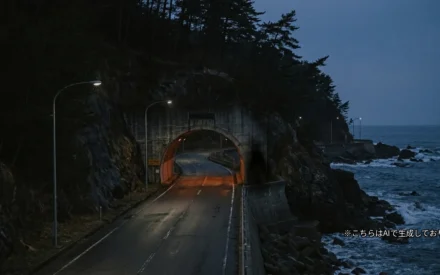
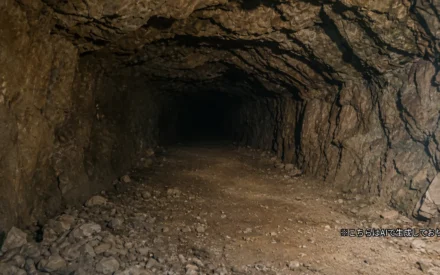
The old tunnel is cramped in both width and height for modern vehicles, and its interior was once a gravel road that was pitch dark even by day. Because it is too narrow for oncoming cars to pass, anyone going through alone at night is bound to feel tense. The stone walls are wet with spring water, and footsteps and voices echo. There are few conditions more obviously suited to breeding rumors.
Recent Years: A Cultural Property and a Rally Stage
In recent years, it has been reported that the area was used as part of the course for the Japan round of the World Rally Championship in 2022 and 2023, and around that time the road surface was paved and LED lighting installed. We would also like to note that this structure is drawing attention not only as a “scary place” but as a regional heritage and a competition venue. About one kilometer east of the east portal there is also the concrete arch bridge “Gunkai Bridge,” built in 1917.
Access & Location
It is in Toyota City, Aichi Prefecture. It is often told together with the New Isegami Tunnel running in parallel, and rumors confusing the two are also seen, so take care. The old tunnel at Isegami Pass is in Toyota City, Aichi Prefecture, and is not a story from another region with a similar name. It can be driven through as a public road, but because of the narrowness and curves typical of an old road, please slow down and watch for oncoming vehicles.
Our Analysis: Memories of Human Pillars and Disasters Overlap in a Hole in the Stone
From here on is only this site’s conjecture. It is rare anywhere in the country for a local newspaper to report on how rumors about a haunted spot came about. We believe the interest of this place lies less in records of specific paranormal phenomena than in the “ecology of rumor,” how the rumors spread. The old and new tunnels are right next to each other and have both been called “Isegami Tunnel,” so which of them is the stage of a rumor may easily differ depending on the teller. The unmistakably atmospheric feel of the old stone portal may also be drawing in rumors that really belong to the new tunnel.
First, let us look at the rumor of the “human pillar.” Legends of human pillars accompany old, large civil engineering works in many parts of the country. The story that a human sacrifice lay behind a difficult project is an expression of the hardship of the work and of awe toward the many people who bore it. This is only conjecture, but perhaps the feat of piercing a difficult pass with a stone tunnel in 1897 drew the human-pillar story to it. The work of Meiji 30 must have been almost entirely human labor, in an age of limited dynamite and heavy machinery. Those of us who have never stood on such a site cannot fully grasp the fear of collapses, spring water and rockfall during excavation. Even if the details of accidents cannot be confirmed in official records, perhaps people sense that “someone must have been sacrificed” because they unconsciously read the weight of the labor poured into this hole in the stone.
Next is the rumor that a mother and child died in a landslide during the Isewan Typhoon. That the 1959 typhoon brought great damage to the Tokai region is historical fact, but reportedly no record remains of deaths near this tunnel. Even so, the rumor may have arisen because the memory of the real disaster became linked with the danger of the mountain road. Aichi Prefecture suffered tremendous damage from the typhoon, and the next year, 1960, the new tunnel opened right beside it. The overlap between the memory of the disaster and the birth of a “new road” in the same period may have made the old tunnel look like the one “left behind,” and led people to place the shadow of the dead there. It is also possible that mourning for nameless victims took the form of a “ghost of a mother and child.” We want to keep respect for those who died in real disasters and treat the rumor without asserting it as fact.
In our view, another key lies in the material, “stone.” Unlike a modern concrete tunnel, hand-stacked stones each differ in shape and change their expression over long years. Walls that bear the marks of human hands readily seem to hold a human presence. Stories that lay sobbing voices and a waving woman over dark, damp stone walls can be read as the nationwide “vanishing hitchhiker” template dressed to fit the texture of this place. It would not be strange if a sound like “sobbing” came from dripping water or wind.
Moreover, the essential frightening quality of this tunnel lies not in ghosts but in the thickness of time. The shrine in 1864, the Meiji stonework, the Showa tunnel, and now the third one under construction: the pass has been repainted generation after generation into a road that can be traveled “wider and faster.” The Old Isegami Tunnel preserves the form of the oldest of those generations. In 2022 and 2023 people around the world saw footage of cars running through a narrow stone tunnel. That a place that was the stage of rumors has come to be known as a cultural property and as a competition venue is an example of how the meaning of a place is renewed with each era. Telling this place only through ghost stories is no longer enough. If ghost stories turn people’s eyes to this place, we would like them to become an opportunity to learn its value as a cultural property.
Nearby Spot: Korankei
In Asuke, the district of Toyota City where the Old Isegami Tunnel stands, is Korankei, known as one of the Tokai region’s best autumn foliage spots. It is said to have begun in 1634, when the abbot of Koso-ji planted maples and cedars along the approach from the Tomoe River to the temple, and in autumn some 4,000 maples along the Tomoe River at the foot of Mount Iimori dye the valley red and yellow. The view from Taigetsukyo Bridge and the evening illumination draw many visitors from inside and outside the prefecture, and in spring katakuri flowers can be seen. Shops selling local food such as gohei-mochi line the approach. Together with the townscape of Asuke along National Route 153 (the Iida Kaido), you can enjoy a stroll tracing the history of the old highway.
Notes and Cautions
The Old Isegami Tunnel is an active public road and not a place closed to entry. However, driving at night or staying for long periods in or around the tunnel carries a risk of traffic accidents, so please avoid it. It is narrow, barely wide enough for one vehicle, so take great care around oncoming cars and pedestrians. Follow on-site signs or Toyota City guidance regarding whether passage is allowed and any restrictions.
This article is published not “for going” but “for recording.”
*KARASU CHANNEL does not recommend entering haunted spots.
The old tunnel is a nationally registered tangible cultural property. Writing graffiti on the walls, taking stones away, and long photography with lights shone on it can all damage the cultural property. Please pass through quietly, take your trash home, and limit yourself to viewing it as a record.

A commercial-grade body warmer that runs hotter and lasts longer than standard ones — slip it into a pocket over your winter gear to endure hours of cold during a midwinter, late-night visit to a ruin or mountain haunted spot.
ST (Esute) On-Pax Adhesive-Free High-Temperature Body Warmers, Commercial Use, 10-Pack ST48034
We may earn a referral fee on purchases made through these links.
Note that the position on the map is an approximate coordinate based on public information and may differ from the exact location.
This article includes topics related to disasters and death, but does not describe any methods. If you are struggling right now, please do not carry it alone; consider using a consultation service such as the Yorisoi Hotline (0120-279-338, free, 24 hours; Japanese only).
Frequently Asked Questions
Q. Can you still drive through the Old Isegami Tunnel?
A. Yes. It survives as an old road registered as a cultural property, and vehicles can pass. However, the road is narrow, so drive carefully. Whether passage is allowed and any restrictions may change over time, so follow on-site signs or Toyota City guidance.
Q. Why did the rumors about the Old Isegami Tunnel spread?
A. Stories of human pillars, victims of the Isewan Typhoon and construction accidents have been handed down, but according to the Toyota City Cultural Properties Division, no record remains of deaths in or near the tunnel. A local newspaper has covered how the rumors arose, but no definite cause has been identified.
Q. Is the rumor of ghosts of construction accident or typhoon victims true?
A. Such rumors are told on the internet, but no primary source supporting specific times or persons has been confirmed.
Q. What is the Old Isegami Tunnel?
A. It is a stone tunnel (Isegami Suido), 308 meters long, built in 1897, and it became a nationally registered tangible cultural property in 2000. It is called “old” because a new Isegami Tunnel opened in 1960.
Q. Has KARASU CHANNEL filmed on location at the Old Isegami Tunnel?
A. No, we are not currently researching or filming at the Old Isegami Tunnel, and a visit is under consideration. Location footage for other haunted spots and kaidan stories can be viewed on KARASU CHANNEL (YouTube).

Supervised by Suzuking.
Affiliation: KARASU CHANNEL
Occult & horror reporting: 7 years (since 2020)
Followers: YouTube 5,000+ / X 25,000+
On-site investigations: 30+
If this appeared in your dream
What it means to dream of something from this story, read through psychology and folklore in our Dream Dictionary.
- Dreaming of a TunnelA symbol of transition or trial. Seeing light at the end means a hard time is nearly over.
Kaidan Tales from This Area
Which haunted location do you find the scariest?
If you think this location is the scariest, press the button below. One vote site-wide — you can change your vote for a different location anytime.
Was this article helpful?
Add this to your favorites to find it again anytime from your My Page.

Comments