Oshira-sama — How a Tragic Love Between a Girl and a Horse Became a Household God
Supervised by Suzuking. (KARASU CHANNEL / Occult & horror reporting, 7 years)
Contents
View sources and last-checked date
- Source
- Wikipedia, "Oshira-sama" https://ja.wikipedia.org/wiki/おしら様
- Source 2
- Denshoen official tourism site, and other sources
- Source 3
- Sengoku History https://sengoku-his.com/2778
- Last verified
- 2026-09-16
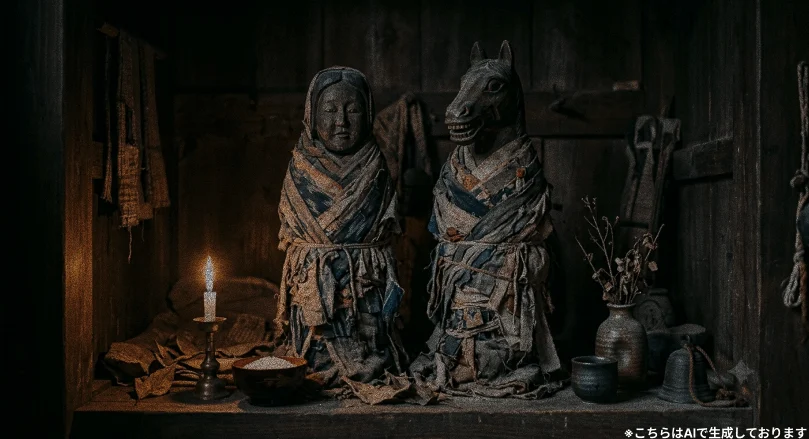
Tōno, Iwate Prefecture — a place known nationwide through Kunio Yanagita’s folklore collection The Legends of Tōno. Here, a household god called Oshira-sama is still enshrined today: a pair of deities carved from mulberry wood into the faces of a man and woman, or a woman and a horse, and dressed in layer upon layer of cloth. The origin story told for this deity is a sad and strange tale of love between a girl and a horse.
Origin — A Tragic Love Between a Girl and a Horse
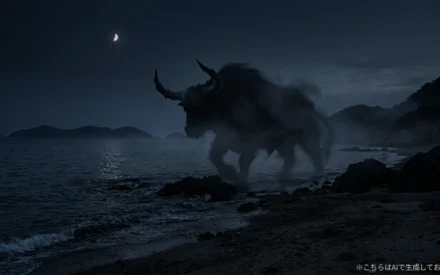
The story recorded in The Legends of Tōno goes like this. A farmer’s daughter grew deeply attached to the horse her family kept, and the two eventually became husband and wife in all but name. When her father learned of this, he flew into a rage and, without telling his daughter, hanged the horse from a mulberry tree and killed it. As the girl clung to the horse’s body weeping, its head suddenly tore free from its body and rose into the sky, carrying her up with it, straight into the heavens. Some time later, the girl is said to have appeared to her father in a dream and told him: “Raise the worms that hatch in the mortar, feeding them mulberry leaves.” When the father did as he was told, the worms eventually spun thread and formed cocoons — said to be the origin of sericulture (silk farming) in this region. The girl and the horse who ascended to heaven are said to have become Oshira-sama.
Why a Horse’s Face and a Woman’s Face Are Paired Together
The Oshira-sama deity is most often a pair of sticks roughly one shaku (about 30 cm) long, each carved or painted with the face of a man, a woman, or a horse, and the two are always enshrined together as a pair. The answer to why there are two figures, and why one is a horse, is exactly the legend above: a horse, indispensable labor for farm work and transport, and a daughter, essential to a household’s continuation. For a farming community at the time, both were things that simply could not be lost — and the story of these two being torn apart and becoming gods reads less like a simple ghost story than like the deification of a deep attachment to household and labor itself. At Denshōen, a folklore museum in Tōno’s Ayaori district, a hall called the Osen Shrine (Oshira Hall) houses roughly 1,000 Oshira-sama dolls donated from across the country, packed in side by side. The custom of dressing these dolls in cloth inscribed with wishes and praying to them still continues today — this is no mere legend, but a living object of faith even now.

Haunted-location research often means remote mountains and ruins, most with no restroom or changing space nearby. A pop-up privacy tent gives you cover for a portable toilet or a place to change out of wet clothes — reassuring when a woman is part of the research team.
Field to Summit Privacy Tent RBC-13 (Pop-Up Changing Room / Portable Toilet Use)
The “Horse-Bride” Legend Found Elsewhere, and How This One Differs
What’s interesting is that the “girl and horse in love” motif isn’t unique to the Tōhoku region — very similar stories appear in ancient Chinese folktale collections as well. The endings differ, though. In most of the overseas versions, the girl and horse who ascend to heaven are simply transformed into silkworms and the story ends there. In Japan’s Oshira-sama legend, by contrast, the girl and horse go on to be enshrined as guardian gods of the household. Rather than ending an “interspecies marriage” motif (a marriage between a human and an animal) with punishment or transformation, this region’s faith chose instead to welcome the pair in and keep venerating them as household gods — and that choice may be exactly what makes this local belief distinctive. On the 16th day of the 1st, 3rd, and 9th lunar months, said to be the anniversary of their deaths, a ritual called Oshira-asobase (“playing with the Oshira”) is still held in various places, in which a housewife or an itako (a blind female shaman) holds the dolls and makes them “dance” while reciting ritual verses.
Haunted-location research often means remote mountains and ruins, most with no restroom or changing space nearby. A pop-up privacy tent gives you cover for a portable toilet or a place to change out of wet clothes — reassuring when a woman is part of the research team.
Field to Summit Privacy Tent RBC-13 (Pop-Up Changing Room / Portable Toilet Use)

Exploring a ruin or mountain haunted spot often means bringing home mud- or water-stained boots, rain gear, or used wet wipes. A foldable, highly waterproof EVA bucket lets you bundle all the dirty items together, then rinse it out and fold it flat afterward.
amon OGC Multi Bucket, EVA Material, Waterproof, Approx. 16L Capacity 8631
We may earn a referral fee on purchases made through these links.
Reflection — When a Tragic Love Becomes a Myth of Prosperity
From here on, this section reflects our own speculation. The cruelty at the core of this story is, frankly, quite raw: a father who kills a horse against his daughter’s will, a couple torn apart, a gruesome final ascent into the sky. On its own, this could easily have become a story about a vengeful curse instead. And yet the tale ultimately lands as a “myth of prosperity through sericulture.” We suspect that, for a farming community at the time, there may have been reasons it couldn’t simply let a tragedy remain a tragedy. Neither the grief of losing a daughter nor the blow of losing a horse’s labor was something easily absorbed — which may be exactly why that loss needed to be converted into something meaningful. Enshrining grief itself as a god, and having that god become a source of household wealth, isn’t a structure that erases the loss; it may instead be a kind of wisdom for carrying that loss forward while still facing ahead.
One more point worth adding: the fact that Oshira-sama continues to be enshrined as a pair is itself suggestive. The girl and the horse were torn apart in the story, yet as deities they are never enshrined alone — they are always kept together, carefully placed in the inner room of the household. Perhaps the very fact that people have kept re-binding these two torn-apart beings back into a single pair, over and over, is the real reason this legend has been told and retold for more than a century.
Notes for Visitors
Oshira-sama remains a living object of faith, cared for in individual homes and at shrines and temples — not a spectacle or a test-of-courage destination. Denshōen’s Osen Shrine is a museum open to the public, but Oshira-sama enshrined in private homes are personal objects of worship, so please don’t attempt to view or photograph them without permission. This article is published to document the tradition, not to encourage visiting it, and anyone visiting Denshōen should follow the facility’s guidance and etiquette.

Sleeping in the car near a haunted spot the night before or while on standby, road noise, insects, or other explorers' voices can keep you awake. These American-made earplugs, rated NRR33 for high noise reduction, block out most surrounding sound and improve the quality of a nap in the car.
Moldex Meteor 6870 Earplugs, 10 Pairs, NRR33 High-Performance Noise Reduction
We may earn a referral fee on purchases made through these links.
Frequently Asked Questions
Q. Is Oshira-sama still enshrined today?
A. Yes. In homes and facilities mainly across Aomori and Iwate Prefectures, extending into northern Miyagi Prefecture, Oshira-sama is still enshrined as a household god. At Denshōen’s Osen Shrine in Tōno, visitors can see roughly 1,000 Oshira-sama dolls.
Q. Why did the horse and the girl become gods?
A. According to the legend recorded in The Legends of Tōno, a girl who loved a horse had it killed by her father, ascended to heaven together with the horse’s head, and taught people the technique of sericulture. This girl and horse are said to have become the household god Oshira-sama.
Q. Has KARASU CHANNEL filmed at Denshōen?
A. No, we haven’t filmed there yet, though we’re considering it. You can watch our footage from other haunted locations and ghost stories on our YouTube channel, KARASU CHANNEL.
Japanese horror 鴉番組

Supervised by Suzuking.
Affiliation: KARASU CHANNEL
Occult & horror reporting: 7 years (since 2020)
Followers: YouTube 5,000+ / X 25,000+
On-site investigations: 30+
If this appeared in your dream
What it means to dream of something from this story, read through psychology and folklore in our Dream Dictionary.
- Dreaming of oshirasamaA household god of Tohoku for silk and farming: protection and prosperity at home.
- Dreaming of a HorseA symbol of drive, progress and work luck. A galloping horse shows things moving smoothly; a wild one warns y…
Which story do you find the scariest?
If you think this story is the scariest, press the button below. One vote site-wide — you can change your vote for a different story anytime.
Was this article helpful?
Add this to your favorites to find it again anytime from your My Page.

Comments