Yamagami Tunnel (Nanasawa, Atsugi City)
Supervised by Suzuking. (KARASU CHANNEL / Occult & horror reporting, 7 years)
Contents
View basic details of this location (address, history, status, etc.)
- Location
- Nanasawa, Atsugi City, Kanagawa Prefecture
- Built
- Unknown
- Closed / Decommissioned
- None (an active road)
- First Rumored
- Unknown
- Current State
- Extant. Open to vehicles
- Access
- Passable. The road is narrow and dangerous at night
- Last Verified
- 2026.09.11
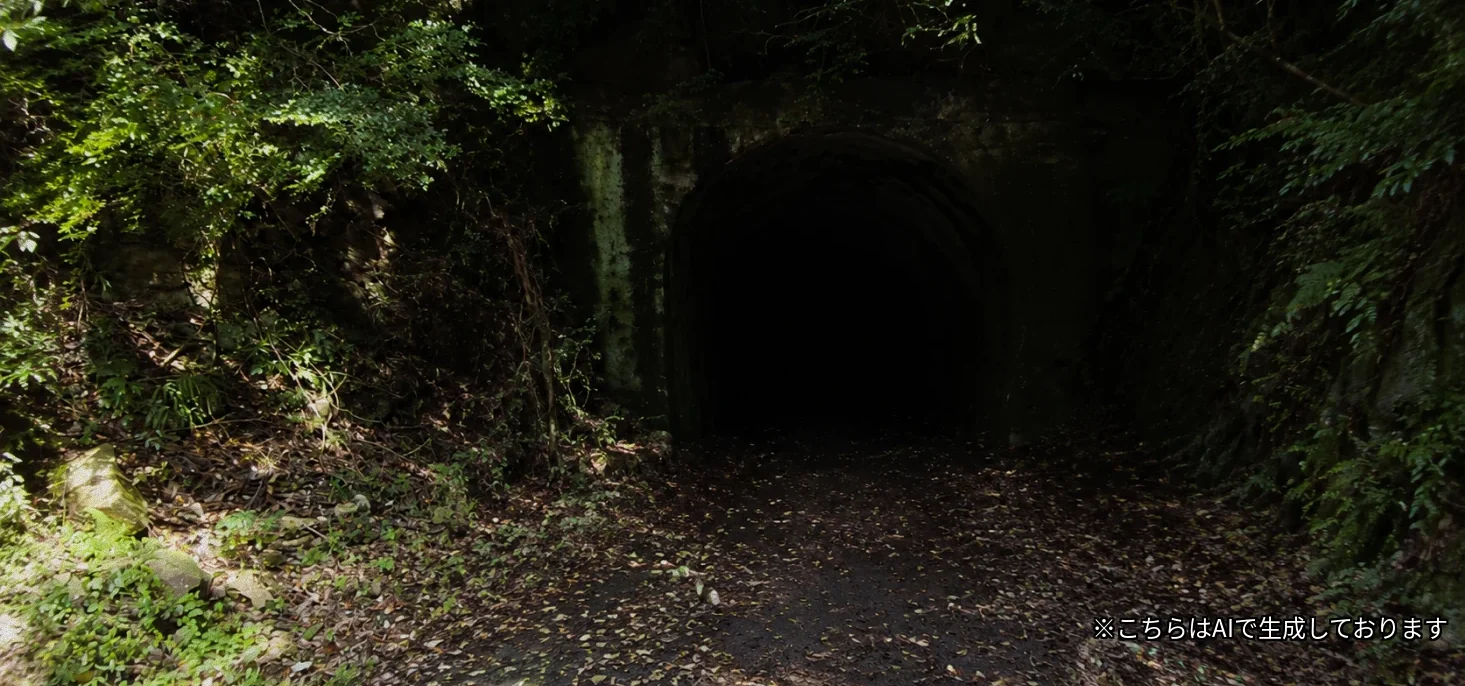
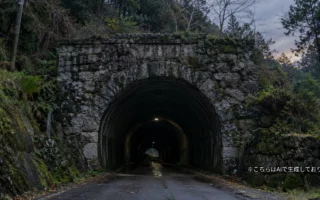
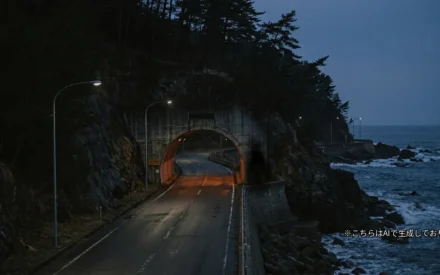
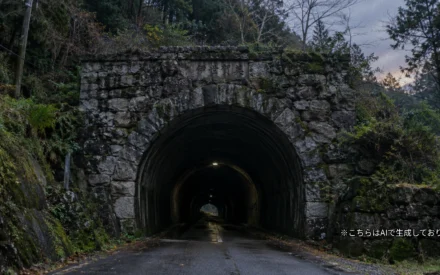
Along a mountain road running from Nanasawa in Atsugi toward the Tanzawa mountains, there is a small tunnel that looks as if it were simply hollowed out of the rock. Locally and on haunted-spot introduction sites it is known as “Yamagami Tunnel,” nicknamed “Bake Tunnel” (Baketon, the “ghost tunnel”), and its name comes up more often than almost any other among the haunted spots of Kanagawa Prefecture. It is still used as a road and can be driven through, but at night the road is narrow and visibility is poor, so caution is needed.
The Tunnel and the Rumor of a Worker’s Death
In this research we could not find any official material confirming the exact year Yamagami Tunnel was completed or how it was built. Old tunnels and cuttings are scattered along the mountain roads that open up the foothills of the Tanzawa range, and this tunnel seems to have been made as part of that kind of development.
According to the rumor, a worker was killed in an accident while the tunnel was being built, and his ghost is still said to linger nearby. Accounts of seeing the ghost of a man in work clothes appear repeatedly on several haunted-spot sites online, but none can be traced back to a primary source (a newspaper article from the time or an official accident record), so how far the rumor rests on actual history remains undetermined.
Why It Is Called a Haunted Spot
The nickname “Baketon” has a strong impact in itself, and its repeated appearance on social media and video sites as one of Kanagawa’s standard haunted spots is thought to explain its high profile. A rumor has also spread that the area around the tunnel is a special “zero field” (zero-magnetic-field) place, and it is distinctive that ghost stories and pseudoscience are told here mixed together.
It should be kept in mind that “zero field” has no strict academic definition and is mostly used in the context of introducing power spots.

Drinks and food left in the car warm up fast during a summer car-camping exploration, so an ice pack in a cooler bag helps. This standard model claims about 8 times the cooling power of an ordinary ice pack, and freezes quickly enough to prep the night before.
LOGOS Rapid-Freeze Ice Pack M 81660642
We may earn a referral fee on purchases made through these links.
The Land of Nanasawa — A Hot-Spring Village and Mountain Roads
The Nanasawa district, where the tunnel stands, lies in the mountain valleys on the eastern side of the Tanzawa range, in the northwest of Atsugi. It was opened up as a hot-spring retreat in the Edo period, and toward the end of that era it is said to have had three bathing inns. Today it is sometimes called the “inner parlor” of Atsugi, and many hikers coming down from Tanzawa and groups on training trips visit. The district also preserves the ruins of Nanasawa Castle, a medieval mountain fortress, so people have long lived and travelled here.
Given this setting, it seems natural to see a small tunnel like Yamagami Tunnel less as a sightseeing road than as a working road linking a mountain village with the outside world. However, we have not been able to reach reliable materials on its completion date or the circumstances of its construction. Below, we take that gap in the records as a premise and consider the background of the rumor.
Access & Location
It is located in Nanasawa, Atsugi City, Kanagawa Prefecture, along a mountain road on the eastern side of the Tanzawa mountains. It is still used as a local road and forest road, and vehicles can pass through this section.
Please note that the position on the map is an approximate coordinate based on public information and may differ from the exact spot.
Current Condition
The tunnel still stands and has not been closed off. However, because it is a mountain road, it is narrow and has almost no streetlights, so visibility at night is poor. Care is needed when passing oncoming vehicles and with the condition of the road shoulder; before any question of ghosts, this is a road that demands a certain level of driving skill and attention simply to pass.
Exploring a haunted spot on foot often means covering long distances, so staying hydrated matters. A one-touch vacuum-insulated steel bottle opens with one hand while the other holds a flashlight or camera, and it keeps drinks cold or hot year-round.
THERMOS Vacuum Insulated Portable Mug Water Bottle 500ml, Ice Blue JNL-S500 ICB
We may earn a referral fee on purchases made through these links.
Our Analysis — Why the Tale of a Tunnel “Martyr” Arises
From here on we are no longer reporting facts; this is our own conjecture. First, consider the name Yamagami, “mountain god.” In Japan’s mountain regions, the mountain god has long been worshipped as the guardian of forestry work and road building. Digging a tunnel means putting a hand inside the mountain, and people have long layered a sense of awe toward the mountain god onto such work. We cannot tell whether the name Yamagami points to the origin of the rumor or simply comes from a place name or a small shrine. Still, the association between the mountain god and safe construction may have made the later tale of a “worker’s ghost” easier to accept.
Next, consider the pattern of “the ghost of a worker who died during construction” itself. Tunnel digging involves dangers such as cave-ins, flooding and gas, and Japan’s tunnel history contains many monuments and memorial customs mourning those lost during construction. This is conjecture, but because people know of such customs, when they come across a new tunnel or a small passage they imagine that “surely someone died here too.” Quite apart from whether an accident actually happened, the sheer weight of the act of building a tunnel may be what produces imagined martyrs.
The specific image of a man in work clothes is another clue. A ghost’s clothing reflects the era and occupation imagery shared by those who tell the story. A man in work clothes is often described not as threatening anyone but simply as still working there. In other words, he is less a frightening spirit than a figure whose time stopped in the middle of his job. In our view, this image seems to carry later generations’ guilt and respect toward the nameless laborers who built roads out of sight and lost their lives.
We should also touch on the “zero field” talk. Zero field is a term used in the context of power-spot introductions and has no strict academic definition. Even so, a mountain tunnel is surrounded by rock and cut off from outside light and sound, and many people feel that compasses or mobile signals become unstable there. That bodily impression strengthens the sense of a “special place” and links up with ghost rumors. Ghost stories and pseudoscience work in similar ways in that both give names to experiences that cannot be explained.
On a night mountain road, the real dangers are far greater. In a narrow tunnel with poor visibility, collisions with oncoming vehicles or falls off the shoulder can happen. Driving in at night to test the rumor is a nuisance to the local people who use this road every day, and dangerous for yourself. We think Yamagami Tunnel is a place that is enough to know about as a record.
Nearby Spot — Nanasawa Onsen
The Nanasawa district, where Yamagami Tunnel lies, is also known as Nanasawa Onsen, with inns dotted among the Tanzawa mountain valleys. Its soft water, sometimes called a “skin-beautifying spring,” is its hallmark, and several inns accept day-trip bathers, so many people stop by after hiking, sightseeing or walks in Tanzawa’s nature. Kōsawa-ji Onsen and others also lie nearby, and a quiet tour of mountain-village hot springs can be enjoyed. It has a side as a place of healing, in contrast to the tunnel’s rumors.
Notes and Cautions
The road can be driven, but at night the risk of a traffic accident caused by its narrow width and darkness is a far more real danger than the ghost rumors. Visiting on foot or by bicycle, or parking on the road, inconveniences nearby residents and other vehicles, so please avoid both.
*KARASU CHANNEL does not recommend late-night visits to haunted spots or staying there as a test of courage.
Frequently Asked Questions
Q. Can you still go to Yamagami Tunnel?
A. Yes, it can be passed through. It is used as an active road, but at night it is narrow and dark, so sufficient caution is needed when driving.
Q. Where does the name “Baketon” come from?
A. It is said to have come to be called that locally and online because of rumors about the ghost of a worker who died during the tunnel’s construction, but its first appearance cannot be identified.
Q. Has KARASU CHANNEL filmed at Yamagami Tunnel?
A. No, we are not filming there at present, and a visit is under consideration. Footage from other haunted spots can be viewed on KARASU CHANNEL (YouTube).
Japanese horror KARASU CHANNEL
Q. Has KARASU CHANNEL conducted an investigation or filmed at Yamagami Tunnel?
A. No, we are not currently investigating Yamagami Tunnel, and a visit is under consideration. Investigation footage from other haunted spots and kaidan stories can be viewed on KARASU CHANNEL (YouTube).

Supervised by Suzuking.
Affiliation: KARASU CHANNEL
Occult & horror reporting: 7 years (since 2020)
Followers: YouTube 5,000+ / X 25,000+
On-site investigations: 30+
If this appeared in your dream
What it means to dream of something from this story, read through psychology and folklore in our Dream Dictionary.
- Dreaming of a TunnelA symbol of transition or trial. Seeing light at the end means a hard time is nearly over.
Kaidan Tales from This Area

Which haunted location do you find the scariest?
If you think this location is the scariest, press the button below. One vote site-wide — you can change your vote for a different location anytime.
Was this article helpful?
Add this to your favorites to find it again anytime from your My Page.
Comments