Yagiyama Bridge (Tatsunokuchi Gorge) (Aoba / Taihaku Ward, Sendai)
Supervised by Suzuking. (KARASU CHANNEL / Occult & horror reporting, 7 years)
Contents
View basic details of this location (address, history, status, etc.)
- Location
- Kawauchi to Yagiyama, Aoba Ward, Sendai City, Miyagi Prefecture (Ryu-no-kuchi Valley) (the map position is an approximate coordinate)
- Built
- Bridge built in 1965 (Showa 40)
- Closed / Decommissioned
- Not applicable — remains in use as an active city road bridge for both vehicles and pedestrians. A safety fence has been installed
- First Rumored
- Unknown (further research needed) — long said that "a ghost beckons" from the bridge
- Current State
- An active city road bridge. A suicide-prevention fence roughly 2m high has been installed
- Access
- Open to cross (entering the valley beyond the fence is prohibited and dangerous)
- Last Verified
- 2026.09.11
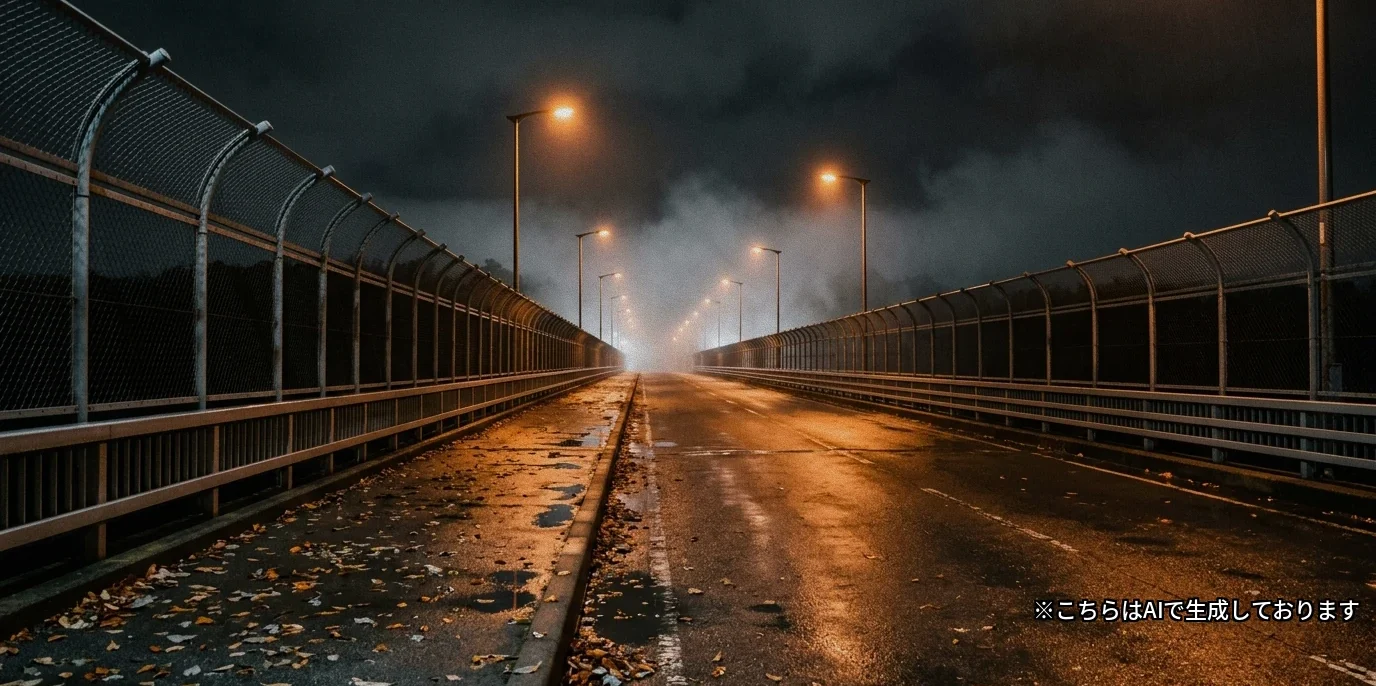
About a 15-minute drive from downtown Sendai in Miyagi Prefecture, a single bridge spans Tatsunokuchi Gorge: Yagiyama Bridge. It is one of the best-known haunted spots in the entire prefecture, and at the same time a bridge where, because it is known as a place associated with suicide, safety measures have been layered on for many years. Today fencing taller than a person stands along it, and the bridge itself remains an active city road that cars and pedestrians cross every day.
History of Yagiyama Bridge: From a Pleasure-Trip Suspension Bridge to Concrete
Yagiyama Bridge sits on the boundary between Kawauchi in Sendai’s Aoba Ward and Nagamachi in Taihaku Ward; the ward line runs right across the middle of the deck. Cross north and you reach the ruins of Sendai Castle; cross south and you arrive in the homes and leisure grounds of Yagiyama. The name “Yagiyama” itself is only about a century old. In the Edo period this hill was called Koejiyama, and after the Meiji Restoration it became land held in common by former retainers of the Sendai domain. In 1924, Yagi Kyubei, the fifth head of the Sendai merchant house of Yagi, bought the land and opened it to the public as a recreation area with a ballpark and a park, and the hill gradually came to be known as Yagiyama, “the Yagi family’s hill.”
Standing between central Sendai and Yagiyama, however, was the deep Tatsunokuchi Gorge. Yagi Kyubei paid out of his own pocket to span it, and in November 1931 the first Yagiyama Bridge opened: a suspension bridge 107 meters long and 3.7 meters wide, billed at the time as the finest suspension bridge in Miyagi Prefecture. The view down into the gorge became famous, and in the early Showa years crowds of Sendai residents crossed it on their way to cherry-blossom viewing and hikes in Yagiyama. The bridge was later donated to the city.
As cars took over, a swaying suspension bridge could no longer do the job. Reconstruction began in 1962 using the Dywidag method, in which concrete is cantilevered out little by little from each pier. The present concrete bridge opened in April 1965. That same year Yagiyama Zoological Park opened just south of the bridge, followed three years later by the Yagiyama Beny Land amusement park. Today’s bridge, in other words, was born in the years when Yagiyama was at its liveliest as Sendai’s favorite day-trip destination.
Tatsunokuchi Gorge: A Sea Five Million Years Old, and the Valley That Guarded Sendai Castle
The gorge beneath the bridge was carved by the Tatsunokuchi stream, a tributary of the Hirose River. It runs for about three kilometers, and directly below Yagiyama Bridge it reaches a depth of roughly 70 meters. The cliff faces show layers stacked from bottom to top: the Tatsunokuchi, Mukaiyama and Dainenji formations. The lowest, the Tatsunokuchi Formation, settled on the floor of a sea that some five million years ago reached from today’s Sendai Bay all the way up to around Hanamaki in Iwate Prefecture, and it takes its name from this very stream. It is rich in fossil shells related to scallops, and fossils of whales and even elephants have been found in it. It is now closed to entry because of the danger of falling rocks.
The gorge also mattered to Sendai Castle, built by the warlord Date Masamune in the early 1600s. The castle’s main enclosure was a natural fortress, protected by the cliffs of the Hirose River to the east and by Tatsunokuchi Gorge to the south, and Yagiyama Bridge crosses precisely that southern line of defense. Sources differ on the origin of the name “Tatsunokuchi”: some say the gorge lay in the direction of the Dragon (tatsu, the southeast in the traditional zodiac compass) as seen from the castle, others that the narrow, perilous path down into it was called the “Tatsu-no-kuchi,” the Dragon’s Mouth. Both explanations, at least, trace it back to the Dragon.
Why Is It Called a “Haunted Spot”?
The rumor most often told is that a spirit stands on the bridge and beckons to passersby. Other stories describe a feeling of being watched while crossing at night, or a human shape appearing briefly in a car’s headlights. We were unable to find any source that pins down specifically when, or by whom, these rumors first began. What is clear is that the bridge is known as a place associated with suicide, and that its protective fencing has been raised in stages for that reason.
No reliable record explains how the rumors spread. This is our speculation, but the scene itself, a ravine so deep you can barely see the bottom, just minutes from the city, lined with fencing that has visibly been raised again and again, may be enough to make visitors imagine that “something happened here,” and so to keep the stories growing. In recent years, fans have also speculated that the bridge was the model for a bridge in the manga Jujutsu Kaisen, bringing its name to a younger audience (we have found no official statement from the author or publisher confirming this).

A cooling towel worn around the neck against heatstroke during summer ruin or outdoor haunted-spot exploration. Just wet and wring it out for a -15°C cooling sensation that lasts up to two hours.
MISSION Original Cooling Towel, Skin Temp -15C, Heatstroke Prevention, UPF50, Black
We may earn a referral fee on purchases made through these links.
Access & Location
Yagiyama Bridge is a city road bridge over Tatsunokuchi Gorge, forming part of a regular commuter route linking central Sendai with the Yagiyama district. It is also a main route from the Taihaku side to the Sendai Castle ruins and Tohoku University’s campuses. The bridge has a sidewalk, and during the daytime a good number of commuters and students cross it as part of daily life.
Current Conditions
Today, fencing taller than a person runs along both sides of the bridge. It did not reach its present form all at once: according to reports, it has been raised in stages to prevent suicides, with an inward-curving section added along the top. The gorge below is also closed to entry because of the risk of falling rocks.
Reflection
Tracing its history, it becomes clear that Yagiyama Bridge was born as a bridge people crossed for pleasure. Yagi Kyubei is said to have built the original suspension bridge so that ordinary citizens could easily climb the hill, get some exercise and enjoy the scenery. Back then, the depth of the gorge was spoken of not with dread but as a spectacular view. In our view, the root of the bridge’s rumors lies in how that same 70-meter drop changed meaning over time, from the highlight of a day out to a depth that calls up painful memories. The place itself has not changed at all; what people see in it has.
Another thing that stands out is how many boundaries this bridge straddles. Aoba Ward and Taihaku Ward divide at its midpoint; the gorge once separated the castle’s defenses from the world outside; and beneath it lies the open floor of a sea from five million years ago. This is speculation, but in Japan, bridges, crossroads and village borders have long been thought of as thresholds to another world. The rumor of “a spirit standing on the bridge, beckoning” may be an extension of that old way of imagining a figure at the threshold drawing people across. And the fence, raised piece by piece, is also a visible accumulation of the feelings of those who lost someone here and of those who have worked to keep it from happening again.
The rumors surrounding Yagiyama Bridge seem, to us, less a matter of the supernatural than something tied to the memory of genuinely painful events that have taken place here. Visiting this location to “test” the legend would not only be dangerous; it risks showing a lack of consideration for those who died here and for their families. We introduce this bridge not as a spot for thrill-seeking, but as a place to record, alongside the history of the safety measures built around it.
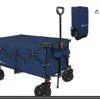
A folding utility cart for hauling heavy, bulky gear — a generator, large lights, a tripod, a full camera kit — in one trip from the parking lot to a ruin or mountain haunted spot. Its brake keeps it stable on slopes, and a 100kg load capacity lets it carry several people's gear at once.
MOON LENCE Folding Utility Cart with Brake, Large Capacity 156L, Wide Big Tires, 100kg Load Capacity
We may earn a referral fee on purchases made through these links.
Nearby: Sendai Castle Ruins, Yagiyama Zoological Park and Yagiyama Beny Land
Cross Yagiyama Bridge to the north and you are close to the ruins of Sendai Castle (Aoba Castle), built by Date Masamune, where the stone walls and the site of the main enclosure can be visited as a National Historic Site. To the south, in the Yagiyama district, are Yagiyama Zoological Park, opened in 1965, and Yagiyama Beny Land, an amusement park long loved by Sendai locals. Bright, family-friendly attractions and the history of a castle sit side by side across a deep ravine, which is part of what makes this area unique.
Notes
Climbing over the fence to enter the valley side is extremely dangerous and must never be attempted. The bridge remains an active local road, so please also be considerate of other pedestrians and nearby residents, especially at night. This article is published as a record, not as an invitation to visit.
*KARASU CHANNEL does not encourage entering haunted locations. If you are struggling, please don’t carry it alone. In Japan, the Yorisoi Hotline (0120-279-338, 24 hours, toll-free) will listen to any kind of worry. If you are outside Japan, please contact a local crisis line.
Frequently Asked Questions
Q. Can you still cross Yagiyama Bridge today?
A. Yes. It’s an active city road bridge with a sidewalk. That said, climbing over the fence to enter the valley side is dangerous and should never be done.
Q. Are incidents here really that frequent?
A. It is known as a place associated with suicide, and its fencing has been strengthened in stages. We do not discuss numbers on this site.
Q. How long has the rumor about Yagiyama Bridge been told?
A. The rumor that a spirit stands on the bridge and beckons to passersby is widely told, but we have found no source establishing when it began or who first told it.
Q. Does Yagiyama Bridge have a safety fence?
A. Yes. Fencing taller than a person runs along both sides of the bridge to prevent falls into the valley. Climbing over it to enter the valley side is extremely dangerous.
Q. When was Yagiyama Bridge built?
A. The first was a suspension bridge built in 1931 at the personal expense of Yagi Kyubei; the current concrete bridge opened in April 1965.
Q. Can you go down into Tatsunokuchi Gorge?
A. No. The gorge is closed to entry because of the danger of falling rocks. Please view it only from Yagiyama Bridge.
Q. Where can I turn if I’m struggling emotionally?
A. Please don’t carry it alone. In Japan, you can call the Yorisoi Hotline (0120-279-338, 24 hours, toll-free) or another public support line. This article is published as a record, not as an invitation to visit.
Q. Has KARASU CHANNEL filmed on location at Yagiyama Bridge?
A. No, we have not filmed there yet; a visit is currently under consideration. Location footage for other haunted spots can be viewed on KARASU CHANNEL (YouTube).

Supervised by Suzuking.
Affiliation: KARASU CHANNEL
Occult & horror reporting: 7 years (since 2020)
Followers: YouTube 5,000+ / X 25,000+
On-site investigations: 30+
Kaidan Tales from This Area
Which haunted location do you find the scariest?
If you think this location is the scariest, press the button below. One vote site-wide — you can change your vote for a different location anytime.
Was this article helpful?
Add this to your favorites to find it again anytime from your My Page.

Comments