The Haunting of Kawara-no-in: Why Did Minamoto no Tōru’s Spirit Appear After Death Saying “This Is My House”?
Supervised by Suzuking. (KARASU CHANNEL / Occult & horror reporting, 7 years)
Contents
View sources and last-checked date
- Source 3
- https://tabi-mag.jp/ky0736/
- Last verified
- 2026-09-30
A little south of Kyoto’s Gojō Ōhashi Bridge, on Kiyamachi-dōri along the Kamo River, stands a single enoki (Chinese hackberry) tree with widespread branches. At its foot is a stone monument inscribed “Site of Kawara-no-in.” This is where one of the finest mansions of the Heian capital once stood. Its master was Minamoto no Tōru, a prince of Emperor Saga and Minister of the Left, and the residence was known for a lavish garden that transplanted the scenery of a distant Mutsu seashore into the capital.
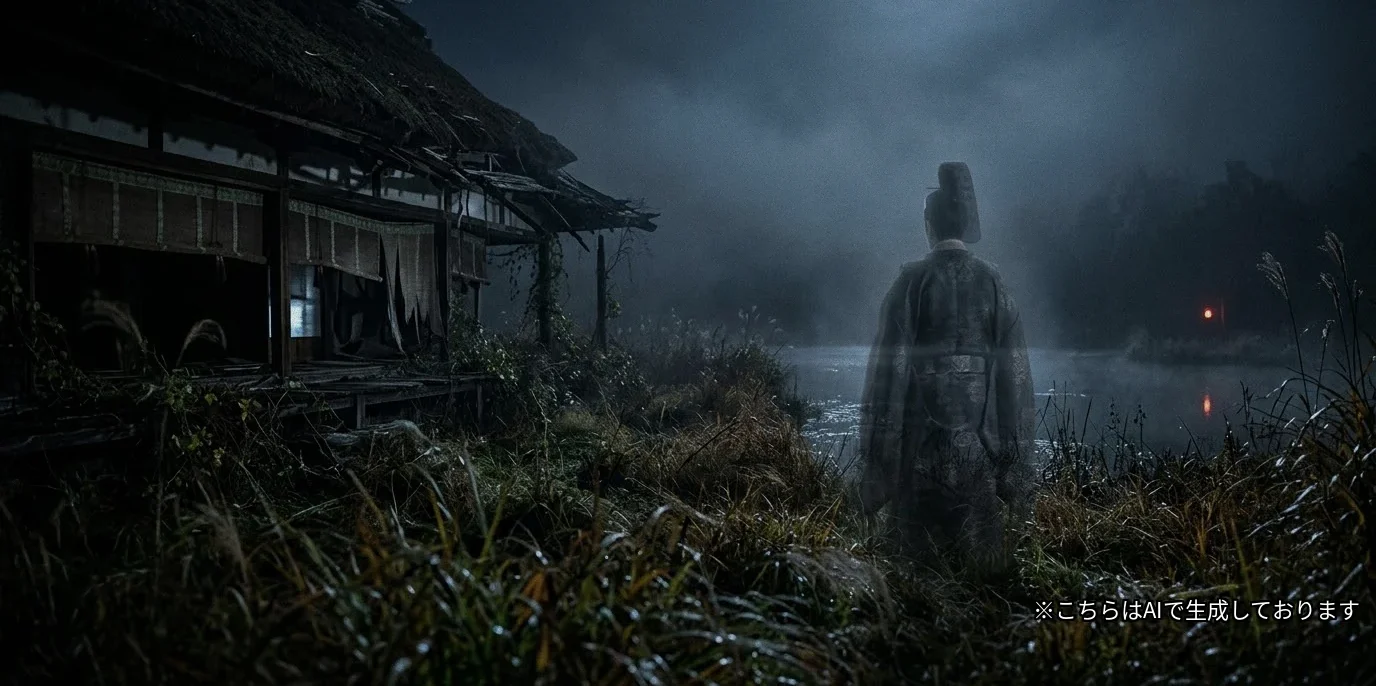
After its master’s death, however, the mansion came to be remembered for another reason. Late at night, a man in formal court dress appears and says, “This is my house.” He voices his complaint face to face to the new resident, a retired emperor. Later, when the mansion fell to ruin, something nameless began to attack those who stayed there. It is among the oldest “haunted house” tales in Japanese texts. Can the dead not let go of their homes even in death? And what comes to dwell in a house that has lost its master? Let us follow the haunting of Kawara-no-in.
Origins: Minamoto no Tōru and the Mutsu Sea Brought to the Capital
Minamoto no Tōru was born in 822 as a son of Emperor Saga. Emperor Saga, who had many children, gave the surname Minamoto to some of his sons and lowered them to the status of subjects. Tōru was one of them. Though he left the imperial register, he was still the emperor’s son by blood. He rose steadily and became Minister of the Left in 872.
But the latter half of Tōru’s life overlapped with the rise of Fujiwara no Mototsune, who became regent. When Mototsune, younger and lower in rank, took real political power, Tōru is said to have shown his intent to resign and withdrawn to his residence. The historical tale Ōkagami even preserves an anecdote in which, when the question of imperial succession arose, Tōru stepped forward saying, “If you are looking for someone with blood close to the emperor, there is also me,” and was brushed off by Mototsune. Whether the tale is true is doubtful, but it at least shows that later generations regarded Tōru as “a man who might have become emperor.”
What Tōru poured his heart into was Kawara-no-in, which he built around Rokujō. Its grounds are said to have been four or even eight chō, many times the size of a standard noble’s mansion in Heian-kyō. He drew in water from the Kamo River to make a pond and built a garden imitating the scenery of Shiogama Bay in Mutsu Province, a famed scenic spot. He is also said to have had large quantities of seawater brought monthly from the shore of Settsu and actually had salt boiled in the garden, enjoying the smoke. He tried to recreate, in the middle of the capital, the landscape of a distant poetic place, right down to the smell of the smoke. Tōru’s poem included as number 14 in the Hyakunin Isshu, “Michinoku no shinobu mojizuri tare yue ni midare somenishi ware naranaku ni” (“Whose fault is it that my heart is tangled like the patterned cloth of Michinoku? Surely not mine alone”), also works in a Mutsu place name.
Tōru died in 895. Kawara-no-in was inherited by his son Minamoto no Noboru and was eventually presented to Retired Emperor Uda, becoming his residence. The haunting begins here.
According to the tale placed at the beginning of Book 27 of the Konjaku Monogatarishū, one night while the retired emperor lived at Kawara-no-in, the door of an inner room called the nurigome opened and a formally dressed figure appeared. When the retired emperor asked who it was, it answered, “I am the old master of this house.” It was Tōru’s spirit. The spirit complained that it was awe-inspiring and unbearably cramped to have the retired emperor there. The retired emperor was not at all shaken and scolded it: “This house was presented by your descendants. I did not seize it on my own. How dare you speak without reason?” The spirit vanished as if erased and never appeared again, the tale says.
The same incident is told more vividly in the Gōdanshō, the collection of talks by Ōe no Masafusa. While the retired emperor was watching the moon at Kawara-no-in with his favorite, the consort Kyōgoku no Miyasudokoro, Tōru’s spirit appeared and pressed, “I would like to have the Miyasudokoro,” clinging to the retired emperor’s waist. The consort fainted, and the retired emperor barely brought her back to health through prayers. Later commentaries also record a variant in which the consort was about to be dragged into the building.
Why Is It Called a “Haunted House”?
What is distinctive about Tōru’s spirit tale is that it is not a story of an onryō, a vengeful spirit. In the same era, the spirit of Sugawara no Michizane was feared for turning into thunder and attacking the palace, causing deaths at the Seiryōden. Tōru’s spirit, however, neither curses anyone to death nor brings plague. It only says that it cannot settle with others in its own house, and withdraws when scolded by the retired emperor. His grudge is directed not at the state but purely at a single house.
This form, “a dead person bound to a place,” is exactly why Kawara-no-in is called the prototype of the haunted house. The building remembers its master’s attachment, and even when the residents change, the previous master stays put. A composition familiar from modern horror films already appears in a tale collection over a thousand years old.
Kawara-no-in was afterward given to Tōru’s son Ninkō, who had become a monk, and became a temple, also called Kawara-dera. In the latter half of the tenth century, Anpō Hōshi, a descendant of Tōru, lived there, and for a time it became an elegant salon where poets gathered. But given its location by the Kamo River, it was repeatedly hit by floods and fires, and the mansion gradually fell to ruin. Hyakunin Isshu number 47, Egyō Hōshi’s “Yaemugura shigereru yado no sabishiki ni hito koso miene aki wa kinikeri” (“In this lonely dwelling overgrown with many weeds, no person is seen, yet autumn has come”), is said to have been composed at Kawara-no-in about autumn visiting a ruined house. The famed garden that once copied the Mutsu sea had turned into a deserted house thick with weeds.
And in the ruined Kawara-no-in, Tōru’s spirit no longer appears. What appears instead is a “something” of unknown name and form. Book 27 of the Konjaku Monogatarishū contains a tale of a couple who came up to the capital from the eastern provinces, found no lodging, and stayed in a vacant room at Kawara-no-in. At night the door at the back of the room suddenly opened, and a hand seized the wife and dragged her inside. The husband pounded on the door but it did not open. At daybreak, when he broke the door down, his wife had been hung on a pole, dead, looking as though drained of all her blood. People said it must be the work of a demon.
Present Day: A Monument, an Enoki, and the “Certain Mansion”
The buildings of Kawara-no-in no longer exist. All that remains at the reputed site, on Kiyamachi-dōri just south of Gojō, are a stone monument and a great enoki said to be a remnant of the old grove. Nearby, town names bearing the name Shiogama, such as “Moto-Shiogama-chō,” remain and keep the memory of Tōru’s garden in place names. It is also said that Shōseien, a detached precinct of Higashi Honganji, was laid out in the Edo period on part of the former site of Kawara-no-in.
Kawara-no-in also lived on in literature. The Tale of Genji commentary Kakaishō names Kawara-no-in as one of the models for the Rokujō-in, Hikaru Genji’s residence. There is also a persistent theory that the “certain mansion” (nanigashi no in) to which Genji took Yūgao, the setting of the scene where Yūgao is killed by a spirit in a ruined house, is based on Kawara-no-in. Considering that Tōru himself is one of the candidate models for Hikaru Genji, Tōru’s mansion may be said to have become the prototype of the most famous “spirit-haunted house” in the history of Japanese literature.
In the Muromachi period, Zeami composed the noh play “Tōru.” A traveling monk who visits the capital meets an old salt-water carrier at the ruins of Kawara-no-in. The old man tells of the past of the Shiogama garden and vanishes, and at night Tōru’s spirit appears in his former form and dances beneath the moon. Here Tōru is drawn not as a terrifying ghost but as an elegant spirit longing for lost splendor.

Attach an AirTag to your car keys, bag, or the car itself before exploring an unfamiliar ruin or mountain haunted spot, and you can check its location in the Find My app if you forget where you parked or lose track of a bag in the dark. Even deep in the mountains with poor reception, its location updates via nearby Apple devices — a safety and anti-loss measure for solo exploration.
Apple AirTag (2nd Generation) Item Tracker, Find by Sound, Water & Dust Resistant, Works with Find My Network
We may earn a referral fee on purchases made through these links.
Our Reading: A Man Who Could Not Remain a Prince, and the Place He Had to Return To
It seems to us that there is special meaning in the fact that the person before whom Tōru’s spirit appeared was none other than Retired Emperor Uda. In our view, this confrontation is not merely a “dispute over who owns the house.” Tōru was born a son of Emperor Saga but was lowered to subject status and cut off from the path to becoming emperor. Emperor Uda, on the other hand, followed an extremely rare career: he too was once given the Minamoto surname and became a subject, was later restored to the imperial family, and took the throne. Both experienced subject status, yet one sat on the throne and the other could not. This is our own speculation, but the people of the time may have seen in the two facing each other at Kawara-no-in a “fork in the road of fate over the imperial throne.” That the retired emperor drove the spirit off by citing “reason” was also, presumably, a scene confirming the rightness of the living imperial line.
Then why did Tōru cling so to his house? The garden of Kawara-no-in copied the sea of Mutsu. There is no firm record that Tōru himself ever visited Mutsu. This is our own speculation, but for a man who could not live as he wished in the political arena, building within the capital the scenery of a distant land he would never go to may have been an act of making a small “country” that only he could govern. The smoke of the salt fires may have been, for him, smoke of longing for the wide world he could not have. If so, it is only natural that even after death he could not leave. Kawara-no-in was not merely a dwelling but the dream of the man Tōru himself.
The Gōdanshō’s tale of the spirit seeking the consort Kyōgoku permits a still more visceral reading. A man deprived of his house now tries to take from the house’s new master what he treasures most. We would like to read this as the process in which the obsession to regain what was lost turns into a desire for what belongs to another. The gentle Tōru of the Konjaku Monogatarishū and the greedy Tōru of the Gōdanshō: depending on which figure is told, the storytellers’ feelings toward the dead, whether sympathy or fear, show through.
And the most frightening thing is Kawara-no-in after Tōru’s spirit disappeared. A spirit with a name could at least be spoken to. The retired emperor scolded it with reason and it withdrew. But the “something” that attacked the wife from the east in the ruined mansion did not give its name, did not exchange words, and simply pulled people in and took their lives. This is our own speculation, but this change seems to reflect the change of Heian-kyō itself. In an age when the capital’s population fell and vast mansions one after another lost their masters and decayed, houses with no one living in them became sources of unknowable fear. When no one who knows the memory of the dead remains, what dwells there is no longer the spirit of “someone” but a nameless darkness. When Tōru ceased to be talked about, Kawara-no-in became a “haunted house” in the true sense.
It should not be overlooked either that those attacked were travelers from the east who did not know the capital’s circumstances. Local people would not go near such a ruin, but outsiders step in unawares. This pattern is no different from modern ghost stories about ruins and vacant houses. A thousand years ago, the tales had already accurately identified the fundamental unease humans feel toward “a house where no one lives anymore.”
Moreover, the reason the story of Kawara-no-in is still told a thousand years later is probably that it touches our feelings about “home,” a space familiar to everyone. The loneliness of moving day, the hesitation of visiting a childhood home that has become vacant, the impulse to leave a deceased person’s room just as it was: these feelings of ours today are not so far from the night Tōru’s spirit insisted, “This is my house.” In our view, the haunting of Kawara-no-in is less a story of a dead man’s grudge than the oldest surviving record of the human tendency to be unable to separate a dwelling from memory.

Ultra-lightweight safety glasses with anti-fog and anti-scratch coating — protect your eyes from falling ceiling debris, flying glass, and dust inside a ruin.
TRUSCO Ultra-Lightweight Safety Glasses, Clear Lens SS936
We may earn a referral fee on purchases made through these links.
Engaging With This Legend
Minamoto no Tōru was a real person, and Kawara-no-in was indeed a mansion that existed. The tale that Tōru’s spirit appeared, however, is tradition recorded in tale collections and stories and cannot be confirmed as history. In this article we have introduced separately the records, such as Tōru’s life and the changes of Kawara-no-in, and the tales about the spirit.
The area around the site of Kawara-no-in is now an urban district lined with houses and shops, a place where local people live their lives. If you visit to see the monument and the enoki, please take care not to enter private property or make noise at night. Shōseien is a temple precinct, and you should follow its visitor guidance.
Places connected with Tōru remain elsewhere too, in Saga, Uji and other areas, and are still carefully kept by their respective temples. You are free to enjoy uncanny tales, but please do not forget to respect the faith and daily life of the temples, shrines, and local people connected to them.
Frequently Asked Questions
Q. Where was Kawara-no-in?
A. It is said to have spread over the west bank of the Kamo River around Rokujō in Heian-kyō. Today, a stone monument reading “Site of Kawara-no-in” and a large enoki tree remain on Kiyamachi-dōri just south of Gojō in Shimogyō Ward, Kyoto.
Q. In what tales does Minamoto no Tōru’s spirit appear?
A. In the Konjaku Monogatarishū, Tōru’s spirit appears before Retired Emperor Uda living at Kawara-no-in and complains that it is “cramped,” but the retired emperor scolds it, “This house was presented by your descendants,” and it disappears. In the Gōdanshō it is told as a more frightening tale in which the spirit seeks the consort the retired emperor had brought.
Q. Is Kawara-no-in related to the Tale of Genji?
A. The commentary Kakaishō names Kawara-no-in as one of the models for Hikaru Genji’s Rokujō-in. There is also a theory that the “certain mansion” in which Yūgao is killed by a spirit is also modeled on Kawara-no-in.
Q. Was Tōru’s spirit the only strange phenomenon at Kawara-no-in?
A. No. As a tale from after the mansion fell to ruin, the Konjaku Monogatarishū records a story in which the wife of a couple from the eastern provinces was dragged deep into a room at night and found dead the next morning. This is attributed to a demon of unknown identity.
Q. What was the Shiogama garden like?
A. It was a garden imitating the scenery of Shiogama Bay in Mutsu Province, said to have actually boiled salt using seawater brought from the shore and to have enjoyed its smoke. Town names such as the nearby “Moto-Shiogama-chō” are also said to derive from this garden.
Tōru’s “Michinoku no” poem can also be drawn in KARASU CHANNEL’s Hyakunin Isshu Divination.
Q. Has KARASU CHANNEL researched or filmed the haunting of Kawara-no-in on location?
A. No. We are not currently researching the haunting of Kawara-no-in, though we are considering doing so. Videos of our research into other haunted spots and ghost stories can be viewed on KARASU CHANNEL (YouTube).

Supervised by Suzuking.
Affiliation: KARASU CHANNEL
Occult & horror reporting: 7 years (since 2020)
Followers: YouTube 5,000+ / X 25,000+
On-site investigations: 30+
If this appeared in your dream
What it means to dream of something from this story, read through psychology and folklore in our Dream Dictionary.
- Dreaming of a GhostRead as a symbol of unease — often said to be an unacknowledged feeling, built-up fatigue, or an unresolved e…
Which story do you find the scariest?
If you think this story is the scariest, press the button below. One vote site-wide — you can change your vote for a different story anytime.
Was this article helpful?
Add this to your favorites to find it again anytime from your My Page.









Comments