The Okiku Doll of Mannen-ji Temple (Kurisawa, Iwamizawa)
Supervised by Suzuking. (KARASU CHANNEL / Occult & horror reporting, 7 years)
Contents
View sources and last-checked date
- Source
- Nihon Densho Taikan, "O-Giku Doll" https://japanmystery.com/hokkaido/mannenji.html
- Last verified
- 2026-09-16
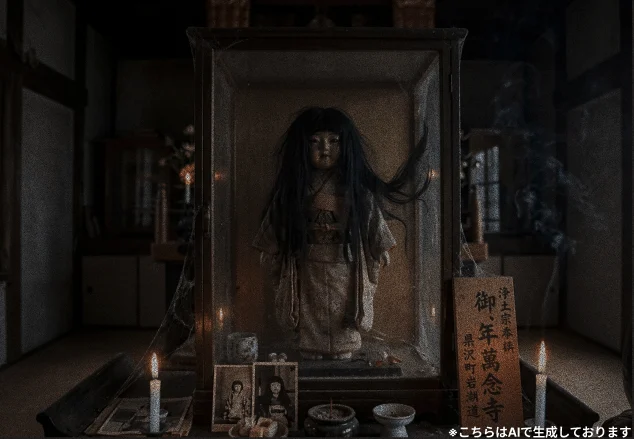
Mannen-ji is a Jōdō-shū (Pure Land) Buddhist temple in Kurisawa, Iwamizawa City, Hokkaido. In a corner of its main hall sits a Japanese doll roughly 30-odd centimeters tall — the kind you might find anywhere. But this particular doll carries a persistent rumor: no matter how many times its hair is cut, it keeps growing back. Known nationwide as the Okiku Doll, it can no longer be photographed, and viewing it up close now requires the head priest’s permission. This article records what is known and what is only legend about a doll that continues to be cared for to this day.
Origin — A Gift for a Sister Named Kikuko
The origin story most often told goes like this. In August of Taishō 7 (1918), the Hokkaido Development 50th Anniversary Exposition was held at sites including Sapporo’s Nakajima Park to mark half a century since Hokkaido’s colonization began — an event that drew more than 1.42 million visitors during its run, an unprecedented scale at the time for a regional exposition outside Tokyo or Osaka. At the fairgrounds, 17-year-old Suzuki Eikichi (some sources give the reading as “Hidekichi”) bought a Japanese doll and gave it to his three-year-old sister, Kikuko. Kikuko grew deeply attached to it, reportedly carrying it to bed and sleeping beside it every night. But in January of the following year, Taishō 8 (1919), Kikuko caught a cold and died suddenly. This period coincided with the worldwide Spanish flu pandemic (1918–1920), which was also raging across Japan — raising the possibility, which can’t be ruled out, that young Kikuko’s “cold” was in fact connected to that outbreak. That said, this is only our own speculation here at KARASU CHANNEL; no historical record states it explicitly. Rather than being placed in her coffin, the doll was set on the family’s Buddhist altar alongside Kikuko’s remains, and her brother kept it afterward as a treasured memento of his late sister.
The Doll Whose Hair Grows — Where the Rumor Began
The turning point came some time later, when the family noticed that the doll’s hair had, at some point, grown down to around its shoulders. Since a doll’s hair should never grow on its own, the Suzuki family reportedly came to believe that the spirit of the late Kikuko had come to dwell inside it. In Shōwa 13 (1938), the family relocated to Karafuto (present-day Sakhalin). Unable to take the doll with him, Eikichi entrusted it to the local temple, Mannen-ji, and asked that it be enshrined and cared for in perpetuity. It has been kept and venerated there ever since — for more than eighty years now.

Essential gear for documenting places like this: a light bright enough to properly illuminate the ground underfoot. Here’s the high-output LED light we use in our own fieldwork.
GENTOS LED Light 600lm, IP66 Compliant RX-022DS
Why It Became Famous Nationwide
The rumor of a “doll whose hair grows” spread nationwide through Shōwa-era weekly magazines and television programs, and the Okiku Doll of Mannen-ji came to be counted among Japan’s most famous “dolls said to house a spirit.” Dig a little deeper, though, and inconsistencies emerge. A 1962 (Shōwa 37) article in the magazine Shukan Josei Jishin gives the name of the child who cherished the doll as “Kiyoko,” and dates the doll’s entrustment to the temple to 1958 (Shōwa 33) — details that don’t match the now-widely-told version featuring “Kikuko” and the year 1938. It’s possible the details shifted over decades of retelling, or that several separate stories became blended together. Mannen-ji itself is said to explain that the doll’s hair is trimmed once a year, at a March hair-cutting ceremony — but no comparison photographs documenting its supposed growth over the years have ever been published, and several articles note that side-by-side comparisons of old and recent photos show no obvious change in length. In truth, this doll’s “origin” doesn’t appear to have been fixed from the start; rather, multiple versions with differing details seem to have circulated in parallel across different eras. The now-standard set of details — “Suzuki Eikichi, Kikuko, Taishō 7” — appears to have solidified into today’s accepted version only around 1970 (Shōwa 45). Rather than a hundred-year-old event passed down unchanged, this looks more like a “living legend” whose outline has been refined a little more with each retelling.
Folds down to a compact roughly 12×19.5×6 cm with a carrying case, and assembles into a 3-in-1 shovel, hoe, and pick. A portable shovel useful for getting unstuck from mud or snow on mountain trails and around ruins, or for clearing footing on overgrown paths.
Takagi KANUCHI OUTDOOR 3-Way Portable Shovel with Storage Case, Black

Exploring a ruin or mountain haunted spot often means bringing home mud- or water-stained boots, rain gear, or used wet wipes. A foldable, highly waterproof EVA bucket lets you bundle all the dirty items together, then rinse it out and fold it flat afterward.
amon OGC Multi Bucket, EVA Material, Waterproof, Approx. 16L Capacity 8631
We may earn a referral fee on purchases made through these links.
Reflection — What Matters Isn’t Whether It’s “Real,” But That It Has Been Cared For
From here on, this section reflects our own speculation. We have no way to verify whether the doll’s hair actually grows. Unlike human hair, hair used in dolls (often real human hair or silk thread) is not something that can scientifically grow on its own. But what we really want to write about here isn’t settling the question of whether it grows or not. It’s why a young man named Eikichi never let go of the doll — and why, even at the life-altering moment of relocating to Karafuto, he chose to entrust it to a temple in his sister’s place rather than simply keeping it or discarding it.
Japan has long had a custom of not simply throwing away worn-out kimono or dolls no longer used, but bringing them to a temple or shrine to have their “spirit removed” — a memorial rite known as ningyō kuyō, or doll memorial service. Underlying it is the sense that anything shaped like a person naturally absorbs some of its owner’s feelings. To Eikichi, this doll was probably never just a toy — it was Kikuko herself. Having to leave his hometown without ever fully coming to terms with his sister’s death, Eikichi didn’t simply hold onto the doll or let it go; instead, he chose to entrust it to a temple, a specialist in laying the dead to rest. We think this was likely an expression of his wish to send Kikuko off properly, rather than abandon her. The realization that “the hair had grown” may have been an illusion born from the family’s own overwhelming grief and longing — or something may genuinely have taken hold in that doll. Either way, we believe the heart of this story lies in the sheer strength of will among the bereaved, determined that no one should forget a single child who died too young.
This idea overlaps with the Japanese folk belief in tsukumogami — spirits said to inhabit tools and dolls that have endured for a great many years, a belief traceable back to picture scrolls from the Muromachi period. Traditionally, an object is thought to gain a spirit only after nearly a century has passed. But in the case of the Okiku Doll, the time between Kikuko’s death and the doll’s hair supposedly beginning to grow was far shorter than that. We suspect that what made people feel a “spirit had taken hold” wasn’t the length of time at all, but something more fundamental: the belief that it is the depth of love and unresolved longing poured into an object — not years elapsed — that gives it a soul. That, at least, is our own reading of it.
Taken purely as a catchy paranormal phenomenon — “a doll whose hair grows” — this could easily end up as just another cursed-doll story among many. But we suspect it has been passed down across the country not because of the fear itself, but because so many people, across different eras and regions, have related to the feeling behind it: the simple wish for someone to be remembered. The fact that Mannen-ji still changes the doll’s kimono and trims its hair today is itself proof that the wish of one brother, a hundred years ago, is still being carried forward by people with no blood tie to him at all.
Mannen-ji and the Okiku Doll Today
Today, the doll remains in a corner of the main hall and continues to be carefully looked after, including having its kimono changed from time to time. Viewing it up close requires the head priest’s permission, and while visitors were apparently once free to photograph it, photography is now prohibited. Some accounts attribute this to a tradition that “Kikuko’s spirit, dwelling in the doll, dislikes being photographed”; others cite a more practical reason — that a number of visitors reportedly mailed their photos back to the temple afterward. In recent years, a newer rumor has also begun circulating that the doll’s mouth is gradually opening — though, like the hair-growing rumor, this comes with no solid evidence either. Visitors who have actually gone report the doll gives off “a somewhat sorrowful atmosphere,” suggesting the place conveys less outright fear than a quiet grief for a child who died too young.
Notes for Visitors
Mannen-ji is an active religious institution, and the Okiku Doll is the memorial keepsake of a child who died, still being cared for to this day. Please don’t visit it as a test-of-courage destination. Pay your respects at the main hall first, and if you wish to see the doll, be sure to obtain the head priest’s permission. Follow any restriction on photography. This article is published to document the location, not to encourage visiting it, and whether viewing is possible can change depending on the time and the priest’s schedule — anyone considering a visit should check with the temple beforehand.
*KARASU CHANNEL does not encourage inconsiderate visits to active religious sites, including unauthorized photography or disruptive behavior on temple grounds.

Nighttime haunted-spot exploration in ruins or on mountain roads often means parking beside a road with passing traffic or moving through dark areas — a reflective vest makes you easier for drivers and companions to spot, helping prevent accidents. The waist adjusts with hook-and-loop fastening, and roughly 7cm-wide reflective tape keeps visibility high.
Takagi Reflective Safety Vest, Orange × Yellow, Free Size
We may earn a referral fee on purchases made through these links.
Frequently Asked Questions
Q. Can the Okiku Doll still be seen today?
A. It remains in a corner of the main hall, but viewing it up close requires the head priest’s permission, and it may not be viewable at certain times. We recommend checking directly with the temple before visiting.
Q. Does the doll’s hair really grow?
A. Mannen-ji is said to explain that the hair is trimmed once a year at a hair-cutting ceremony, but no photographs documenting continued growth have been published, and the truth of the matter cannot be confirmed.
Q. Has KARASU CHANNEL filmed at Mannen-ji?
A. No, we haven’t filmed at Mannen-ji yet, though we’re considering it. You can watch our footage from other haunted locations and ghost stories on our YouTube channel, KARASU CHANNEL.
Japanese horror 鴉番組

Supervised by Suzuking.
Affiliation: KARASU CHANNEL
Occult & horror reporting: 7 years (since 2020)
Followers: YouTube 5,000+ / X 25,000+
On-site investigations: 30+
If this appeared in your dream
What it means to dream of something from this story, read through psychology and folklore in our Dream Dictionary.
- Dreaming of a DollA symbol of suppressed feelings or feeling controlled. A moving doll reflects worries you are ignoring.
- Dreaming of a Memorial ServiceThoughts of the departed, or a wish for closure; your heart is sorting itself out.
Which story do you find the scariest?
If you think this story is the scariest, press the button below. One vote site-wide — you can change your vote for a different story anytime.
Was this article helpful?
Add this to your favorites to find it again anytime from your My Page.









Comments