The Demon Abe no Nakamaro: Why Did a Poet Who Died in Tang China Become a Demon and Help Kibi no Makibi?
Supervised by Suzuking. (KARASU CHANNEL / Occult & horror reporting, 7 years)
Contents
View sources and last-checked date
- Source
- Wikipedia, “Abe no Nakamaro” (Japanese)
- Source 2
- Wikipedia, “Kibi Daijin Nitto Emaki” (Japanese)
- Source 3
- Kotobank, “Kibi no Makibi” (Japanese)
- Source 4
- Into Japan Waraku, article on Abe no Nakamaro (Japanese)
- Last verified
- 2026-09-30
Many people learned in school the poem by Abe no Nakamaro, number 7 in the Hyakunin Isshu: “Ama no hara furisake mireba Kasuga naru Mikasa no yama ni ideshi tsuki kamo,” roughly, “Looking up at the vast plain of the sky, I see the moon rising, the very same moon that rose over Mount Mikasa at Kasuga.” It is a clear, pure song of longing for home, sung in a distant foreign land.
Yet toward the end of the Heian period, the author of this poem came to be told of in an entirely unexpected form: as a fearsome demon (oni) haunting a tall tower in the Tang capital. The demon appears before a later arrival from Japan, Kibi no Makibi, reveals who he is, and helps Makibi return safely home. A man who could not go home becomes a demon and helps his countryman return. Why did this strange tale come to be? Setting the historical Nakamaro beside the legendary demon, we read the “longing of one who could not return” that lies behind it.
Origins: A Student Who Lived and Died in Tang China
Abe no Nakamaro was born around 698 (the second year of Emperor Monmu’s reign). In 717, at about nineteen, he crossed to Tang China as a student sent with the embassy. In the same fleet were Kibi no Makibi, who would later rise to Minister of the Right, and the monk Genbo.
In the Tang capital, Chang’an, Nakamaro showed outstanding talent. He studied at the empire’s highest academy and eventually entered the Tang court as an official. Taking the Chinese name Chao Heng (Zhao Heng), he was favored by Emperor Xuanzong and held posts including work with the palace’s books. He also became close friends with great poets whose names are remembered in the history of Chinese literature, such as Li Bai and Wang Wei. That a Japanese man was so valued at the court of a world empire was highly exceptional.
Kibi no Makibi, for his part, studied in Tang China for more than a decade and returned to Japan in 735 with many books and much knowledge. Nakamaro stayed behind. In 753, he was finally granted permission to return home. Among the Japanese embassy then in Tang China was Makibi, who had come again as deputy ambassador.
Nakamaro boarded the same ship as the ambassador, Fujiwara no Kiyokawa. But the ship met a storm, was blown south, and drifted ashore in Annam (present-day northern Vietnam). Many of the crew died, and word reached Chang’an that Nakamaro, too, was dead. Li Bai, on hearing it, wrote a poem containing the line “The bright moon does not return, sunk in the blue sea,” mourning his friend. But Nakamaro was alive. After great hardship he made his way back to Chang’an, but soon the rebellion of An Lushan threw the Tang into chaos, and the chance to return home never came again. He went on living as a Tang official, was entrusted with the governance of Annam, and died in Chang’an around 770, past the age of seventy. It is said the Tang emperor mourned his death and posthumously conferred an office on him.
According to the commentary in the Kokin Wakashu, the “Ama no hara” poem was composed while looking at the moon at a farewell banquet held on the shore at Mingzhou (present-day Ningbo, Zhejiang) when he was about to return home in 753. There are, however, other views on the circumstances of its composition. The poem is also quoted, in slightly altered form, in Ki no Tsurayuki’s Tosa Nikki. In any case, that this poem was handed down as the song of one “about to go home” weighs all too heavily when we think of his fate afterward.
Why Is He Called a “Demon”?
Nakamaro appears as a demon in the tale “Kibi’s Time in Tang China” in the Godansho, a record of talks by the late-Heian scholar Oe no Masafusa, and in the Kibi Daijin Nitto Emaki (Illustrated Handscroll of Minister Kibi’s Journey to Tang China), which depicts it. The outline runs as follows.
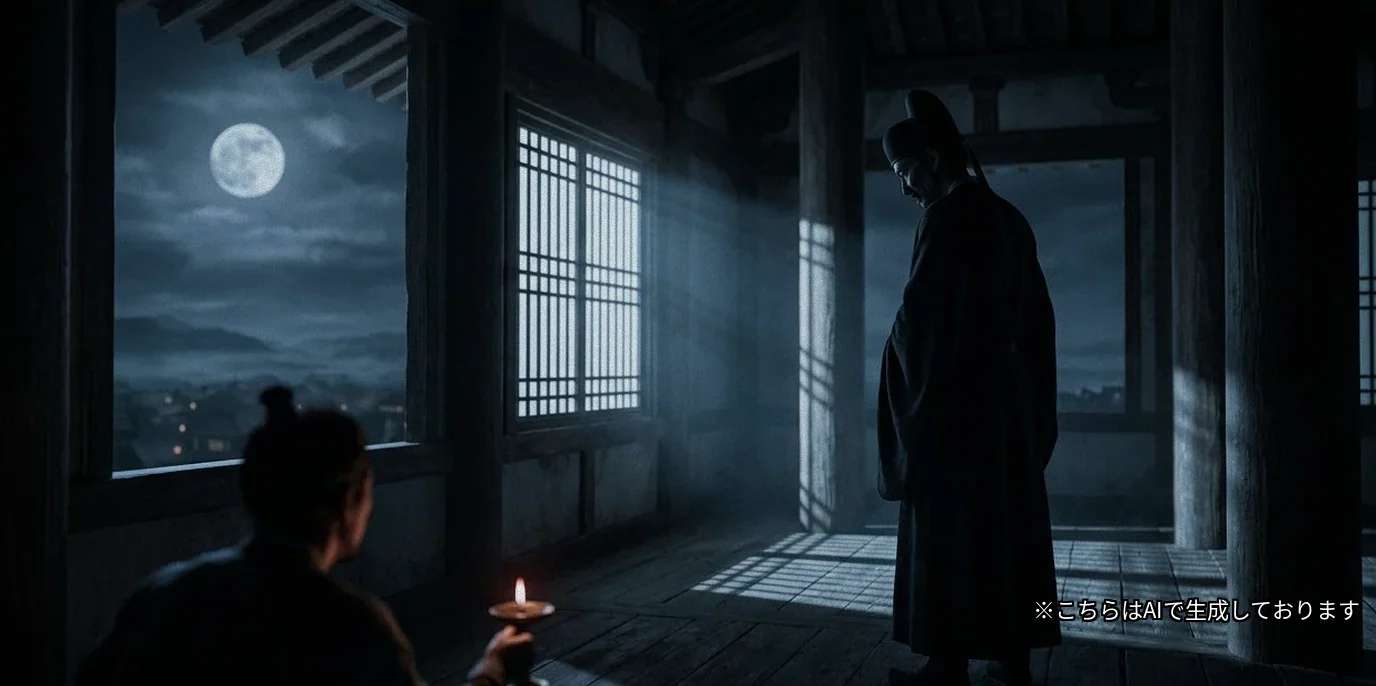
When Kibi no Makibi reaches Tang China as an envoy, the Tang people, fearing his talent, plot to test and humiliate him and shut him in a tall tower. It is a fearsome place where anyone put inside is sure to die. At night a demon appears with wind and rain. Makibi tells it that he cannot talk with it looking like that and that it should come back properly dressed, and the demon leaves, then returns in court dress. The demon reveals that he too once came from Japan as an envoy, was shut in this tower, and died there, and he asks about the descendants he left behind in his homeland. When Makibi tells him all he knows, the demon is overjoyed and promises to repay the kindness.
So the demon, Nakamaro, becomes Makibi’s helper. The Tang people set him one difficult test after another: reading the difficult classic, the Wen Xuan, and playing a master at the game of Go. The demon flies Makibi through the air so that he can eavesdrop on scholars lecturing on the Wen Xuan. At Go, Makibi secretly swallows one of his opponent’s stones and wins, and even when the Tang side makes him take a purgative and examines him, the stone does not come out. Later, when he is made to solve the Yabatai poem, a mysterious prophecy whose characters are arranged so that the reading order cannot be known, Makibi prays to the gods and buddhas of Japan, and a spider trails a thread across the characters and shows the path to read them. In the end, Makibi hides the sun and moon by a mysterious art, and the Tang emperor finally decides to send him back to Japan, so the story closes.
The handscroll is thought to have been made between the end of the twelfth and the early thirteenth century. It was one of the great masterpieces of Japanese picture scrolls, but it was sold abroad in the early Showa period and is now held by the Museum of Fine Arts, Boston. Its loss overseas became a major issue in Japan and is known as one of the incidents that led to laws to prevent the export of art. The scroll lacks its opening and the scene of the Yabatai poem, among others, and the full shape of the story is supplemented by the Godansho.
A discrepancy with history should be noted here. In 752 to 754, when Makibi visited Tang China a second time, Nakamaro was still alive and active as a high Tang official. It is quite likely that the two actually met again in the fleet that was to sail for home. In other words, the tale of “Nakamaro, dead and become a demon, helping Makibi” cannot hold up chronologically and is entirely legend.
A sheet-type bear repellent that works through smell, color, and movement, lasting about a year. No battery or power needed — just hang it from a backpack, car mirror, or tent.
Plus Rib Bear Repellent 'Gekishu Sheet' (Strong-Odor Sheets), 3-Pack, Black, ~1-Year Effect
We may earn a referral fee on purchases made through these links.
Present Day: Between the Poet of Longing and the Demon’s Form
Today, Abe no Nakamaro is known above all as the poet of “Ama no hara.” In Xingqing Palace Park in Xi’an, China, a memorial to Nakamaro was erected in 1979 to commemorate the sister-city relationship with Nara, and it is spoken of as a symbol of Sino-Japanese friendship. His life, buried in a foreign land while longing for home, still moves many people as the story of one who lived across national borders.
The demon Nakamaro, on the other hand, is not widely known to the general public, partly because the scroll is overseas. Even so, the exhilarating story of Makibi solving one difficulty after another has increasingly appeared in recent exhibitions, guidebooks, and manga, often introduced with the surprise that “the red demon was actually Nakamaro.” The demon in the scroll has red skin and horns and a frightening form, but in the scene where he appears in court dress, he is drawn as a proper nobleman. One person is depicted in two forms, as demon and as noble.
Makibi, for his part, came in later ages to be regarded as a founder of Onmyodo and of the art of war, and became the hero of many legends. The tale of the Nitto Emaki has been handed down as part of these superhuman legends of Makibi.
KARASU CHANNEL’s Take: Why Did One Who Could Not Return Help One Who Could?
What moves us most in this legend is that the first thing the demon asks Makibi is for news of his descendants in his homeland. A man who won renown across borders wanted to know, even in death, neither about honors at the Tang court nor about the reputation of his poem, but about how the family he left in Japan was faring. This is our own inference, but the storytellers of the Heian period may have seen Nakamaro’s greatest suffering not in “having been unable to return” itself but in the fear of “being forgotten by his homeland.” A man who lived and died in Tang China was, seen from the Japanese side, one who was gradually vanishing from the record. The demon’s question sounds like a quiet resistance against such oblivion.
Next, why did Nakamaro have to be a “demon”? In our view, the ancient Japanese sense of “the dead who could not return” is involved here. The dead who are not buried in the soil of their homeland and who receive no rites from their descendants were thought unable to become peaceful spirits and to become wandering beings instead. Nakamaro died in a foreign land, and no one in Japan could tend his grave. People could hardly help imagining such a dead man as a demon. What is interesting, however, is that this demon does not harm people but takes the side of helping a countryman. This is our own inference, but for Nakamaro, helping Makibi return to Japan may have been a kind of “homecoming by proxy,” accomplishing through another’s body the return he himself could not make.
The background of the era in which the tale was told should not be overlooked either. By the late Heian period, when the Godansho was compiled, more than two hundred years had passed since embassies to Tang China had ceased. The Tang state had also fallen, and for Japanese intellectuals the continent had become a world of longing found in books, one they would never visit directly. We believe the tale carries the complex feelings the Japanese of that time held toward China: deep admiration and, on the flip side, a spirit of rivalry. The Japanese beat the tests set by Tang intellectuals one after another with wit, the protection of the gods and buddhas, and a bit of cunning. That exhilaration must also have been a device for dispelling, within the story, a sense of inferiority toward the “original home” of learning. And the one who quietly supports that victory is Nakamaro, who knew China more deeply than anyone at the Tang court yet whose heart was in Japan, which is truly clever casting.
Going further, the figure of the narrator himself, Oe no Masafusa, shows through as well. Masafusa was born into a family of scholars and was the foremost scholar of his day, having made his career on his knowledge of Chinese classics. It remains only inference, but as one who lived in the world of Chinese texts, Masafusa may have overlaid on both Nakamaro, recognized at the Tang court, and Makibi, who brought knowledge back to Japan, the ideals and sorrows of scholars like himself. However far one carries one’s learning, the price of crossing borders is great. Nakamaro was a man who rose through learning and who, because of learning, lost his homeland.
Finally, let us return to the moon of the “Ama no hara” poem. The moon rising over the Tang sky and the moon rising over Mount Mikasa are one and the same moon. The discovery that the same moon can be seen wherever one is, is both a consolation and a despair. The moon can return, but I cannot. When Li Bai mourned his friend with “the bright moon does not return,” he likened Nakamaro himself to a moon sunk in the sea, never to return. In our view, the legend of the demon Nakamaro may have been a kind of prayer by the Japanese people to guide that “moon that does not return” to its homeland, at least within a story.

For footing during exploration of a ruin or mountain spot in the rain or mud.
Atom Unisex Adult No.2620 'Green Master' Rain Boots, for Farm Work/Gardening/Outdoor, Waterproof, Non-Slip, Lightweight, Maroon
We may earn a referral fee on purchases made through these links.
Engaging With This Legend
Abe no Nakamaro and Kibi no Makibi were both real people, and it is historical fact that Nakamaro lived in Tang China as an official and died without being able to return home. The tale that Nakamaro became a demon and helped Makibi, on the other hand, is a legend based on a late-Heian tale, and it does not fit history even in its chronology. In this article we have presented the two separately.
Nakamaro’s life is treasured and passed down in both Japan and China as a symbol of the history of exchange between the two countries. Please avoid receiving it in a way that, in one’s amusement at the legendary demon, disparages the real person, his origins, or the countries and regions concerned. In particular, please understand that the story of the Nitto Emaki was drawn from the viewpoint of the Japanese of that time and in some respects portrays the Tang people one-sidedly as villains, as a product of its age.
Frequently Asked Questions
Q. Did Abe no Nakamaro really become a demon?
A. No. The tale of Nakamaro becoming a demon and helping Kibi no Makibi is a legend found in the late-Heian Godansho and the Kibi Daijin Nitto Emaki. In reality, when Makibi visited Tang China a second time, Nakamaro was alive and active as a Tang official.
Q. Where was the “Ama no hara” poem composed?
A. According to the commentary in the Kokin Wakashu, Nakamaro, about to return home in 753, composed it while looking at the moon at a farewell banquet on the shore at Mingzhou. There are, however, other views on the circumstances of its composition.
Q. Why couldn’t Nakamaro return to Japan?
A. He boarded a ship for home in 753, but a storm blew it to Annam. After he returned to Chang’an, the An Lushan Rebellion threw the Tang into chaos and the chance to return was lost, so he ended his life in Tang China.
Q. Where can the Kibi Daijin Nitto Emaki be seen?
A. It is now held by the Museum of Fine Arts, Boston in the United States. It was sold abroad in the early Showa period, and it has sometimes returned to Japan for public display at exhibitions.
Q. How is Nakamaro’s demon depicted in the scroll?
A. He appears as a fearsome demon with red skin and horns, but he is also drawn as a nobleman in court dress after Makibi tells him to dress properly. One person is drawn in two forms, demon and noble.
Nakamaro’s “Ama no hara” poem can also be drawn in KARASU CHANNEL’s Hyakunin Isshu Divination.
Q. Has KARASU CHANNEL researched or filmed the legend of Abe no Nakamaro’s demon on location?
A. No. We are not currently researching the legend of Abe no Nakamaro’s demon, though we are considering doing so. Videos of our research into other haunted spots and ghost stories can be viewed on KARASU CHANNEL (YouTube).

Supervised by Suzuking.
Affiliation: KARASU CHANNEL
Occult & horror reporting: 7 years (since 2020)
Followers: YouTube 5,000+ / X 25,000+
On-site investigations: 30+
If this appeared in your dream
What it means to dream of something from this story, read through psychology and folklore in our Dream Dictionary.
- Dreaming of an OniA symbol of anger, fear or power; defeating one means overcoming hardship.
Which story do you find the scariest?
If you think this story is the scariest, press the button below. One vote site-wide — you can change your vote for a different story anytime.
Was this article helpful?
Add this to your favorites to find it again anytime from your My Page.









Comments