Ryujin Onsen: The Bath a Dragon God’s Oracle Opened
Supervised by Suzuking. (KARASU CHANNEL / Occult & horror reporting, 7 years)
Contents
View sources and last-checked date
- Source
- Wikipedia, "Ryujin Onsen" (Japanese)
- Source 2
- Three Beauty Baths of Japan official site, "Wakayama Ryujin Onsen" (Japanese)
- Last verified
- 2026-09-16
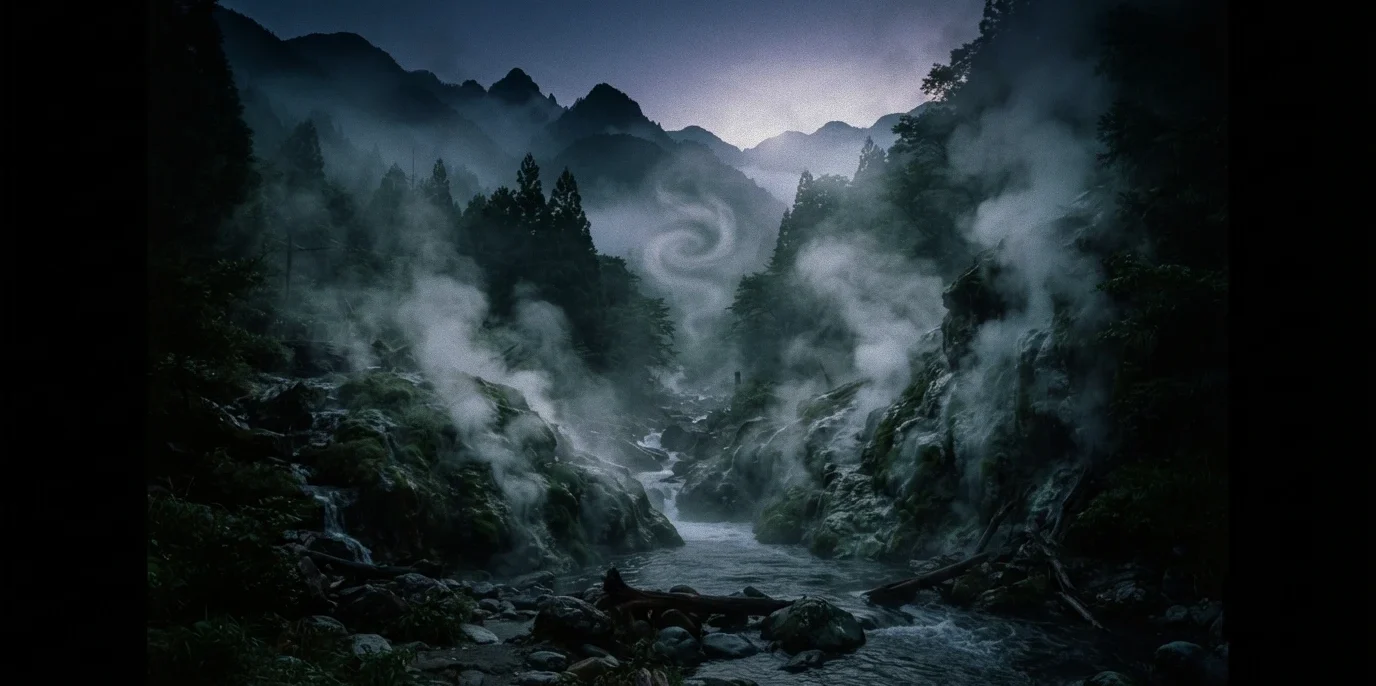
Ryujin Onsen, in Ryujin Village, Tanabe City, Wakayama Prefecture, is counted among Japan’s “Three Great Beauty Baths,” alongside Kawanaka Onsen in Gunma and Yunokawa Onsen in Shimane. True to its name, the spring carries an opening legend tied to a ryujin, a dragon god who governs water. What is unusual is that the legend is not told just once: it unfolds in two stages, through two figures from two different eras.
Origin (1) — The Smoke That En no Ozunu Noticed
According to the legend, the mountain ascetic En no Ozunu (regarded as the founder of Shugendo, Japan’s mountain-ascetic tradition) first noticed smoke rising in this place. When he struck the spot with his shakujo (the ringed staff carried by ascetics), hot water welled up. This is said to be the spring’s first discovery.
En no Ozunu is remembered as a sorcerer of the Asuka period and the founder of Shugendo. His traditional dates are 634 to 701, which leaves a gap of about a hundred years before the time when Kukai is said to have visited. That hundred-year blank between the two legends looks almost like time during which the spring was quietly nurtured in people’s memory. About seventy percent of Ryujin Village lies at an elevation of 500 meters or more, and the Hidaka River threads through its valleys, so this is deep mountain country. The ascetic’s act of spotting smoke and striking the ground with a staff was probably bound up with that life in the mountains.
Origin (2) — Kobo Daishi and the Oracle of the Dragon King Nanda
About a hundred years later, Kobo Daishi Kukai, founder of the Shingon school, is said to have visited this land and, after receiving an oracle from the dragon king Nanda Ryuo (a dragon deity of water in Buddhism), formally opened a bathhouse. With two legendary figures of different eras and different standing involved, the discovery by En no Ozunu and the opening by Kukai, a mystical lineage fitting the name “Ryujin Onsen” (Dragon God Hot Spring) has taken shape.
Nanda Ryuo, who is said to have given Kobo Daishi the oracle, is the foremost of the Eight Great Dragon Kings who protect the Buddhist teachings. His name is said to mean “joy,” and together with his younger brother Upananda he is told to have protected lands from famine and to have sent rain at the birth of the Buddha. In other words, he is a dragon king with a strong side as a giver of water and blessings. The Eight Great Dragon Kings have also long been enshrined across Japan as deities of rain-making. That the spring’s opening is told as the oracle of a giving dragon rather than a raging one is probably not unrelated to this dragon king’s character.

A self-inflating sleeping mat for conserving energy during a late-night stakeout or wait in the car. Laid across a seat or the cargo area, it softens the hard, cold surface and eases fatigue during a long haunted-spot stakeout.
CAPTAIN STAG Inflating Sleeping Mat UB-3005
We may earn a referral fee on purchases made through these links.
Present Day — A Mansion Tied to the Tokugawa, and a Renowned Spring That Continues
In the Edo period, Tokugawa Yorinobu, lord of the Kishu Domain, is said to have built a mansion here and furnished its bathing quarters. The building from that time, “Kamigoten,” is now a nationally registered Tangible Cultural Property. The spring is also known for appearing in Nakazato Kaizan’s novel “Daibosatsu Toge” (Daibosatsu Pass) as the place where the protagonist heals his eyes, and in 1989 it signed a sister agreement as one of the “Three Great Beauty Baths” with the famous springs of Gunma and Shimane. It remains an active hot spring resort, visited by many guests seeking cures and by sightseers.
The water is a sodium hydrogen carbonate spring (a baking-soda spring), with a source temperature said to be 48 degrees Celsius. Inns line the Hidaka River, and from each inn’s open-air bath you can look out over the mountain stream. To the north of the village rises Mt. Goma-dan, 1,372 meters high. In Kumano tradition, Taira no Koremori, who had left the battle lines in the Genpei War and was hiding in a nearby gorge, learned that the Taira had been defeated at Dan-no-ura and burned a goma fire on this mountain to divine the clan’s fate, which is said to be the origin of the mountain’s name. Behind a spring called a beauty bath, the memories of those who fled and survived also lie sleeping.
Reflection — Why Tell of a “Discoverer” and a “Founder” Separately?
What we find interesting is that the spring’s origin is not told as one person’s achievement. It is divided into two different stages: the chance “discovery” by an ascetic roaming the mountains, and the formal “opening” by a renowned monk based on a divine oracle. This is our speculation, but perhaps a spring that was no more than something an unnamed practitioner found in the mountains was later given new meaning by an authoritative high priest, who declared it to be “the work of the dragon god’s oracle,” and that this lent it dignity and mystery after the fact. Not satisfied with a plain discovery story, the people of this land may have layered on the presence of a water god, the dragon god, in order to treat the spring itself not as a mere natural phenomenon but as something sacred to be protected.
This, too, is only our imagining, but a spring given the name of a dragon god has been enshrined together with the dread of a being that causes flood and drought when it rages. There is also a story that, when you soak alone in an empty bath at night, the sound of water welling up from the bottom can seem like something very large shifting in its sleep. Perhaps the spring remains a blessing because someone is still, constantly, watching the mood of whatever sleeps behind it.
This is also our imagining, but the two-stage origin, an ascetic’s discovery followed by a high priest’s “dragon god oracle,” can be read as a structure that shored up with authority, after the fact, a dread of the power of unseen water itself. A dragon god by nature governs water, and at times is also a raging presence that brings flood and drought. That such a dragon god is said to have taken part in the spring’s discovery in the form of an “oracle” may quietly suggest that this spring is not merely a blessing, but a tightrope-like blessing that can keep being granted only as long as the raging power is soothed.
The link between hot springs and dragon gods has one more reading. In mountain country, the sudden welling of hot water from the earth must have given people the sense that some living thing lay hidden below. And Ryujin Onsen’s water, with its silky feel, has long been believed to be good for wounds and skin troubles. In our view, the form of the “dragon” may have been the wisdom of mountain people, entrusting both the blessing and the threat of water to a single image. By accepting both the healing spring and the raging water as the faces of one dragon, people may have kept a workable distance from nature.
This is our speculation, but it is worth noting that a tradition of divining the fate of the Taira at Mt. Goma-dan survives in the same village. For people who fled into the mountains and had nowhere left to go, the hot spring may have been one of the few places to heal a wounded body. A spring that quietly received the exhaustion of the defeated. When it was given the sacred name of a dragon god, perhaps it carried at once gratitude toward the nature that had helped them and a prayer that nothing more be taken from them.
In modern times, the spring became known nationwide after Nakazato Kaizan’s novel “Daibosatsu Toge” depicted it as the place where the protagonist heals his eyes. A mountain ascetic’s discovery, a high priest’s oracle, a domain lord’s improvements, and a novelist’s pen: in every era, this spring has been given “meaning” by borrowing someone’s story. For more than a thousand years the same water has kept welling up, while only the storytellers change. The spring itself probably says nothing. That may be exactly why people have kept layering stories onto it.
Inside an unwired building like a ruin or abandoned school, placing a battery-powered sensor light that turns on automatically as you approach at your feet or by an entrance helps you spot steps or obstacles a flashlight might miss. No installation needed — just set it down or stick it on, even where there's no power.
IRIS OHYAMA Battery-Powered LED Sensor Light, Downward-Facing Type BSL-MS1
We may earn a referral fee on purchases made through these links.
Everyday Face — One of Japan’s Three Great Beauty Baths
Ryujin Onsen, said to have been found by a mountain ascetic, remains beloved by guests seeking cures and by tourists as one of the “Three Great Beauty Baths,” alongside Yunokawa Onsen in Shimane and Kawanaka Onsen in Gunma. Its silky water is known for its skin-beautifying effects, and the quiet hot spring town, with its inns standing along the clear Hidaka River, also has a day-use bathing facility, “Motoyu.” A spring said to have been opened by a dragon god’s oracle continues, more than a thousand years on, to soothe travelers as a hidden bath in the mountains.
Notes for Visiting
Ryujin Onsen is an active hot spring resort and not a dangerous place. Whether cultural properties such as Kamigoten can be viewed, and the availability and hours of day-use bathing, may change, so we recommend checking with the facilities or the tourist association before visiting.
The spring’s benefits described here are general information and not medical advice. If you have a chronic condition or concerns about your skin, please consult a doctor before bathing. Mountain hot spring areas may also have road restrictions or suspended public transport in winter, so please check the latest information beforehand.
Frequently Asked Questions
Q. Why is Ryujin Onsen called one of the “Three Great Beauty Baths”?
A. Because of water quality said to be highly beneficial for the skin, it is counted with Kawanaka Onsen in Gunma and Yunokawa Onsen in Shimane as one of the “Three Great Beauty Baths,” and the three signed a sister agreement in 1989.
Q. Can “Kamigoten” still be visited today?
A. It is a building developed by the lord of the Kishu Domain in the Edo period and is a nationally registered Tangible Cultural Property. We recommend checking with the facility about availability and hours.
Q. Has KARASU CHANNEL researched or filmed on location at Ryujin Onsen?
A. No, we are not currently researching it, and a visit is under consideration. Footage from our other haunted-spot and kaidan investigations can be viewed on KARASU CHANNEL (YouTube).

Supervised by Suzuking.
Affiliation: KARASU CHANNEL
Occult & horror reporting: 7 years (since 2020)
Followers: YouTube 5,000+ / X 25,000+
On-site investigations: 30+
If this appeared in your dream
What it means to dream of something from this story, read through psychology and folklore in our Dream Dictionary.
- Dreaming of a Hot SpringA lucky symbol of healing and recovery; fatigue easing and relationships softening.
- Dreaming of the Dragon GodThe god of water and weather: one of the luckiest dreams, riding a great current.
Which story do you find the scariest?
If you think this story is the scariest, press the button below. One vote site-wide — you can change your vote for a different story anytime.
Was this article helpful?
Add this to your favorites to find it again anytime from your My Page.










Comments