Momiji: Demon in Togakushi, Saint in Kinasa
Supervised by Suzuking. (KARASU CHANNEL / Occult & horror reporting, 7 years)

Contents
View sources and last-checked date
- Source
- Go! NAGANO, "A deep report on Togakushi" (Japanese); Wikipedia (Japanese), "Momiji legend"; and others
- Last verified
- 2026-09-16
In Nagano Prefecture, two neighboring communities — Togakushi and Kinasa — tell completely opposite legends about the same woman. In one, she is remembered as a fearsome demon who terrorized travelers. In the other, she is honored as a wise, generous teacher who saved a village. Her name was Momiji. We looked into why the very same person came to be remembered in two such contradictory ways.
Origins — How a Woman Exiled From the Capital Reached the Mountains
According to legend, Momiji was a concubine of Minamoto no Tsunemoto, a military commander of the Heian period. At some point she was accused of trying to curse Tsunemoto’s principal wife to death, and was banished from the capital as a result. She eventually made her way to Kinasa, a remote mountain village neighboring what is now Togakushi in northern Nagano Prefecture. Accounts say that, at first, Momiji built a friendly relationship with the villagers there.
“Demon” and “Noble Lady” — Two Opposite Legends From Two Neighboring Villages
From this point, the story diverges sharply between Togakushi and Kinasa. In the Togakushi version, Momiji is said to have gradually transformed into an evil, demon-like creature (kijo) as she lived in the mountains, and the surrounding area suffered as a result. The imperial court is said to have ordered the military commander Taira no Koremochi to hunt her down. According to legend, Koremochi divined her whereabouts at Yamoto Shrine and, after a fierce battle, finally killed her.
Yet in Kinasa — the very village where Momiji is said to have actually lived — an entirely different image of her survives. There, she is remembered fondly as a learned and compassionate noble lady (also pronounced kijo, though written with different characters) who taught the villagers weaving and sericulture (raising silkworms to produce silk thread). It’s striking that the same sound, kijo, carries opposite meanings depending on which village tells the story: a fearsome “demon” on one side, a revered “noble lady” on the other.
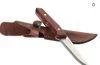
A full-tang knife with the blade running through the handle for durability — a versatile tool for cutting rope or branches, cutting packing string, or preparing emergency food during an expedition. Comes with a cowhide sheath for carrying on your belt.
Takagi KANUCHI OUTDOOR Full-Tang Stainless Sheath Knife with Cowhide Case
We may earn a referral fee on purchases made through these links.
A Legend Passed Down Through Noh and Kabuki
The Kijo Momiji legend later became the subject of a Noh play titled “Momijigari” (Maple-Leaf Viewing), which was subsequently adapted for kabuki as well. Its plot — a warrior encounters a beautiful woman in the mountains, is invited to a banquet, and eventually realizes she is a demon and defeats her — remains one of the classic templates of the “demon-slaying” story type in Japanese classical theater, and is still performed today.

Granular repellent for scattering around grass or the grounds of a ruin, aimed at snakes, lizards, and centipedes — a preventive measure against ground-crawling reptiles and pests in general.
Rainbow Yakuhin Snake Repellent 'Hebi-Less' Granules, Value Pack 900g
We may earn a referral fee on purchases made through these links.
Reflection — Who Was Really Turned Into a “Demon”?
This is only our own view, but we think it’s significant that the very same person could be remembered in such starkly opposite ways in two neighboring communities, Togakushi and Kinasa. From the perspective of those doing the hunting — the imperial court and its warriors — a woman who defied the capital’s authority and held independent power in the mountains needed to be framed as “a demon to be slain.” But for the people of Kinasa, who actually learned weaving and sericulture from Momiji and saw their livelihoods improve as a result, she was a benefactor who had supported their way of life. We think this is a striking example of how the very same historical event (or possible event) can turn into two completely different stories, depending on who is telling it.
As we see it, the label “demon” was often a convenient tag attached to whoever proved inconvenient to those in power at the time. From the capital’s point of view, a woman who spread her own knowledge and skills in the mountains, and who was beloved by the local people, may well have looked like a threat to the established order. Turning Momiji into a story about hunting down a “demon woman” may also have served as a convenient way of explaining away that threat as something justly eliminated. The two faces of a single person quietly remind us that history is not always told solely from the winner’s point of view.
This, too, is nothing more than our own imagining, but we find it hard to look past the detail that, in Noh works such as “Momijigari,” the hunted spirit of Momiji is said to still wander the mountains of Togakushi even now, in the shape of a demon much like the Yuki-onna (snow woman) of folklore. To be remembered in life as a benefactor who taught the art of weaving, and yet, even after death, to go on being told of only in the shape of a “demon” — that double treatment feels almost like a sign that her spirit has never been allowed to rest peacefully in either form. On snowy nights on Mount Togakushi, there are still accounts today of hikers hearing what sounds like the rustle of a kimono, or the faint sound of a loom at work, somewhere along the mountain trail. Perhaps that isn’t mere coincidence.
Everyday Face — Togakushi, Land of Soba and Mountain Ascetics
Today, Togakushi, where the Kijo Momiji legend lives on, is widely known for its “Togakushi Five Shrines” pilgrimage route, a popular spot for those seeking spiritual power, and for Togakushi soba noodles made with the area’s clean spring water. The cedar-lined approach leading to the Okusha (Inner Shrine) is wrapped in a solemn atmosphere, and visitors can even try their hand at making soba by hand at local shops. If the woman once called a demon is still watching over this place, what she sees now are visitors drawn here by mountain worship — and by very good soba.
A Note on Visiting
The shrines and historic sites connected to the Momiji legend are still carefully maintained by local communities today. Regardless of how you feel about the legend itself, please visit quietly and with respect for local faith and history. Both Togakushi and Kinasa are mountainous areas, so please be careful of snow and icy roads in winter.
Frequently Asked Questions
Q. Who was Kijo Momiji?
A. According to legend, she was a woman said to have been a concubine of the Heian-period military commander Minamoto no Tsunemoto. Accused of trying to curse his principal wife to death, she was banished from the capital and made her way to the mountains of what is now Nagano Prefecture.
Q. Why did Momiji come to be called a “demon”?
A. According to the Togakushi tradition, Momiji, after settling in the mountains, is said to have gradually transformed into an evil spirit (kijo), eventually prompting the imperial court to order her hunted down.
Q. How is she remembered in neighboring Kinasa?
A. In contrast to Togakushi, the neighboring village of Kinasa remembers Momiji very differently: as a learned noble lady (kijo) who taught local villagers the arts of weaving and sericulture (raising silkworms to produce silk).
Q. What ultimately happened to Momiji?
A. By order of the imperial court, the military commander Taira no Koremochi set out to hunt her down, and, according to legend, killed her after a fierce battle.
Q. Has this legend inspired any performing arts?
A. Yes. It became the subject of a Noh play called “Momijigari” (Maple-Leaf Viewing), which was later adapted for kabuki as well.
We plan to cover the Kijo Momiji legend in video as well — please also check out our YouTube channel.
Q. Has KARASU CHANNEL filmed on location for the Kijo Momiji legend?
A. No, we have not filmed there yet; a visit is currently under consideration. Location footage for other haunted spots and kaidan stories can be viewed on KARASU CHANNEL (YouTube).

Supervised by Suzuking.
Affiliation: KARASU CHANNEL
Occult & horror reporting: 7 years (since 2020)
Followers: YouTube 5,000+ / X 25,000+
On-site investigations: 30+
If this appeared in your dream
What it means to dream of something from this story, read through psychology and folklore in our Dream Dictionary.
- Dreaming of autumn LeavesA symbol of maturity and graceful change; a rich time of life.
- Dreaming of a Demon WomanSuppressed jealousy, anger or unrequited feelings; escaping one means breaking an obsession, becoming one war…
Which story do you find the scariest?
If you think this story is the scariest, press the button below. One vote site-wide — you can change your vote for a different story anytime.
Was this article helpful?
Add this to your favorites to find it again anytime from your My Page.

Comments