What Is Tarot? How Game Cards Became “Picture Cards of Fate”

Supervised by Ms.M
Affiliation: KARASU CHANNEL
Traditions studied: 12+ (Western astrology, Four Pillars of Destiny, Nine Star Ki, tarot, runes, palmistry & physiognomy, name numerology, numerology, feng shui, Vedic astrology / Zi Wei, Onmyodo, spiritual reading, and more)
Personal readings: by request via Contact,
currently booked years out
Contents
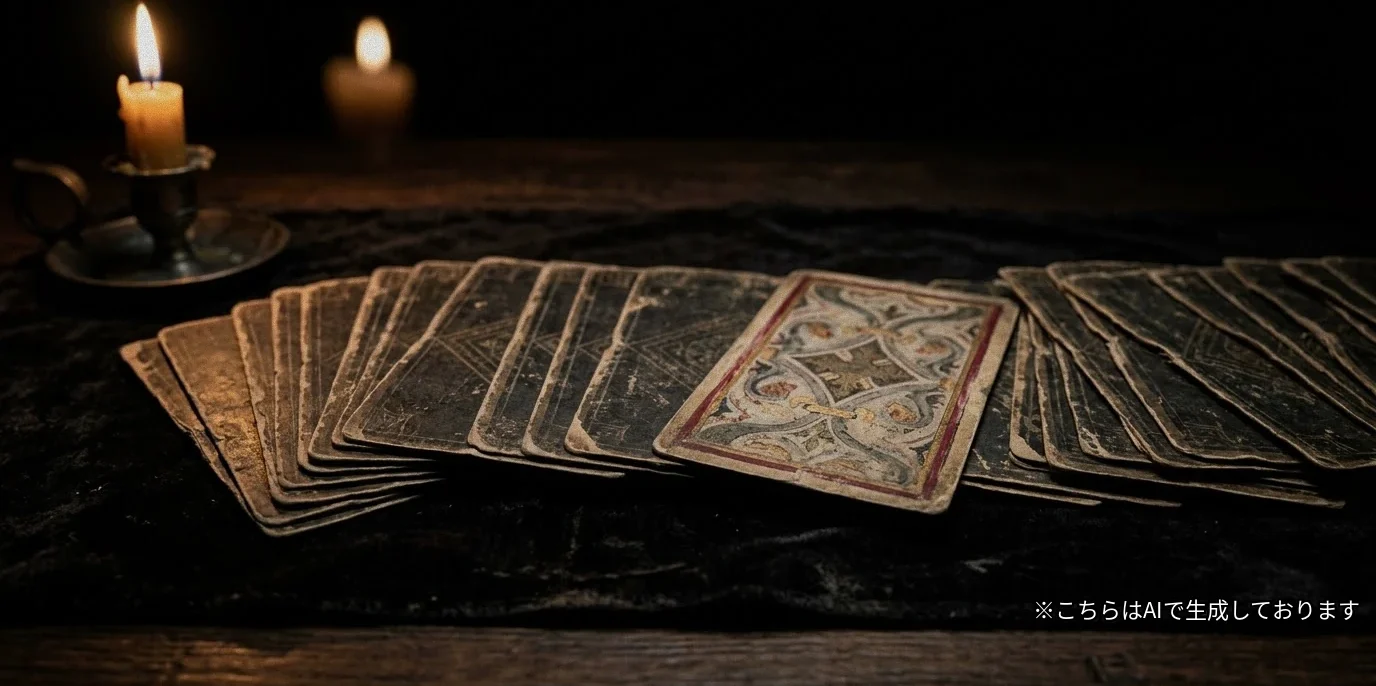
A single picture card, drawn to reflect where you stand right now. That is the experience tarot has spread around the world. Names such as “The Fool,” “The Magician,” “The Empress,” “The Tower,” and “The Star” may already be familiar. Yet where those cards came from, and how they became a tool for divination, is surprisingly little known.
In fact, tarot was not originally made for fortune-telling. In 15th-century Italy, these were cards for a game that nobles played around the table. How did they turn into “picture cards that mirror fate”? This article follows that path, separating what can be confirmed as history from the legends added later.
On our free “Tarot Reading” tool, you can choose either all 78 cards or only the 22 Major Arcana, and draw in five ways: single card, three cards, love, either-or, and Celtic Cross. Terms you will see in the results, such as “upright” and “reversed,” are unpacked here one by one. Whenever a technical term appears, we rephrase it in a quote box that begins “Put simply,” so if anything feels difficult, you can skim just those boxes. Toward the end we have also added our own reflections, which go beyond a summary of history.
Key Points (a 3-Minute Summary)
- Tarot is a set of 78 picture cards (22 Major Arcana plus 56 Minor Arcana). In our tool you can draw from all 78, or from the 22 Major Arcana only.
- It did not begin as divination. It began as cards for a game played by nobles in 15th-century northern Italy (then called “trionfi”).
- Use for divination took off in late 18th-century France. The claim that tarot descends from a secret book of ancient Egypt was born around then, but no evidence supports it (a myth).
- The Waite deck of 1909 (created by Waite together with Pamela Colman Smith) became the standard foundation of modern tarot reading.
- Upright and reversed meanings, and the layouts (spreads), vary by school and by reader. Our tool offers five spreads: single card, three cards, love (5 cards), either-or (5 cards), and Celtic Cross (10 cards), and each card has an even chance of appearing upright or reversed.
- No scientific evidence has been found that tarot predicts anything. We recommend enjoying it lightly, as a prompt for organizing your own thoughts.
What Is Tarot? 78 Picture Cards and How They Are Used
Tarot refers to a set (a deck) of illustrated cards. A standard deck has 78 cards in total, divided into two main groups. One is the 22 cards called the “Major Arcana.” The other is the 56 cards called the “Minor Arcana.”
The Major Arcana are 22 cards, from “The Fool” to “The World,” each named for a figure or symbol. They are numbered 0 to 21, with The Fool as number 0 and The World as number 21. Each card carries a name that symbolizes a way of living or a state of mind.
The Minor Arcana are 56 cards: four suits (generally said to be wands, swords, cups, and coins), with 14 cards in each. They consist of number cards and court cards, a structure close to the ancestor of modern playing cards. They are often used to read the small events, feelings, and actions of daily life.
Put simply, the Major Arcana are “22 leading-role cards that represent the big scenes and movements of the heart in a life,” while the Minor Arcana are “56 supporting-role cards that represent everyday events.”
The word “arcana” is commonly explained as coming from a Latin word meaning “secret” or “something hidden.” Whether a card is called major or minor is best understood not as a matter of how big the secret is, but as a way of distinguishing the roles of the cards.
To read tarot, you first keep in mind what you want to know and shuffle the cards well. Then you draw a set number of cards and read the situation using the meaning of each card and the position in which it was laid down (which draw it was). Details of etiquette differ from reader to reader, but the basic framework of “shuffle, draw, read” is shared.
On our “Tarot Reading,” you can choose the cards to use from “All 78 cards” and “Major Arcana only.” Choose all 78 and you read with the full deck, Minor Arcana included. Choose Major Arcana only and it becomes a lighter reading narrowed to the 22 “leading roles.”
Put simply, our tarot is built so that you can read with the full 78, or narrow things down to the 22 best-known cards. With only 22, each card’s presence comes through more strongly.
Examples Used in This Article: The Cards Drawn by A and B
Talk about cards is hard to follow in words alone. So in this article we explain with the results that two fictional people, “A” and “B,” actually drew using the same mechanism as our tool. They are not real people.
A is set as a woman born on January 1, 2000. Keeping in mind the feeling “I can’t decide whether to apply for a new job,” she tried a three-card draw. B is set as a man born on May 15, 1990. Keeping in mind the feeling “I’ve been a little tired lately,” he tried a single-card draw. Note that tarot is not a divination calculated from a birth date, so the birthdays do not affect the results. They are only a device for telling the two apart.
- A’s three cards: “Strength (reversed)” → “The Emperor (upright)” → “The Hanged Man (upright)”
- B’s one card: “The Star (upright)”
These are copied exactly from results actually drawn with our card data and drawing mechanism. Because the draw is random, the same person drawing again would get completely different results. Both are examples drawn with “Major Arcana only.” Examples of how to read them appear later, in the chapter “How to Read Our Tool’s Results.”
The Origins of Tarot: From a Nobles’ Game to Divination Cards
15th-Century Northern Italy: A Card Game Called “Trionfi”
Tarot’s starting point is northern Italy in the first half to the middle of the 15th century. In the courts and cities of Milan, Ferrara, Florence, Bologna, and elsewhere, special cards were made and played that combined the four suits with trump cards bearing allegorical pictures. At the time these cards were called “trionfi” (meaning triumphs or victories). The name “tarocchi” is said to appear in documents only in the early 16th century (around 1502, in Brescia).
The most famous of the oldest surviving cards are the sumptuous set painted around the middle of the 15th century for the Visconti family, who ruled Milan, and then the Sforza family (called the “Visconti-Sforza” cards). They are hand-painted cards decorated with gold and fine detail, and the cards of about 15 decks are now scattered among museums and private collections around the world. These were, above all, cards for everyday play. No record has been found from this period showing that they were made as a divination tool.
Put simply, the first tarot was “a luxurious card game enjoyed by nobles.” It was not born as a divination tool.
Incidentally, the English word “trump,” meaning a winning card in a card game, is explained as going back to the same root as “triumph.” At the origin of the “trump card” feeling we know so well stands an ancestor of tarot.
Later, as woodblock printing spread, cards could be made cheaply and in large numbers, and they reached ordinary people. On the other hand, it is said there were periods when the game was banned as disruptive to public morals, because betting on it became too popular. It was the game’s popularity as play, not divination, that caused such events.
On to France: The Designs Called the “Marseille Tarot”
The cards soon reached France. From the 17th to the 18th century, designs produced in the southern French city of Marseille and elsewhere circulated widely, and later came to be called the “Tarot de Marseille.” The oldest cards confirmed as made in Marseille are said to date from 1639.
There is one surprising point here. The name “Marseille Tarot” itself is said to have been given much later, in 1856, by a French card researcher. In other words, people at the time did not call their cards the “Marseille Tarot.” It is a label that fortune-tellers and researchers later began using to refer to one traditional style.
The 18th Century: When Did Use for Divination Begin?
So when did people start using them for divination? The card researcher Michael Dummett has stated, in essence, that “no one told fortunes with tarot until the 1780s” (he also points out that divination with ordinary playing cards had been established some 20 years earlier). The tarot that appears in documents from the 16th and 17th centuries is almost entirely described as a game.
There are, however, sources that hint at earlier signs. An anonymous manuscript dated to around 1750 gives simple divinatory meanings for the tarot used in Bologna. Some sources give this first record as “the first half of the 18th century,” so accounts of the date vary. In any case, use for divination is thought to have begun gradually in “18th-century Europe.”
The decisive turning point came in Paris in the 1780s. In 1781, Antoine Court de Gébelin, a French clergyman and scholar, published an essay on tarot in volume 8 of his great work “Le Monde primitif.” He claimed that “tarot is a secret book in which the priests of ancient Egypt sealed their wisdom.” Furthermore, a text by the Comte de Mellet included in the same work linked the 22 Major Arcana to the 22 letters of the Hebrew alphabet.
However, no evidence at all has been found to support this “ancient Egyptian origin theory.” Later research in Egyptology has likewise found nothing to support the “Egyptian etymologies” that Court de Gébelin cited. Current scholarship treats it as a myth (an idea that is interesting but not factual).
Put simply, the story that “tarot is a secret book of ancient Egypt” is a tale made in 18th-century Paris. As history, the card game of 15th-century Italy came first.
The person who reacted strongly to this claim was the Paris fortune-teller Jean-Baptiste Alliette (1738–1791), known as “Etteilla.” He likened tarot to “the Book of Thoth, the Egyptian god,” and from 1783 to 1785 published guides for telling fortunes with tarot. He is often credited with setting up the system of assigning each card an upright and a reversed meaning, and he is also called the world’s first professional tarot reader. At the end of the 1780s he even made a dedicated deck for divination (with an Egyptian-style design).
The details of Etteilla’s activities (what he began in which year) are explained slightly differently depending on the source. Here it is enough to grasp the broad flow: “in 1780s France, the use of tarot for divination quickly took shape.”
The 19th Century: Ties to Magic and Mystical Thought
In the 19th century, tarot became deeply tied to the world of Western magic (occultism). The French mystic Eliphas Lévi, in works from around 1854, spread the idea of matching the 22 Major Arcana to the 22 Hebrew letters and linking them to the Kabbalah (Jewish mystical thought). Later figures such as Papus developed the theory further, and this current was passed on to the Hermetic Order of the Golden Dawn, a magical society born at the end of the 19th century.
The Golden Dawn tried to organize tarot into one great table of correspondences, linking it with the zodiac signs and planets of astrology, the Hebrew letters, and the Kabbalistic system. Many of the explanations found in today’s tarot guides, such as “this card corresponds to this sign” or “this number means this,” rest on the arrangements made in that era. But it is more accurate to regard them not as historical fact, but as a system of interpretation built up by 19th-century mystical thinkers.
The 20th Century: The Waite Deck (1909) Becomes the “Standard”
The greatest influence on modern tarot reading came from the “Rider-Waite” deck (later also called the “Waite-Smith” deck, adding the name of the person who painted it), published in December 1909 by the London publisher William Rider & Son. The scholar of mystical thought Arthur Edward Waite laid out the concept, and the painter Pamela Colman Smith drew the pictures. Both were members of the Golden Dawn.
This deck was groundbreaking in two ways. One is that even the number cards of the Minor Arcana, whose designs had mostly been closer to arrangements of symbols, were given people and scenes. The other is that the order of Major Arcana numbers 8 and 11 was swapped. In the traditional order, 8 was “Justice” and 11 was “Strength,” but in this deck, to align with the correspondences to the zodiac, 8 became “Strength” and 11 became “Justice.” In our tool as well, “Strength” is number 8 and “Justice” is number 11, following this lineage.
In 1910, Waite published a guide, “The Pictorial Key to the Tarot” (the book carries the date 1911). It contains an explanation of the famous card layout called the “Celtic Cross,” and this is said to be what made the layout widely known. The Waite deck itself is past its copyright term and is in the public domain (free for anyone to use) in the United Kingdom and many other countries, and countless derivative decks have appeared around the world.
After the Waite deck, decks with their own worldviews also appeared, such as the “Thoth Tarot,” created around the middle of the 20th century by the magician Aleister Crowley and others. Today countless decks are published, from those that keep the traditional style to those that take modern art, myth, animals, or daily life as their subjects.
Put simply, today’s form of tarot reading is built in layers: the “15th-century game cards,” overlaid with “18th-century French divination” and “19th-century mystical thought,” with the “1909 Waite deck” setting the standard.
Note that our site does not use the artwork or explanatory text of any commercially published deck. We prepare card names and short interpretations in our own words. Nor does this article describe the artwork of commercial decks or follow their explanatory text.
Reading Tarot, Basics 1: The 22 Major Arcana Are Read as “One Journey”
The Major Arcana are the 22 cards from number 0, “The Fool,” to number 21, “The World.” A view that reads this sequence as the story of one person traveling and growing is often used in modern tarot guides. It is called the “Fool’s Journey.” This is less a traditional rule than an easy-to-grasp way of organizing things that was popularized by commentators from the 20th century onward.
In our own words, the flow of the journey can be laid out roughly as follows (a rough guide only, not an absolute rule).
- Setting out and learning: from The Fool (0) to about The Chariot (7). The stage of going from a state where nothing is decided to gaining skill, wisdom, love, and will.
- Trials and inner reflection: from Strength (8) to about Temperance (14). The stage of restoring balance while experiencing one’s own weakness and solitude, the turning of fortune, judgment, and closure.
- Collapse and rebirth: from The Devil (15) to The World (21). The stage of passing through attachment and collapse, then hope, anxiety, joy, and a fresh start, to arrive at a kind of completion.
Seen this way, even cards with frightening names such as “The Tower,” “The Devil,” and “Death” stand as important scenes along the journey. Even a card that sounds ominous by name often has a meaning that represents a scene of change, such as “an old framework collapses,” “you notice an attachment,” or “an ending becomes a beginning.”
Put simply, the Major Arcana are easier to grasp when read not as “22 separate cards” but as “22 scenes a single person meets while traveling.”
Reading Tarot, Basics 2: Upright and Reversed
When the picture of a drawn card is facing the right way from the reader’s view (top up), it is called “upright,” and when it is upside down, “reversed.” It is generally thought that the same card changes meaning depending on its orientation.
The arrangement of reversed meanings is often said to have been made by Etteilla, introduced earlier (accounts of the date vary by source). Even now, though, whether to use reversals differs from reader to reader. Some schools do not use reversals at all and read everything upright, and other schools do not treat a reversal as “the opposite meaning” but read it as “the power is weakened” or “turned inward.”
In other words, there is no simple rule that “reversed means bad.” In our tool as well, reversed meanings mix “warning” and “release.” For example, “The Devil” upright is a warning about “attachments and temptations that are hard to escape,” but reversed it takes a rather positive reading: “release from bondage, a move to break a vicious circle.”
Put simply, a reversed card is “the other face of that card.” It does not always mean something bad; it can also tell you about “a state where your strength is hard to bring out” or “a sign of change.”
Reading Tarot, Basics 3: Spreads (How Cards Are Laid Out)
The way of drawing cards and laying them out is called a “spread.” The layout gives each card a “role.” Here are some representative ones.
- One-card oracle (single draw): the simplest method, reading a hint for today or your present feelings with a single card.
- Three-card spread (three-card draw): a method that reads the three cards as “past, present, future,” or as “situation, challenge, advice,” and so on. The flow is easy to see, and it is popular with beginners.
- Celtic Cross: a large traditional layout of 10 cards arranged in a cross and a vertical line. It became widely known after being introduced in Waite’s 1910 guide.
No spread is “the correct one.” You choose according to the depth of your worry and the time you have. The more cards, the more information, but the harder it becomes to interpret. It is common to start with one card and move on to three once you are used to it.
Put simply, a spread is “a template that fixes the role of the question for each place where a card is put.” Even the same card can yield different content depending on where it is placed.
Tarot and Psychology: The Power of “Associating from a Picture”
In recent years, more people use tarot not as a tool for prophecy but as “a tool for putting your own thoughts into words, using pictures as a trigger.” When you look at the figures and symbols drawn on a card, associations arise naturally: “this person resembles me,” “this scene reminds me of that event.” The idea is that those associations themselves become a clue for organizing your feelings and situation.
This idea is often linked with psychology (especially Jung’s notion of the “archetype”). But this was tied together by later commentators, and it is a separate matter from the history of tarot itself. Nor does it mean that a “psychological effect has been scientifically proven.” Please take it only as an explanation that “many people use it this way.”
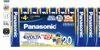
AAA alkaline batteries for gear that takes this size, such as some headlamps, IC recorders, and small EMF-meter-type devices. They keep for 10 years, so they double as disaster-prep stock — swap in a fresh set before heading out to explore.
Panasonic Evolta Alkaline Batteries AAA (20-Pack) LR03EJ/20SW
We may earn a referral fee on purchases made through these links.
How to Read Our “Tarot Reading” Tool’s Results
Here we explain accurately what our free tool actually does. Features that are not implemented are not described here.
The Cards Used and the Ways of Drawing
- Cards used: on the page you can choose “All 78 cards” (22 Major Arcana plus 56 Minor Arcana) or “Major Arcana only” (the 22 cards from number 0, The Fool, to number 21, The World).
- Ways of drawing: you can choose from five: “single card,” “three cards,” “love,” “either-or,” and “Celtic Cross.” The three-card button reads “Draw 3 (past, present, future),” and in a three-card result each card gets a heading of “Past,” “Present,” or “Future.” Love, either-or, and Celtic Cross are explained in detail below.
- Within one draw, the same card never appears twice (cards are chosen from the selected 78 or 22 without overlap).
- Upright or reversed: each card is set to one or the other with an even chance. The Minor Arcana also have upright and reversed positions.
- Because the draw is random, it is not affected by your birthday or the date. Each time the same person draws again, the result changes.
With Major Arcana only, a single-card draw has 44 possible outcomes (22 cards × 2 orientations). For a three-card draw, take “22 for the first card × 21 for the second × 20 for the third = 9,240 possibilities” and multiply by the 2 × 2 × 2 = 8 combinations of upright and reversed, for a total of 73,920. With all 78 cards, a single card has 156 outcomes, and a three-card draw has “78 × 77 × 76 = 456,456 possibilities” times 8, or 3,651,648. The chance of drawing the same result is quite small.
If you choose all 78 cards, the 56 Minor Arcana also enter the pool. The Minor Arcana are divided into four suits, Wands (fire), Cups (water), Swords (air), and Pentacles (earth), and each suit has number cards from Ace to 10 plus four court cards: Page, Knight, Queen, and King. These four suits come from the lineage of the ancestors of playing cards, which had four marks of cups, coins, swords, and batons, and are said to trace back to cards that came to Europe from the Islamic world in the late 14th century. The correspondence with the four elements of fire, water, air, and earth is an idea linked to them later, in divination and mystical thought, and was not a rule from the time the cards were born.
When Minor Arcana are mixed into a three-card draw, the way of reading changes. With three Major Arcana, you can follow the numerical order and read it like a “story of a journey,” but once Minor Arcana are included, it no longer forms a story connected by numbers. So on our site, we read the overall tendency from how many of the three cards are Major Arcana and which suit they lean toward. In general, the more Major Arcana there are, the more the reading concerns major turning points in life, and when the same suit repeats, the story’s center of gravity is read to lie in the area that suit is said to represent (for Wands, drive and action; for Cups, feelings and relationships; for Swords, thought and conflict; for Pentacles, money, work, and daily life). The upright and reversed reading of each card works as before, even for Minor Arcana.
Put simply, when you draw with 78 cards, the “leading” Major Arcana are joined by “supporting” Minor Arcana, making it easier to reflect even the small events of daily life. When Minor Arcana are mixed into three cards, look not at a story in the order but at “how many leading cards there are” and “which suit is most common.”
What Appears on the Result Screen
The result screen shows the name of each drawn card, an upright or reversed label, and a short interpretation matched to the card’s orientation. Each card has one interpretation for upright and one for reversed. The picture of the card itself is not displayed.
In a three-card draw, the result screen lines up the three cards in the order drawn, with a heading of “Past,” “Present,” or “Future” on each one. Right under the heading come the card’s name and upright or reversed label, followed by the interpretation. The first card takes the role of the past, the second the present, and the third the future. With a single card, on the other hand, no heading is shown, only the card’s name and interpretation.
Put simply, our tarot is built so that you “draw from 78 cards, or from the 22 Major Arcana, and receive a short one-line message.” With three cards, you read them in order along the “Past,” “Present,” and “Future” headings attached to each.
How the Love, Either-Or, and Celtic Cross Spreads Work
Besides the single-card and three-card draws, there are three ways of drawing suited to particular purposes. The flow is the same as for the single and three-card draws: from the spread of cards you pick the required number and turn them over one at a time. What differs is the number of cards and the “role” fixed to each place. In the result, each card is shown with the role of its place.
- Love (5 cards): read in the order “your feelings,” “the other person’s feelings,” “the current relationship between you,” “what lies between you (obstacles),” and “your near future.” Its feature is that you can look separately at yourself, the other person, and what is between you. Note, however, that the “other person’s feelings” card does not tell you the other person’s true heart. Take it as a tendency in the other person as it appears to you.
- Either-or (5 cards): a way of drawing for when you cannot decide between A and B. The first card is “you now,” the second and third are “the flow if you choose A” and “where A leads,” and the fourth and fifth are “the flow if you choose B” and “where B leads.” For A and B you can optionally enter words such as “change jobs” or “stay at my current job,” and what you enter is reflected in the display of the result. In the final overall reading, the cards for A and B are compared and a summary is given of which looks like the brighter flow.
- Celtic Cross (10 cards): a large way of drawing that reads a single worry from many directions. It has ten roles: “the present situation,” “the obstacle or crossing influence,” “what you aim for (conscious),” “the root (unconscious),” “the past,” “the near future,” “your attitude,” “the surroundings,” “hopes and fears,” and “the final outcome.” The overall reading gathers and presents the two central cards, the gap between conscious and unconscious, the tendency of all ten cards, and hints that can be read from the “your attitude” card.
The Celtic Cross is said to have come into wide use after it was introduced in Waite’s guide “The Pictorial Key to the Tarot,” published around 1910. Waite presented it as an “ancient Celtic method of divination,” but whether it truly goes back to antiquity has not been confirmed. There is also a view that it was a method born around the Golden Dawn, the magical society Waite belonged to, and its clear origin is unknown. The order in which cards are placed and the meaning given to each place also differ slightly by book and by reader. Our ten roles take these differences into account and are rephrased in words that are easy to follow, even for first-timers.
In our view, the more cards a draw uses, the better suited it is to searching for “where you can make a change to shift the flow” than to deciding “good or bad.” A single card gives you one answer, but the ten-card Celtic Cross shows the situation, obstacles, your attitude, and your surroundings separately, in different places. Even if the resulting cards are heavy, for example, if the one card for “your attitude” changes, where things end up may change too. The same holds for either-or: use it not only to choose the side that looks brighter, but as material for learning where you are likely to stumble in the flow of the side that looks darker, and you can make better use of the number of cards.
Put simply, love is “looking at the relationship in separate parts,” either-or is “laying two paths side by side to compare,” and the Celtic Cross is “viewing one worry from 10 directions.” The more cards, the more clues you gain for thinking, rather than the answer itself.
Reading A’s Three Cards
Back to the earlier example. The three cards drawn by A, who was thinking “I can’t decide whether to apply for a new job,” are shown on screen with the following headings and interpretations (shown as the tool displays them).
- Heading “Past”: Strength (reversed): a state of lost confidence, or of being swept along by inner impulses.
- Heading “Present”: The Emperor (upright): established order and the power to command. The strength to lead things with responsibility.
- Heading “Future”: The Hanged Man (upright): a time of deliberately not moving brings a new perspective.
Let us read this as one story (only one example of reading, not a prediction). The past is a time when confidence wavered or feelings ran ahead. Now she is in a state where she holds the arrangements herself and can decide with responsibility. And what comes next can be read as a time of deliberately not hurrying, stopping to look from another angle. It can also be taken as suggesting a flow of “calmly reviewing the conditions before deciding,” rather than “pressing the apply button right away.”
What matters is that the result is not commanding “apply” or “don’t.” The result of a divination is only material for organizing your own feelings. What has meaning is that after reading it, a reaction arises within you, such as “that may be so” or “that doesn’t feel right.”
Reading B’s One Card
The card drawn by B, who felt “a little tired lately,” was “The Star (upright).” Its interpretation reads: “A quiet hope, and a sign of healing. A time when the heart clears.” It is a card that eases the tension in your shoulders a little when drawn while tired. It can be taken as the message that “it is fine to value a time of quiet recovery rather than forcing yourself to push on.” Here too, this is not a medical judgment, but a reading offered as one way to help settle your feelings.
Tarot Terms: A Quick Reference
- Tarot: a set of picture cards of 78 (22 Major Arcana plus 56 Minor Arcana). Originally the cards of a 15th-century Italian card game.
- Trionfi: the name in use when tarot was born. It means “triumph, victory,” and is said to share its root with the English “trump.”
- Major Arcana: the 22 cards from The Fool (0) to The World (21). Leading-role cards that symbolize big scenes and movements of the heart in life.
- Minor Arcana: 56 cards, 4 suits × 14. Supporting-role cards that represent everyday events and feelings. In our tool they are used when you choose “All 78 cards.”
- Arcana: a word said to derive from the Latin for “secret.”
- Upright and reversed: the distinction between a card facing the right way and one upside down. The reading changes with orientation.
- Spread: a method of drawing and laying out cards. Includes single card, three cards, and the Celtic Cross.
- Celtic Cross: a traditional 10-card spread. Became widely known through Waite’s 1910 guide.
- Fool’s Journey: a view that reads the Major Arcana as the journey and growth of one person. A way of organizing that spread from the 20th century onward.
- Marseille Tarot: a traditional style of design that spread in 17th–18th-century France. The name was given in 1856.
- Waite deck: the deck by Waite and Pamela Colman Smith, published in 1909. One of the standards of the modern era.
- Etteilla: an 18th-century Paris fortune-teller. Considered the person who spread tarot reading as a profession.
- Egyptian origin theory: the theory that “tarot is a secret book of ancient Egypt.” Proposed in 1781, but with no evidence; a myth.
How Is Tarot Used Today?
Tarot today is used in three main settings. The first is face-to-face or online readings by a professional reader. The second is “self-reading,” in which you draw cards yourself for enjoyment. The third is as a tool for counseling, coaching, and drawing creative ideas. More people are also making the act of drawing a card itself “a time to stop and ask yourself a question.”
On the other hand, tarot as play also continues to this day. In parts of Europe such as France, Italy, and Austria, card games using tarot cards are still played by enthusiasts. For those of us who strongly associate it with divination cards, it is surprising, but its history as “cards for play” has never been broken.
Online, there are many tools and apps for drawing cards on screen. The ease of drawing with a single button, as on our site, is useful as an easy way in. Of course, the feel of shuffling real cards and drawing them with your own hand has a different charm.
5 Tips for Enjoying Tarot
- Make your question specific and open: a question that fixes the other person’s heart, such as “Does that person like me?”, is harder to read than one that focuses on your own side, such as “What do I want to value in this relationship?”
- Don’t judge too much as “good or bad”: even if a card with a frightening name appears, there is no need to panic. It often represents a scene of change or closure.
- Read three cards as a “story”: rather than cutting each card apart, read them as the flow “from past to present, and then the next step,” and the meaning connects more easily.
- Value your intuition: the reaction of “maybe” or “that doesn’t feel right” when you read the interpretation is an important clue.
- Treat redrawing as a way to check your feelings: it is natural to want to redraw again and again when you dislike a result. But that can also be a sign telling you what you truly want.
It is also recommended to briefly note the card you drew that day, together with your feelings and what happened, in a notebook or memo. When you read it back later, you may notice, “maybe that card meant this.”
Reflections: Why Have People Projected “Fate” onto Picture Cards?
From here, going beyond a summary of history, we consider from our own viewpoint what lies behind tarot as a form of divination. The parts we mark with “This is speculation, but” and “In our view,” are our site’s own thoughts, not established theory.
A “False Origin” Gave the Cards Weight
The ancient Egyptian origin theory does not hold up as history. Even so, it went on influencing the world of divination for a long time. Why?
This is speculation, but it may be because this story was so appealing in 18th-century Europe. At the time, ancient Egypt was an object of longing in Europe, a land older than Christianity that held lost wisdom. When the story of “a secret book from long ago” was laid over what had been “cards for play,” mere picture cards suddenly took on a mystical weight.
In our view, one essence of divination lies here. A divination tool gets its power less from “what it is made of” than from “what story it wears.” The story need not be fact. What matters is that the user can feel “this will mirror my fate.” That feeling turns the picture card from “a picture to look at” into “someone to ask.”
Why Do Even “Defeat” and “Villains” Line Up in the Major Arcana?
The Major Arcana include cards that are by no means bright: “The Tower” (collapse), “The Devil” (temptation), “Death” (an ending), “The Hanged Man” (a figure unable to move). Some may wonder, “Why include frightening cards in a tool for telling fortunes?”
Here, let us again note that tarot’s predecessor was the “trionfi (triumph).” In 15th-century Italy, processions honoring victors and allegorical pictures on the themes of life and death were popular (some say it was inspired by the poet Petrarch’s “Triumphs”). Seen from that worldview, “death,” “fortune,” and “evil” may all have been natural faces in the human procession. This is speculation, but a set of cards that included fear and failure, rather than one lining up only good fortune, may have felt like it “reflected a whole life,” and so been used for a long time.
Our tool also carries on this way of thinking. For example, “The Tower” is read as a sudden collapse and also as “a necessary change that breaks an old framework,” and “Death” is read as “an ending is also a beginning.” To leave room, in a card with a frightening name, for “so there is no need to be afraid.” This is an attitude our site values.
The Role of Reversal as “Another Way of Reading”
The chance of a card coming up upside down brings a wide range to a divination result. Even the same “The Devil” is a “warning about attachment” upright and “release from bondage” reversed. Even the same “The Moon” is “sensing an unclear anxiety” upright, and “a sign the fog is lifting” reversed.
In our view, a reversal works less as “a device for making the result worse” than as “a second entrance the reader can choose to suit their own state.” Even if a card drawn in a hard time is upright with a severe meaning, a different light may come in if it is reversed. Perhaps people draw cards seeking that “room.”
That said, the meanings given to reversals differ by reader even within the tradition, and our own interpretations are just one way of reading. Please do not decide that “this is the correct meaning of a reversal,” and take it only as a rough guide.
The Number 22, and the Fact That Only “The Fool” Stands Outside the Numbers
The fact that there are 22 Major Arcana has long been linked to the fact that the Hebrew alphabet has 22 letters. It began with the text of the Comte de Mellet included in Court de Gébelin’s 1781 work, and was later passed on to 19th-century magical thought. But this correspondence was not there from the beginning, historically. Rather, it is thought that meaning was found in the coincidence of numbers afterward.
Among these 22, “The Fool” holds a somewhat curious position. While the other cards carry numbers 1 through 21, The Fool is number 0, in other words “outside the numbers.” In some old traditional orderings, The Fool is not numbered at all. This is speculation, but perhaps The Fool is placed as “a being who views the world from outside the ordered rules.”
In our tool as well, The Fool’s interpretation is “a new departure. A free beginning of possibility, bound to nothing.” Within the same set of cards that lines up order (The Emperor) and tradition (The Hierophant), a free being outside them is included. The interest of this contrast is, we think, one of the charms of tarot.
The Mind’s Mechanism That Makes Divination Words Seem to “Hit”
Many people have had the experience of reading a card’s interpretation and feeling “that’s right on.” In psychology there is a phenomenon in which people take vague statements that could apply to anyone as accurate words addressed to themselves alone, called the “Forer effect (Barnum effect).”
In our view, this phenomenon is not just a term for rejecting divination. Rather, it explains well the mechanism by which divination words work as “a mirror that draws something out of you.” On reading the interpretation of “Strength (reversed),” a person searches within themselves for “a time I lost confidence.” That work of searching becomes a time of looking at yourself anew.
For that reason, our site positions tarot results not as “a forecast of the future” but as “a trigger for finding the questions within you.”
Why Do People Seek to “Draw”?
Finally, let us touch on tarot’s essential question. Why do people “draw” cards? It is not only because they want to shorten the time spent thinking.
This is speculation, but when hesitating, perhaps people are afraid to carry the responsibility of a decision alone. If there is the reason “the card said so,” they can hand off a little of that weight. On the other hand, if you feel “wait, this isn’t right” the moment you draw a card, that reaction is your real answer. In other words, the act of drawing a card, while seeming to hand a decision to the outside, is in fact a device for observing the reactions of your own heart.
When a 15th-century noble shuffled the cards, when 18th-century Parisians sat before a fortune-teller, and when we today press a button on a screen: the forms differ, but what lies there may be less “wanting to know the answer” than “wanting someone to give a name to our own feelings.”
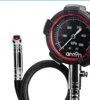
Getting to a haunted spot often means unpaved mountain roads or gravel, where low tire pressure easily leads to a flat or worse fuel economy. Checking your tires with a gauge before you set out reduces the risk on rough roads.
amon Air Gauge, Standard Grade Tire Gauge 8821
We may earn a referral fee on purchases made through these links.
Cautions When Approaching This Divination
This article and our “Tarot Reading” are offered as entertainment and as hints for self-understanding, and do not guarantee results. They are also no substitute for important decisions on medicine, law, investment, schooling, employment, marriage, and the like. Please make such decisions yourself, after consulting specialists or people you trust.
Statements such as “a bad card came up, so I will be unhappy from now on” or “this card came up, so it will surely go well” are not appropriate ways of reading tarot either. Cards do not fix the future; they are a chance to look again at your present feelings and situation. If you feel strong anxiety about a result, step away from divination for a while, rest, or talk to someone close to you. If you cannot sleep or your low mood continues, please also consider consulting a medical institution or a public support line.
Also, if you are strongly urged to pay high reading fees or buy good-luck goods, do not decide on the spot; take it home and think calmly. We also do not recommend telling the fortune of a specific real individual or organization and making definitive claims about their fate.
The historical statements in this article were compiled in our own words with reference to multiple sources. There are various theories about the history of tarot, and in particular the dates of its earliest use for divination and the details of certain people’s activities are described differently depending on the source. Also, the parts marked “This is speculation, but” and “In our view,” are our site’s own reflections, not established theory.
Frequently Asked Questions
Q. What is tarot?
A. It is a set of picture cards (usually 78) used for divination and as a tool for organizing your own thoughts. Originally these were cards that nobles used for card games in 15th-century Italy.
Q. Since when has tarot been used for divination?
A. Reliable records of divination date from the 18th century. Simple meanings appear in a manuscript from around 1750, and in 1780s France, use for divination spread in earnest through fortune-tellers such as Etteilla. When born in the 15th century, they were cards for a game, not for divination.
Q. Is it true that tarot originated in ancient Egypt?
A. No. It was a theory proposed by a French scholar in 1781, but no evidence has been found to support it. Its historical origin is the card game of 15th-century northern Italy.
Q. What is the difference between the Major and Minor Arcana?
A. The Major Arcana are the 22 cards from The Fool to The World, and symbolize the big scenes of a life. The Minor Arcana are 56 cards, 4 suits × 14, and represent everyday events and feelings.
Q. How many cards does our tarot reading use?
A. On the page, you can choose “All 78 cards” (22 Major Arcana plus 56 Minor Arcana) or “Major Arcana only” (22 cards). Either way, you can choose from five ways of drawing: single card, three cards, love (5 cards), either-or (5 cards), and Celtic Cross (10 cards).
Q. How should I read a three-card draw that includes Minor Arcana?
A. Once Minor Arcana are included, it becomes harder to read as a story connected by numerical order. On our site, we read the overall tendency from how many of the three cards are Major Arcana and which of Wands, Cups, Swords, or Pentacles they lean toward. The upright and reversed reading of each card is the same as for the Major Arcana.
Q. What are upright and reversed?
A. A card that comes up facing the right way is upright, and one that comes up upside down is reversed. The reading changes with orientation. On our site, each card is set to one or the other with an even chance.
Q. Does reversed mean something bad?
A. Not necessarily. It can mean a “warning,” but it can also take a positive meaning such as “release from bondage” or “a sign the fog is lifting.” The meanings given to reversals also differ by reader.
Q. I drew “Death” or “The Tower.” Will something bad happen?
A. Though the names are frightening, in many cases they represent scenes of change such as “ending and rebirth” or “an old framework collapsing and becoming new.” It is not settled that something bad will happen.
Q. Does the order matter in a three-card draw?
A. Yes. In our three-card draw, the result gets headings of “Past,” “Present,” and “Future” from the top, with the first card in the role of the past, the second the present, and the third the future. With a single card, no heading is attached.
Q. What is the Celtic Cross?
A. It is a way of drawing in which 10 cards are laid out in a cross and a vertical line, reading one worry from directions such as “the present situation,” “obstacles,” “conscious and unconscious,” “past and near future,” “your attitude,” “surroundings,” “hopes and fears,” and “outcome.” It is said to have spread after being introduced in Waite’s guide around 1910, but its clear origin is unknown. You can draw 10 cards on our site as well.
Q. How should I use the either-or draw?
A. Use it when you cannot decide between A and B. If you enter words for A and B, such as “move” and “keep living in my current place,” those words are reflected in the display of the result, which makes it easier to read (you can also draw without entering them). The first card is you now, the second and third are the flow and destination of A, the fourth and fifth are the flow and destination of B, and finally a summary tells which looks like the brighter flow. The decision is yours in the end, so use it as one piece of material for judgment.
Q. Can I draw as many times as I like on the same day?
A. There is no limit on the number of times. But rather than repeating redraws because you dislike a result, we recommend fully savoring the meaning of the first card that came up. Because the draw is random, the result changes each time you draw.
Q. Does my birthday change which cards I can draw?
A. No. Tarot is not a divination calculated from a birth date, and our tool draws at random.
Q. What is the Waite deck?
A. It is a deck published in London in 1909, supervised by Arthur Edward Waite and illustrated by Pamela Colman Smith. Because even the Minor Arcana were given scenes, among other things, it became one of the standards of modern tarot.
Q. Does our site use commercially published tarot cards?
A. No. Our tarot has card names and short interpretations prepared in our own words, and does not use the artwork or explanatory text of any commercially published deck.
Q. Is tarot accurate?
A. No established scientific research has been found supporting that it is accurate. On our site, we present it as a culture with a long history and as a chance to organize your feelings.
Q. Can I use our site’s tarot reading for free?
A. Yes, it is free. Just by pressing a button you can draw from all 78 cards or from the 22 Major Arcana, in five ways: single card, three cards, love, either-or, and Celtic Cross.
Related Divination to Try Together
Even in the same experience of “drawing,” the feel of the words you receive changes when the tool changes. Reading them side by side will make your present feelings look more three-dimensional.
Explainer Articles to Read Alongside
If you would like to read at length, please also try these explainer articles.
- Explainer article on oracle cards
- Explainer article on the I Ching (Zhouyi)
- Explainer article on rune divination
Sources Consulted
This article was compiled in our own words with reference to the following sources (not a transcription of their text). The cards of “A” and “B” in the article are results actually drawn using the card data and drawing mechanism of our “Tarot Reading” tool.
- Tarot – Wikipedia (English)
- Tarot card reading – Wikipedia (English)
- Tarot de Marseille – Wikipedia (English)
- Antoine Court de Gébelin – Wikipedia (English)
- Etteilla – Wikipedia (English)
- Rider–Waite Tarot – Wikipedia (English)
- The Pictorial Key to the Tarot – Wikipedia (English)
- Tarot – Wikipedia (Japanese)
Suzuking. publishes videos of ghost-story and haunted-spot investigations on KARASU CHANNEL (YouTube).
Supervised by Ms.M
Affiliation: KARASU CHANNEL
Traditions studied: 12+ (Western astrology, Four Pillars of Destiny, Nine Star Ki, tarot, runes, palmistry & physiognomy, name numerology, numerology, feng shui, Vedic astrology / Zi Wei, Onmyodo, spiritual reading, and more)
Personal readings: by request via Contact,
currently booked years out
If this appeared in your dream
What it means to dream of something from this story, read through psychology and folklore in our Dream Dictionary.
- Dreaming of tarot CardsThe card you drew holds a message; if you remember it, look it up in our tarot reading.
Which story do you find the scariest?
If you think this story is the scariest, press the button below. One vote site-wide — you can change your vote for a different story anytime.
Was this article helpful?
Add this to your favorites to find it again anytime from your My Page.


Comments