Akiyoshido Cave: How a Cavern Feared as a Water God’s Home Became a Tourist Site
Supervised by Suzuking. (KARASU CHANNEL / Occult & horror reporting, 7 years)
Contents
View sources and last-checked date
- Source
- Wikipedia「秋芳洞」 https://ja.wikipedia.org/wiki/秋芳洞
- Source 2
- 美祢市公式サイト「秋芳洞」 https://www2.city.mine.lg.jp/soshiki/kyoiku/hogoka/bunkazai/bunkazai/kunishitei/tokubetsu/1537.html
- Last verified
- 2026-09-16
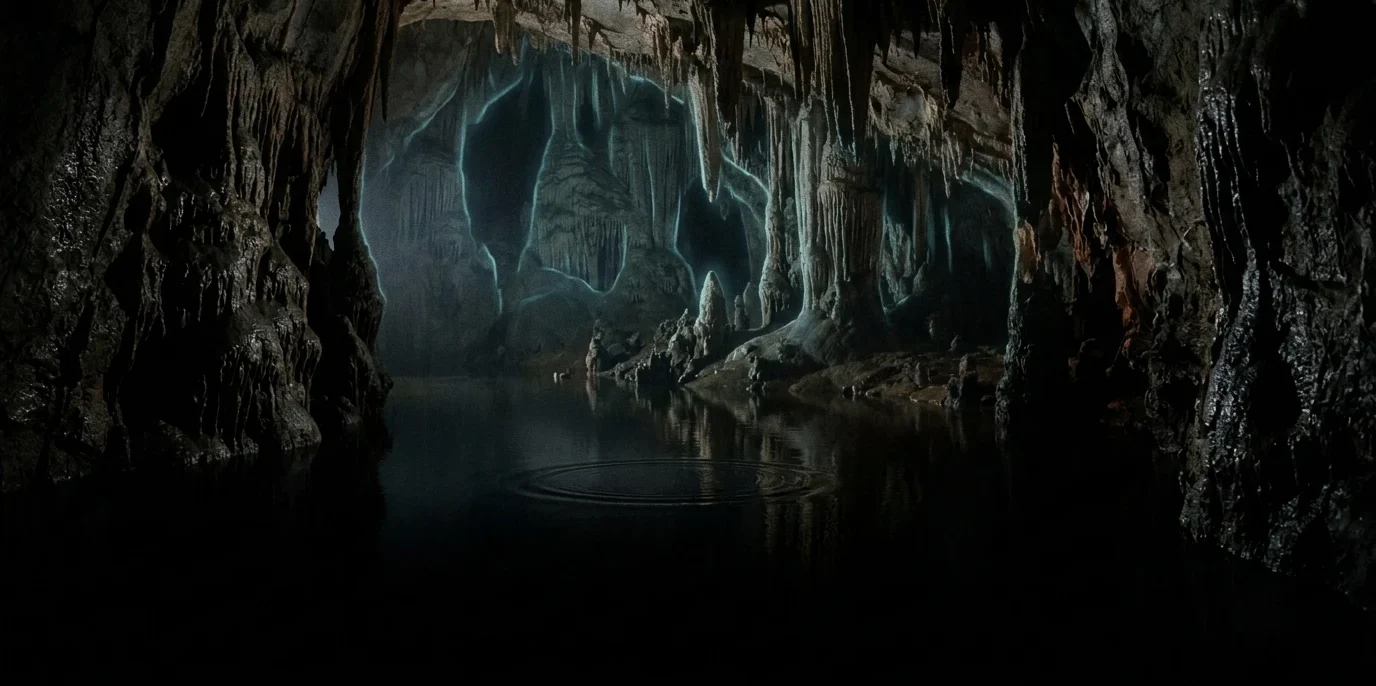
Akiyoshido Cave in Mine City, Yamaguchi Prefecture, is one of Japan’s largest limestone caverns, a Special Natural Monument that now draws large numbers of tourists every year. But this vast cave once went by an entirely different name and was treated in an entirely different way: it was a place so feared that no one dared go near it.
Origins: The Waterfall Cave Called “Home of the Water God”
Akiyoshido was once called “Takiana”, a simple name derived from a waterfall at the cave’s entrance. During the period when this name was in use, locals are said to have believed the cave was the “home of a water god” and to have feared it so much that no one approached. Records from a formal scholarly survey conducted in 1907 (Meiji 40) confirm that this belief genuinely existed at the time. The vast, pitch-black underground space, and the water that flowed there without end, must have inspired in people a sense of awe toward what they took to be the domain of a god.
That said, the phrase “no one went near it” deserves a closer reading. Following the surviving records, the cave was never a place wholly cut off from people. According to tradition, in 1354, amid a severe drought, a Zen monk named Daido Juen performed rain-making rites inside the cave and died in the torrential flood that came on the twenty-first day, when his prayers were fulfilled; this is said to mark the cave’s founding as a sacred site. It is also said that during the droughts of 1830 and 1843, in the late Edo period, large numbers of local people searched deep into the cave. Though it was a place of awe, it was also, it seems, a place people could not help but turn to when the water ran out.
Modern exploration began in 1907. Edward Gauntlett, a British fellow of a geographical society, and others surveyed the interior at the request of a mining operator; in 1909 the cave was then developed as a show cave, with a grand opening ceremony. Electric lighting began in 1925, and large-scale lighting was added in the 1960s. From the early to the middle twentieth century, the “Takiana” that had lain in darkness gradually changed into a show cave full of light.
How It Became “Akiyoshido”: A Renaming Prompted by an Imperial Visit
What changed this cave’s fate was an event on May 30, 1926 (Taisho 15). When the then 25-year-old Crown Prince (later Emperor Showa) visited the area, the name “Takiana” came up during a lunch conversation. Nobuaki Makino, the Lord Keeper of the Privy Seal accompanying him, suggested a renaming, remarking that the name “Takiana” gave an impression that did not match the cave’s actual grandeur. At the request of the Yamaguchi governor, Chamberlain Tamemori Irie devised the new name “Akiyoshido,” which was formally adopted the following June. A single visit by a member of the imperial family transformed a cave long feared by locals as the “home of a water god” into one bearing a dignified new name.
It is interesting that many of the cave’s famous features were renamed together with it. For example, Hyakumaizara (the “Hundred Plates”) was originally “Chijimizara,” Kasazukushi (the “Umbrella Series”) was “Kasaya,” Iwaya Kannon was “Ana Kannon,” and Kurotani (“Black Valley”) was, it is said, originally called “Jigoku” (Hell). That plain, blunt name “Hell” shows well how people of old perceived the cave’s darkness and terror. Tidying up names was also a way of removing fear. There is also an anecdote that, because the telegram gave the name only in kana as “Akiyoshido,” it was at first read as a cave of “Akiyoshi” written with a different, more ordinary character for “yoshi,” and a return inquiry confirmed that “the yoshi is the one meaning fragrant.”
A self-inflating sleeping mat for conserving energy during a late-night stakeout or wait in the car. Laid across a seat or the cargo area, it softens the hard, cold surface and eases fatigue during a long haunted-spot stakeout.
CAPTAIN STAG Inflating Sleeping Mat UB-3005
We may earn a referral fee on purchases made through these links.
Current Conditions: A Beloved Tourist Site and Special Natural Monument
Akiyoshido is now designated a Special Natural Monument and is one of Japan’s leading tourist caves, with paved walkways allowing anyone to explore it safely. Nearby is Beppu Benten Pond, famed for its clear blue water and ranked among Japan’s Top 100 Waters, where the mystical scenery associated with water continues to be treasured as part of the region’s appeal.
Reflection: When an Object of Fear Becomes an Object of Pride
What we find fascinating is how dramatically people’s attitude toward this cave shifted, from “a place to fear and avoid” to “a tourist site to welcome with pride.” The cave itself did not change at all, yet simply changing its name and adding the fact that a member of the imperial family had once visited was enough to completely transform how people related to it. This is only our speculation, but perhaps both the humble belief in a “home of the water god” and the dignified name “Akiyoshido” spring from the very same emotion: awe toward the overwhelming power of nature at this place, beyond human comprehension. What was once expressed as fear may simply have changed shape into pride over time. The sound of water still flowing deep underground has not changed one bit from when people once feared it as the presence of a god.
From a religious perspective, we feel a certain complicated sentiment about the fact that a cave feared as the “home of a water god” had its name changed overnight by the secular authority of an imperial visit. It can also be seen as a case in which a local, indigenous faith cultivated over many years was overwritten by the decision of a greater authority. Even so, changing the name did not change the water flowing deep underground, or the darkness that spreads there, in the slightest. In our view, beneath the beautiful name Akiyoshido, the same awe once felt toward the “home of the water god” may still be quietly sleeping today.
This, too, is only our speculation, but before lighting was installed, Akiyoshido must have been a place where every step deeper brought total darkness and cold air, with only the sound of water echoing through the space. When it was still called “home of the water god,” it would not be surprising if those who entered by torchlight alone sensed something beyond the sound of water lurking in the darkness ahead. Beyond the brightly lit tourist route of today, a vast expanse of untouched darkness still remains.
The fact that a feature inside the cave was reworded from “Jigoku” (Hell) to “Kurotani” (Black Valley) offers a major clue for reading this cave’s story. People cut dark, frightening places off from their living space by naming them directly “hell.” Then, once the place proves safe, they replace that word with a gentler one. In our view, the renaming from “Takiana” to “Akiyoshido” may have been one part of a region-wide effort to “translate” a place of fear into a landscape to be proud of.
Even so, the rain-making records tell us that fear and dependence were directed at the same cave. This is only our speculation, but behind the name “home of the water god” there may also have been the way the water that kept flowing deep in the cave was keenly felt as a lifeline during droughts, when other water ran out. It may be closer to the truth that people did not stay away because they were afraid, but because the place was too sacred to enter lightly. Fear and reverence are like two branches growing from the same root.
The cave’s own timescale is also utterly different from human time. Geological studies hold two views on when the underground cavity that became the cave was born, roughly 1.1 million years ago or more than 100,000 years ago, and volcanic ash from the eruption of the Aso caldera is thought to have covered this plateau 80,000 to 90,000 years ago and flowed into the cave as well. The few hundred years in which humans gave names and renamed them are a mere instant for this cave. Names change; the darkness does not. We find ourselves, just a little, consoled by that fact.
Five 100% cotton face towels vacuum-compressed to palm size for disaster prep — they stay clean for a long time unopened, so keeping a pack in the car is handy for wiping off sweat and grime in a dusty ruin, and doubles as an emergency bandage, blindfold, or makeshift ground sheet for warmth.
Hayashi Compressed Face Towels, Set of 5, Approx. 34x80cm, Disaster-Prep Compressed Towels FO496900
We may earn a referral fee on purchases made through these links.
An Everyday Face: The Akiyoshidai Quasi-National Park
Akiyoshido, once feared as the home of a water god, is now one of Japan’s leading limestone caverns, drawing tourists year-round. Inside, striking formations such as the Hyakumaizara (“hundred plates”) and Ogonbashira (“golden pillar”) stretch on one after another, and above ground, the distinctive scenery of Akiyoshidai, one of Japan’s largest karst plateaus, unfolds with white limestone rocks scattered across its grasslands. As a place where visitors can enjoy both underground mystery and above-ground grandeur in a single visit, it has long held its place as a leading tourist destination in Yamaguchi Prefecture.
A Note on Visiting
Akiyoshido is a tourist site with paved walkways and is not a dangerous location. Visiting hours and fees are subject to change, so we recommend checking with the Mine City or Akiyoshidai Quasi-National Park tourist information before your visit.
Frequently Asked Questions
Q. Why did the name change from “Takiana” to “Akiyoshido”?
A. In 1926, following a visit by the Crown Prince (later Emperor Showa), the Lord Keeper of the Privy Seal proposed a renaming, and the Chamberlain devised the new name “Akiyoshido.”
Q. Did the belief in a “home of the water god” really exist?
A. A scholarly survey record from 1907 describes locals believing this and avoiding the cave.
Q. Has KARASU CHANNEL filmed on location at Akiyoshido?
A. No, we have not filmed there yet; a visit is currently under consideration. Location footage for other haunted spots and kaidan stories can be viewed on KARASU CHANNEL (YouTube).

Supervised by Suzuking.
Affiliation: KARASU CHANNEL
Occult & horror reporting: 7 years (since 2020)
Followers: YouTube 5,000+ / X 25,000+
On-site investigations: 30+
If this appeared in your dream
What it means to dream of something from this story, read through psychology and folklore in our Dream Dictionary.
- Dreaming of a Tourist SpotA wish for a change of scene and new stimulation.
- Dreaming of a CaveA symbol of the depths of the mind or a refuge. Going deeper means a time to explore your true feelings.
Which story do you find the scariest?
If you think this story is the scariest, press the button below. One vote site-wide — you can change your vote for a different story anytime.
Was this article helpful?
Add this to your favorites to find it again anytime from your My Page.








Comments