Why Tsuruga’s Name Means “Horn” — The Legend of a Horned Visitor from Overseas
Supervised by Suzuking. (KARASU CHANNEL / Occult & horror reporting, 7 years)
Contents
View sources and last-checked date
- Source
- Wikipedia (Japanese), "Tsunuga Arashito"; and others
- Last verified
- 2026-09-16
Tsuruga City in Fukui Prefecture is known as a port town, and its very name carries a strange legend. The story tells of a figure with horns growing from his forehead who arrived on a boat from far across the sea — a being known as Tsunuga Arashito. Far from being a simple monster tale, the legend is also said to preserve a memory of real contact between ancient Japan and the Korean peninsula. We looked into the story behind this legend and its connection to the name Tsuruga itself.
Origins — The Story of a Man with Horns on His Forehead
The Nihon Shoki (Chronicles of Japan), a historical record compiled in the Nara period, contains two separate legends about a figure named Tsunuga Arashito. In the first, during the reign of Emperor Sujin, Tsunuga Arashito — a man with horns on his forehead — is said to have arrived by boat at a port on the Sea of Japan coast called Kehi-no-ura, the site of present-day Tsuruga. The story continues that he later received a bolt of red silk from Emperor Suinin as a gift before attempting to return home, only for the people of Silla (an ancient kingdom on the Korean peninsula) to seize it from him — an episode said to mark the beginning of worsening relations between Japan and Silla.
A second, more mythological version of the story tells of a white stone obtained in exchange for a yellow ox, which transformed into a beautiful young woman. She is said to have eventually crossed over to Japan, where she came to be worshipped as a deity in Naniwa (present-day Osaka) and in the land of Toyo (the area around present-day Fukuoka and Oita). The striking image of a horned figure is generally understood as a symbolic way of describing someone unfamiliar — a person with an unusual appearance who had come from across the sea.
From “Tsunuga” to “Tsuruga” — A Memory of Settlers Preserved in a Place Name
This legend is more than an old tale; it is deeply tied to the origin of the name Tsuruga itself. The sound “tsunuga” is believed to derive from a native-Japanese reading of “jofutsukan” (also written “kakukan”), a term for one of the highest official ranks in the kingdom of Silla. This is thought to have first been written with characters meaning “horned deer” (read “tsunuga”), before gradually shifting, over the centuries, into the characters used for “Tsuruga” today. In fact, several shrines with historical ties to Silla are scattered around the area, offering further evidence that settlers from the southern Korean peninsula, including Silla, put down roots in this region in ancient times.

Haunted-spot exploration drains a phone fast between filming, recording, checking maps, and using it as a flashlight, and running out of battery in the dark on site is a serious problem. This power bank has a built-in cable so you can't forget one, plus a display that shows the remaining charge at a glance.
Anker Power Bank (10000mAh, 22.5W) with Display, USB-C to USB-C Cable Included
We may earn a referral fee on purchases made through these links.
Tsuruga Today — Traces of Its Past as a Gateway to the Continent
Today, a statue depicting Tsunuga Arashito stands in Tsuruga City, and it has become one of the local sights associated with the origin of the city’s name. Tsuruga has flourished since ancient times as a key port for trade across the Sea of Japan, and it has continued to serve as an important gateway to the Asian continent in the modern era as well. The legend of a horned visitor from overseas can be read as a mythological record of this port town’s long history as a point of contact with the outside world.

Granular repellent for scattering around grass or the grounds of a ruin, aimed at snakes, lizards, and centipedes — a preventive measure against ground-crawling reptiles and pests in general.
Rainbow Yakuhin Snake Repellent 'Hebi-Less' Granules, Value Pack 900g
We may earn a referral fee on purchases made through these links.
Reflection — A Settler Described as “Something Other”
What follows is our own speculation. We suspect that describing Tsunuga Arashito as “a man with horns on his forehead” carries more meaning than a simple strange appearance. To people in ancient Japan, someone who had crossed the sea from a foreign land would have been a complete stranger — different in language, dress, and custom. We wonder whether giving him the clear, easily understood mark of “having horns” was a way of expressing that fundamental strangeness.
What strikes us most is that this legend did not simply fade away as an invented story, but has survived embedded in a place name for well over 1,300 years. Buried within a name that people today use without a second thought lies a memory of ancient international exchange, alongside both a fear of and a fascination with people of a different culture. We suspect that the image of a horned, otherworldly figure was less an object of pure terror than a symbol of the sheer impact that contact with another culture made on this land.
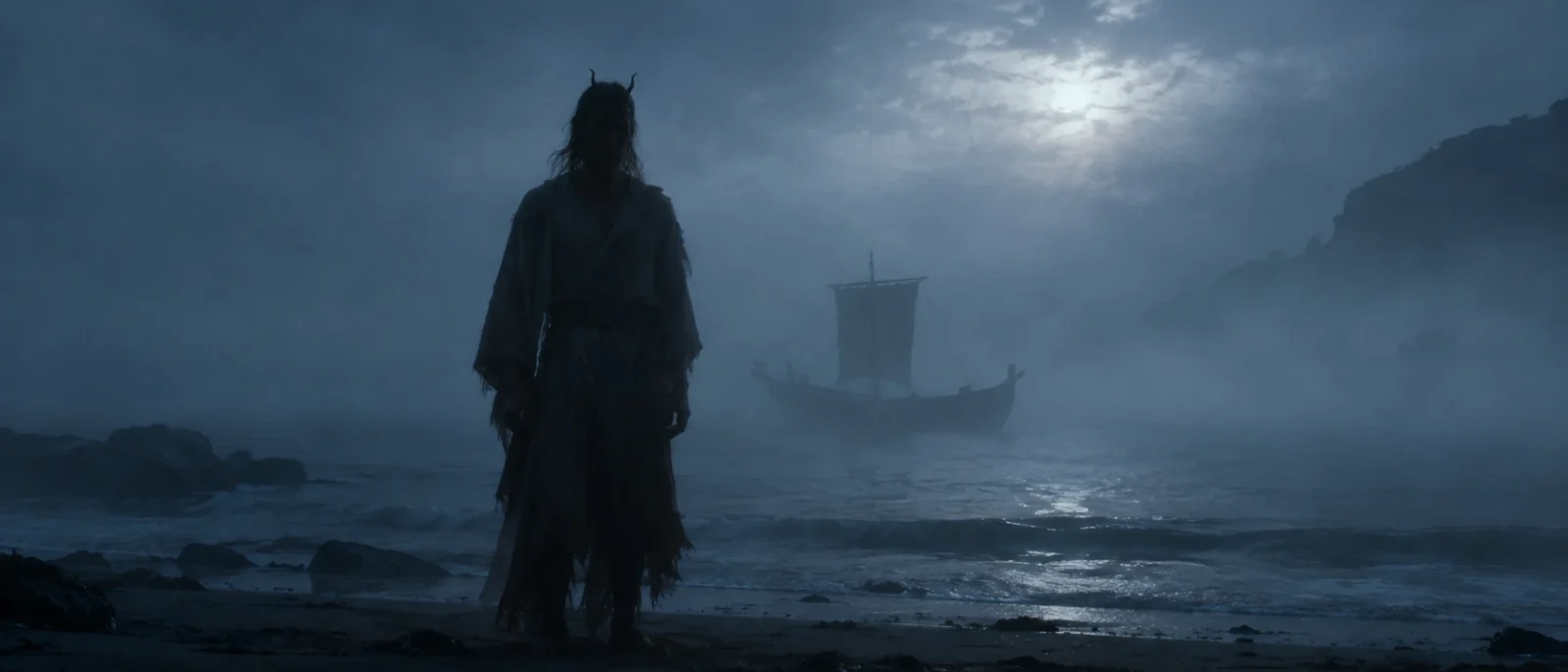
This, too, is only our own imagining, but picture the scene plainly: a figure with horns on his forehead, unable to communicate in a shared language, suddenly standing on this shore one night. The fear that the people of the time must have felt could not have been a small thing. A misty beach, an unfamiliar and unearthly shape standing perfectly still, staring back — if anyone actually lived through an encounter like that, the terror of that night may still linger, faintly, more than a thousand years later, somewhere in the sound of the name Tsuruga.
A Nearby Recommendation — Kehi Jingu Shrine
In the heart of Tsuruga City stands Kehi Jingu, long venerated as the guardian shrine of the entire Hokuriku region. Its vermilion great torii gate is counted among Japan’s “three great torii,” and the poet Matsuo Basho is said to have visited and composed verse here during his travels recorded in Oku no Hosomichi. The grounds are colored by flowers through the seasons, and the neighboring Kehi-no-Matsubara, one of Japan’s three great pine groves, is a scenic stretch of white sand and green pines. It’s worth taking a quiet moment to visit both the faith and the natural beauty that live on in Tsuruga.
A Note on Visiting
The Tsunuga Arashito statue and the shrines around Tsuruga sit within the city and, in the case of the shrines, on active religious grounds. Please be mindful not to obstruct traffic while visiting, and treat the shrines with the respect owed to places of ongoing worship.
Frequently Asked Questions
Q. Who was Tsunuga Arashito?
A. He is a legendary figure appearing in the Nihon Shoki (Chronicles of Japan), said to have had horns growing from his forehead. He is generally understood as a symbolic figure representing settlers who crossed to Japan from the Korean peninsula.
Q. Where does the name Tsuruga come from?
A. The sound “tsunuga” is believed to derive from a native reading of a term for a high official rank in the kingdom of Silla. It is thought to have first become the place name “Tsunuga” (written with characters meaning “horned deer”), before later being written with the characters used for “Tsuruga” today.
Q. Did this person really have horns on his forehead?
A. This is generally understood not as literal historical fact, but as a symbolic detail in a legend representing someone who had come from overseas. To people of the time, an unfamiliar-looking settler may have come to be remembered, over generations, as a horned, otherworldly figure.
Q. Why are there so many shrines with ties to Silla in Tsuruga?
A. As the legend of Tsunuga Arashito suggests, ancient Tsuruga is thought to have been a place where settlers from the southern Korean peninsula, including Silla, put down roots, and shrines connected to Silla remain scattered across the area as a trace of that history.
Q. Can the Tsunuga Arashito statue still be seen today?
A. Yes. A statue depicting Tsunuga Arashito stands in Tsuruga City and has become one of the local sights associated with the origin of the city’s name.
We plan to cover the Tsuruga place name and the legend of Tsunuga Arashito on video as well. Please also check out our YouTube channel.
Q. Has KARASU CHANNEL filmed on location for this legend of Tsuruga’s place name?
A. No, we have not yet filmed on location here; a visit is currently under consideration. Location footage for other haunted spots and kaidan stories can be viewed on KARASU CHANNEL (YouTube).

Supervised by Suzuking.
Affiliation: KARASU CHANNEL
Occult & horror reporting: 7 years (since 2020)
Followers: YouTube 5,000+ / X 25,000+
On-site investigations: 30+
Which story do you find the scariest?
If you think this story is the scariest, press the button below. One vote site-wide — you can change your vote for a different story anytime.
Was this article helpful?
Add this to your favorites to find it again anytime from your My Page.








Comments