The Ushioni Legend of Ushimado: A Grudge Slain Once Came Back in Another Form
Supervised by Suzuking. (KARASU CHANNEL / Occult & horror reporting, 7 years)
Contents
View sources and last-checked date
- Source
- 牛窓ウォータートレイル公式サイト「牛窓に伝わる伝説」 https://www.watertrail.com/tips/legend.html
- Source 2
- 瀬戸内Finder「牛窓の姫伝説と牛鬼伝説が残るパワースポット」 https://www.setouchi.travel/jp/trip-ideas/f724/
- Last verified
- 2026-09-16
Ushimado is a calm port town in Setouchi, Okayama Prefecture, looking out over the Seto Inland Sea. Yet the name itself is said to come from a ferocious battle with a monster. And the monster was not simply slain and forgotten: it is said to have come back with its grudge intact, in a different form, to attack the people again. It is a legend in two acts.
Origins: The Jinrin Demon, and the Ushioni Born of Its Grudge
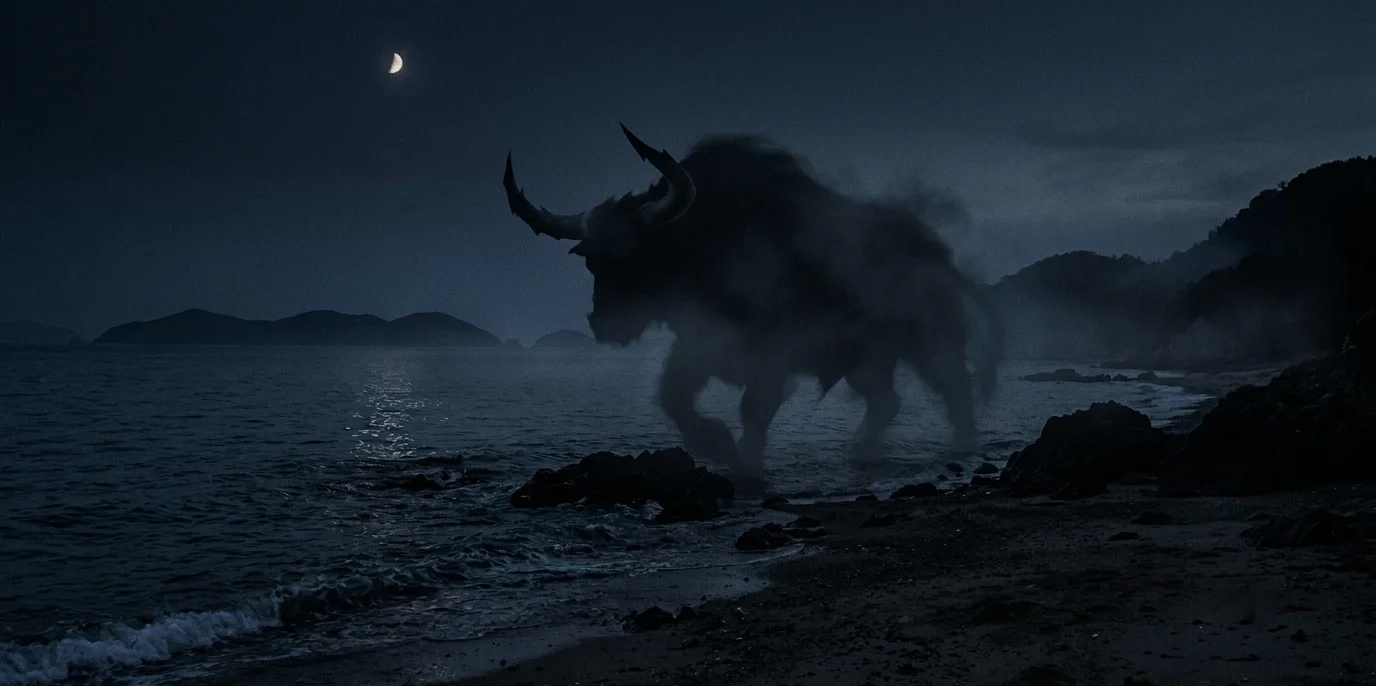
About 1,800 years ago, Emperor Chuai and Empress Jingu were on their way to subdue the Kumaso of Kyushu when, the story goes, they were attacked here by a monster called Jinrinki (the “Jinrin demon”). Emperor Chuai killed it. But on the return journey, the dead demon’s grudge is said to have taken the form of an ox-shaped monster, the Ushioni (“ox demon”), and to have attacked the land once more. An enemy that was already beaten and comes back in another shape: this twist is what makes the Ushimado legend more than a simple tale of a monster slain.
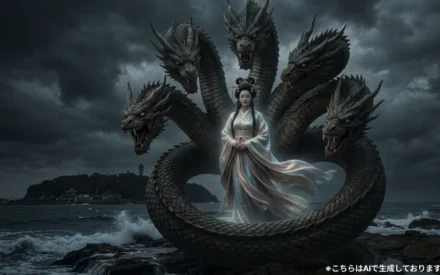
Jinrinki is described differently from place to place. In the Ushimado version, it is a huge ox-like monster with eight heads, shot dead by Empress Jingu with a bow. Its body is said to have split into head, torso and tail, which became the islands of Kishima, Maeshima and Aoshima off Ushimado. A demon named Jinrin fighting Emperor Chuai also appears in the Hachiman Gudokun, a Kamakura-period text on the divine power of the god Hachiman, and the Ushimado legend is thought to stand in that lineage.
Empress Jingu and the God Sumiyoshi: From “Ushimarobi” to “Ushimado”
Against the returning Ushioni, Sumiyoshi Myojin, the god of safe voyages whom Empress Jingu revered deeply, is said to have appeared in the guise of an old man. He loosed an arrow, seized the Ushioni by its horns and finished it off. The place where the Ushioni fell came to be called “Ushimarobi” (“the ox tumbles”), and over time the pronunciation shifted into today’s “Ushimado.”
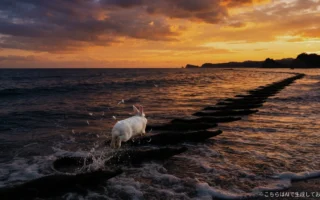
The second battle has a continuation. As the Empress was returning from Silla, Jinrinki, unable to pass on, is said to have turned into an Ushioni and attacked again. Sumiyoshi Myojin grabbed its horns and hurled it away, and it perished. Its body is said to have broken apart and become the islands of Kuroshima, Nakanokojima and Hanokojima. In other words, the islands floating off Ushimado have been counted as parts of a monster that was defeated twice: three islands from the first battle, three from the second. The view looks as though the slain grudge still lies there, transformed into sea and stone.

A natural-rubber door stopper you wedge into the gap between a door and the floor — a practical safeguard against one of the most feared scenarios in ruin exploration: the door you came through swinging shut on its own from wind or a tilted building, trapping you inside.
TRUSCO Door Stopper, Natural Rubber Type, Black, 142mm TDS140-20
We may earn a referral fee on purchases made through these links.
Present Day: Ushimado Shrine and the Three Islands in the Sea
Ushimado Shrine, closely tied to the legend, is said to have been founded here about 1,700 years ago. It is a shrine for household safety, good fortune, warding off misfortune and traffic safety, and worshippers still come from far away. From the observation deck at nearby Kameyama Park, you can see the islands associated with the legend (Kishima, Maeshima, Aoshima and others), a place loved for letting visitors feel the origin of the town’s name together with the actual scenery.
The shrine’s history is a little more complicated than the legend. It is generally said to have been founded in the Chowa era of the Heian period (1012-1016), but Ushimado has several large keyhole-shaped burial mounds and many shell middens, so the shrine’s beginnings are thought to be older still. Originally the land’s own spirit was worshipped as “Ushimado Myojin”; later, based on the legend of Empress Jingu’s Korean campaign, the Great Deity Hachiman, including Empress Jingu, was enshrined here (kanjo, the invitation of a deity to be worshipped in a new place). That means this land already had a god of its own before the story of Empress Jingu slaying monsters was laid over it.
Reflection: Why Did the Monster Not End With “Once”?
What KARASU CHANNEL finds striking in the Ushimado legend is its structure: even after Jinrinki is slain, its “grudge” gains another form, the Ushioni, and appears again. Most monster-slaying tales end in a single battle, but here the emotion of resentment itself survives the loss of the body and lingers on as a new threat in a new shape. This is our own speculation, but for the people of that time, the deeper fear may have lain less in defeating a visible enemy than in the worry that the enemy’s “grudge” might still be lingering somewhere. The fact that the place where the Ushioni fell remains in the place name may also have been less a record of an event than something close to a prayer by the locals that the grudge would never return to this land.
This is our own imagining, but the revival of Jinrinki’s grudge as the Ushioni seems to embody more than a frightening story: it gives shape to a primal fear people of that age held, a grudge that one death cannot erase. That “Ushimarobi” changed form into “Ushimado” and survives to this day feels almost like proof that the grudge was carved into this land and has never entirely vanished. Behind the name of a gentle port town overlooking the sea, the memory of two ferocious battles may still be sleeping quietly, and the sound of the name may come to seem a little different.
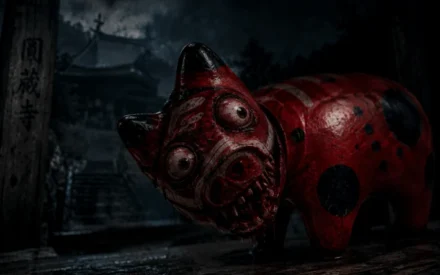
This, too, is only our imagining. If the grudge of the slain Jinrinki really took the new form of an Ushioni, with an ox-like head and sharp fangs, and prowled the shore night after night, then returning alive from the sea can never have been something fishermen took for granted. That tenacity, coming back even in a changed shape, still conveys the eeriness of not being able to be sure whether an enemy once defeated has truly gone.
The Ushioni is not unique to Ushimado. Along the coasts and in the deep pools of western Japan there are many tales of it. Some describe a terrifying man-eating monster, while others revere it as the incarnation of a god that drives away evil spirits. In the Uwajima area of Ehime Prefecture, the Ushioni is the star of a festival that parades through the town, and there is even a saying that a child whose head is bitten by the Ushioni grows wise. Yanagita Kunio is also said to have suggested that it was a metal-working god worshipped in the mountains who fell from grace and came to be seen as a yokai. In our view, the Ushimado Ushioni may likewise have been, besides a terrifying monster, an aspect of the land’s own god.
This is our own speculation, but perhaps the process by which “Ushimado Myojin,” an old god of the land, was later absorbed into the tales of Empress Jingu and Sumiyoshi Myojin was told in the form of the monster’s “two defeats.” The first was subjugation by a force from outside; the second, a two-stage pacification in which another god suppressed the grudge that remained. When a faith rooted in the land is folded into the order of new gods, the side being absorbed is left with something it cannot fully accept. If that was told as “a grudge that could not pass on,” then this legend may also be an expression of guilty respect toward the old god.
And the idea that the slain monster’s body became islands in the sea shows how a land’s memory endures. As long as the corpse has turned into scenery and keeps being called by a place name, the battle cannot be forgotten. Each time the people of Ushimado looked out over the calm sea, they may somehow have been aware of the grudge lying asleep there. Something that has been pacified lies within the beautiful view. We feel that this is the quiet fear of this port town.
Uketsu's signature work, unraveling the mystery hidden in a floor plan — a book worth introducing as a reference for our analysis pieces.
The Strange House (Uketsu / Asuka Shinsha)
We may earn a referral fee on purchases made through these links.
Its Everyday Face: The Ushimado Olive Garden, Japan’s Aegean Sea
Ushimado, where the Ushioni legend is told, is also a tourist destination called “the Aegean Sea of Japan,” for its rows of white-walled houses and the calm scenery of the Seto Inland Sea. At the Ushimado Olive Garden on the hill, you can look across Mediterranean-style olive groves to Maeshima and the other islands of the Inland Sea, and the grounds hold a Bell of Happiness and Greek-style buildings. Watching the olive leaves sway in the sea breeze, you notice that this port town has another face, that of a gentle resort, quite apart from the terror of the legend.
Respect for a Place of Worship
Ushimado Shrine is an active shrine today, and the deities of this legend are still carefully worshipped. When you visit, please check the shrine’s guidance on visiting hours and etiquette in advance, and behave in a way fitting for a place of faith.
Frequently Asked Questions
Q. Does the name “Ushimado” really come from this legend?
A. It rests on a local tradition that “Ushimarobi,” the place where the Ushioni fell, shifted in pronunciation into “Ushimado.” It is a story of origin handed down in the area, not an established scholarly etymology.
Q. Can I still visit Ushimado Shrine?
A. Yes. As a shrine for household safety, good fortune, warding off misfortune and traffic safety, it still welcomes many worshippers.
Q. Has KARASU CHANNEL reported or filmed at Ushimado Shrine?
A. No. We have not done any fieldwork there at present, and are considering it. Our field videos of other haunted spots and kaidan (Japanese ghost stories) can be watched on KARASU CHANNEL (YouTube).

Supervised by Suzuking.
Affiliation: KARASU CHANNEL
Occult & horror reporting: 7 years (since 2020)
Followers: YouTube 5,000+ / X 25,000+
On-site investigations: 30+
If this appeared in your dream
What it means to dream of something from this story, read through psychology and folklore in our Dream Dictionary.
- Dreaming of an Ushi-oniA fierce seaside yokai: a tough opponent or an unavoidable trial.
- Dreaming of a ShrineA symbol of protection, cleansing and wishes. Praying at a shrine hints your wish will be heard.
Which story do you find the scariest?
If you think this story is the scariest, press the button below. One vote site-wide — you can change your vote for a different story anytime.
Was this article helpful?
Add this to your favorites to find it again anytime from your My Page.








Comments