Mushi no Shirase: Why a Bug Brings Omens of Death
Supervised by Suzuking. (KARASU CHANNEL / Occult & horror reporting, 7 years)
Contents
View sources and last-checked date
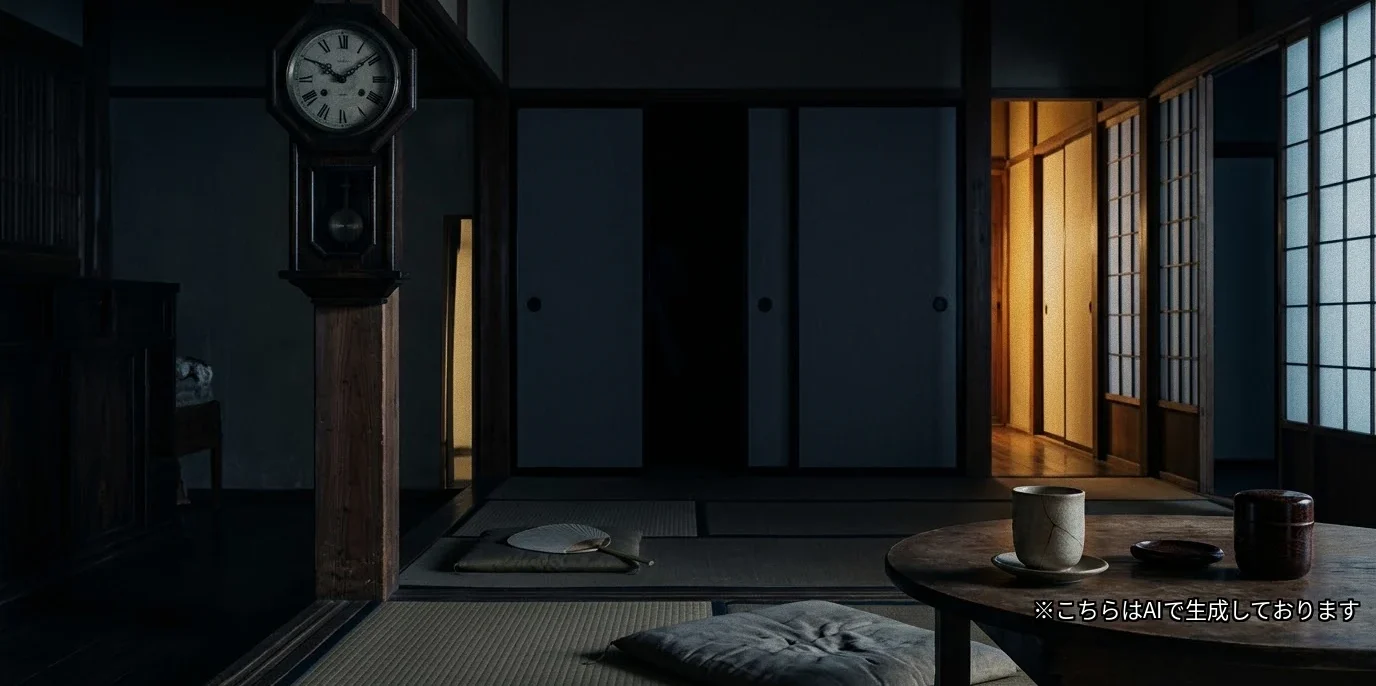
“Come to think of it, I felt strangely uneasy that night and couldn’t sleep.” Not a few people look back this way after hearing news of the death of someone close. My late grandmother appeared in a dream and smiled without saying anything. The wall clock that never should have stopped had stopped at exactly that time. In the morning, the teacup I picked up cracked with a snap. Japanese people have long called such events “mushi no shirase” (a notice from the bug, roughly a premonition).
If you think about it, it is a strange phrase. Why is it a “bug” that announces a premonition of death or misfortune? And why does the notice always arrive in the form of very familiar things, such as dreams, clocks, and teacups? This article does not go into the experiences of real individuals; it traces the types of “notice” tales handed down from long ago and the view of the body underlying them. It is less a scary ghost story than a somehow poignant one.
Origins: The Idea of a “Bug” Living in the Body
“Mushi no shirase” refers to feeling that something bad is about to happen without any clear reason. Examples are said to already appear in Edo-period texts, so it is an expression used for at least several hundred years. The “mushi” here is not the insect of the field or the cicada of summer. It refers to an invisible being thought to live inside a person’s body.
Japanese has a surprising number of phrases involving these bugs in the body. “Hara no mushi ga osamaranai” (the bug in my belly won’t settle), “mushi no idokoro ga warui” (the bug’s location is bad), “mushi ga sukanai” (the bug doesn’t like it), “uwaki no mushi ga sawagu” (the infidelity bug stirs). All express the movements of emotions and impulses one cannot control as the doing of a bug in the body. There is also an explanation that early modern people thought about nine bugs lived in a human body and affected a person’s health and mood in various ways. The idea of blaming a child’s night crying or tantrums on the “kan no mushi” is an extension of the same view of the body.
Deeper behind this view of the body lies the notion of the “sanshi” (three corpses), which derives from Chinese Taoism. The sanshi are three bug-like beings said to lurk in the upper, middle, and lower parts of a person’s body; it was believed that on the Koshin night that comes around once every sixty days, while the host slept, they would slip out of the body, ascend to heaven, and report the host’s sins to the god of heaven. Because life was shortened by the sins reported, people stayed awake that night to prevent the bugs from getting out. The Japanese custom of “Koshin-machi” spread as this belief mixed with Buddhist and Shinto elements.
What is notable about the sanshi tale is that the bug in the body was said to be “exchanging information about the host’s life and death with the outside without the host’s knowledge.” That is, the bug was another window of perception outside the person’s own consciousness. Distant events the person does not yet know, or misfortunes yet to come, the bug in the body senses first and notifies. The soil from which the phrase “mushi no shirase” grew was thus already prepared in this old view of the body.
Why Are Dreams, Clocks, and Teacups “Notices”?
Events told as mushi no shirase have several clear types. Best known is the type “standing at the pillow in a dream.” A distant family member or acquaintance appears in a dream and says something or just stands silently. After you wake and some time passes, word comes that the person has died. Since ancient times the pillow was regarded as a place where the soul dwells or where divine spirits appear, and stepping over or on a pillow was avoided. The expression of someone standing at one’s bedside in a dream meant that person’s soul had crossed the boundary to come to see you.
The tale of meeting the dead in dreams is far older than the phrase mushi no shirase. Collections of tales from the Heian and Kamakura periods contain many stories in which a person who died in a faraway place appears in a dream and speaks of their death or of memorial services for the afterlife. For people of ancient times, a dream was not merely the workings of the brain but a formal channel through which words of gods, buddhas, and the dead arrived. That is why so many stories remain in histories and tale collections of building temples or setting out on journeys based on what was told in dreams. The dream visit of mushi no shirase can be said to have drawn this long tradition of “dream oracles” into the very private scene of a family’s parting.
The next most common is the type involving things around one. A beloved teacup or tea bowl suddenly breaks without a crack. The thong of geta or zori snaps. A memorial tablet on the household altar falls over. A photo frame drops. All of these are things the person touched, put to the mouth, and wore every day. One can read the idea that when things deeply tied to a person break, it shows that the connection with the owner has been cut.
The type of the stopped clock is comparatively new, because mechanical clocks spread into homes only after the Meiji period. But the story that stopped hands point to “the moment that person’s time ended” was so easy to understand and so dramatic that it quickly became a staple of omen tales. An old-type notice survives by borrowing the form of a new tool. It shows well the flexibility of omen tales.
Notices involving animals have also been told in many places, such as crows crying noisily near the house, a dog howling, or an unfamiliar bird or butterfly wandering onto the veranda. In many regions, butterflies and moths in particular are thought to be the souls of the dead in another form. It is an interesting coincidence that the “mushi” of mushi no shirase has been imagined to span both the bug in the body and the small creature appearing before one’s eyes.

A safety item for avoiding a wildlife encounter on the way to a haunted spot in the mountains or an abandoned village where bears might appear.
Mont-bell Trekking Bell Square Silent 'Monta Bear', Bear Bell with Mute Function, for Mountain Climbing/Hiking #1134332
We may earn a referral fee on purchases made through these links.
Present Day: Omens That Do Not Disappear in the Age of the Telephone
Even as means of communication moved from letters to telegrams, telephones, and smartphones, mushi no shirase tales have not disappeared. If anything, a call late at night, or a smartphone notification that rang at a time when it should not have, is even told as a new type of “notice.” One could say that each time the tool changes, people turn their eyes to read omens in it anew.
In psychology, on the other hand, such experiences are often explained by the workings of memory. People dream nearly every night, and teacups and clocks sometimes break or stop for no reason. Most of these are forgotten without incident, and only when misfortune happens to coincide do they stay in memory with strong impression. Looking back afterward, that dream and this event are given meaning as “a notice.” This is not to deny mushi no shirase; it concerns the workings of the mind by which people find meaning in events.
Even so, it is still not unusual to see relatives at funerals and memorial services exchanging notice stories: “Come to think of it, that day.” Such conversations become an important place of telling, where people remember the dead and share feelings among those left behind.
KARASU CHANNEL’s Take: Who Is It That Waits for the Notice?
Collecting mushi no shirase tales, one notices a common point. The notice mostly reaches those who could not be at the deathbed. A daughter married far away, a son away working, a family member at the front or in service elsewhere. Someone who was in the same house and saw the person out has no need of a notice. In our view, mushi no shirase may be a tale told precisely for people who could not say goodbye.
This is our own inference, but in an age of scant transport and communication, one learned of the death of a distant family member days, sometimes months later. When the news arrives, one must face the void left after the funeral is already over. Into that void is inserted the story, “in fact, that night, that person had come to see me.” Standing in a dream, a cracked teacup: these become proof that at the last moment one was connected to that person too. Mushi no shirase was presumably also a tale to soften a little the regret of those who did not make it in time.
That the one who brings the notice is a “bug,” a being within one’s own body, also seems meaningful. In our view, it may have been a device for entrusting the feeling “I did feel it properly” to a place apart from one’s own will. If you say you had a premonition, you end up blaming yourself for why you did nothing. But if you think a bug in the body had secretly notified you, the premonition becomes not your fault but part of a fate that could not be helped. As the sanshi bugs were said to exchange with heaven without the host’s knowledge, mushi no shirase too has been told as the voice of “another self” working outside a person’s consciousness.
We also think deep feeling is put into the fact that the notice is carried by everyday goods like teacups and clocks. This is our own inference, but when people remember the dead, they picture not grand words but the teacup that person used every morning and the watch they always wore. Time from the person who kept touching them is soaked into things. The event of such a thing breaking or stopping translated the parting of an invisible soul into a visible form. Behind the type of daily goods announcing death lies a simple, sure sense that a person’s presence dwells in daily life itself.
One more thing on our mind is the curious resemblance between the Koshin night and the wake. On Koshin night, people stayed up all night so the bugs in their bodies would not slip out and tell tales to heaven. And on the night a person dies, the bereaved likewise keep watch by the deceased without sleeping, so that incense and lamps do not go out. This is our own inference, but on both nights there may flow the same rooted anxiety that “while asleep, the soul or the bug leaves this world.” Sleep has been thought a small death, and dreams the time when the soul goes wandering. That is why word of parting arrives in dreams, and on the night of parting people do not sleep. Mushi no shirase and the dream-visit tales quietly convey the sense of an age in which the boundary between sleep and death was far vaguer than now.
The fear in mushi no shirase may lie less in the omen of death itself than in the question, “Will I be able to receive the notice?” When someone precious departs far away, will the bug within me stir properly? If reading this ghost story made your heart stir even a little, it may be a signal that you could contact someone far away right now.

Driving to a haunted spot while running your phone's GPS, flashlight app, and camera drains the battery fast, and running out on site is dangerous. A dual-port car charger keeps two phones charged up en route.
Anker PowerDrive 2 Alloy (24W 2-Port Car Charger)
We may earn a referral fee on purchases made through these links.
Engaging With This Legend
Mushi no shirase tales are mostly told as the personal experiences of people who lost someone close. In this article we have not touched on the death of any specific real person but have introduced the types of tales handed down and the ideas behind them. When someone confides a notice story as their own experience, please stay with their feelings of remembering the deceased rather than questioning its truth.
Also, there is no need to stoke anxiety by immediately linking events like a teacup breaking or a clock stopping to a bad omen. Things breaking in daily life is not rare. Please take superstitions as clues to how people of old thought, without fearing them more than necessary or pressing them on others. If the pain of losing someone close continues for a long time, please do not bear it alone; rely on people around you and specialized consultation services.
If the pain of losing someone close or a low mood continues, please do not bear it alone; rely on a consultation service such as the Yorisoi Hotline (0120-279-338, free, 24 hours, in Japanese).
Frequently Asked Questions
Q. What is the “mushi” of “mushi no shirase”?
A. It is not an insect in the fields but an invisible being thought to live inside a person’s body. It was said to sway emotions and health, and the same idea remains in phrases such as “hara no mushi” and “mushi ga sukanai.”
Q. Is the sanshi bug related to mushi no shirase?
A. The sanshi is a bug of Taoist origin said to lurk in the body and report the host’s sins to heaven. It cannot be asserted to be the direct etymology, but the idea that a bug in the body exchanges with the outside without the person’s knowledge overlaps with the view of the body underlying mushi no shirase.
Q. What does “standing at the pillow in a dream” mean?
A. It means that a dead person or a god or buddha appears at one’s bedside in a dream and says something. Since ancient times the pillow was thought a place where the soul dwells and where divine spirits appear, and that idea lies behind this expression.
Q. Can mushi no shirase be explained scientifically?
A. In psychology it is often explained by the workings of memory, in which only striking events remain and are given meaning afterward. That does not deny the feelings of the person who experienced it; it should be taken as showing the mechanism by which people find meaning in events.
Q. Is it true that a broken teacup is ominous?
A. The superstition that a beloved teacup breaking is a notice of misfortune in the family is handed down in many places, but it is not a prophecy with a basis. It should be received as the sensibility of people of old who overlaid the breaking of a thing deeply tied to a person onto the severing of a connection with that person.
This saying can also be looked up in KARASU CHANNEL’s Superstition and Omen Dictionary and Dream Interpretation.
Q. Has KARASU CHANNEL researched or filmed the tradition of mushi no shirase on location?
A. No. We are not currently researching the tradition of mushi no shirase, though we are considering doing so. Videos of our research into other haunted spots and ghost stories can be viewed on KARASU CHANNEL (YouTube).

Supervised by Suzuking.
Affiliation: KARASU CHANNEL
Occult & horror reporting: 7 years (since 2020)
Followers: YouTube 5,000+ / X 25,000+
On-site investigations: 30+
If this appeared in your dream
What it means to dream of something from this story, read through psychology and folklore in our Dream Dictionary.
- Dreaming of a ClockA symbol of time and urgency. A stopped clock means stagnation; a running one, things moving.
Which story do you find the scariest?
If you think this story is the scariest, press the button below. One vote site-wide — you can change your vote for a different story anytime.
Was this article helpful?
Add this to your favorites to find it again anytime from your My Page.








Comments