Senshu Tunnel (Akita City)
Supervised by Suzuking. (KARASU CHANNEL / Occult & horror reporting, 7 years)
Contents
View basic details of this location (address, history, status, etc.)
- Location
- Akita City, Akita Prefecture, near Senshu Park (exact address withheld)
- Built
- Unknown
- Closed / Decommissioned
- Not applicable — no closure or entry restriction; open to anyone as a public road
- First Rumored
- Unknown (further research needed — mainly discussed on social media and horror-related sites)
- Current State
- Still standing and open to traffic. In everyday use as a local road for nearby residents
- Access
- Open — public road
- Last Verified
- 2026.09.11
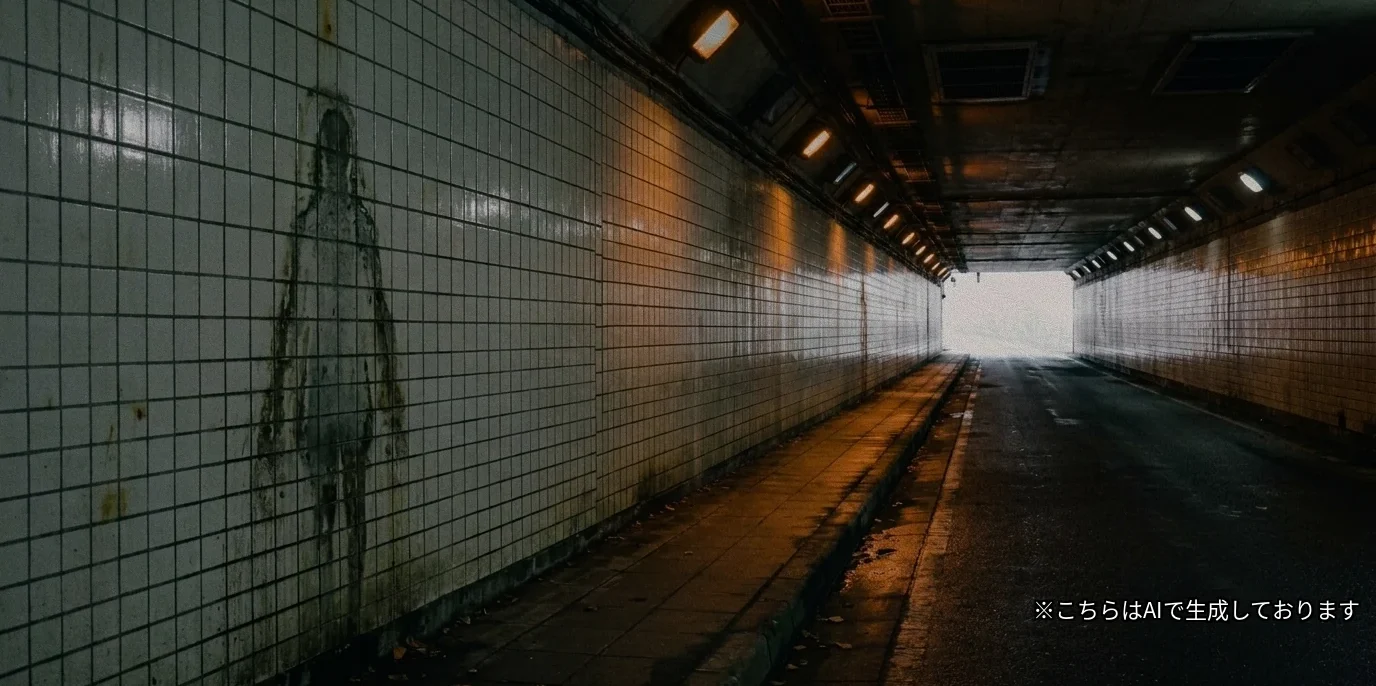
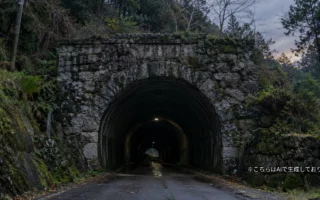
On the north side of Senshu Park (the ruins of Kubota Castle) in central Akita City runs a municipal road tunnel called Senshu Tunnel (千秋トンネル, read “Senshū”). Opened in December 1978 and roughly 190 meters long, it cuts east–west beneath Hachimanyama, a hill at the park’s northern end, linking the Tegata side of town with Hodono. It isn’t a tourist attraction or an abandoned ruin — it’s an everyday street used by both cars and pedestrians. Even so, it comes up again and again as one of Akita City’s haunted spots, and it has become a staple of Japanese haunted-spot listings online. No closure or entry restriction is currently in place, and it remains an ordinary public road that anyone can pass through.
History — A Road Through Kubota Castle’s Hachimanyama
The hill above the tunnel was once part of Kubota Castle. The castle was built on Shinmeiyama by Satake Yoshinobu, who was moved from Hitachi Province to Akita in 1602 and began construction the following year. It used almost no stone walls; instead it relied on earthen ramparts and water-filled moats that made use of old channels of the Asahi River. Northwest of the main enclosure, where the lord’s palace stood, lay a section called Hachimanyama. Rather than housing senior retainers, it held religious sites: a Hachiman shrine, an Inari shrine, and Konjōin, the temple that managed them. Behind it ran a moat called the Hachimangū Ushiro-bori — “the moat behind the Hachiman shrine.”
With the Meiji era, the castle’s role came to an end. A great fire in 1880 destroyed almost all of its buildings, and many of the moats were filled in as the town was rebuilt. The main and second enclosures became a park, and the name “Senshu” is said to have been chosen by the Akita-born Confucian scholar Kanō Ryōchi, who placed the character for “a thousand” — signifying lasting prosperity — before the “aki” (autumn) of Akita. The Hachiman shrine building on Hachimanyama was reborn as Iyataka Shrine in 1909 and moved into the second enclosure in 1916.
Then, in 1978, Senshu Tunnel was bored through beneath Hachimanyama, reportedly to ease traffic congestion in the city center. Meitoku Elementary School sits on the hill; its new playground was completed in 1979 and its new school building in 1981. Children now run across a hill where shrines once stood, while cars pass beneath it all day long. That is Hachimanyama today.
What the Rumors Say — A Woman’s Spirit and Things That Fall
At the center of the rumors is the spirit of a woman. The story repeated on several haunted-spot websites is that a woman took her own life near the tunnel’s exit, and that she has been seen there ever since — though some versions place it inside the tunnel, so even the location is told inconsistently. On top of that come more elaborate, kaidan-style embellishments: “if you honk your horn inside the tunnel, a woman’s head or hair drops onto your hood,” or “masses of hair rain down from the ceiling.” Some add that the ghost of a child wearing an old-fashioned padded air-raid hood appears there. However, we were unable to find any primary source confirming when or how the woman’s death is said to have happened, and we could not pin down when the rumor began. What we could confirm is only that, by the 2010s at the latest, the story was being repeated in online haunted-spot listings and automated social-media posts.
The way the rumor has spread is telling. Most online write-ups copy the “woman who died” and “horn” stories in nearly identical form, with little sign of new firsthand accounts being added. In the comments on one haunted-spot site, a local says they pass through every morning and have never experienced anything, and a local blogger has complained that the tunnel is still labeled a haunted spot based on outdated information, even though it is now brightly lit. Being well known and being well documented are two different things, and this article keeps what is confirmed separate from what is not.
Uketsu's newest horror mystery, unraveling the unease hidden in a single picture — a reference for our analysis pieces.
Strange Pictures (Uketsu / Futabasha)
We may earn a referral fee on purchases made through these links.
Access & Location
The tunnel lies west of Akita Station, at the northern end of Senshu Park. Its eastern entrance is on the Senshu-Jōkamachi side, approached through a cutting with slopes on both sides. The western end comes out in Senshu-Yadomemachi and continues across Takajō Bridge over the Asahi River toward Hodono. The road is known as Senshu Tunnel-dōri (Senshu Tunnel Street), and a city bus route runs through it. The surroundings are an urban neighborhood of homes, schools, inns, and hotels, with normal daytime traffic as part of everyday life.
Current Conditions
It’s a short, lit tunnel with a sidewalk alongside the roadway, used during the day by commuters, students, and pedestrians. The road inside is on a gentle slope, and because the surface freezes easily in winter, automatic de-icing sprayers have been installed at the entrances. People recall that it was once lit with dim orange lamps, but the lighting has since been replaced and the tunnel is now bright, with nothing derelict about it.
Reflection — A Hole Bored Through Sacred Ground
What follows is our own speculation. The first thing to note is that Senshu Tunnel is not just “a small tunnel in the middle of town.” It is a road bored through a castle hill — and specifically through Hachimanyama, where shrines once stood. To the people of the Edo period, Hachimanyama was sacred ground guarding the lord’s castle from the north. In the Meiji era the shrines were moved, the moats were filled in, and near the end of the Showa era a hole was opened through the hill itself. The memory of the castle town was peeled away layer by layer in the name of convenience. In our view, the rumor that “something appears” there may be an unspoken unease — a vague sense of guilt about how much the land has been changed — taking the shape of a ghost story.
Senshu Tunnel is often compared to Sendagaya Tunnel in Tokyo, which runs beneath a hill holding a temple cemetery and is known for the rumor of “a woman dangling upside down from the ceiling.” The Senshu stories — a woman who died, a head or hair falling from above — share much the same skeleton. This is speculation, but a nationally known urban-legend template may have been transplanted onto a local tunnel with a similar condition, “passing beneath a sacred place,” and taken root there. The feeling of carrying the weight of earth and history overhead may itself be what summons the fear that something will fall from above.
The horn story can be read for meaning, too. A horn exists to warn of danger, but sounded carelessly in a quiet place it becomes a rudeness that wakes whatever rests there. The idea that “if you honk, something falls” may be a car-era retelling of the old admonition not to make noise at shrines and graves. As for the “child in an air-raid hood” and the woman’s death, since no concrete source has been confirmed, it remains possible that they are narratives common to tunnel kaidan across Japan, carried over to this place. This is, in the end, only one way of looking at it.
A long-selling survey of charm and ward-off-evil customs from across Japan — folkloric backup material for our strange-phenomena articles.
A Folk Record of Charms Against Evil (Tama Saito / Ronso-sha)
We may earn a referral fee on purchases made through these links.
A Nearby Recommendation — Senshu Park (Kubota Castle Ruins)
Senshu Park, which spreads out directly above Senshu Tunnel, is a park built on the ruins of Kubota Castle, once the seat of the Satake clan, lords of the Akita domain. It features a reconstructed corner turret and main gate, along with the Satake Historical Museum, which tells the history of the Satake family, and it’s also known as a popular spot for cherry blossoms in spring and autumn foliage in fall.
Notes
This is not a restricted area — it’s a public road used daily by both cars and pedestrians. Please remember that local residents use this as an ordinary street, not as a haunted spot, and refrain from lingering for long periods, talking loudly, or parking late at night. This article is published as a record, not as an invitation to visit.
*KARASU CHANNEL does not encourage entering haunted locations.
This article touches on the topic of suicide, but does not describe any specific method. If you’re struggling and need to talk to someone, Japan’s Yorisoi Hotline (0120-279-338, free, 24 hours) and other public support lines are available — please don’t carry it alone.
Frequently Asked Questions
Q. Can you still drive through Senshu Tunnel today?
A. Yes. No closure or entry restriction is in place, and it remains an ordinary public road used every day.
Q. How do you pronounce the tunnel’s name, and when and where was it built?
A. It’s read “Senshū Tunnel.” It’s a municipal road tunnel about 190 meters long, opened in December 1978, running east–west beneath Hachimanyama at the northern end of Senshu Park (the ruins of Kubota Castle).
Q. Is it true that a suicide happened there in the past?
A. It’s a widely told rumor within Akita City, but this investigation found no primary source confirming when or how it is said to have happened. The facts remain unconfirmed.
Q. Where can I turn if I’m struggling emotionally?
A. Please don’t carry it alone — reach out to a public support line such as Japan’s Yorisoi Hotline (0120-279-338, free, 24 hours). This article is published as a record, not as an invitation to visit.
Japanese horror KARASU CHANNEL
Q. Has KARASU CHANNEL filmed on location at Senshu Tunnel?
A. No, we have not filmed there yet; a visit is currently under consideration. Location footage for other haunted spots and kaidan stories can be viewed on KARASU CHANNEL (YouTube).

Supervised by Suzuking.
Affiliation: KARASU CHANNEL
Occult & horror reporting: 7 years (since 2020)
Followers: YouTube 5,000+ / X 25,000+
On-site investigations: 30+
If this appeared in your dream
What it means to dream of something from this story, read through psychology and folklore in our Dream Dictionary.
- Dreaming of a TunnelA symbol of transition or trial. Seeing light at the end means a hard time is nearly over.
Kaidan Tales from This Area
Which haunted location do you find the scariest?
If you think this location is the scariest, press the button below. One vote site-wide — you can change your vote for a different location anytime.
Was this article helpful?
Add this to your favorites to find it again anytime from your My Page.


Comments