Enoshima — The Legend of the Goddess Who Reformed a Five-Headed Dragon Through Love, Not Force
Supervised by Suzuking. (KARASU CHANNEL / Occult & horror reporting, 7 years)
Contents
View sources and last-checked date
- Source
- Fujisawa City official tourism website
- Source 2
- Enoshima Shrine official website, "Enoshima Engi (Origin Legend)," and others
- Last verified
- 2026-09-16
Enoshima, an island floating off the Shonan coast, is known today as a power spot for matchmaking and romantic bonds — but its origin story is carved from a grand myth involving a terrifying five-headed dragon that once brought down mountains and caused floods, and a single goddess. We looked into the origins of this legend of “the Heavenly Maiden and the Five-Headed Dragon,” and the traces it has left on the opposite shore to this day.
Origin — The Five-Headed Dragon That Tormented Kamakura in the Age of Emperor Kinmei
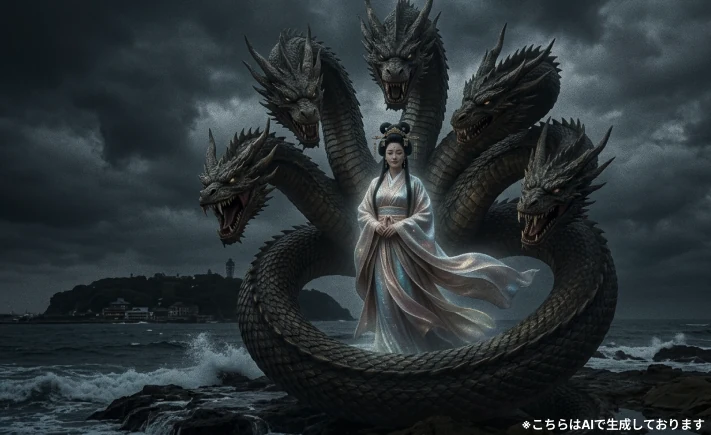
According to tradition, in the 13th year of Emperor Kinmei’s reign (552 CE), a giant dragon with one body and five heads lived in a lake said to have existed in what is now the Fukasawa area of Kamakura. This five-headed dragon is said to have brought down mountains and caused floods and typhoons, tormenting the people of the surrounding area for many years. Geologically, the Kamakura area is riddled with narrow yato valley terrain prone to landslides and flood damage whenever heavy rain falls, and it is thought that this combination of natural disasters was mythologized into the single monster with five heads.
The Appearance of the Heavenly Maiden and the Dragon’s Reform
One day, clouds are said to have gathered over the sea, and after heaven and earth shook violently, a heavenly maiden descended to this place. At that moment, an island suddenly appeared on the sea where nothing had been before — this is said to be the birth of Enoshima. Captivated by the maiden’s beauty, the five-headed dragon proposed marriage, but was refused at first because of its past misdeeds.
Rather than resorting to force, the dragon vowed never to torment the people again and to devote itself to good deeds for their benefit from then on. Believing this vow, the heavenly maiden finally accepted the proposal, and the two became husband and wife. Among Japanese myths and legends, where monstrous dragons and serpents such as Yamata no Orochi are typically vanquished by force, this legend is unusual in choosing not “conquest” but “reform through love” as its resolution.

A collection of true ghost stories passed down among police officers — a reference for our reading-feature articles.
Police Ghost Stories: Scary Tales Left Out of the Report (Jun Aimine / KADOKAWA)
We may earn a referral fee on purchases made through these links.
Ryuko Myojin Shrine and Enoshima Shrine — Two Deities Still Enshrined as a Pair
After becoming husband and wife, the five-headed dragon is said to have transformed its own body into the mountain on the opposite shore, becoming a guardian deity watching over the land of Katase and its people for generations to come. People named this mountain “Ryūkōzan” and built Ryūkō Myōjin Shrine to enshrine the reformed dragon as “Ryūkō Myōjin.” Meanwhile, the heavenly maiden — Benzaiten — took up residence on Enoshima and came to be enshrined as Enoshima Shrine. Counted among the three great Benzaiten shrines of Japan, Enoshima Shrine still sits on its island in the sea, as if watching over Ryūkō Myōjin Shrine on the opposite shore.
Facing each other across the Katase River, these two shrines are not simply separate places of worship, but a paired set of sites that together carry the two ends of a single myth said to have been forged in 552 CE down to the present day.

A breakdown on the way to a mountain or backroad haunted spot, with no streetlights around, is genuinely dangerous. This LED stop-signal light is smaller and easier to carry than a traditional warning triangle, mounts to the car body with a base magnet, and is visible to following traffic from about 1,000m at night.
GENTOS LED Stop/Warning Signal Light 'Murapika-kun' MP-34D
We may earn a referral fee on purchases made through these links.
Reflection — Why “Marriage” Was Chosen Over “Conquest”
In our view, the single most distinctive feature of this legend is that the threatening monster is not slain, but “won over” through marriage to a goddess. Given that landslides, floods, and typhoons — disasters entirely beyond the control of people at the time — were personified as a single monster with five heads, it would hardly be surprising if the story had instead cast a heroic warrior to subdue it. Yet the myth of Enoshima chooses an exceptionally rare solution: turning the disaster itself into an “ally,” not through force, but through love and a vow.
We speculate that this reflects how people living along the coast understood natural disasters — not as something that could be completely eliminated, but as something that could only be lived with and continually appeased. Typhoons and storm surges cannot be defeated and made to vanish. The idea of deifying them instead, and continuing to honor them respectfully so as not to provoke their anger, was likely closer to the lived reality of people by the sea. We believe that Enoshima continues to be loved today as a sacred site for “matchmaking” not simply because of Benzaiten’s blessings, but because the very structure of this story — turning a threat into something through love — resonates with people’s own wishes.
From a religious perspective, we feel that the choice of “marriage” over “conquest” in this legend strongly reflects the ambivalent nature of Japan’s ancient serpent and dragon worship. Snakes and dragons were never merely evil monsters; across Japan, they were worshipped as beings who governed water and, at times, brought blessed rain. Benzaiten herself traces her origins to Saraswati, the Indian goddess of water, and is known as a deity deeply connected to serpents and dragons. The structure in which a raging force of water, the five-headed dragon, is taken as a husband by a goddess likewise deeply tied to water may reflect the urgent religious outlook of people at the time: that coexistence with natural disaster was only possible not by eliminating the threat itself, but by drawing it into the same lineage of water and mastering it from within.
This is only our own imagining, but we find something faintly unsettling in the fact that the five-headed dragon was not “defeated and erased” — it transformed its own body into Mount Ryūkō and remains there to this day. If the very power that once brought down mountains and caused floods, reformed though it may be, has simply changed form and continued to sit on the opposite shore ever since, then the Katase River separating Enoshima from the far shore may be, at once, a bond between two reconciled deities and a boundary — still active today — dividing a raging force from the sphere of human life. The fact that Ryūkō Myōjin Shrine continues to be so reverently maintained might be seen less as a simple expression of gratitude than as an unbroken act of appeasement, nearly fifteen hundred years old, meant to keep that mountain-bound power from growing angry again.
Another Side — Enoshima as a Tourist Destination
Enoshima is the setting of a legend, but it is also one of Kanagawa’s leading recreational destinations. Benten Bridge, just across the causeway from the end of the Enoden line; Nakamise-dori, lined with souvenir shops and eateries along the approach; the Enoshima Sea Candle observation lighthouse at the summit; and the seaside Enoshima Iwaya caves are all beloved as spots that can be enjoyed for a full day even without knowing the legend of the dragon and the goddess. Many visitors come specifically for the local specialty, shirasu (whitebait) rice bowls, and most people who visit Enoshima Shrine are seeking blessings for matchmaking or financial fortune rather than anything to do with curses or fate. Walking the island with the legend in mind, though, may change how you see Okutsu-no-miya, which enshrines the dragon deity, and the dragon statue at the very back of the cave.
A Note for Visitors
Both Enoshima Shrine and Ryūkō Myōjin Shrine are active shrines, visited daily by many worshippers. Enoshima is also a highly popular tourist destination and can become extremely crowded, especially on weekends and in summer. Visitors are asked to be considerate of other worshippers and to refrain from any disrespectful behavior at the shrine buildings or grounds.
Frequently Asked Questions
Q. What is the legend of the five-headed dragon?
A. It is the legend that in the 13th year of Emperor Kinmei’s reign (552 CE), a five-headed dragon living in a lake in Fukasawa, Kamakura, which had tormented people by causing landslides, floods, and typhoons, fell in love at first sight with a heavenly maiden (Benzaiten) who appeared on the sea, proposed marriage, and became her husband on the condition that it reform its wicked ways.
Q. How is Enoshima said to have been formed?
A. According to the legend, when the heavenly maiden descended, heaven and earth shook violently, and an island suddenly appeared on the sea where nothing had existed before. This island is said to be present-day Enoshima.
Q. What is the difference between Ryuko Myojin Shrine and Enoshima Shrine?
A. Enoshima Shrine enshrines the heavenly maiden — Benzaiten — whom the reformed dragon took as his wife, and it is located on Enoshima. Ryuko Myojin Shrine enshrines the reformed five-headed dragon (Ryuko Myojin), said to have transformed its own body into a mountain, and it is located across the water in Katase, Fujisawa. The two shrines are considered to form a pair.
Q. Is this legend historical fact?
A. Although a specific date, the 13th year of Emperor Kinmei’s reign, is given, Enoshima is geologically a tombolo that has existed since ancient times, so the legend should not be taken as literal history. It is thought to be a myth that conveys the occurrence of natural disasters and the formation of the landscape in narrative form.
Q. Can Enoshima Shrine still be visited today?
A. Yes. It is an active shrine known as one of the three great Benzaiten shrines of Japan, and many visitors still come seeking blessings for matchmaking, the arts, and financial fortune.
We plan to introduce the legend of the heavenly maiden and the five-headed dragon of Enoshima in video form as well. Please also check out our YouTube channel.
Q. Has Karasu Channel filmed on location at Enoshima?
A. No, Karasu Channel has not filmed there yet; a visit is currently under consideration. Location footage for other haunted spots and kaidan stories can be viewed on Karasu Channel (YouTube).

Supervised by Suzuking.
Affiliation: KARASU CHANNEL
Occult & horror reporting: 7 years (since 2020)
Followers: YouTube 5,000+ / X 25,000+
On-site investigations: 30+
If this appeared in your dream
What it means to dream of something from this story, read through psychology and folklore in our Dream Dictionary.
- Dreaming of a GoddessA lucky symbol of beauty, motherhood and abundance; her smile means great luck.
- Dreaming of benzaitenGoddess of the arts and wealth: talent blooming and money rising.
- Dreaming of a ShrineA symbol of protection, cleansing and wishes. Praying at a shrine hints your wish will be heard.
Which story do you find the scariest?
If you think this story is the scariest, press the button below. One vote site-wide — you can change your vote for a different story anytime.
Was this article helpful?
Add this to your favorites to find it again anytime from your My Page.









Comments