Sugisawa Village (Former Site, Aomori City)
Supervised by Suzuking. (KARASU CHANNEL / Occult & horror reporting, 7 years)
Contents
View basic details of this location (address, history, status, etc.)
- Location
- Estimated to be within Aomori City, Aomori Prefecture (identified from the title and the prefecture taxonomy; the exact location is unknown, so the map position is an approximate municipality-level coordinate).
- Built
- Unknown (no record exists, since the existence of the village itself has not been confirmed)
- Closed / Decommissioned
- Not applicable (existence unconfirmed, so no record of when it was abandoned has been found)
- First Rumored
- A post to the website "Kaii: Nihon no Nanafushigi" in 1997 is regarded as the first record. A feature on Fuji TV's "Kiseki Taiken! Unbelievable" on August 24, 2000 made it a nationwide urban legend (based on several analysis sites and Wikipedia; not verified against original primary sources by this site)
- Current State
- Neither its existence nor its location has been confirmed (told only as folklore and an urban legend)
- Access
- Treated as off limits (as neither location nor existence is confirmed, we cannot offer directions to any specific place)
- Last Verified
- 2026.09.23
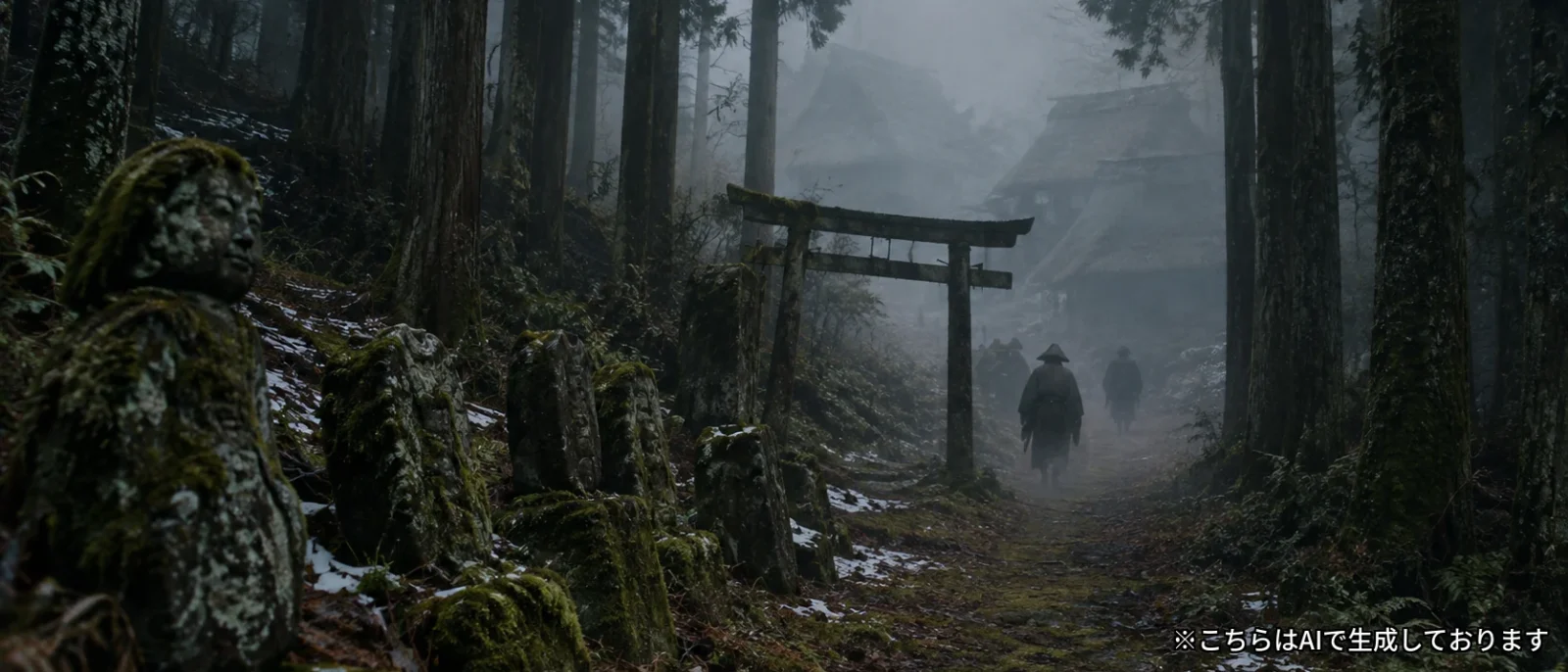
Few people in Japan have never heard the name “Sugisawa Village” somewhere in the history of Japanese urban legends. The gruesome tale of a young man who slaughtered an entire village with an axe has spread nationwide through occult books and the internet, and it is often the first place named when people think of haunted locations in Aomori Prefecture. But to state our conclusion up front: this article will not tell you how to get there. That’s because, even now, it has never been settled whether Sugisawa Village was ever a real settlement, or whether it exists only within the urban legend.
The Legend — The Massacre That Has Been Told
The core of the legend is consistent across its many versions. In a small settlement deep in the mountains, a young man (variously described as the village headman’s son, or a mentally ill resident, among other versions) is said to have slaughtered every villager with an axe, leaving characters such as “wanabi (wa)” and “curse” written in blood on the walls of the houses. Accounts describing survivors, or outsiders who later visited the site of the settlement and witnessed something bizarre, spread through magazines and internet message boards. Mixed in with these are traditions about ubasute (the abandonment of the elderly) and tales that anyone who wanders in will be cursed, and it is thought that the legend grew not as a single incident but as several kaidan merging into one urban legend.
Why the Location Cannot Be Identified
Some sources cite an address, “117 Yamabuki, Obetsunai, Aomori City,” but many point out that this address doesn’t actually exist, and no map service can locate it. The name “Sugisawa Village” also does not appear to exist in any national census or the records of former municipalities, which undermines the very premise that this was ever a real village. On the other hand, several mountain settlements in Aomori Prefecture have genuinely been abandoned over the years, so the possibility cannot be ruled out that real stories — records of depopulation and villages being deserted — became the basis for the legend. The view among those who believe there is a real basis is that dark memories handed down in the mountain villages of Tōhoku, of ubasute and mabiki (reducing the number of mouths to feed), may have been reconstructed in the form of an urban legend.

For getting to a haunted spot with poor footing, such as a mountain area or animal trail.
BISINNA Trekking Poles, Aluminum Alloy, 5-Section Telescoping & Folding, Set of 2, Adjustable Length, Lightweight, for Hiking/Walking, with Storage Bag
We may earn a referral fee on purchases made through these links.
How the Rumor Spread — From Message Boards to Television
The route by which the name Sugisawa Village spread is surprisingly recent. In the late 1990s it became a topic online, and people interested in ruins and the paranormal reportedly began to search for it. The decisive moment came on August 24, 2000, when Fuji TV’s program Kiseki Taiken! Unbelievable covered it, and it is said to have become a nationally known urban legend from then on. The program followed up with further coverage, but even its investigation reportedly never determined what the village really was.
After that, a documentary-style DVD (2000) and even a work billed as a theatrical version (2014) were made, and the legend came to be consumed as something to be “explored.” It is a pattern in which the story kept being reproduced without any evidence that the village existed.
Theories About the Origin — Did Several Stories Blend Together?
Writers and researchers have offered several views on the origin. One holds that a real past incident served as the basis and blended with the memory of another incident, changing shape. Another suggests that the mountain settlement in the novel Yasei no Shomei (Proof of the Wild) was the motif. None of them has decisive evidence. Some theories name specific real incidents; out of consideration for the victims and their families, this article does not name them.
This is only our speculation, but the plot — one man kills every villager and the village vanishes — lines up the fears that city dwellers tend to hold about closed mountain villages: kinship, madness, isolation. That may be why the story feels “plausible” and completes itself in a listener’s mind even without identifying any particular incident.
Access & Location
This article does not publish an address or map information. The reason is simple: no primary source confirming its existence has been found. Even if you were to travel to a location said to be associated with the legend, there is no guarantee it is actually “Sugisawa Village,” and the greater risk is trespassing on unrelated private property or forest land. This is unusual for a haunted-location article, but we believe it is the honest way to write about this one.
Reflection — Why Did the Urban Legend Choose “Aomori” as Its Setting?
Everything from here on is nothing more than our own speculation. One way to view the spread of the Sugisawa Village legend is that it drew on the image people tend to hold of Aomori Prefecture: a land deep in the mountains, deep in snow, cut off from the outside world. Aomori already had fertile narrative ground for stories of “harsh nature living side by side with death,” from the Hakkōda Mountains snow-march disaster to the spiritual culture epitomized by Mount Osore. We think it reasonable that this image overlapped with the real disappearance of depopulated settlements and traditions of ubasute, and that the legend then took on a life of its own as an urban legend, without any evidence of its own reality ever surfacing.

Drinks and food left in the car warm up fast during a summer car-camping exploration, so an ice pack in a cooler bag helps. This standard model claims about 8 times the cooling power of an ordinary ice pack, and freezes quickly enough to prep the night before.
LOGOS Rapid-Freeze Ice Pack M 81660642
We may earn a referral fee on purchases made through these links.
Notes
Since neither the existence nor the location of this place has been confirmed, we cannot recommend the act of “going to look for it” at all. Entering, without permission, any forest or abandoned building claimed to be “Sugisawa Village” may constitute trespassing if the land is privately owned. We publish this article for the record, not as an invitation to visit.
*KARASU CHANNEL does not encourage entering haunted locations.
Frequently Asked Questions
Q. Can Sugisawa Village still be visited today?
A. No. To begin with, its location has never been identified, and it has not been confirmed whether it was ever a real settlement. We do not recommend entering, without permission, any place said to be associated with the legend.
Q. Are there any specific eyewitness accounts of paranormal experiences?
A. Many accounts describing visits to “the site of the massacre” circulate on the internet, but none of them has a clear source or date, and none could be confirmed as a primary source.
Q. When did the Sugisawa Village legend begin to spread?
A. It is said to have become a topic online in the late 1990s and to have become known nationwide after a television program covered it on August 24, 2000.
Q. What theories exist about its origin?
A. Some see it as a blend of real incidents, other ghost stories, and fiction such as a novel, but none has decisive evidence and none is settled.
Q. Has KARASU CHANNEL filmed on location at Sugisawa Village?
A. No, KARASU CHANNEL has not filmed there yet; a visit is currently under consideration. Location footage for other haunted spots and kaidan stories can be viewed on KARASU CHANNEL (YouTube).

Supervised by Suzuking.
Affiliation: KARASU CHANNEL
Occult & horror reporting: 7 years (since 2020)
Followers: YouTube 5,000+ / X 25,000+
On-site investigations: 30+
Which haunted location do you find the scariest?
If you think this location is the scariest, press the button below. One vote site-wide — you can change your vote for a different location anytime.
Was this article helpful?
Add this to your favorites to find it again anytime from your My Page.

Comments