Akabeko — The Red Cow Born from Two Disasters: Earthquake and Plague
Supervised by Suzuking. (KARASU CHANNEL / Occult & horror reporting, 7 years)
Contents
View sources and last-checked date
- Source
- Wikipedia, "Akabeko" https://ja.wikipedia.org/wiki/赤べこ
- Last verified
- 2026-09-16
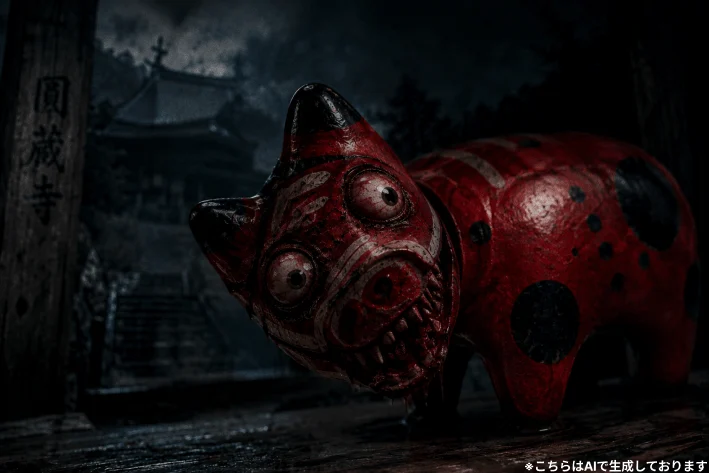
Yanaizu, Kawanuma District, Fukushima Prefecture. The Akabeko — a papier-mâché red cow that gazes back at you while nodding its head — is known nationwide as Fukushima’s signature folk toy. But painted into this cow’s red body is more than a simple good-luck charm: it carries the memory of two separate hardships, a disaster and a plague.
Origins — The Red Cattle That Climbed the Cliff
The setting for the Akabeko legend is Enzō-ji Temple (also called Kokuzō-dō) in Yanaizu. The main hall was damaged in the Aizu earthquake of 1611 (Keichō 16), and rebuilding it required hauling a huge amount of material up a steep cliff. Laborers and oxen struggled to make progress, and then, so the story goes, a herd of red-coated cattle appeared from nowhere, working alongside the black cattle to carry the heavy materials up one load after another and help complete the hall. Once the work was finished, the red cattle quietly vanished. People came to call these mysterious cattle “Akabeko,” and passed the story down as that of guardian spirits who had helped rebuild the temple.
The setting of the legend is not fixed to a single period, however. Another version places the rebuilding of the main hall in the Heian period, with the red cattle appearing during the grueling work of hauling great quantities of timber out of the mountains. In every version the cattle vanish without a trace once the work is done, and it is said that papier-mâché red cows were later made in the hope of sharing in that miraculous blessing — the origin of the Akabeko.
How It Became a Charm Against Plague
There is another event behind how the Akabeko went from a mere legend to an actual toy placed in children’s hands. In 1713 (Shōtoku 3), when smallpox swept through the Aizu region, a belief spread that children given a papier-mâché Akabeko with black spots painted onto its red body either avoided the disease or came through it lightly. In another telling, it was not only children holding the toy: households that kept an Akabeko at home were said to have had no one fall ill. Red has long been thought to ward off evil, and the black spots painted on the body are also said to represent the pustules of smallpox itself. In other words, the Akabeko’s black spots were not mere decoration — they were modeled directly on the symptoms of the disease people feared most at the time. There is a desperate kind of prayer embedded in the idea of deliberately copying the appearance of a terrifying disease onto a toy and handing it to a child as protection.
A collection of essays on strange stories connected to food — an easy reference to cite in a kaidan column.
Scary Food (Tanishi Matsubara, Futami Shobo)
A Head That Still Nods — Craft and Prayer
Around Yanaizu today, Akabeko are still made by hand, following the traditional process. Layers of washi paper are pasted over a wooden mold to shape the cow, a white gofun (shell-lime) base coat is applied, the body is painted red, and finally the face and spots are added in black ink. The head is attached to the body by nothing but a thread, and a small weight fitted inside makes it slowly rock from side to side whenever it is touched. This “nodding head” is more than a charming mechanism — some read it as depicting a cow that keeps shaking its head to ward off disease.
Yanaizu still presents itself as the birthplace of the Akabeko and continues efforts to pass the legend on; the name is also often written in hiragana as あかべこ. Its original meaning as a charm against disease, easily hidden behind its image as a cute toy, has not been lost: the Akabeko is still chosen as a good-luck gift to ward off misfortune and illness.
A folklorist’s reading of Korean urban legends — a useful reference for articles on overseas urban legends.
Korean Urban Legends: A Folklorist’s Notes on Kaidan (Takanori Shimamura, Chikuma Bunko)

A mook covering everything from forbidden grounds and folk beliefs to modern urban legends — a reference for our taboo and custom-related articles.
Reading Japan's Customs and Traditions Through Folklore (supervised by Yasunori Shimamura / Media Soft)
We may earn a referral fee on purchases made through these links.
Our Take — Why Turn a Feared Symptom into a Toy’s Pattern?
From here on, this is our own view, mixed with speculation. If it is true that the Akabeko’s black spots represent smallpox pustules, then parents of the time were deliberately placing the very symptom their children had most to fear into their hands, as a pattern on a toy. That may sound like a strange idea at first. But rather than let a child go on fearing an invisible, unknowable disease, giving that fear a visible shape and taming it may have been a way to help the child find the strength to face it — or so we read it. For a child who fell asleep hugging an Akabeko, those black spots were probably no longer something to fear, but the markings of a companion watching over them.
The legend of cattle that helped rebuild an earthquake-damaged temple, and the tradition of a toy that protected children from plague — it is probably no coincidence that these two stories are passed down together as a single Akabeko. Whether facing a natural disaster or an epidemic, hardships beyond human control, people may have found a way to hold onto their peace of mind by converting an invisible anxiety into something red, round, and faintly endearing. That Akabeko remains, more than 300 years later, one of Fukushima’s signature good-luck charms may be proof that this wisdom of transformation has not faded even now.
This is speculation, but there may also be meaning in the fact that the red cattle of the legend never showed themselves again once their work was done. As we see it, the very act of appearing before people, fulfilling a task, and then simply vanishing impressed on them that these cattle were not ordinary livestock but something beyond human understanding. Perhaps that is exactly why, when facing plague — another threat beyond human power — people once again reached for the image of those red cattle.
A Note on Visiting
Enzō-ji is an active religious institution, and it is also a casual tourist stop as the setting of the Akabeko legend. Please observe proper visiting manners on the temple grounds; facilities nearby offer an Akabeko painting experience, and details are best confirmed with the Yanaizu Tourism Association or similar. This article is published to record this place, not to encourage going there.

A Peltier-cooled neck device that lowers heatstroke risk from protective gear or long sleeves during summer ruin exploration or a haunted-spot tour under blazing sun. It cools your neck directly and instantly, giving a stronger sense of cool than a fan-blade handheld fan, and suits long outdoor location shoots.
TORRAS COOLiFY 2S Neck Cooler, Cooling Plate, Wearable Fan, Peltier, 28-Hour Battery Life
We may earn a referral fee on purchases made through these links.
Frequently Asked Questions
Q. Do the black spots on the Akabeko have a meaning?
A. According to tradition, during a smallpox outbreak, children were given Akabeko painted with black spots resembling the disease’s pustules as protection against illness. Red itself has long been considered to ward off evil.
Q. Are Akabeko still made in Yanaizu today?
A. Yes. Handmade Akabeko following the traditional process of layering washi paper over a wooden mold are still produced around Yanaizu, and some facilities offer a painting experience.
Q. Where is the birthplace of the Akabeko?
A. Enzō-ji Temple (Fukuman Kokūzō-son) in Yanaizu, Kawanuma District, Fukushima Prefecture, is considered its birthplace. Yanaizu still passes on the legend as the birthplace of the Akabeko.
Q. In what era did the red cattle help rebuild the temple?
A. The best-known version sets it after the Aizu earthquake of 1611 (Keichō 16), but another version places it during a rebuilding of the main hall in the Heian period, so the setting is not fixed to one era.
Q. Has KARASU CHANNEL filmed a report in Yanaizu?
A. No, we have not filmed there yet, though we are considering it. Other haunted-spot and kaidan field-report videos can be viewed on KARASU CHANNEL (YouTube).
Japanese horror 鴉番組

Supervised by Suzuking.
Affiliation: KARASU CHANNEL
Occult & horror reporting: 7 years (since 2020)
Followers: YouTube 5,000+ / X 25,000+
On-site investigations: 30+
If this appeared in your dream
What it means to dream of something from this story, read through psychology and folklore in our Dream Dictionary.
- Dreaming of earthquakeRead as a sign that a major life change is coming — in love, work or living situation. It can point either wa…
Which story do you find the scariest?
If you think this story is the scariest, press the button below. One vote site-wide — you can change your vote for a different story anytime.
Was this article helpful?
Add this to your favorites to find it again anytime from your My Page.









Comments