The Tomb of Taira no Masakado’s Head — The Thousand-Year Curse That Can’t Be Moved from Prime Ōtemachi Real Estate
Supervised by Suzuking. (KARASU CHANNEL / Occult & horror reporting, 7 years)

Contents
View sources and last-checked date
- Source
- Bunshun Online article
- Source 2
- Multiple explanatory websites
- Source 3
- National Tax Agency column, and others
- Last verified
- 2026-09-16
Ōtemachi, Chiyoda Ward, Tokyo. In the middle of one of Japan’s premier business districts, on some of its most valuable land, there is a small plot that has never once been touched by the redevelopment sweeping the area around it: the tomb of Taira no Masakado’s head. Judging by land value alone, this is exactly the kind of spot that should have been replaced by a high-rise long ago — so why has this single mound survived for nearly a thousand years? We looked into its origins and the curse legend that keeps being told about it.
Origins — The Legend of a Head Displayed in Kyoto That Flew Back to Kantō
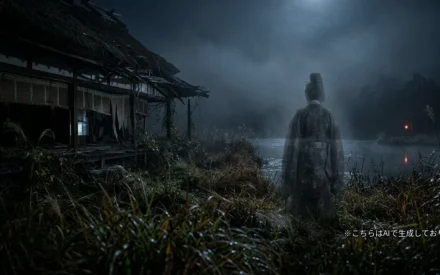
In 940 (Tengyō 3), Taira no Masakado, who had sought to establish an independent regime in Kantō, was struck down by the forces of Fujiwara no Hidesato and Taira no Sadamori, and his head was carried to Kyoto and displayed as a warning. From here the story shifts from history into the realm of legend: Masakado’s severed head is said to have kept its eyes wide open, glowing white, for three days and three nights, before eventually taking flight through the sky toward Kantō in search of its body. It is said to have fallen to earth, spent, at the spot now known as Ōtemachi 1-chōme, and that local villagers built a mound there and held a memorial for it — the origin of the head-tomb, as the story is passed down.
Of course, the story of a flying head cannot be taken as literal history. But records confirm that a mound already existed at this site as Masakado’s head-tomb by the Edo period, and there is no doubt it has remained an object of local faith for at least several hundred years.
Naritasan Shinshoji Temple in Chiba Prefecture, where a ritual was once held to suppress Masakado’s rebellion, still carries a folk belief today that one must not visit both the head-tomb and Naritasan on the same trip. The uneasy relationship between a site honoring the defeated and a site built to defeat him is explored in more depth in our article on Naritasan Shinshoji.
The “Curse” That Struck Every Time Someone Tried to Move It
What made the head-tomb famous nationwide was a series of incidents said to have occurred whenever someone tried to remove or relocate the mound, from the Taishō through the Shōwa era. After the Great Kantō Earthquake of 1923 (Taishō 12), the Ministry of Finance tried to level the site to build a temporary building for its burned-down headquarters. Immediately after work began, the Finance Minister is said to have died suddenly, and more than a dozen ministry officials and construction workers reportedly died one after another in the time that followed. The construction was called off, and a memorial stone was erected for the mound instead.
After the war, the occupying GHQ (General Headquarters of the Allied Powers) requisitioned the surrounding area and is said to have tried to remove the mound to turn it into a parking lot. Heavy machinery is said to have overturned during the work, killing its operator, and GHQ is said to have abandoned its removal plans afterward. During a fifth round of restoration work in 1976, its timing overlapped with the Lockheed scandal and major typhoon damage, which likewise got tied to rumors of Masakado’s curse. In 2020, the 1,081st anniversary of Masakado’s death, a sixth round of renovation work began — and just three days after it started, an earthquake centered in southern Ibaraki Prefecture struck, prompting a wave of concern about the curse on social media.

Protective gear for exploring a ruin, old mine, or old tunnel where dust, mold, or asbestos may be a concern.
3M [N95 Equivalent] Disposable Dust Mask 8805-DS2, 10-Pack, with Exhalation Valve, Nationally Certified (DS2), for Dust/Pollen/PM2.5
We may earn a referral fee on purchases made through these links.
Prime Land That Never Gets Redeveloped — A Mound the Companies of Ōtemachi Protect
Ōtemachi is packed with the headquarters buildings of major corporations, including Mitsui & Co. and the Keidanren Kaikan, and its land ranks among the most valuable in Japan. Even so, the small plot holding the head-tomb has been left untouched through repeated rounds of redevelopment. Today, nearby companies cooperate in cleaning and maintaining the site with great care. Many businesspeople are said to stop by to pay their respects when transferred or reassigned, and even on weekday afternoons, suited visitors are a constant presence.
At the heart of a business district that should, above all, prioritize rationality and efficiency, an irrational fear of the curse continues to take precedence over the economically optimal choice — redeveloping into a high-rise. This very structure is probably the biggest reason the head-tomb stands out as more than a mere historical site: a living legend, even today.
A hands-on guide to researching strange phenomena and ghost stories, right down to how to look up haunted spots online — a reference for our own reporting and research methods.
Handbook for Investigating Strange Phenomena and Ghost Stories: How Anyone Can Explore Other Worlds (Yoshiyuki Iikura et al. / Seikyusha)
We may earn a referral fee on purchases made through these links.
Our Take — Why Japan’s Most Valuable Land Keeps Yielding to a Legend
This is our own view, but we think there is more behind the persistence of the head-tomb’s curse legend than a mere run of coincidental accidents. The deaths of Ministry of Finance construction workers and the GHQ heavy-machinery accident could very plausibly be explained by the poor labor conditions and poorly maintained equipment of the time, and cannot be pinned down as supernatural events. But the sheer coincidence that these “explainable misfortunes” kept clustering, of all times, around construction work touching Masakado’s head-tomb is itself what left such a strong impression on people.
In our reading, this legend continues to effectively halt redevelopment of this extremely valuable Ōtemachi plot partly because, when companies weigh “the risk of ignoring it and suffering the consequences” against “the cost of leaving the mound alone,” an entirely rational calculation shows the latter to be overwhelmingly smaller. In other words, Masakado’s curse, however irrational a superstition it may be, ends up performing an extremely practical function: protecting the memory of a thousand-year-old warlord from modern urban planning. It is a rare place where the fear of a curse and economic rationality have come to strangely coincide.
This too is nothing more than our own imagination, but picturing the legend as it is told — Masakado’s severed head flying through the night sky from Kyoto toward Kantō and finally falling, spent, at this spot — conjures a fairly eerie image. The sheer obsession of a mere head continuing to fly night after night in search of its own body carries a weight that a simple historical anecdote cannot fully contain. The very sight of the mound still sitting there, seemingly left behind alone in the middle of the high-rise-ringed Ōtemachi office district, starts to look as if a thousand-year-old obsession has personally shut this one small plot out of modern redevelopment. Some say that if you pass by the mound late at night in the empty office district, the moment the building lights go out, that one spot alone is wrapped in an eerie silence.
A Note on Visiting
The head-tomb is still a living place of faith, carefully tended by local companies and volunteers. Because the area is a business district, it can get crowded with visitors and businesspeople on weekday afternoons. Please strictly refrain from touching the mound, its stone fence, or its memorial stones, eating or drinking, or making loud noise, and keep your visit to quietly putting your hands together.
Frequently Asked Questions
Q. Where is the tomb of Taira no Masakado’s head?
A. It is located in Ōtemachi 1-chōme, Chiyoda Ward, Tokyo, on a small plot within the high-rise district of Ōtemachi — right next to the Mitsui & Co. headquarters building, in the very heart of one of Japan’s leading business districts.
Q. Why is the head-tomb located here?
A. Taira no Masakado was defeated in his rebellion and his head was displayed in Kyoto, but according to legend, his head flew through the sky toward Kantō and this is where it fell, spent. This cannot be verified as historical fact, but a mound has been enshrined here since ancient times.
Q. What exactly is the curse associated with the head-tomb?
A. The most commonly told versions of the curse legend include the string of deaths among construction workers when the Ministry of Finance tried to build a temporary headquarters after the Great Kantō Earthquake, and the fatal accident when heavy machinery overturned during GHQ’s postwar attempt to remove the mound.
Q. Has the head-tomb survived without being redeveloped?
A. Yes. While the surrounding area has been redeveloped into a high-rise district multiple times, the small plot holding the head-tomb has remained untouched throughout, and nearby companies help maintain and clean it.
Q. Is there anything to keep in mind when visiting the head-tomb?
A. It is still carefully enshrined, and there is a constant stream of people coming to pay their respects. We ask that visitors refrain from making noise out of idle curiosity or touching the mound and its surrounding stones and fence, and instead visit quietly and with respect.
We plan to also cover the tomb of Taira no Masakado’s head and its curse legend in video form. Please also check out our YouTube channel.

Supervised by Suzuking.
Affiliation: KARASU CHANNEL
Occult & horror reporting: 7 years (since 2020)
Followers: YouTube 5,000+ / X 25,000+
On-site investigations: 30+
If this appeared in your dream
What it means to dream of something from this story, read through psychology and folklore in our Dream Dictionary.
- Dreaming of a Head MoundA place known for curse legends: a reminder to respect what must not be neglected.
Which story do you find the scariest?
If you think this story is the scariest, press the button below. One vote site-wide — you can change your vote for a different story anytime.
Was this article helpful?
Add this to your favorites to find it again anytime from your My Page.

Comments