Why Does “Kitsune no Yomeiri” Mean Both a Sun Shower and a Line of Lights Moving Across a Mountain at Night?
Supervised by Suzuking. (KARASU CHANNEL / Occult & horror reporting, 7 years)
Contents
View sources and last-checked date
- Last verified
- 2026-09-30
The sky is clear, yet drops of rain patter down. Many people have probably said, on such a day, “It’s a fox wedding, isn’t it?” Today it is an elegant name for a sun shower, appearing in weather forecasts and seasonal talk. But this phrase had another, far eerier meaning: lights seen in a dotted line on a night mountain.
Rain from a clear sky, and a line of lights moving through the dark. Why were two such different phenomena both called “kitsune no yomeiri” (the fox’s wedding)? And why was the fox wedding said not to be seen by people? In this article, following sayings left in various regions, we dig up the old sense of weddings and boundaries lying beneath the phrase fox wedding.
Origins: The Sun Shower and the Procession of Lights on the Mountain
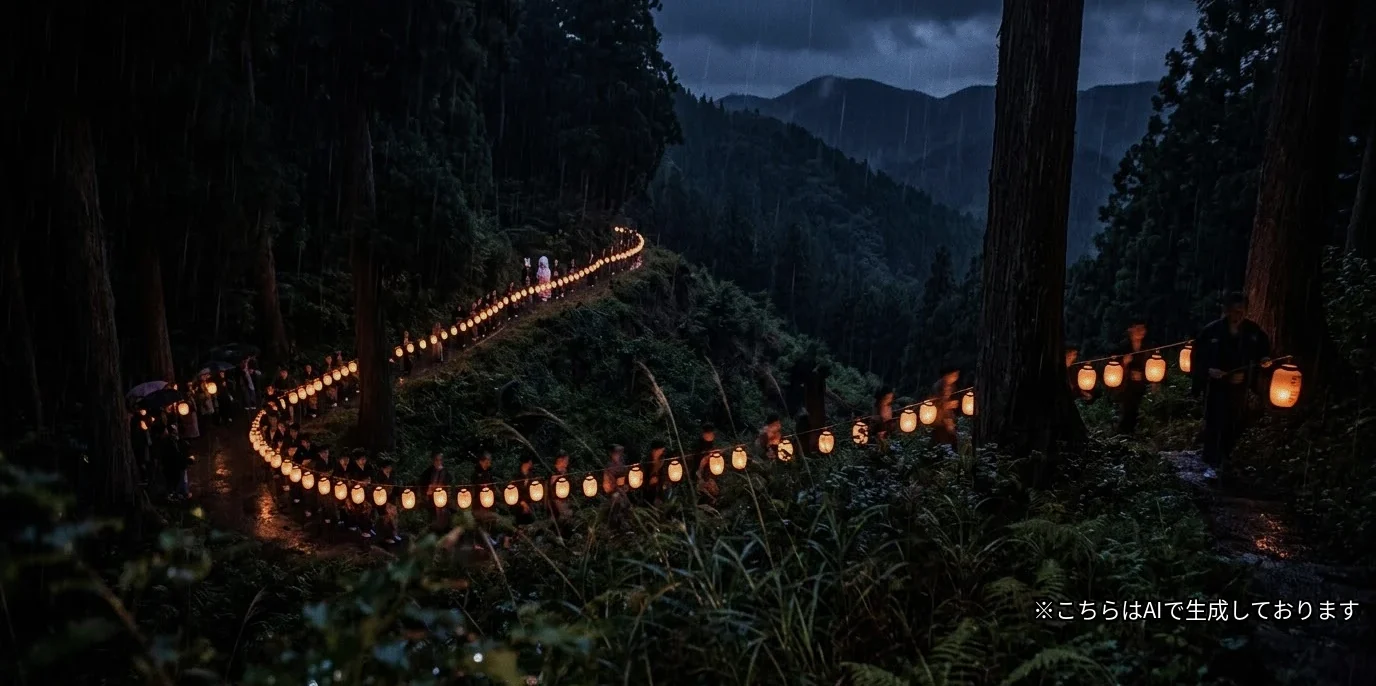
The fox wedding has two broad meanings. One is the sun shower, rain falling while the sun shines. The other is the phenomenon of eerie fires appearing in rows on night mountains and fields, as if lined-up lanterns.
Records of the night fires appear in Edo-period gazetteers and the like. They are descriptions such as: fires continued unbroken for over a ri, and seen from afar looked like a wedding lantern procession. Reports of similar fires span a wide area from Niigata Prefecture to Tottori Prefecture. At Mount Kirin in Niigata Prefecture, there is a saying that a wedding procession carrying lanterns was seen; in a mountain village in Gifu Prefecture, it is said that after eerie fires were seen, a sound like burning bamboo splitting continued for days. In Saitama Prefecture, a simple tale remains that the morning after the fires appeared, fox droppings lay on the road, so people knew it was the fox’s doing.
There are also tales in which foxes actually marry. In one story of gratitude, an old man of Shinano Province helped a fox cub, and when that fox grew up and came to hold its wedding, it brought gifts to the old man. On the other hand, a rather sad tale is also told in which the grievance of a woman who died young in illness possessed a fox and appeared as a procession of fire. The fox wedding could be either a happy tale or a tale of grudge.
Names for the sun shower divide further by region. Records show it called “kitsune no yometori” (fox’s taking of a bride) in southern Aomori Prefecture, “kitsune-ame” (fox rain) around Chigasaki in Kanagawa, and “kitsune no yometori-ame” in parts of Chiba Prefecture. In Kumamoto Prefecture a fox wedding was said to occur when a rainbow appeared, and in Aichi Prefecture when hail fell. Clear and rain, or clear and hail: the fox wedding was overlaid on the moment when opposite weathers occurred at once.
The Edo-period painter Katsushika Hokusai, based on the saying that fox weddings occur on sun-shower days, painted the fox wedding procession and the humans startled by the rain in one picture. It is interesting that the procession that should be invisible to human eyes and the lives of people who do not notice it are placed side by side under the same sky.
Why Is It Called a “Fox Wedding”?
Why is a sun shower a fox wedding? A well-known explanation is that “the foxes make it rain to drive people indoors so their wedding procession will not be seen by humans.” Weather that rains while clear is as though one has been bewitched by something. It was natural that the fox, known for bewitching people, was chosen as the culprit.
The night procession of fires is easy to understand if you picture weddings of old. Weddings in the past were often held after dark, and the bride’s party walked in a line along the road from her family home to her husband’s house, holding up lanterns. The sight of lights strung in a swaying line on a dark mountain road was itself the familiar image of a wedding for people. That is why, when a similar line of lights was seen on a mountain where no one should be, people called it a “fox wedding.”
Interestingly, ways of tying the sun shower to an animal wedding exist not only in Japan but all over the world. On the Korean Peninsula, besides “fox’s wedding” it is called a “tiger’s wedding”; in parts of India, a jackal’s wedding; in South Africa, a “monkey’s wedding”; and in the Philippines, the wedding of Tikbalang, a mountain monster. In the southern United States and in France there are phrases such as the devil beating his wife or the devil marrying off his daughter. To the “state that should not exist” of clear sky and rain at once, people everywhere have overlaid the celebrations and commotions of nonhuman beings.
And what many traditions have in common is that humans must not see that wedding. Foxes dislike being seen, so they make it rain. One must not go outside on a rainy day and peek at the fox procession. This taboo is depicted head-on in the first episode, “Sunshine Through the Rain,” of Akira Kurosawa’s film Dreams (1990). A boy told by his mother not to go to the forest on a sun-shower day breaks her order and sees the fox wedding procession. When he returns home, his mother tells him that the angry foxes left a short sword and that he cannot come into the house unless he goes to beg the foxes’ forgiveness. The boy sets off toward the mountain where a rainbow hangs, sword in hand. Few scenes so quietly portray the weight of the price for seeing what must not be seen.

Uketsu's newest horror mystery, unraveling the unease hidden in a single picture — a reference for our analysis pieces.
Strange Pictures (Uketsu / Futabasha)
We may earn a referral fee on purchases made through these links.
Present Day: The Phrase for a Sun Shower, and a Procession Made a Tourist Draw
In Japan today, “kitsune no yomeiri” mostly refers to a sun shower. It is often used in weather talk and as a seasonal word, and expressions like “kitsune-ame” and “kitsune no yomeiri-ame” remain. The meaning of lights on a night mountain has come to be told mainly in ghost stories and folktales.
Meanwhile, some places recreate the fox wedding as a festival. In the Tsugawa district of Aga Town, Niigata Prefecture, an annual event based on the Mount Kirin legend has a bridal procession in white costume and fox makeup walking through the town and draws many spectators. Elsewhere there are regions that hold fox-wedding rites tied to Inari faith. That a procession once “not to be seen” has become an event to be seen by many shows well how the times have changed.
The fox wedding is also told in connection with other fox superstitions. One is the tale that if you use the “fox window,” making a fox face with interlaced fingers and peering through the gap, you can see the fox wedding on a rainy day. There is a charm for seeing a procession you must not see. This very contradiction may be what still gives the fox wedding its eerie charm.
The eerie lights lined up on night mountains, so-called kitsunebi (foxfire), are hard to tell apart from hitodama and onibi, and there is a local legend that foxes gather and light fires on New Year’s Eve; each could be a large topic in itself. In this article, we would like to focus less on what the fires really were than on the meaning of their being called a “wedding.” When people saw countless fires, they thought of neither battle torches nor festival lamps, but of a wedding procession. We believe that is the heart of this phrase.
KARASU CHANNEL’s Take: A Wedding Was a Ritual of Crossing the “In-Between” of This World and the Next
It would be a waste to dismiss the fox wedding as merely a stylish rephrasing of a sun shower. In our view, this phrase quietly seals in the awe and unease that people of old felt toward weddings.
First, the sun shower is itself a “boundary.” A time that is neither clear nor rainy, both and neither. Like twilight, the boundary between day and night, or a mountain pass, the boundary between village and mountain, such ambiguous times and places have been thought easy for nonhuman beings to pass through. And a wedding, too, is a ritual of crossing a great boundary in life, in which a daughter leaves the house she was born in and becomes a person of another. The weather of a boundary overlaps the ritual of a boundary. The phrase fox wedding rests on this double boundary.
This is our own inference, but weddings of old may have carried a sense closer to “death” than we now imagine. It is often explained that the bride’s wearing of white signified dying once as a member of her birth family and being born again in her husband’s. For the family seeing them off, a wedding procession carrying lanterns along a dark mountain road at night may have looked like a funeral procession of a daughter departing for a place from which she would not return. In the hearts of the people who called a line of foxfire floating in the mountain dark a “fox wedding” there may have been overlaid the images of daughters and sisters married far away, of people they would never meet again.
The tradition that the grievance of a woman who died young became a procession of fire is symbolic in this sense. The feelings of a woman who left the world without marrying cross the mountain at least in the form of a wedding. We think the foxfire of the fox wedding was sometimes told as a wedding that did not come to pass, a procession of a life not fulfilled. That is probably why a certain melancholy echo clings to this supposedly auspicious story.
And then there is the taboo of “must not look.” A wedding is a sacred ritual joining house to house and person to person, and not something an outsider may peep at without restraint. The prohibition against peeking at a fox wedding can also be read as the etiquette of human society, that one must not intrude on another’s sacred time, projected onto the otherworld. That the boy in Kurosawa’s film is handed a short sword shows the intensity of the foxes’ anger and at the same time teaches the weight of seeing another’s holy thing. Seeing is sometimes also taking. Rain falling from a clear sky may be a quiet warning the foxes send us.
Finally, let us touch on the character of “bewitchment” in the sun shower itself. Rain normally falls after the sky is covered with clouds. Rain that falls with the sun shining betrays the order of people’s experience. At the moment the world’s conventions slip just slightly, people probably sensed the otherworld right next door. This is our own inference, but the phrase fox wedding may have been a well-judged distance for not fearing that small slip too much, yet not making light of it either. Think of it as the foxes’ celebration and strange weather becomes a little more amusing. Yet behind that smile, awe of what must not be seen still quietly breathes.

A 192kg-load-capacity paracord for a ruin or mountain haunted spot — useful for clearing rubble, getting past a fallen tree or fence, securing gear, or as an improvised marker line.
Brotree Paracord 3mm 3-Strand Guy Line, Reflective, 30m Tent Rope, Parachute Cord, 192kg Load Capacity
We may earn a referral fee on purchases made through these links.
Engaging With This Legend
In some regions the fox wedding tradition is deeply connected with Inari faith and local festivals. Where it is carried on as an event or rite, please respect the feelings of the people who have cherished it, and take care not to mock it or cause trouble at the event.
Also, the fox was once feared as an animal that bewitches people and as a possessing spirit, yet it has also been revered as a messenger of the gods. Please try not to speak of it in a one-sided way.
Even if you see lights on a night mountain, it is dangerous to go into the mountain alone to check. Rather than searching for the identity of eerie fires, please limit yourself to enjoying it as a saying.
Frequently Asked Questions
Q. What does “kitsune no yomeiri” mean?
A. It has mainly two meanings. One is the sun shower, rain that falls while the sun shines. The other is the phenomenon in which eerie fires appear in a line like a lantern procession on night mountains and fields.
Q. Why is a sun shower called a fox wedding?
A. The strange weather of rain falling while it is clear was thought to be the doing of the fox, which bewitches people. A well-known explanation is that the foxes make it rain to confine people indoors so their wedding procession will not be seen.
Q. Is it true that you must not look at a fox wedding?
A. There is a saying that you must not peek because foxes dislike having their weddings seen. The first episode of Akira Kurosawa’s film Dreams also takes this taboo as its subject. Naturally there is no basis that anything actually happens; it is to be enjoyed as a saying.
Q. Are there similar expressions overseas?
A. Yes. Ways of tying a sun shower to the wedding of animals or nonhuman beings are seen around the world, such as the “tiger’s wedding” of the Korean Peninsula, the jackal’s wedding of India, and the “monkey’s wedding” of South Africa.
Q. Are there festivals that recreate the fox wedding?
A. In the Tsugawa district of Aga Town, Niigata Prefecture, an annual event based on the Mount Kirin legend has a bridal procession in fox makeup walking through the town. There are also regions that hand down fox-wedding rites tied to Inari faith. When visiting, please enjoy them remembering that they are events the local people have cherished.
This saying can also be looked up in KARASU CHANNEL’s Superstition and Omen Dictionary.
Q. Has KARASU CHANNEL researched or filmed the fox wedding on location?
A. No. We are not currently researching the fox wedding, though we are considering doing so. Videos of our research into other haunted spots and ghost stories can be viewed on KARASU CHANNEL (YouTube).

Supervised by Suzuking.
Affiliation: KARASU CHANNEL
Occult & horror reporting: 7 years (since 2020)
Followers: YouTube 5,000+ / X 25,000+
On-site investigations: 30+
If this appeared in your dream
What it means to dream of something from this story, read through psychology and folklore in our Dream Dictionary.
- Dreaming of a FoxA symbol of trickery and cunning; beware lies or too-good offers. As the messenger of Inari, it can also mean…
Which story do you find the scariest?
If you think this story is the scariest, press the button below. One vote site-wide — you can change your vote for a different story anytime.
Was this article helpful?
Add this to your favorites to find it again anytime from your My Page.









Comments