Former Matsushiro Imperial Headquarters Underground Bunker (Nagano City)
Supervised by Suzuking. (KARASU CHANNEL / Occult & horror reporting, 7 years)
Contents
View basic details of this location (address, history, status, etc.)
- Location
- 479-11 Saijo, Matsushiro-machi, Nagano City, Nagano (Zozan bunker entrance)
- Built
- Construction began in November 1944 (Showa 19); halted unfinished at war's end
- Closed / Decommissioned
- Construction halted at the end of the war in August 1945 (some sections open to the public since 1990)
- First Rumored
- Unknown
- Current State
- Some sections of the Zozan bunker open free of charge (9:00-16:00, last entry 15:30; closed the third Tuesday and at year-end and New Year)
- Access
- Open sections may be entered (free); closed sections may not
- Last Verified
- 2026.09.11
What’s Said
An underground bunker dug at Matsushiro in Nagano City near the end of the Pacific War to relocate the Imperial Headquarters, the center of government. Some of the workers mobilized for the rush construction are said to have died in the harsh conditions, and visitors’ accounts such as "sensing a presence" and "feeling unwell" deep in the open section are told online.
What the Records Show
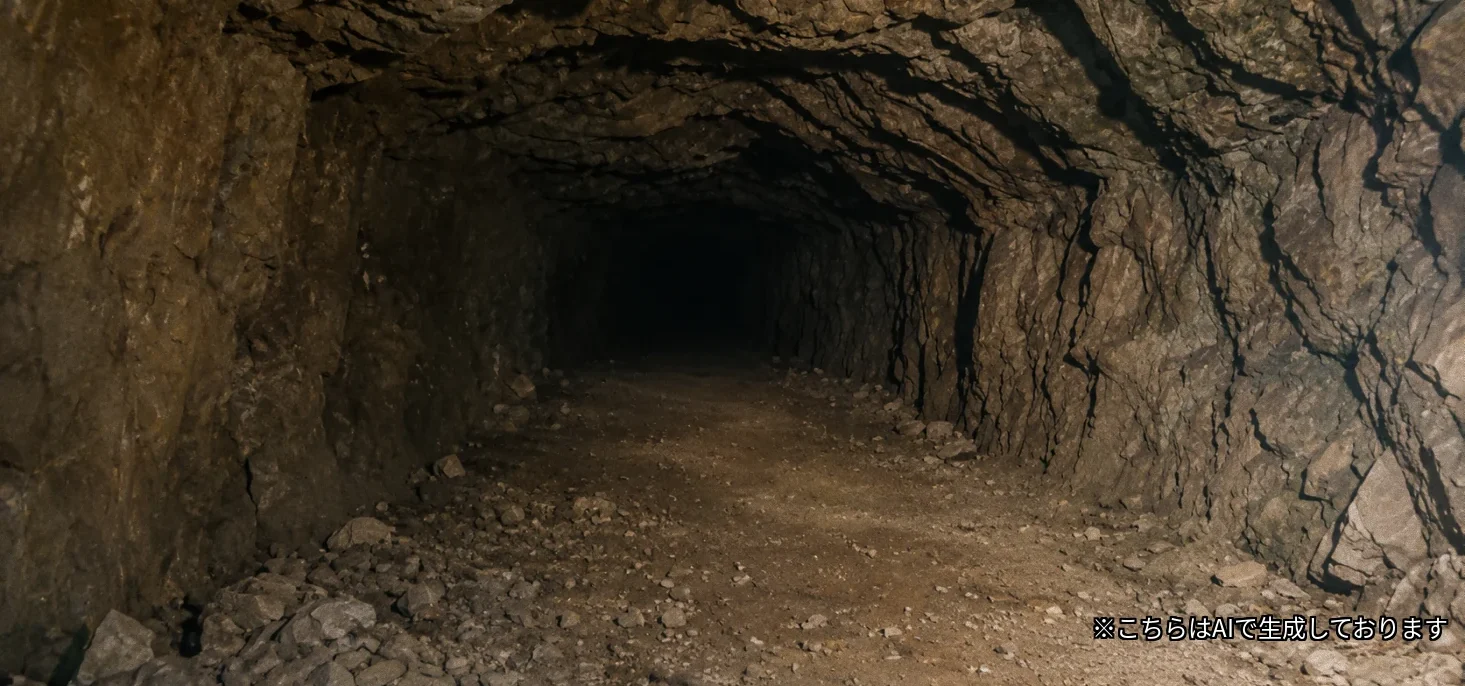
The Zozan bunker was dug in a rush between 1944 and the following year, and it is a historical fact that many Korean workers were mobilized as labor. Accounts of the reality of the forced labor and the number of victims vary by source, so definite figures should be avoided. We have confirmed no primary source supporting any paranormal phenomenon. Some sections of the Zozan bunker are open to the public free of charge, and visitors can walk inside with a flashlight. Closed sections may not be entered.
The plan took shape after the fall of Saipan, when a decisive battle on the home islands began to look realistic. Matsushiro is said to have been chosen because it lies inland, away from the coast, and because an airfield could be built nearby. Excavation began on November 11, 1944 (Showa 19) and continued until the war ended on August 15, 1945. Enormous funds and, reportedly, several million person-days of labor were poured in, and the site is described as roughly 80 percent complete when the war ended without it ever being used. Underground facilities were also planned at Maizuru-yama and Minakami-yama in addition to Zozan.
The work mobilized many people, including a large number of Korean workers. Under poor food and living conditions, accidents such as cave-ins are said to have occurred. However, the numbers of people mobilized and of those who died differ greatly by source, so we avoid giving definite figures here. Today, a section of about 500 m entered from the Keimyoji entrance in Saijo is lit and open to the public in the Zozan bunker. Accounts of the total length differ by source; it is said to have been a vast underground complex dug in a grid pattern.
A book that reads kaidan and urban legends across the ages, from the Kojiki to TikTok — a reference for our analysis pieces.
The Scariest Ghost Stories as Culture: From the Kojiki to TikTok (Yuki Yoshida / One Publishing)
We may earn a referral fee on purchases made through these links.
Our Analysis — What the Bunker Tells Us Today
In our view, the reason part of the Zozan bunker is still open free of charge, and that many people can walk it with flashlights in hand, is not simply for tours of a ruin but so that visitors can feel the very era of the end of the Pacific War. Behind the word "rush construction" lies the historical fact that many people, including Korean workers, were made to labor in harsh conditions.
This is speculation, but when visitors say they "sense a presence" or "feel unwell," it may be not only because of the darkness and humidity but because they unconsciously sense the weight of the history carved into this place. Before treating the bunker as an amusing haunted spot, we hope visitors will reflect on who worked here, and with what feelings. We give no definite figure for the number of victims not because we take history lightly but so as not to spread uncertain information as if it were fact.
From here on we layer our own speculation. The defining feature of the Matsushiro Imperial Headquarters is that it was never completed. A huge construction effort, undertaken at the cost of lives, ended without anyone ever using it. Many of the people who worked here may not even have been told in detail what the bunker was being dug for. In our view, what lies beneath the rumors may be the unspent resentment of people who wore down their lives without knowing what their labor would become. A finished building stays in memory through its role; a bunker that was never used leaves behind only what happened there, like a hollow.
Next, we would like to touch on what the space of an underground tunnel means. A dark passage bored deep into a mountain lets in little light or wind from the outside. If people worked there for months, even the sense of day and night must have blurred. When visitors say they “feel unwell,” dampness and cold surely play a part, but we think it may also be the body’s honest reaction to a place that is “shaped to confine people.” This is speculation, but the narrowness and darkness of the bunker may make visitors relive the suffocation of those who worked here, and that may be what is expressed in the word “presence.”
The fact that the bunker was planned to protect the Emperor and government organs adds further weight to the place. Nameless people were mobilized to protect the center of the nation, and then the war ended. What was dug in order to protect was left behind with no one left to protect. That irony seems to state plainly whose will, and whose sacrifice, a war involves. What is frightening is not ghosts but this very structure.
That part of the bunker is now open free of charge is probably because it carries meaning for passing this history on to the next generation. A visit to learn what happened here is far more meaningful than one in search of rumors. If content touching on war and death weighs on your heart, please consider contacting the Yorisoi Hotline (Japan, 0120-279-338, 24 hours, Japanese-language). KARASU CHANNEL will record this place not as a ghost story, but as a memory.
Nearby Recommendation — Matsushiro Castle Ruins and the Sanada Residence
The Matsushiro district, where the bunker lies, is also a historic castle town known as the domain of the 100,000-koku Sanada clan. The Matsushiro Castle ruins are a designated national historic site and a beloved cherry-blossom spot. There are many sights, including the Sanada Residence, which preserves Edo-period palace architecture, and the Bunbu School, once the domain school, and one can trace the atmosphere of the old days while walking the storehouse-lined streets. Museums and archives linked to the Sanada family are scattered through the town, and many visitors spend a whole day making the rounds as a base for historical strolling.
Reporter’s Notes
This article is a draft based on desk research. In view of the weight of the history, it is composed to avoid assertive expressions and sensational staging. We plan to review the descriptions of forced labor after further confirmation from primary sources, before publication.
Nighttime haunted-spot exploration in ruins or on mountain roads often means parking beside a road with passing traffic or moving through dark areas — a reflective vest makes you easier for drivers and companions to spot, helping prevent accidents. The waist adjusts with hook-and-loop fastening, and roughly 7cm-wide reflective tape keeps visibility high.
Takagi Reflective Safety Vest, Orange × Yellow, Free Size
We may earn a referral fee on purchases made through these links.
Please note that the position on the map is an approximate coordinate based on public information and may differ from the exact spot.
Frequently Asked Questions
Q. Can I visit the Zozan bunker?
A. Some sections are open to the public free of charge, and visitors can walk inside with a flashlight. However, the closed sections may not be entered.
Q. What is the history of the bunker?
A. It was dug in a rush between 1944 and the following year, and many Korean workers were mobilized as labor. Because figures such as the number of victims vary by source, we avoid definite statements.
Q. Is there any material supporting paranormal phenomena?
A. Accounts such as "sensing a presence" are told online, but we have confirmed no primary source supporting any paranormal phenomenon.
Q. Has KARASU CHANNEL filmed on location at the former Matsushiro Imperial Headquarters bunker?
A. No, we have not filmed there yet; a visit is currently under consideration. Location footage for other haunted spots and kaidan stories can be viewed on KARASU CHANNEL (YouTube).

Supervised by Suzuking.
Affiliation: KARASU CHANNEL
Occult & horror reporting: 7 years (since 2020)
Followers: YouTube 5,000+ / X 25,000+
On-site investigations: 30+
Kaidan Tales from This Area
Which haunted location do you find the scariest?
If you think this location is the scariest, press the button below. One vote site-wide — you can change your vote for a different location anytime.
Was this article helpful?
Add this to your favorites to find it again anytime from your My Page.


Comments