Oshino Hakkai — The Day “Lake Utsu” Vanished, Was It Really Only Water That Sank to the Bottom?
Supervised by Suzuking. (KARASU CHANNEL / Occult & horror reporting, 7 years)
Contents
View sources and last-checked date
- Source
- yamanakako.gr.jp, "Origins and history of the names of the Fuji Five Lakes" (Japanese); Mapple Web (Japanese); Wikipedia (Japanese), "Miyashita Documents"; and others
- Last verified
- 2026-09-16
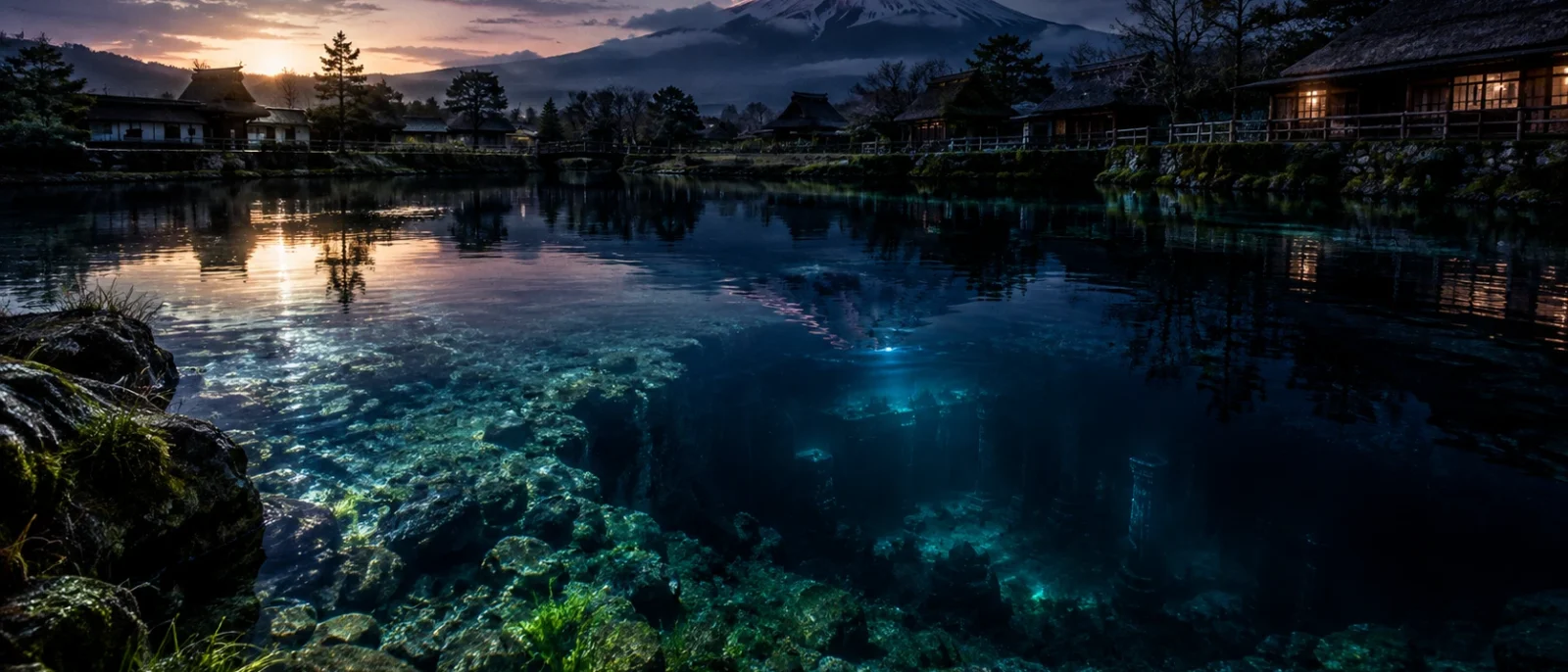
Oshino Hakkai, where springwater filtered through Mount Fuji’s slopes wells up into clear pools, is famous for the sheer transparency of its water. But these eight ponds are said to have once been a single, enormous lake called “Lake Utsu,” and the story of how it came to be divided still carries whispers of a “lost, ancient civilization” — one that never made it into the official histories.
Origins — How One Lake Became Eight Ponds
Today, Oshino Hakkai consists of eight separate ponds scattered across the area — Deguchi-ike, Okama-ike, Sokonashi-ike, and others — but this entire area is said to have once been a single large body of water known as Lake Utsu. According to the legend, lava flows from Mount Fuji’s eruptions and centuries of sediment gradually shrank and divided the lake, leaving behind the eight spring-fed ponds seen today.
This area is also home to a lost-civilization legend, drawn from a body of writings known as the “Fuji Ancient Documents,” which claim that an advanced civilization already flourished here back when Lake Utsu still existed. Treated as a heterodox history distinct from the official record, it continues to be passed down among a certain circle of enthusiasts even today.

Being able to grab a flashlight or phone instantly matters when exploring a ruin or mountain trail. A 2-way waist bag you can also wear across the body frees both hands, making it easier to move and film in tight spaces.
Coleman Walker Pouch S, Black WALKERPOUCH-S-BK
We may earn a referral fee on purchases made through these links.
Why Was a “Lost Civilization” Ever Spoken Of?
Around the foot of Mount Fuji, there exists a body of writings called “koshi-koden” — texts that stand apart from officially recognized history — and some of these include passages claiming that an advanced civilization once existed around Mount Fuji. We suspect that when the geological fact of a once-real, vast ancient lake meets these heterodox historical texts, the two combine to layer a dream of a lost civilization, and a certain romance, beneath the beautiful surface of Oshino Hakkai.
Within Mount Fuji worship, this entire area has also long been treasured as a site of misogi — ritual purification — where pilgrims of the Fujiko sect would cleanse themselves before ascending the sacred mountain. The custom of visiting each of the eight ponds in turn to wash away impurity speaks to the fact that this place was never simply a scenic spot, but has carried sacred meaning since ancient times.
Current Conditions — A Component Site of a World Heritage Listing
Oshino Hakkai today is registered as a component site of the UNESCO World Heritage listing “Fujisan, sacred place and source of artistic inspiration,” and draws visitors from Japan and abroad who come for its remarkably clear springwater and its views of Mount Fuji.
A waterproof bag for carrying a phone, camera, or valuables without getting them wet at a ruin in the rain or a damp haunted spot.
Sea to Summit Evac Dry Bag 8L, Beluga Dark Gray, Lightweight, Waterproof, Roll-Top Stuff Sack
We may earn a referral fee on purchases made through these links.
Reflection — Was It “Memory” That Sank to the Bottom of the Lake?
This is only our speculation, but we wonder whether the geological fact itself — that Lake Utsu was divided and became eight separate ponds — may have handed people a ready-made template for a story: something large was lost, and only fragments remain. A longing for a lost civilization, precisely because it can never be proven, stirs the imagination all the more strongly, and it seems to have kept lending a sense of romance to this beautiful springwater ever since.
As we see it, when you look down into the clear surface of Oshino Hakkai’s water, what’s reflected back may not be only the shape of Mount Fuji — it may also be the memory of a lake that was once whole, and the afterimage of “another history” that people wanted to believe in.
Looking at this from a religious angle, we think there’s more meaning behind Oshino Hakkai’s continued role as a site of Fujiko misogi than simple, clean water. Climbing Mount Fuji, a sacred mountain, meant leaving the mundane world behind and stepping into sacred ground. The custom of purifying oneself by visiting each of the eight ponds in sequence may well have been a rite of passage — shedding the impurities of the ordinary world one stage at a time while gradually crossing the boundary between this world and the next, between the profane and the sacred. That the terrain of a once-single, enormous lake happened to split into exactly eight parts, conveniently providing a stage for a step-by-step purification rite, may be too neat to be pure coincidence — but we admit we can’t help being drawn to that coincidence all the same.
This, too, is only speculation, but while the loss of Lake Utsu is explained in purely geological terms, we suspect the rumor of a “lost ancient civilization” has survived precisely because water this clear ends up stirring the imagination rather than settling it. Water so transparent that you can see the bottom should, in theory, hide nothing at all — and yet people seem drawn to believe that something enormous lies sunk just beneath that very transparency. The fact that no one knows for certain exactly how deep the connections run between the eight ponds that were once a single lake only adds to the strangeness of this place. Beneath Oshino Hakkai’s reputation as a beautiful tourist destination, “another history” that fell out of the official record may still be lying quietly at rest.
This, too, is nothing more than our own imagining, but it’s said that when you look into water clear enough at Oshino Hakkai to see straight to the bottom, there are moments, at unexpectedly deep points, where the light suddenly gives way to darkness. No one knows for certain exactly how deep the connections between the eight ponds truly run. If something that sank long ago is still lying quietly in the depths, beyond where the light reaches — if you consider that possibility, even the calm surface of these tourist-filled ponds might start to look a little different.
Everyday Face — Oshino Hakkai, a World Heritage Component Site
Oshino Hakkai is made up of eight ponds fed by springwater filtered through Mount Fuji, and is registered as a component of the UNESCO World Heritage listing “Fujisan, sacred place and source of artistic inspiration.” Its transparent water and backdrop of Mount Fuji draw large numbers of tourists, and the surrounding area is lined with soba restaurants and souvenir shops that keep it lively as a sightseeing destination. Looking out at the springwater today, still just as clear as ever, it’s worth remembering the legend of the great lake called “Lake Utsu” that is said to have once spread across this land.
A Note on Visiting
Oshino Hakkai is maintained as a tourist destination, but some of the ponds sit on private land, so please stay on the designated viewing routes. Several active shrines are also scattered around the area, so please keep your behavior quiet and respectful.
Frequently Asked Questions
Q. Was Oshino Hakkai originally a single lake?
A. It is said to have once been a single large lake called “Lake Utsu,” which split apart due to Mount Fuji’s eruptions and centuries of sediment buildup, eventually becoming today’s eight ponds.
Q. What is the “lost ancient civilization” legend?
A. A body of writings distinct from official history, known as “koshi-koden,” contains passages claiming that an advanced civilization once existed around Mount Fuji, and this has come to be linked with the legends surrounding Oshino Hakkai.
Q. How is Oshino Hakkai connected to religious practice?
A. It has long been considered sacred as a site of misogi, where pilgrims of the Fujiko sect would purify themselves by visiting each of the eight ponds before climbing Mount Fuji.
Q. Has KARASU CHANNEL filmed on location at Oshino Hakkai?
A. No, we have not yet filmed on location here; a visit is currently under consideration. Location footage for other haunted spots and kaidan stories can be viewed on KARASU CHANNEL (YouTube).

Supervised by Suzuking.
Affiliation: KARASU CHANNEL
Occult & horror reporting: 7 years (since 2020)
Followers: YouTube 5,000+ / X 25,000+
On-site investigations: 30+
Which story do you find the scariest?
If you think this story is the scariest, press the button below. One vote site-wide — you can change your vote for a different story anytime.
Was this article helpful?
Add this to your favorites to find it again anytime from your My Page.









Comments