Naritasan and Kanda Myōjin — The Thousand-Year Grudge Over Taira no Masakado You’re Not Supposed to Visit at Once
Supervised by Suzuking. (KARASU CHANNEL / Occult & horror reporting, 7 years)
Contents
View sources and last-checked date
- Source
- Naritasan Shinshoji Temple official website, "The Origin of Naritasan"
- Source 2
- Multiple articles on the folk belief
- Last verified
- 2026-09-16
Naritasan Shinshoji in Narita, Chiba Prefecture, is one of Japan’s most visited temples for the New Year’s first shrine visit. Behind that crowded popularity, an unsettling belief is still whispered in some circles: that you must not visit it and Tokyo’s Kanda Myōjin, or Masakado Zuka, on the same trip. What connects these two places of worship is the rebellion of Taira no Masakado, a warlord who shook the Kantō region in the Heian period, and the flame lit to suppress him. We looked into the origins of this rivalry and how it is understood today.
Origins — The Rebellion of Taira no Masakado and the Fudō Myōō Carried Ashore
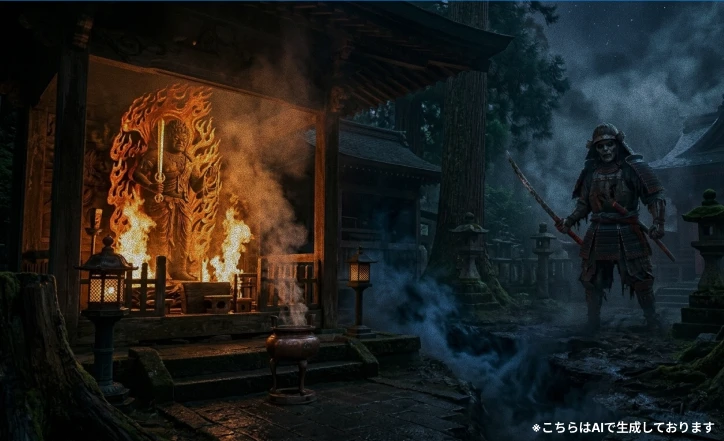
In 939 (Tengyō 2), the Kantō warlord Taira no Masakado rose in revolt against the imperial court and brought a wide stretch of Bandō (the Kantō region) under his effective control. This was the Tengyō Rebellion, better known as the Masakado Rebellion. To quell the chaos in Kantō, Emperor Suzaku issued an imperial order to the high priest Kanchō. Kanchō is said to have carried a statue of Fudō Myōō, said to have been consecrated by Kōbō Daishi Kūkai (an image kept at Jingo-ji on Mount Takao in Kyoto), landing by ship on the Bōsō Peninsula and building a goma altar at Kōzu-ga-hara, in what is now Narita.
Kanchō continued a goma fire ritual of “chōbuku” — subjugating an enemy’s power — for 21 days at this site. According to tradition, on the very day the ritual reached completion, February 14, 940 (Tengyō 3), Taira no Masakado was struck down in Shimōsa Province (near present-day Bandō, Ibaraki Prefecture) by the forces of Fujiwara no Hidesato and Taira no Sadamori, bringing the rebellion to an end.
The Statue That Wouldn’t Move — Why It Stayed in Narita
After the rebellion was put down, Kanchō tried to bring the Fudō Myōō statue back to the capital. But tradition says the statue became fixed to that spot “like solid bedrock,” refusing to move. When a bewildered Kanchō prayed, he is said to have received a divine message from Fudō Myōō: “I will remain here and save the people.” Emperor Suzaku then granted the site the temple name “Shinshōji.” What was meant to be a temporary place of prayer to suppress a rebellion thus took root as a temple protecting the eastern provinces — the beginning of Naritasan Shinshōji.
The dramatic episode of a statue that would not move is a legend with no way to verify it as historical fact, but by being linked to the real, concrete event of the rebellion’s end, the court-dispatched ritual gave Naritasan a special standing beyond that of an ordinary regional temple: it became known as the sacred site that pacified Masakado.

An all-purpose tool for exploring a ruin or mountain spot.
WORKPRO Multi-Function Pliers, Outdoor Multi-Tool, 18-in-1 Folding Pliers with Wire Cutter/Saw/File/Screwdriver/Can Opener, Locking, with Pouch, Blue
We may earn a referral fee on purchases made through these links.
How the “Simultaneous-Visit Taboo” Spread
After his defeat and death, Taira no Masakado was, ironically, increasingly regarded in Kantō with a mix of fear and respect, as “the warlord who stood up to the imperial court.” Masakado Zuka (his burial mound) in Ōtemachi, Tokyo, along with Kanda Myōjin and Tsukudo Shrine, are all places that enshrine Masakado as a deity or spirit. Out of this arose the folk belief that it brings bad luck to visit, on the same trip, both Naritasan — founded through a ritual meant to subdue Masakado — and Kanda Myōjin or Masakado Zuka, which enshrine him.
A psychological unease about visiting, on the same day or around the same time, both “the temple of the side that struck him down” and “the shrine of the side enshrining the one who was struck down” appears to have been passed down among Edo commoners. In fact, some areas said to be under Kanda Myōjin’s parish, and some families with ties to Masakado, are said to still practice avoiding visits to Naritasan today. Kanda Myōjin itself, however, officially takes a skeptical view of this belief, stating that “no curse occurs even if you visit both,” and it remains no more than a folk tradition handed down among ordinary people.

A palm-sized, battery-powered digital thermo-hygrometer — record the indoor temperature and humidity while reporting at a ruin or haunted spot, adding an objective number alongside a note like "it suddenly felt colder."
dretec Digital Thermo-Hygrometer 'Corone' White O-415WT
We may earn a referral fee on purchases made through these links.
Our Take — A Thousand-Year-Old Political Settlement, Still Alive as “Visiting Etiquette”
This is our own view, but we suspect this folk belief has survived for more than a thousand years because it is rooted not in a simple ghost story, but in a sensibility the Japanese have long held: consideration for the defeated. Though struck down as an enemy of the court, Taira no Masakado has continued to be honored in Kantō as a hero who sought independence. We think the discomfort some people have long felt at having history told only through the victor’s logic has crystallized into this tradition, in the form of a feeling that “visiting both might be disrespectful.”
In our reading, this rivalry has survived into the present day partly because both Naritasan and Kanda Myōjin have remained, without decline, active centers of faith. If either one had fallen into decline, the very structure of opposition would have lost its meaning, and the folk belief would likely have been forgotten along with it. Precisely because both sacred sites still draw large numbers of worshippers, the thousand-year-old political tension of needing to “save face for both the defeated and the victor” quietly lives on today in the form of modern visiting etiquette.
From a religious perspective, what Kanchō performed was not simple prayer but an esoteric Buddhist rite called “chōbuku.” In contrast to “kotomuke,” persuading an opponent through words, chōbuku is a ritual that uses spiritual power to forcibly subdue and seal away the power of a hostile being. The coincidence of the ritual reaching completion on the very day Masakado was struck down must have reinforced, for people of the time, a conviction that it was not only the imperial army’s military force but Kanchō’s own spiritual power that brought Masakado down. The tradition that the Fudō Myōō statue refused to return to the capital and settled in this place can also be read this way: the grudge of Masakado, the very target of the subjugation ritual, became bound, ironically, to the sacred site where that ritual was performed.
This is speculation, but we sense something more unsettling in the episode of the statue becoming “fixed like solid bedrock” than a simple tale of divine miracle. The purpose of a chōbuku ritual is not to erase a target’s power, but only to subdue and seal it. If the statue refused to leave this place, it may be because the statue itself has continued, for more than a thousand years, to serve as a “lid” keeping Masakado’s supposedly-pacified grudge contained right there. If so, Naritasan Shinshōji can be understood not merely as a memorial site where Masakado was pacified, but as an active “sealing device” still containing that grudge today. Seen this way, the folk taboo against visiting Naritasan and Kanda Myōjin on the same trip starts to carry a tension that goes beyond a simple matter of etiquette.
A Note on Visiting
Both Naritasan Shinshōji and Kanda Myōjin are active religious institutions, visited daily by many people as sincere objects of faith. The “simultaneous-visit taboo” introduced in this article is only a folk tradition, not an established religious doctrine. Whether or not you believe it, please avoid idle curiosity-driven behavior and any disrespect toward the halls and grounds of either site, and visit both quietly and with respect.
Frequently Asked Questions
Q. Is it true that you shouldn’t visit Naritasan Shinshōji and Kanda Myōjin on the same trip?
A. There is a folk belief that has said so since long ago. However, there is no documented scientific or doctrinal basis for it, and Kanda Myōjin officially denies the belief. Ultimately, whether to worry about it, once you know its origin, is left to each visitor’s own judgment.
Q. Why did this belief arise?
A. Because Naritasan Shinshōji was founded through a ritual meant to suppress the Masakado Rebellion, while Kanda Myōjin and Masakado Zuka are places that enshrine Masakado himself. A psychological discomfort with visiting both “the side that struck him down” and “the side enshrining the one struck down” at once is thought to have been passed down as this folk belief.
Q. When and why was Naritasan Shinshōji founded?
A. It was founded in 940 (Tengyō 3) at the site where the high priest Kanchō, acting on Emperor Suzaku’s imperial order, performed a goma fire ritual to suppress the Masakado Rebellion. When he tried to bring the Fudō Myōō statue used in the ritual back to the capital, it is said to have become immovable, and so it was left enshrined at this site.
Q. Why does Kanda Myōjin enshrine Taira no Masakado?
A. Although Masakado was defeated and killed in his rebellion, he came to be honored in later generations in Kantō as a warlord and hero who tried to build an independent regime. To pacify and honor his spirit, he is enshrined as a deity at Kanda Myōjin and several other shrines.
Q. Knowing this story, is it okay to visit both Naritasan and Kanda Myōjin?
A. In the end, it comes down to each visitor’s own thinking. Some people, knowing the folk belief, visit both with respect anyway; others deliberately avoid doing so. We do not take a position on which is “correct.”
We plan to also cover the rivalry between Naritasan and Taira no Masakado in video form. Please also check out our YouTube channel.

Supervised by Suzuking.
Affiliation: KARASU CHANNEL
Occult & horror reporting: 7 years (since 2020)
Followers: YouTube 5,000+ / X 25,000+
On-site investigations: 30+
Which story do you find the scariest?
If you think this story is the scariest, press the button below. One vote site-wide — you can change your vote for a different story anytime.
Was this article helpful?
Add this to your favorites to find it again anytime from your My Page.








Comments