What Is Crow Call Divination? Why People Heard Fortune and Prayer in a Crow’s Cry

Supervised by Ms.M
Affiliation: KARASU CHANNEL
Traditions studied: 12+ (Western astrology, Four Pillars of Destiny, Nine Star Ki, tarot, runes, palmistry & physiognomy, name numerology, numerology, feng shui, Vedic astrology / Zi Wei, Onmyodo, spiritual reading, and more)
Personal readings: by request via Contact,
currently booked years out
Contents
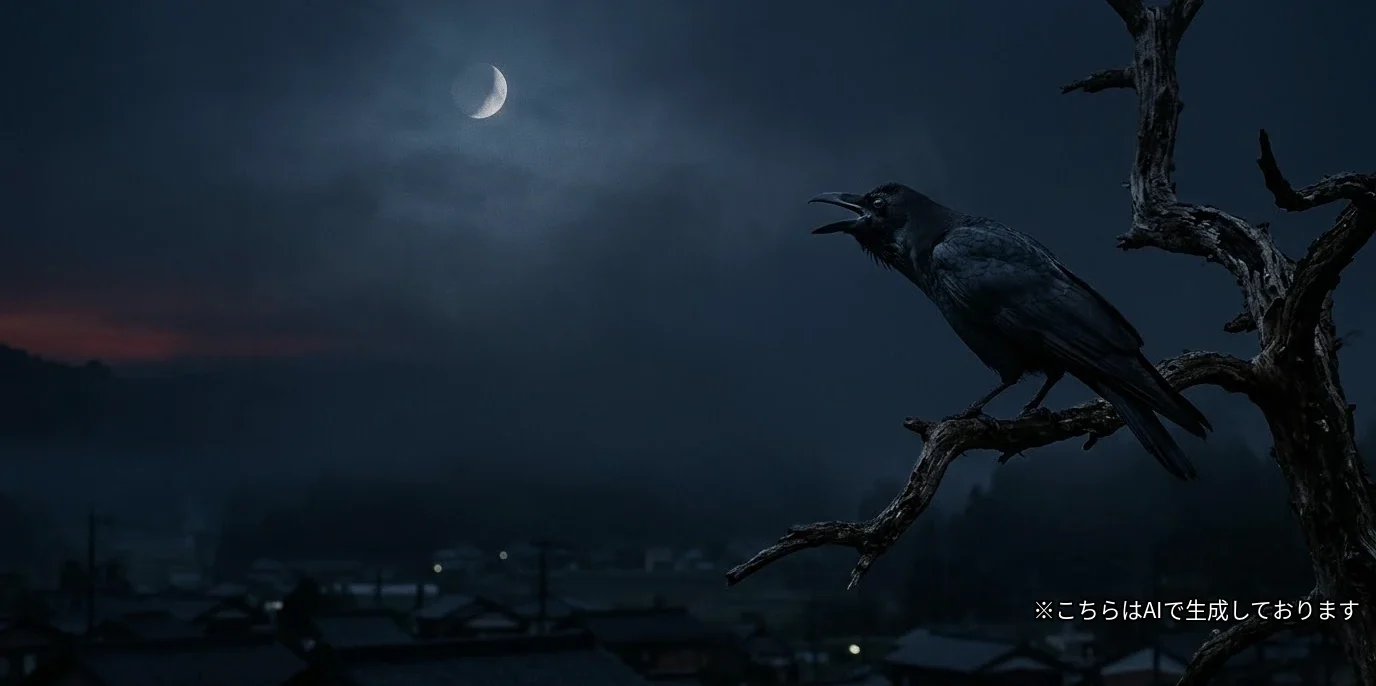
On the way home at dusk, a crow on the power line is cawing longer and more insistently than usual. Before dawn, while it is still dark, a single “caw” rings out beyond the window. At moments like that, doesn’t something in your chest stir? “If a crow caws badly, someone nearby will die.” Not a few people were told this by their grandparents as children and still feel a little uneasy about it today.
Our free fortune-telling tool, the Crow Call Reading, lets you choose the number of caws, the time, the direction, and the way of cawing you heard, and then displays a reading for each, an overall tendency, and a word from the crow. The mascot of KARASU CHANNEL is a crow. That is exactly why we wanted to dig properly into what people have heard in the voice of this bird.
First, two important points. One: within the scope of our research, we could not find any established “Japanese system of divination” that fixes good or bad fortune by number of caws, time, or direction. The readings of this tool are our own creation, built with reference to sayings from various regions and to the old crow divination that traveled from India to Tibet. Two: the voice of a crow never predicts anyone’s life or death or an accident. Please read the result as a “nudge” to look after those close to you and yourself.
When a technical term appears, we rephrase it in a quote box marked “Put simply.” If something feels difficult, you can skim just those boxes. Later in the article we have also added our own original reflections, which go beyond summarizing history. We would like to come a little closer to the feelings of people who have laid anxiety and prayer on the voice of the crow.
Key Points (a 3-minute summary)
- The Crow Call Reading is our free fortune-telling tool. Choose the number of caws you heard (1 to 7, or “many”), the time (the twelve traditional hours), the direction (8 compass points), and the way of cawing (6 kinds), and it shows a reading for each, an overall tendency, and a word from the crow. You can also use it without choosing items you are unsure about.
- Japanese dictionaries carry the word “karasu-naki” (crow cawing) and explain that there is a folk saying that good or bad fortune can be told from the sound, especially a folk belief that it foretells misfortune. Examples also appear in a late 17th-century ukiyo-zōshi (Edo-period popular fiction).
- Yet the crow is also a bird that has been revered as the Yatagarasu, which guided Emperor Jinmu, and as a messenger of the gods of the three Kumano shrines. The Kumano Goō Hōin talismans are printed with characters formed from crow figures.
- An Indian crow-cawing divination book was passed to Tibet, and old Tibetan documents found at Dunhuang list readings by direction and time of cawing, such as “a guest will come” or “a great wind will rise.” The Orientalist Laufer published his study in 1914.
- However, we could not confirm any established Japanese system that fixes fortune by number of caws, the twelve hours, and eight directions. The readings on our site are our own creation, made with reference to these traditions. Where the old sayings say “a person will die,” we have rephrased it as “a day to look after your family,” and so on.
- The real calls of crows vary with the species (the clear voice of the large-billed crow, the hoarse voice of the carrion crow), with contact between flock mates, and with alertness in the breeding season. Please enjoy the result as entertainment, and do not do anything dangerous such as approaching a nest.
What Is Crow Call Divination? The Culture of “Reading” a Single Voice
Crow call divination is a form of fortune-telling that takes a crow’s voice heard by chance as a message and tries to read its meaning. Divination that reads good or bad fortune from the voices and flight of birds is collectively called “bird divination” (toriuranai), and it is found all over the world. The ancient Roman historian Tacitus wrote that the Germanic peoples were known to consult the voices and flight of birds.
Among birds, the crow was a special one. It lives right next to human settlements, cries in a far-carrying voice, makes a racket in flocks, and sometimes behaves as if it remembers people’s faces. And it is entirely black. This bird, clothed in the color of night, was easily thought to travel between the human world and an unseen world. In Japan too, the crow has been revered as a messenger of the gods, while its voice has also been feared as a sign of ill omen.
What makes call divination a little different from other kinds is that you cannot “choose” the material for the reading. Your date of birth and your name are decided from the start, and with tarot you draw the cards yourself. A crow’s voice, however, simply arrives on its own. Precisely because it is a voice you did not go out to hear, I think it carries the special weight of “did it just try to tell me something?”
Put simply, crow call divination is “a kind of fortune-telling in which you read a crow’s voice heard by chance as a small letter addressed to you.” It is closer to thinking about how to spend today from clues such as how many times it cawed, when, from where, and in what voice.
Crows and the Japanese, Part 1: The Crow as Messenger of the Gods
Yatagarasu: the bird that guided Emperor Jinmu out of Kumano
When talking about crows in Japan, the first name to come up is the Yatagarasu. The Kojiki and the Nihon Shoki tell how, when Emperor Jinmu, said to be the first emperor, lost his way on a steep mountain road from Kumano toward Yamato (present-day Nara Prefecture), a Yatagarasu sent from heaven guided him. The deity who sent it is Takagi no Ōkami in the Kojiki and Amaterasu Ōmikami in the Nihon Shoki, so the books differ.
The Yatagarasu is famous as a “three-legged crow,” but the Kojiki and Nihon Shoki are said to contain no description of three legs. The oldest text tying it to three legs is said to be the Heian-period dictionary Wamyō Ruijushō, and it is thought to have been overlapped with the Chinese idea of the “three-legged crow” (sanzoku-u) said to live in the sun. At Kumano Hongū Taisha, the three legs are explained as standing for heaven, earth, and humanity.
Within the grounds of Kumano Nachi Taisha, there is a “Karasu-ishi” (crow stone), said to be where the Yatagarasu, after guiding Emperor Jinmu, returned and changed form, and a shrine to the Yatagarasu, Miagatahiko-sha, is also said to stand. In 1931, the predecessor of the Japan Football Association adopted the three-legged crow as its symbol, and the Yatagarasu remains familiar today as a “bird of guidance.”
The Kumano crow and the Goō Hōin: a bird that witnesses promises
At the three Kumano shrines (Kumano Hongū Taisha, Kumano Hayatama Taisha, and Kumano Nachi Taisha), the crow has been regarded as a messenger of the gods. The Kumano Goō Hōin, a talisman issued by the Kumano shrines, is printed with distinctive “crow characters,” written by combining the figures of dozens of crows. The number of birds and the design are said to differ among the three shrines. According to Wakayama Prefecture’s guide, a ritual of making this talisman is held at Kumano every New Year.
In the Middle Ages this talisman was also used as the paper for a “kishōmon,” a written oath to the gods and buddhas. A vow is written on the back of the talisman, then signed, and sometimes sealed with a drop of blood. It is also told that in 1185, Minamoto no Yoshitsune wrote a kishōmon on the back of a Goō Hōin to show his elder brother Yoritomo that he had no divided loyalty. It was believed that if you broke the oath, a Kumano crow would die (one crow or three, it is said) and punishment would fall on the oath-breaker as well.
The crow here is not a bird of ill omen. It is a solemn witness that watches people’s promises on behalf of the gods and, if a lie is told, announces it at the cost of its own life. The three Kumano shrines are still places where many people offer prayers today, and the Goō Hōin is also a living talisman. We should take care not to treat that weight lightly.
Karasu-kanjō: asking the gods’ will of the crow
There was also a custom of “calling” the crow to divine. It is called “karasu-kanjō,” and it is explained that at the start of the New Year’s farming work, offerings such as rice cakes and dumplings were given to crows, and depending on whether they ate them and which they pecked first, people decided that year’s harvest, and whether to plant early, middle, or late rice. Rituals of offering sacred food (shinsen) to crows are also said to be handed down at places such as Atsuta Jingū and Itsukushima Shrine.
This divination looks not at the voice but at “whether they eat,” but the idea of inquiring after the gods’ will through the crow is the same. The crow was also a bird that carried the gods’ reply, close to people’s daily lives.
Put simply, the crow in Japan was a “guide of the gods,” a “watcher of promises,” and a “bird carrying the gods’ reply.” Behind the image of a black, slightly frightening bird lies a long history of being revered.
Crows and the Japanese, Part 2: The Unease of “A Crow Caws Badly”
“Karasu-naki” preserved in dictionaries and ukiyo-zōshi
Yet from long ago, the voice of the crow was also feared as a sign of misfortune. Japanese dictionaries carry the word “karasu-naki” (crow cawing) and explain it as crows cawing noisily, and as a folk saying that good or bad fortune can be told from that voice, especially a folk belief that it is a sign that something bad will happen.
The example given is the 1694 ukiyo-zōshi (Edo-period popular fiction) “Kōshoku Man’kintan.” It contains a passage meaning that if you hear a bad crow cawing, you should worry about your elderly neighbor, and it shows that more than 300 years ago the way a crow cawed was already being told in connection with the death of someone close.
Adults’ foreboding and children’s affection
This folk belief continued to be passed down in various places into modern times. In materials from the Tottori Prefectural Museum, adults’ sayings collected in Kano-chō, Tottori City, are introduced, such as “If a crow caws badly, someone will die soon” and “If a crow caws ‘kaa’ long, someone will die soon.” Many of you may have heard such stories: if a crow caws long in an unusual voice or makes a racket in a flock, a funeral is coming in the neighborhood.
What is interesting is that the same material contrasts this with the crow as an object of affection for children. The sight of crows hurrying to their roost across the sunset sky was, in the world of children’s songs, something nostalgic and romantic. The children’s song “Nanatsu no Ko,” by Noguchi Ujō, published in the magazine “Kin no Fune” in 1921, asks why the crow cries and answers that it is for its lovable chicks in the mountains. In the nursery song “Yūyake Koyake” too, the crow is sung of as a companion going home with the children.
The same voice was heard by adults as a sign of death and by children as a signal to go home. We will take up this “double way of hearing” again in the reflections later.
Why did the crow become linked with “death”?
There are several theories about why the crow came to be linked with death. One is that it was long thought to be a “bird that carries souls.” In the custom of “kimori,” where one or two last persimmons are left on the tree at harvest, there is also a saying that the crow takes home the spirit dwelling in the persimmon tree, so fruit is left for the crow.
Another is that the crow has the nature of a so-called “scavenger” that eats dead animals and the like. It was seen as a bird that gathers first at the smell of death, and people thought, “The crows are noisy because they sense a presence of death.” This is not only a Japanese idea; as we will see later, crows are also described as birds of the battlefield in Norse poetry.
Put simply, “a crow caws badly” is an old saying: “when a crow caws in an eerie, unusual way, something bad (especially someone’s death) will happen nearby.” However, there is no basis for the idea that the voice of a crow actually predicts a person’s death.
Crows of the World: Messengers of Wisdom and Birds of Ill Omen
Huginn and Muninn of Norse myth: “thought” and “memory”
Odin, the chief god of Norse myth, is said to keep two ravens, Huginn and Muninn. Huginn is said to derive from a word for “thought,” and Muninn from a word for “memory” or “mind.” In the old poem “Grímnismál,” the two fly around the world every day and report what they have seen and heard to Odin. And Odin fears whether they will return safely, worrying especially about Muninn, the poem says.
On the other hand, Norse poets also used expressions that called a warrior “one who feeds the crow” and blood “Huginn’s drink.” The crow was both a messenger of wisdom and a bird that gathered around the dead on the battlefield. An example cited in a note to Laufer’s paper also says that in Germanic divination, a crow crying three times on a roof was a sign of a warrior’s death.
Greek myth: Apollo’s crow that turned black
Greek myth has a story about why crows became black. The crow that served the sun god Apollo is said to have been originally white and beautiful, and able to speak human language. But after it told on the unfaithfulness of Apollo’s lover Coronis, it earned Apollo’s wrath and had its feathers turned black (the details differ by tradition, and it also appears in the Roman poet Ovid’s “Metamorphoses”). Here the crow is a “bird that carries news” and at the same time “a bird punished for telling.”
The three-legged crow in the sun, the raven that stole the light
In China, a three-legged crow is said to live inside the sun, and the three-legged crow became a symbol of the sun. There is also an explanation that it has three legs because odd numbers are “yang” numbers. It is said that this idea lies behind the Yatagarasu being drawn with three legs.
Among peoples of the Northwest Coast of North America, such as the Tlingit, a creation story is told in which the raven stole the sun, or light, that had been shut in a box, and brought light to a dark world. Here the crow is a mischievous, clever benefactor of the world.
From India to Tibet: the crow-divination table found at Dunhuang
This is the story most closely connected to our fortune-telling. In India there is a book of divination by the crow’s call, which was translated into Tibetan and passed on. The American Orientalist Berthold Laufer, in his 1914 paper “Bird Divination among the Tibetans,” published in the journal T’oung Pao, compared this book with old Tibetan documents (the Pelliot collection) found in the caves of Dunhuang, China. Laufer considered that this Indian book was already known in Tibet by the first half of the ninth century.
The mechanism reads what will happen by combining the “direction” and the “time period” in which the crow cawed. There are nine directions: the eight compass points plus the zenith. The day is divided into several periods. For example, in the first period, if a crow caws in the east, “a person’s wish will be granted”; in the southeast, “an enemy will approach”; in the south, “a friend will visit”; in the west, “a great wind will rise”; in the northwest, “a stranger will appear”; in the north, “scattered wealth will be found.” In other periods, illness, attack by enemies, and unexpected gain are also read.
The book also has readings that tell apart the calls themselves. If it calls “ka ka,” you gain wealth; if it calls “da da,” misfortune will come. The sounds of the calls are written out, and each is given a meaning. There are also readings that divine that year’s rain and harvest by which side of the tree the nest was built on.
Laufer also introduces examples from other regions in his notes. In South India, it was believed that when a crow caws repeatedly at the house, a guest will come, and some women prepared extra food. The Parsis of India (Zoroastrians) considered the crow’s call to be able to mean good or bad, and would drive away a crow that called badly, saying, “Go away and bring good news.” In a Tibetan didactic poem, the raven’s call is heard as the words “A friend comes, a friend comes.” The feeling of taking a crow’s voice as “news that someone is coming” seems to have been widespread across countries.
Put simply, Tibet had something like a quick-reference table for crow divination, where you could look up meaning from the combination of “which direction, at what time it cawed.” People more than a thousand years ago were also “looking up in a table” the voices of crows. Some of the directions in our fortune-telling refer to this table.
Why Do Real Crows Caw? The Bird’s Voice
Before going into fortune-telling, let us also learn about the actual voice of crows. The crows we often see in towns are mainly two kinds, the large-billed crow (hashibuto-garasu) and the carrion crow (hashiboso-garasu). According to guides from Sapporo City and Niigata Prefecture, the large-billed crow is said to caw with a clear “kaa kaa” voice, and the carrion crow with a hoarse, muddy “gaa gaa.” The carrion crow is said to have the trait of cawing in a bowing posture.
In other words, the difference between a “clear voice” and a “muddy voice” is often not the crow’s mood or your fortune but a difference of species. Crows are also birds that keep in touch by calling to each other, and they have voices for claiming territory and warning calls that signal danger. In the breeding season from spring to summer (roughly early April to late July), they threaten people who approach the nest by calling “kak-kak-kak” and pecking at branches, and if approached further, they are said to sometimes swoop very close to the head.
There is one more interesting study. In 2015, researchers at the University of Washington confirmed that wild American crows gather and make a commotion around dead flock mates, and reported that this becomes an opportunity to learn that “there is danger there.” Some crows remembered a person they saw near a carcass as a dangerous one after just one encounter, and made a fuss at them for some time afterward. Crows gathering and making a racket near death seems not to be only a story from the old sayings.
Put simply, most differences in a crow’s voice can be explained by “differences of species” and “contact with flock mates.” If a crow keeps cawing insistently near you, especially from spring to summer, it may not be a fortune-telling sign but a warning: “Don’t come near my nest.” The best thing is to quietly move away.

A window net that fits over the car window, letting air in while keeping insects and prying eyes out. It lets you leave the window open without bugs getting in during a late-night car stay or stakeout, and also makes the interior harder to see from outside — good for security and privacy while parked or napping near a haunted spot for a long time.
meltec Car Window Net for Front Door, W1200 x H800mm (1-Piece) WP-30
We may earn a referral fee on purchases made through these links.
How to Read Our Crow Call Reading, and How It Works
From here, we explain accurately how our tool actually works. Knowing the mechanism lets you enjoy the result well without fearing it more than necessary.
Four things to choose: leave blank what you don’t know
- Number: how many times in a row the crow cawed. Choose from 1 to 7, and “many (too many to count).”
- Time: choose the time you heard the call from the twelve traditional hours (jūni-jishin). At first, the hour matching the current time is selected.
- Direction: choose the direction the voice came from among 8 compass points: north, northeast, east, southeast, south, southwest, west, and northwest.
- Way of cawing: choose from six: a short clear voice, a muddy low voice, a long drawn-out voice, a noisy flock voice, a coaxing voice, and a bathing voice.
You may not have counted the caws, or you may not know the direction. Items you don’t choose are simply skipped, and only the readings for the items you chose are shown. No personal information such as date of birth or name is used.
Put simply, the twelve traditional hours (jūni-jishin) are “an old way of counting time, dividing the day into 12 parts of about two hours each and naming them with the zodiac animals: rat, ox, tiger, and so on.” For example, the “rat hour” is roughly 11 p.m. to 1 a.m., and the “rabbit hour” is roughly 5 a.m. to 7 a.m.
The system of readings is our own creation
This is a very important point, so we will write it plainly. The folk belief that you can tell good or bad fortune from a crow’s voice is handed down in various parts of Japan. Yet within the scope of our research, we found no established Japanese system that fixes good or bad fortune in detail by number of caws, time of day, and direction, such as “what it means to caw so many times,” “what it means to caw in such an hour,” and “which direction means what.”
So we assembled our own readings of number, time, direction, and way of cawing, with reference to the atmosphere of the “karasu-naki” sayings, the traditions of the Kumano crows and the Yatagarasu, and the Tibetan and Dunhuang crow divination introduced by Laufer. The readings of some directions refer to the Tibetan crow-divination table. In other words, the result of this tool is not “an old fortune-telling handed down as it is” but our own creation inspired by tradition. Please be careful not to mistake it for something found in an old book of divination.
Also, the parts of the sayings where “a person will die” have not been used as they are; we have rephrased them into actions that consider those close to you, such as “a day to look after the health of family and close ones” and “a day to contact someone far away.” The idea is not to scare you but to give the reader a chance to say a word to someone.
Readings by number of caws
The readings by number combine the image each number carries (beginnings, connections, ties, fullness, and so on) with the ways of cawing that have been worried about in sayings. The general direction is as follows.
- 1 time: a signal of a “beginning.” A reading that if you finish one small errand you have been meaning to do, the flow will start to move.
- 2 times: news of a “connection” with people. A reading that indicates letters going back and forth with someone you have not contacted for a while.
- 3 times: as a number long worried about, a caution-leaning reading, “a day to quietly look after the health of family and close ones.”
- 4 times: a caution about “your footing.” A reading to sleep on hasty decisions and check for forgotten items and the fire.
- 5 times: as a number linked with “ties,” a reading that a good encounter awaits in meetings and unexpected invitations.
- 6 times: a “turning point” of flow. A reading not to panic if things do not go as planned, and to enjoy the detour.
- 7 times: a number of fullness. A reading of a sign that what you have piled up begins to take shape.
- Many: as a sign that the crows are watching something, a caution-leaning reading to not overdo it and to take extra care with locking up and your health.
We made “three” caution-leaning because it is a design reflecting how often the number three shows up in dark traditions about crows: the theory that three crows die when a Kumano oath is broken, and the Germanic divination introduced by Laufer in which a “crow cawing three times” is ill-omened. The readings for the other numbers are not based on established traditions either.
Readings by time (the twelve hours)
The readings by time draw on the look of the sky in each period and the feeling of daily life for people in the past. Dawn is a hopeful time when “the dark ends,” dusk is “ōmagatoki,” the hour of meeting demons, and deep night is an anxious time when “even the grass and trees sleep.”
- Rat hour (11 p.m. to 1 a.m.): a sign that the thoughts of someone who cannot sleep have arrived. A reading to send a short note to someone on your mind the next morning.
- Ox hour (1 to 3 a.m.): a time long regarded as a seed of foreboding. A caution-leaning reading to not overlook small troubles in yourself or your family.
- Tiger hour (3 to 5 a.m.): a herald before dawn. A sign that an exit begins to appear from a long worry.
- Rabbit hour (5 to 7 a.m.): a voice that opens the day’s gate together with the morning sun. A reading suited to starting something new.
- Dragon hour (7 to 9 a.m.): a tailwind for work and study. A reading that gladly taking on requests will return as fortune.
- Snake hour (9 to 11 a.m.): news of money coming and going. A reading to tidy up the inside of your wallet.
- Horse hour (11 a.m. to 1 p.m.): a sign that something hidden comes to light. A reading to honestly tell what you have left unsaid.
- Sheep hour (1 to 3 p.m.): a sign of a leisurely guest’s visit.
- Monkey hour (3 to 5 p.m.): a caution about small misunderstandings in relationships. A reading to add one more word.
- Rooster hour (5 to 7 p.m.): the voice of crows returning to their roost. A reading to avoid detours and value time with family.
- Dog hour (7 to 9 p.m.): a lingering trace of the hour of meeting demons. A caution-leaning reading to check the fire and locks, and to avoid walking alone on night roads.
- Boar hour (9 to 11 p.m.): a signal that closes the day. A reading to write down what is on your mind before sleeping.
Readings by direction: the Tibetan crow divination and Japan’s demon gate
Two clues are used for the readings by direction. One is the Tibetan crow-divination table introduced by Laufer. The other is the long-familiar Japanese way of thinking about directions, which shuns the northeast as the “kimon” (demon gate) and the southwest as the “ura-kimon” (reverse demon gate).
- North: news to think quietly. A reading to not hurry big decisions and to listen to elders’ opinions.
- Northeast: as the direction of the demon gate, a signal to purify your surroundings. A caution-leaning reading to clean the entrance and water areas.
- East: the direction where the sun rises. A good omen that wishes move forward.
- Southeast: a caution about arguments. A reading to refrain from answering a sharp word with a sharp word.
- South: joy of being known. A sign that effort will be recognized.
- Southwest: as the direction of the reverse demon gate, a voice that tells of accumulated fatigue. A caution-leaning reading to rest early.
- West: the direction where the sun sets. A sign that the wind is changing. A reading to let even changes of plan go with the flow.
- Northwest: news of distant guests and letters. A reading that ties with people living far away deepen.
Lining these up with the Tibetan table’s readings for the first period, the east’s “wish granted” overlaps in atmosphere with our “wishes move forward,” the southeast’s “an enemy approaches” with “a caution about arguments,” the west’s “a great wind rises” with “the wind is changing,” and the northwest’s “a stranger appears” with “guests and letters from far away.” However, in the Tibetan table the reading changes by time period even for the same direction, and our site does not multiply direction and time together. It was “referred to,” not reproduced.
Readings by way of cawing
- Short clear voice: a bright piece of news. A reading that answering “yes” to something you are hesitating over leads in a good direction.
- Muddy low voice: a voice reflecting tired mind and body. A caution-leaning reading recommending that you not pack your schedule and instead rest.
- Long drawn-out voice: a way of cawing that people have long felt uneasy about. A caution-leaning reading to contact family or friends far away.
- Noisy flock voice: a sign that things around you will become lively. A reading to be a listener at gatherings.
- Coaxing voice: a voice like a young crow’s. A reading to respond to small requests as a sign that someone close is asking for help.
- Bathing voice: a voice at the waterside. News of a chance to let go of one old grudge.
We made the “long drawn-out voice” caution-leaning based on the Tottori saying “If it caws ‘kaa’ long, someone will die soon.” However, the reading is replaced not by “death” but by “get in touch.” As we wrote earlier, please keep in the back of your mind that the difference between a “clear voice” and a “muddy voice” is in fact often a difference of crow species.
What appears on the result screen
- Readings for each item: for each of the number, time, direction, and way of cawing you chose, the meaning the voice is said to tell, and a hint for how to spend today.
- Overall tendency: putting together the readings of the chosen items, which way this cawing was as a whole a sign.
- A word from the crow: a short message to you from our crow. A line is added that, whether the fortune is good or bad, the next step is yours to decide.
Examples: What A, B, and C Heard from the Crows
Here we look at examples of how to read, with made-up “A,” “B,” and “C” using the tool (none of them is a real person). This fortune-telling does not use dates of birth, so age and birthdays have no effect on the result.
A: at dusk, from the west, three long drawn-out calls
Around 6 p.m. on the way home from work, A heard a crow from the direction of the western sky caw three times, trailing off in a long “kaaa, kaaa, kaaa.” Reminded of the “a crow caws badly” story from childhood, A felt a little uneasy and opened the tool. A chose “3 times” for the number, “rooster hour (5 to 7 p.m.)” for the time, “west” for the direction, and “long drawn-out voice” for the way of cawing.
- Number (3 times): a reading that this is a day to quietly look after the health of family and close ones, and to reach out to them.
- Time (rooster hour): the voice of a crow returning to its roost is news to hurry home. A reading to avoid detours and value time with family.
- Direction (west): a sign that the wind is changing. A reading that even if plans change, going with the flow will bring an unexpected gain.
- Way of cawing (long drawn-out voice): a reading that this is a day to contact family or friends far away and check whether they are well.
Lined up, the four show one line: “a day to look after family and people who live far away.” This is a combination that, in the old saying, could be read as “someone will die soon,” but in our reading it turns into an action: “Tonight I’ll go straight home and call my parents.” A phoned their mother, whom they had not contacted for some time, chatted about nothing much, and went to sleep. The crow’s voice did not predict anything. But if the voice was a chance to remember someone, that is not a bad way to end the day.
B: at dawn, from the east, a single clear call
During an early morning walk, B heard a crow to the east, where the sun was starting to rise, caw once in a short clear voice: “kaa.” It was around 6 a.m. B chose “1 time” for the number, “rabbit hour (5 to 7 a.m.)” for the time, “east” for the direction, and “short clear voice” for the way of cawing.
The results: 1 time is a signal of a “beginning,” the rabbit hour is a good voice suited to starting something new, east is a good omen that wishes move forward, and a short clear voice is bright news. All the readings are positive, and the overall tendency is bright as well. B decided to start the qualification study they had been putting off, from that very day. What matters here is not that they began because the result was good, but that the wish to begin was already there and the crow’s voice gave it a push, in that order.
C: remembers only the number
During the day, while indoors, C heard crows outside cawing on and on, too many to count. C did not remember from which direction, or in what voice. So C chose only “many” for the number and left the rest blank.
Only the reading for the number was displayed. Crows cawing on too many times to count is a sign that they are watching something. Today, don’t overdo it, and take extra care with locking up and your health, it said. Incidentally, when real crows keep cawing insistently, possible reasons include a nest nearby and alertness, calling flock mates, or making a fuss after finding an outside enemy such as a bird of prey. The reading “they are watching” may be closer to the real crow than you would expect.
Five Tips for Enjoying Crow Call Reading
- Note it down as soon as you hear it: the number and direction get vague as time passes. Leaving one line in your phone’s notes, “about what time, from which way, how many times, in what voice,” makes reading easier.
- Don’t force items you don’t know: if you choose vaguely, the reading can drift from how you feel. Reading with only the items you are sure of gives a more convincing result.
- Take caution-leaning readings as “a signal to care for someone”: a caution-leaning result is not a prophecy that something bad will happen. Turning it into small actions such as contacting family, resting early, or checking the fire is enough.
- Don’t redo the reading many times for the same voice: choosing again each time you dislike the result only makes anxiety grow. One voice, one reading: that distance is just about right.
- Don’t go near the crows themselves: approaching a nest or flock to find out the direction of the voice is dangerous. Especially in the breeding season from spring to summer, stay at a distance and just listen.
A Quick Glossary of Crow Divination Terms
Here are the terms and people that appeared in the article, summarized in a phrase each.
- Karasu-naki (crow cawing): crows cawing noisily. There is a folk saying that good or bad fortune can be told from the voice, especially a folk belief that it foretells misfortune.
- Toriuranai (bird divination): a general term for divination that reads good or bad fortune from the voices and flight of birds. Found all over the world.
- Yatagarasu: the crow said to have guided Emperor Jinmu from Kumano to Yamato. Known for its three-legged form.
- Sanzoku-u (three-legged crow): a three-legged crow said in China to live in the sun. A symbol of the sun.
- Kumano Goō Hōin: a Kumano talisman printed with “crow characters” made from crow figures. In the Middle Ages it was also used as paper for kishōmon.
- Kishōmon: a written oath to the gods and buddhas, stating that punishment will fall if it is broken.
- Karasu-kanjō: a custom, at the start of New Year’s farming work and similar occasions, of offering food to crows and divining that year’s harvest and so on from how they eat.
- Huginn and Muninn: the two ravens serving Odin, the chief god of Norse myth. Said to mean “thought” and “memory.”
- Laufer: Berthold Laufer. An Orientalist who in 1914, in his paper “Bird Divination among the Tibetans,” introduced the crow divination passed from India to Tibet.
- Jūni-jishin (the twelve traditional hours): an old way of telling time, dividing the day into 12 parts of about two hours each and naming them with the zodiac animals.
- Kimon (demon gate) and ura-kimon: the northeast and southwest directions. Long avoided as the directions where disasters come and go.
- Ōmagatoki (the hour of meeting demons): the dim time of dusk. Thought to be a time when you easily meet demons.
Reflection: Why Have People Listened Closely to a Crow’s Single Voice?
From here, rather than summarizing history or mechanisms, we look at the Crow Call Reading in our own way. Please note in advance that what follows is speculation and hypothesis by this site, not established theory.
Turning “unreadable anxiety” into “readable words”
The passage in Kōshoku Man’kintan meant that if you hear a bad crow cawing, you should worry about your elderly neighbor. What deserves attention here is that the words say not “be afraid” but “worry about them.” In our view, what lay at the core of the folk belief “a crow caws badly” may have been not fear of death itself, but a nameless anxiety that “someone close to me might be lost.”
In an age of scarce medicine, when one epidemic could fell family members one after another, a person’s death always arrived without warning. Nothing frightens people more than lack of warning. Then, from the evening sky, comes the crow’s voice, different from usual. This is speculation, but by giving that voice the role of a “forewarning,” people may have tried at least to give an outline to an unpredictable death. “The crow cawed, so let’s go check on Grandma next door.” If you can think that, anxiety becomes not mere anxiety but action.
Tibetan crow divination seems to have had the same function. With a table of directions and time periods, the voice of an unfathomable bird becomes words you can “look up.” According to Laufer, in this divination there was a rite of speaking your own question aloud at the moment the crow cawed. Wait for the voice, throw a question, and look up the answer in the table. It may have been a technique for starting a “conversation,” from the human side, with nature’s chance. That our tool replaces “a person will die” with “look after your family” is because we wanted to carry into the present this wisdom of divination: “turning anxiety into action.”
A bird that has seen funerals: the flock’s commotion and the memory of death
Why did the crow’s voice come to be linked so concretely to “a death nearby”? In our view, there seems to lie in it the memory of scenes people actually saw.
Before cremation became widespread, remains were sent to the fields, buried in the earth, and sometimes left in secluded places. In the Middle Ages, a Buddhist painting called “kusōzu,” depicting the process of a body’s decay in nine stages, was drawn, and it is said to include scenes of birds and beasts gathering on the remains. This is speculation, but the sight of crows flocking, making a commotion, and calling to each other near a funeral site was surely not rare for people in the past. Where there is death, there are crows. As that memory piled up, the order may have been reversed into the saying, “Where crows are noisy, there is death.”
As the 2015 University of Washington study showed, crows gather and make a commotion around dead flock mates and learn about danger from it. For the crows themselves, death is “an event to make a fuss about.” The “voice different from usual” that people heard may have been the crows conducting something like their own mourning. Thinking so, the ominous voice sounds a little different. It may have been not a voice calling death but the voice of living creatures mourning death and trying to learn something from it.
A bird that cries at the boundary hours: dawn and dusk
Crows leave their roost with the dawn and return to it at dusk. In other words, the time when crows’ voices carry best is at the “boundary hours,” when day and night switch.
In Japan, the dim time of dusk was called “ōmagatoki,” the hour of meeting demons, and was thought to be a time when you easily meet demons and things not of this world. In our view, the crow may have been seen as a “bird connecting this world and the next” or a “bird carrying souls” not only because of its black feathers, but because people had watched this bird every day cross the sky crying at the boundary hour. In the sunset, a flock of black shadows disappears toward the mountains. It would not be strange if some people laid over it the place where a lost loved one goes.
On the other hand, the crow’s voice at dawn was also a voice announcing the end of darkness. It is surely no coincidence that the Yatagarasu was made a messenger of the sun god and the three-legged crow was said to live in the sun. This is speculation, but the fact that the same bird showed two faces in a single day, “toward the side of death at dusk, toward the side of light at dawn,” may have been the simplest source of the two-sidedness of good and bad omens around crows. In our time readings, the tiger and rabbit hours are given a positive turn and the dog hour a caution-leaning one, reflecting these two faces.
The crow as witness to a promise: the courtesan’s oath and “the crows of the three thousand worlds”
The kishōmon written on Kumano’s Goō Hōin was not used only for samurai oaths. In the pleasure quarters of the Edo period, it is said that a courtesan sometimes wrote and handed a client a kishōmon promising marriage after her term of service ended, in order to hold on to him. The story that she gave the same promise to several clients became the subject of the rakugo “Sanmai Kishō.”
And well known is the dodoitsu verse, “I would kill the crows of the three thousand worlds, and sleep late in the morning with you.” It is also said to be by Takasugi Shinsaku, a patriot of the last years of the shogunate. If no crows announce the dawn, the morning will not come, and you will not have to part from your beloved. If breaking a kishōmon kills a Kumano crow, then you would kill every crow in the world to stay with your beloved. It is one of several interpretations, but this short song folds together, in many layers, a false oath and true longing, the pain of the morning parting, and resentment toward the crow.
In our view, this is where the essence of the crow as a bird shows. The crow has been imagined as a bird that sees people’s “true feelings”: whether an oath is real or false, and how much lovers dread the coming of morning. Did a courtesan who wrote oaths to clients again and again in the dark of the pleasure quarters ever wonder how many Kumano crows would die? For women who had no choice but to write false oaths in order to live, the crow’s voice may have been, at once, a warning of punishment and the voice of the only witness who knew their lie. This is speculation, but there may have been an age in which the crow’s voice at dawn sounded, to some people, more frightening than the voice of death.
The weight of the number “three”
Following the traditions about crows, the number “three” appears again and again. The three legs of the Yatagarasu. The three-legged crow living in the sun. The three Kumano crows (some say one) that were said to die when an oath was broken. The Germanic divination cited in a note to Laufer’s paper, in which a warrior dies if a crow cries three times on the roof.
In Chinese thought, three is an odd number, that is, a “yang” number, and was considered fitting for the sun. A sacred number that is also an ominous number. In our view, this is not a contradiction but an expression of an old religious sense that “something with great power can be either a blessing or a curse.” A messenger of the gods brings punishment to a traitor. A bird of guidance also descends on the dead. We made “three caws” in our fortune-telling a caution-leaning reading, “a day to look after the health of family,” because we wanted to keep the weight carried by this number in a form that does not scare too much.
Fear and affection grew from the same root
The contrast reported in the Tottori materials, “adults feared it as a sign of death, while children were fond of it in nursery songs,” captures, I think, the two-sidedness of the crow superbly.
In “Nanatsu no Ko,” the crow cries thinking of its lovable chicks left in the mountains. In China there is also the phrase “hanpo no kō” (filial repayment by feeding), which says that grown young crows bring food to old parent crows to repay their kindness, and the crow has also been seen as a bird of deep parent-child affection. In our view, the fear “a crow caws badly” and the affection “a crow cries thinking of its young” actually grew from the same root. That root is the feeling that “this bird, like people, is crying out of concern for someone dear.”
That is exactly why, when a crow cawed long and sadly, people felt that “someone may be about to lose someone.” Fear was also the flip side of empathy. This is speculation, but the adults who heard the sense of death in a crow’s voice may have been, like children, laying over the crows crossing the sunset sky the places they return to and the people who wait there. The only difference may be that adults knew how heavy loss is.
Why KARASU CHANNEL turned the crow’s voice into fortune-telling
Finally, a word about our thinking. KARASU CHANNEL collects ghost stories and haunted spots “in order to record them.” Many scary stories, when you get to the heart of them, come down to the feelings “I don’t want to lose someone dear” and “I want to meet a lost person once more.” The folk beliefs about the crow’s call are a typical case.
The result of this tool predicts nothing. But on the day you hear a crow’s voice, you can picture someone’s face and send one line, “How are you?” Just as people of the age of Kōshoku Man’kintan heard a crow’s cawing and worried about their elderly neighbor. We would like to quietly hand over the Crow Call Reading as such an old-fashioned “nudge to care for someone.”
A portable shovel for clearing dirt from poor footing at a ruin or mountain haunted spot, or for digging a car out if it gets stuck in snow or mud.
CAPTAIN STAG Steel Folding Shovel with Bag M-3249, Portable, Outdoor/Camping/Car Use
We may earn a referral fee on purchases made through these links.
A Note on Using This Fortune-Telling
This article and our “Crow Call Reading” are offered as reading material and entertainment, and do not guarantee results. The system of readings was created by us with reference to sayings from various regions and to old crow divination, and does not reproduce any particular tradition as it is. They are also not a substitute for important decisions about medicine, law, investment, education, employment, marriage, and the like.
A crow’s call cannot be used to determine anyone’s life or death, illness, or accident. If someone stirs up anxiety with claims such as “because the crow cawed, misfortune will happen” or “purification or expensive prayer is needed,” and recommends fees for readings or prayers or the purchase of lucky charms, please do not decide on the spot; take it home and think calmly.
If you are very anxious about the death or illness of someone close, and a state persists in which you cannot sleep or your mood stays low, please do not carry it alone; consult someone close to you or a specialized service. There are services such as Japan’s Yorisoi Hotline (0120-279-338, a free consultation line available 24 hours a day).
Please do not approach real crows. Especially in the breeding season from spring to summer (roughly April to July), they may threaten people who approach the nest or swoop close to the head. Approaching a nest or flock to find the direction of the voice, or feeding crows to attract them, can lead to injury and trouble with neighbors. Please limit yourself to just listening.
The shrines touched on in this article, including the three Kumano shrines, remain places of faith today. When visiting, please follow each shrine’s rules and etiquette for worship. The statements about history and traditions in this article are compiled in our own words from several sources. Traditions have various theories, and descriptions differ depending on the source. The parts marked “our view” or “speculation” are this site’s own reflections, not established theory.
Frequently Asked Questions
Q. What is crow call divination?
A. It is a kind of fortune-telling that takes a crow’s voice heard by chance as a message and tries to read its meaning. In our tool, when you choose the number, time (the twelve traditional hours), direction, and way of cawing, a reading for each, an overall tendency, and a word from the crow are displayed.
Q. Is this fortune-telling the old method as handed down?
A. No. Within the scope of our research, we found no established Japanese system that fixes fortune by number of caws, time, and direction. It is a system created by us, with reference to “karasu-naki” sayings from various regions and to the Tibetan and Dunhuang crow divination introduced by Laufer.
Q. Is it really true that if a crow caws badly, someone will die?
A. Such sayings exist in various regions, and Japanese dictionaries also list them as a folk belief that it foretells misfortune, but there is no basis for the idea that a crow’s voice predicts a person’s death. In our fortune-telling, we have rephrased such sayings into words like “a day to look after family.”
Q. Should I worry if I get an ominous result?
A. No need to worry. Crows are birds that call to each other, and most of their calls are thought to be contact, territory claims, or warnings. Please take a caution-leaning result as a nudge to small acts of care, such as contacting someone close or resting early.
Q. What should I do if I don’t know the number or direction?
A. Items you don’t choose are skipped, and only the readings for the items you chose are shown. We recommend reading with only the items you are sure of rather than choosing vaguely.
Q. What are the “twelve traditional hours” (jūni-jishin)?
A. It is an old way of counting time, dividing the day into 12 parts of about two hours each and naming them rat, ox, tiger, and so on after the zodiac. For example, the “rat hour” is roughly 11 p.m. to 1 a.m. In the tool, the hour matching the current time is selected at first.
Q. What kind of crow is the Yatagarasu?
A. It is the crow said in the Kojiki and Nihon Shoki to have guided Emperor Jinmu from Kumano to Yamato. It is known for its three-legged form, but the two books do not describe three legs, and there is a theory that from the Heian period on it was overlapped with the Chinese three-legged crow. It is cherished as a messenger of the gods at the three Kumano shrines.
Q. What is the connection between Kumano’s Goō Hōin and crows?
A. The Kumano Goō Hōin is a talisman printed with “crow characters” made from crow figures, and in the Middle Ages it was also used as paper for kishōmon, oaths. It is told that if an oath was broken, a Kumano crow (one or three) would die and punishment would fall on the person as well.
Q. Are there cultures of divination by crows’ calls abroad too?
A. Yes. An Indian book of crow-call divination was passed to Tibet, and old Tibetan documents found at Dunhuang list readings by the direction and time of the call. Laufer’s paper also introduces the saying in South India that when a crow caws repeatedly at the house, a guest will come.
Q. Tell me about the crows of Norse myth.
A. Odin, the chief god, is said to have kept two ravens, Huginn (thought) and Muninn (memory), and made them fly around the world every day to gather information. In Norse poetry, on the other hand, the crow is also depicted as a bird of the battlefield, tied to both wisdom and death.
Q. What is the difference between a clear voice and a muddy voice?
A. In reality, it is said to often be a difference of crow species. The large-billed crow, commonly seen in towns, is said to caw with a clear “kaa kaa,” and the carrion crow with a muddy “gaa gaa.” Apart from the reading, knowing the differences as birds adds to the fun.
Q. A crow keeps cawing at me insistently. What should I do?
A. Especially from spring to summer, there may be a nest nearby and the crow may be warning “don’t come near.” Rather than a fortune-telling sign, quietly leave the place and avoid approaching the nest. If you are in trouble, it is good to ask your local municipality’s consultation desk.
Q. Is it okay to read many times in one day?
A. Reading again when you hear a different crow’s voice is fine. But if you keep choosing again for the same voice until you get a result you like, your anxiety tends to grow. Enjoy it with the feeling of one voice, one reading.
Q. Is our Crow Call Reading free?
A. Yes, it is free. Just choose the number, time, direction, and way of cawing; you do not need to enter personal information such as your date of birth or name.
Related Fortune-Telling to Try Next
Like the Crow Call Reading, these are fortune-telling forms that look to Japanese sayings and to familiar living creatures. Looking up the origins of old sayings such as “if you cut your nails at night…” or taking a fresh look at yourself through creatures may change how the crow’s voice sounds to you as well.
For Deeper Reading
Here are articles that dig into fortune-telling that reads meaning into “chance signs” from a different angle.
Sources Consulted
This article was compiled in our own words with reference to the following sources (it is not a copy of their text). The examples of “A,” “B,” and “C” in the article, and the readings for number, time, direction, and way of cawing, are based on the data of our “Crow Call Reading” tool.
- Karasu-naki – Kotobank (Daijisen and Nihon Kokugo Daijiten, Concise Edition)
- Tottori Prefectural Museum materials (sayings and children’s songs about crows) – Tottori Prefecture
- Crow – Wikipedia
- Yatagarasu – Wikipedia
- Yatagarasu and the Goō talisman – Wakayama Prefecture
- About the Yatagarasu – Japan Tourism Agency Multilingual Explanation Database
- Goō Hōin – Kotobank
- Kumano Goō talismans and kishōmon – Wraku Web
- Karasu-kanjō – Kotobank
- Berthold Laufer, “Bird Divination among the Tibetans” (T’oung Pao, 1914) – Internet Archive
- Bird divination among the Tibetans – Smithsonian Libraries
- Hugin and Munin – Norse Mythology for Smart People
- Huginn and Muninn – Wikipedia
- Koronis – Theoi Greek Mythology
- Creation Story (Raven and the Box of Daylight) – Sealaska Heritage Institute
- Consultation about crows – Sapporo City
- Large-billed crow – Niigata Prefecture
- Wild American crows use funerals to learn about danger – University of Washington
- About the children’s song “Nanatsu no Ko” – tenki.jp
We publish investigation videos of ghost stories and haunted spots on the KARASU CHANNEL (YouTube) channel.
Supervised by Ms.M
Affiliation: KARASU CHANNEL
Traditions studied: 12+ (Western astrology, Four Pillars of Destiny, Nine Star Ki, tarot, runes, palmistry & physiognomy, name numerology, numerology, feng shui, Vedic astrology / Zi Wei, Onmyodo, spiritual reading, and more)
Personal readings: by request via Contact,
currently booked years out
If this appeared in your dream
What it means to dream of something from this story, read through psychology and folklore in our Dream Dictionary.
- Dreaming of animal CriesNews or warnings; the animal and how near the cry was change the meaning.
Which story do you find the scariest?
If you think this story is the scariest, press the button below. One vote site-wide — you can change your vote for a different story anytime.
Was this article helpful?
Add this to your favorites to find it again anytime from your My Page.










Comments