Rajomon: When a Nation’s Gate Became a Graveyard
Supervised by Suzuking. (KARASU CHANNEL / Occult & horror reporting, 7 years)
Contents
View sources and last-checked date
- Source
- Konjaku Monogatarishu (primary source)
- Source 2
- Wikipedia, “Rajomon” (Japanese)
- Source 3
- Setsuwa Hyakkei, “The Tale of the Thief Who Climbed the Upper Floor of Rajomon and Saw the Dead” (Japanese)
- Last verified
- 2026-09-16
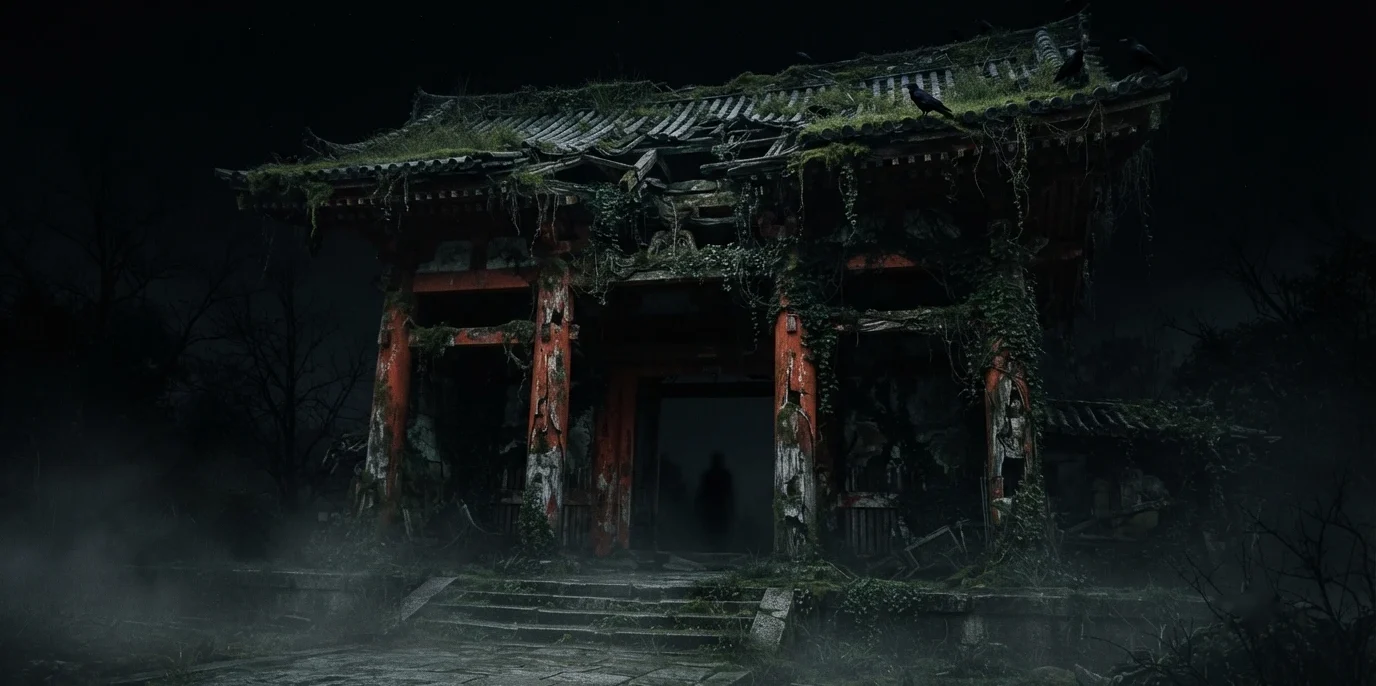
At the southern end of Suzaku Avenue, the great boulevard running through the center of Heian-kyo in what is now Minami Ward, Kyoto, there once stood an enormous gate called Rajomon (written “Rashomon” in later ages). It was built as the formal front entrance to Heian-kyo, in a sense the face of the state. By the middle of the Heian period, however, the gate had fallen into complete ruin, and it is said to have become a feared place where unclaimed bodies were piled in its upper story.
Origins — A Massive Gate Built as the Nation’s Front Door
Rajomon was built in 794, when the capital moved to Heian-kyo. As its name suggests, it was the main gate of the “rajo” (the walls enclosing a city), a symbolic structure dividing the inside of the capital from the outside, and a gate staked on the prestige of the state, used even in ceremonies welcoming envoys from abroad. However, Heian-kyo’s rajo is said never to have been completed as a true wall around the whole city, and it is thought to have been less a practical defensive facility protecting the city than a symbol displaying authority.
The way the name is read has also changed. It was originally read “Rajomon” or “Raseimon,” but the sound later shifted, the reading “Rasho” spread by the medieval period, and the character-substitute spelling “Rashomon” also came into use. The spelling “Rashomon” that we know today from Ryunosuke Akutagawa’s novel and elsewhere does not in fact date from the era when the gate stood; it is a name that arose after the gate’s ruined state came to be told of.
Another important point is what the gate was needed for. Research suggests that Rajomon was largely a structure meant to adorn the southern face of the capital, and that once envoys from abroad stopped entering the capital, the need for it itself faded. In other words, the ruin was not merely the result of natural disasters but also a process in which a building that had finished its role was quietly left behind.
For reference, Nara’s Heijo-kyo also had a Rajomon. Its remains now lie in the flow of the Saho River, so much of the central part is said to have been lost. Excavations have found the western end of the platform, and a stone said to be a foundation stone of the Rajomon is reported to be built into the stone walls of Koriyama Castle. The Kyoto gate’s foundation stones were carried off by Michinaga, while the Nara gate’s foundation stone turned into part of a castle wall. Both of the capitals’ main gates survived as parts of other buildings.
In addition, recent excavations have found a belt-shaped rise made of alternately tamped layers of gravel and soil south of Kujo Avenue, which marks the southern edge of Heian-kyo. It is presumed to be the base of the rajo, and it suggests that very short wall-like structures may actually have been built on both sides of Rajomon. The gate did not stand in isolation; it was part of a continuous setting that formed the southern “face” of the capital.
Why Did It Fall Into Ruin? — Natural Disaster, Fiscal Crisis, and a Graveyard
By the mid-Heian period, Rajomon is said to have repeatedly collapsed in storms and been rebuilt, and, with the court’s fiscal difficulties, to have been left at last without being rebuilt. This enormous gate, which should have been the capital’s front door, came to be used as a place to dump unclaimed bodies. The Konjaku Monogatarishu (a collection of tales compiled at the end of the Heian period) records a story in which a thief who climbs to the upper story of Rajomon comes upon an old woman pulling hair from the body of a young woman to make a wig. The thief strips the old woman of her clothes and flees, but what this tale conveys is thought to be not merely a ghost story but the very real hardship of society: in Kyoto at that time, famines and epidemics recurred, and bodies were left without proper funeral rites.
Tracing the records, Rajomon was blown down by a gale one night in August 816 and later rebuilt. But it collapsed again in a storm in July 980, and after that, even when rebuilding was discussed, it is said never to have come about. In the first half of the eleventh century there is also a record that Fujiwara no Michinaga took the gate’s foundation stones when he built the Hojo-ji temple. By then, the gate would have been reduced to nothing but foundation stones.
Meanwhile, the Konjaku Monogatarishu tells that Rajomon was already ruined before its collapse and that the dead were being abandoned in its upper story. About the same gate, the records convey a “form that fell and vanished,” while the tale conveys a “form that was ruined and feared.” We would like to take this slight gap between historical sources and story just as it is.
There is also a noh play, “Rashomon,” on the subject of a demon at Rajomon. As a separate line of weird tale from the thief and the old woman of the story, it shows that the gate came to be told of as a place where a demon dwelled. People presumably overlaid onto the ruined gate not only the presence of the dead but even the shadow of something not human.

A book guide introducing 88 landmark scary reads, from Edogawa Ranpo to modern mockumentaries — a reference for our reading-list articles.
88 Great Scary Books: From Rampo and King to Mockumentary (Unga Asamiya / Kodansha)
We may earn a referral fee on purchases made through these links.
Current Conditions — Only a Stone Marker Remains
Rajomon vanished completely before the Heian period ended, and today only a small stone marker, set in a corner of a children’s park in Minami Ward, Kyoto, shows that a gate once stood here. Almost nothing of the former front door of the state can be imagined from the present landscape.
No remains of the gate itself have been confirmed so far. However, the national treasure wooden standing statue of Tobatsu Bishamonten and the nationally designated Important Cultural Property three-color glazed demon-faced roof tile (onigawara) held at To-ji Temple are said to have originally been at Rajomon. Bishamonten, as a deity who stands at the entrance of the capital and wards off disasters coming from outside, was a fitting guardian for a gate. The story runs that even after the gate vanished, only its guardian deity moved to the temple and remained. The place-name “Karahashi” in the area is also said to derive from a bridge that spanned the ditch in front of the gate, so the memory of the gate remains in the name of the land.
The site’s explanatory board was installed by the city of Kyoto, and the only clues to the gate’s position are this stone marker, the town name “Rajomon-cho,” and the place-name “Karahashi.” Visible remains are scarce, but that is exactly why there is room left to picture in your mind the two-story great gate standing at the southern end of Suzaku Avenue. The feeling that the entrance to the capital of over a thousand years ago lies layered over the everyday life of a residential neighborhood is probably one that can only be experienced on the spot.
Reflection — From a Symbol of Authority to a Place for the Forsaken
What we find interesting about Rajomon is this: why did a gate built on the prestige of the state turn, of all things, into a “place of the abandoned dead”? This is only our speculation, but perhaps it is precisely because Rajomon was a building that embodied the court’s authority that it became the first place to be abandoned when the court’s power waned and its finances tilted. There is nothing but irony in the pattern whereby the bodies of people abandoned by the state itself came to gather at the symbol of a state that could no longer protect the people it should have protected. The act of the old woman in the Konjaku Monogatarishu, who strove to survive even by stealing hair from a corpse, can be read not merely as a frightening tale but as an expression of the desperation of people who had no choice but to live unnoticed behind the capital’s public stage; that is our view.
This, too, is nothing more than our own imagining, but if we simply picture the scene from the Konjaku Monogatarishu, with the bodies of the kinless dead piled in layers beneath Rajomon at night and a lone old woman pulling hair from a corpse to make her living, a rather grisly sight comes to mind. A tale is sometimes told of the sound of something quietly walking about among the unmourned piled remains, but we have not been able to confirm its source. In any case, Rajomon may not have been a mere ruin but the place in the capital where the presence of the dead hung thickest.
This is only our speculation, but we suspect that the reason this story has been handed down in the Konjaku Monogatarishu and, in later ages, even in noh and in Ryunosuke Akutagawa’s fiction is that the place called Rajomon itself had the power to symbolize the “edge” of the order called the capital. Rajomon came to serve as a boundary, with the inside of the gate the world of the living and the outside the world of the dead and of spirits. In the fact that a structure meant to display the state’s prestige turned into a barrier dividing life from death, we see the depth of the shadow carried by the civilization called the capital.
From here we would like to add our own distinctive view. The tale that the dead were placed in the upper story of Rajomon may indicate not merely that “it was a dumping ground,” but that “there was nowhere else to put them.” The town of Kyoto was filled with people’s lives and rules. For people with no means of holding a funeral, the upper story of the great gate towering at the capital’s entrance may have been something like a vacant lot for those with nowhere to go, belonging neither to the inside of the town nor to the outside. This is speculation.
Layering on the tradition that Bishamonten was enshrined at the gate gives another way of seeing it. A deity placed to ward off disasters from outside came to be positioned as the one watching over the death that overflowed from within. The picture of what was meant to protect silently looking down on the last moments of the people who should have been protected is almost too sad. Of course, this is our imagination, and there is no basis to say that people of that time perceived it that way.
In Akutagawa’s “Rashomon,” the servant hesitates over whether to turn to evil in order to live, and finally runs off borrowing the old woman’s argument. The original tale in the Konjaku Monogatarishu is far simpler; the thief is merely astonished, takes the clothes, and flees. That a story set at the same gate has grown in the direction of digging ever deeper into the wavering of the human heart is probably evidence that this place had the power to make people think about “what it means to live.” What we sense as the essence of the fear is not the figure of a ghost but the edge-of-the-precipice atmosphere in which, at the end of hunger and poverty, a person is about to stop being a person.
Finally, let us return to the record that the foundation stones were carried off. A man in power uses the stones of the state’s gate as material to build his own temple. This is our inference, but it may have been the moment when people saw with their own eyes that the “prestige of the state” that had resided in the gate had crumbled away without anyone’s help. The same stones became, on one hand, the foundation of a place for the dead and, on the other, the foundation of a new place of prayer. The stones of Rajomon seem to have silently accepted both of these faces to the end.
That is why the quiet we feel when standing before the marker now is closer to the lingering afterglow of something large that has finished its role than to fear. We would like to record the site of this gate not as a place to check whether ghosts appear, but as a place to quietly remember the people whom the great system called the capital let slip away.

A best-of collection from Sohiko Koike, known for his evidence-based reportage on the strange — a reference for our analysis pieces.
Fragments of the Uncanny: Best Reportage by ‘Occult Detective’ Sohiko Koike (Sohiko Koike & Unga Asamiya, eds. / Futami Shobo)
We may earn a referral fee on purchases made through these links.
A Nearby Recommendation — To-ji Temple (Kyoogokokuji)
A short walk east from the former site of Rajomon brings you to To-ji Temple (Kyoogokokuji), a World Heritage site that still stands proudly. It is a temple built as a pair with Rajomon when Heian-kyo was constructed, and its five-story pagoda, the tallest in Japan, can be seen even from around Kyoto Station. In contrast to Rajomon, which flourished as the capital’s main gate and eventually degenerated into a place where corpses gathered, To-ji continues to draw many worshippers as a holy site of Shingon esoteric Buddhism.
A Note on Visiting
The present site of Rajomon is nothing more than a small park and a stone marker in a residential area, and it is not a dangerous ruin. Because the surroundings are an ordinary residential neighborhood, please visit quietly and take care not to disturb the neighbors.
Please also note that this article includes stories of hunger and of dead people whose identities are unknown. If you are carrying painful feelings, please do not bear them alone; contact a support service such as the Yorisoi Hotline (Japan, 0120-279-338, available 24 hours a day).
Frequently Asked Questions
Q. Can you still see Rajomon today?
A. The structure itself was lost within the Heian period, and today only a stone marker remains in a children’s park in Minami Ward, Kyoto.
Q. Is the story in the Konjaku Monogatarishu historical fact?
A. It is a tale recorded in a collection of anecdotes and cannot be taken as historical fact as it stands, but other sources also suggest that in Kyoto at that time, famines and epidemics left unclaimed bodies.
Q. Has KARASU CHANNEL researched or filmed on location at the former Rajomon site?
A. No. We are not currently researching the former Rajomon site, though we are considering doing so. Videos of our research into other haunted spots and ghost stories can be viewed on KARASU CHANNEL (YouTube).

Supervised by Suzuking.
Affiliation: KARASU CHANNEL
Occult & horror reporting: 7 years (since 2020)
Followers: YouTube 5,000+ / X 25,000+
On-site investigations: 30+
If this appeared in your dream
What it means to dream of something from this story, read through psychology and folklore in our Dream Dictionary.
- Dreaming of an EntranceThe gateway of luck and meetings; a clean entrance invites good ties.
- Dreaming of a Dead BodyThings that have ended or feelings to let go; surprisingly, sometimes a lucky money dream.
Which story do you find the scariest?
If you think this story is the scariest, press the button below. One vote site-wide — you can change your vote for a different story anytime.
Was this article helpful?
Add this to your favorites to find it again anytime from your My Page.








Comments