Why Did the Baku Come to Eat the “Nightmares” It Never Ate in Its Homeland of China, Once It Reached Japan?
Supervised by Suzuking. (KARASU CHANNEL / Occult & horror reporting, 7 years)
Contents
View sources and last-checked date
- Source
- Wikipedia, “Baku” (Japanese)
- Source 2
- Wikipedia, “Baku (mythology)”
- Source 3
- Yokai.jp, “Baku”
- Source 4
- Into Japan Waraku, article on Baku (Japanese)
- Source 5
- USC Digital Folklore Archives, “Tell It to Running Water”
- Last verified
- 2026-09-30
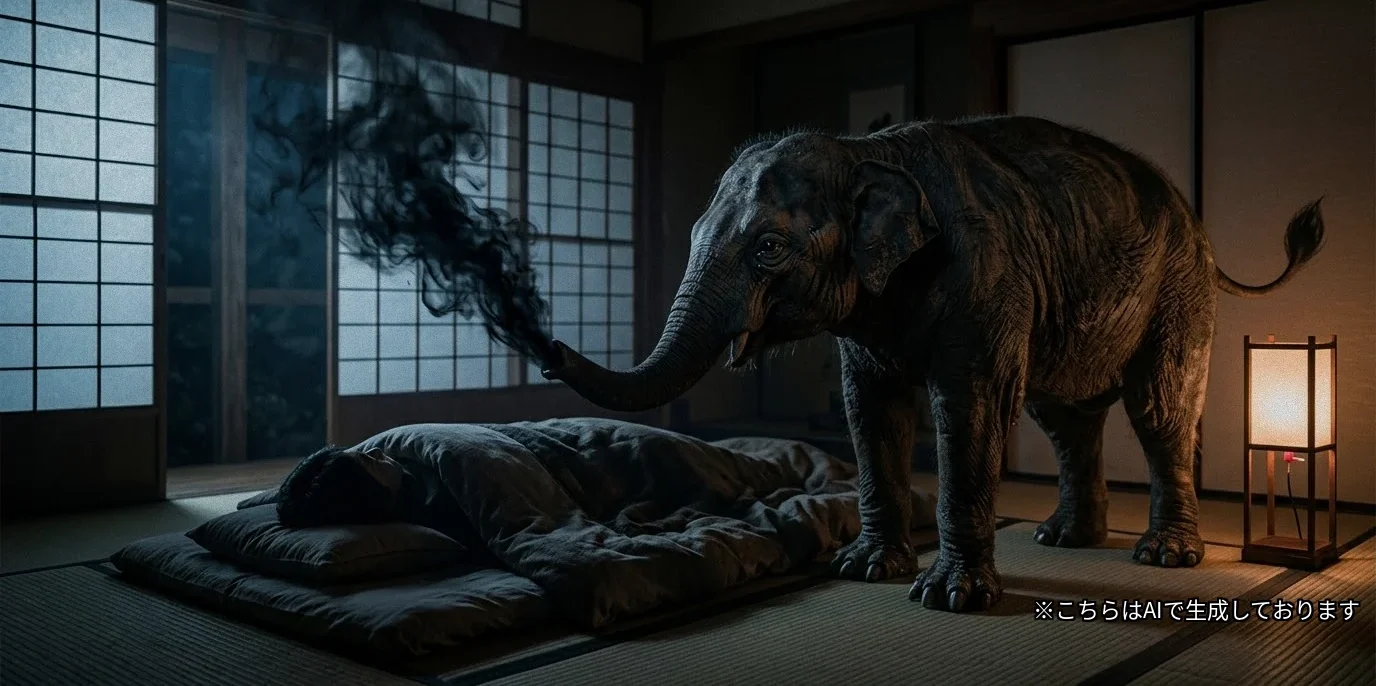
Not a few people, waking from a bad dream, have murmured under the covers, “Let the baku eat it.” In Japan the baku, a spirit beast that eats nightmares, has become a figure that hardly needs explanation: a small ornament by the pillow, a gentle creature in a picture book, or a slightly goofy shape blended with the black-and-white tapir at the zoo. It has the face less of a subject for scary stories than of a protector against scary things.
Yet this image of a “dream-eating baku” is hardly to be found in its homeland, China. The mo (the Chinese character for the animal, read baku in Japanese) that appears in Chinese classics was a beast that warded off evil and had nothing to do with dreams. When, and why, did the Japanese, after it crossed the sea, come to have the baku eat “bad dreams”? And why did people feel they had to have someone else eat their nightmares? In this article we follow the baku’s origins and the dream superstitions that piled up around it, and consider the fears people have carried about sleep, a defenseless time.
Origins: From a Beast of the Bamboo Grove to a Guardian of Folding Screens
The name baku (written mo in China) appears in old Chinese dictionaries and gazetteers. In the Erya, counted among the oldest dictionaries, it is mentioned as a beast like a white leopard, and the Han-dynasty Shuowen Jiezi explains it as a beast resembling a bear with yellow and black fur, living in Shu (around present-day Sichuan). The Jin scholar Guo Pu added that it resembles a bear with a small head and short legs and mottled black and white. A mountain region of Sichuan, a bear-like body, black and white spots: from this combination, the view is now strong that the old descriptions of the mo referred to the giant panda.
On the other hand, Chinese texts also carry a curious tale that this beast eats iron, copper, and bamboo. Its power to crush hard things came in time to be tied to the trait of “driving away evil.” The Tang poet Bai Juyi (Bai Letian) left a short piece, “In Praise of the Mo Screen,” about a folding screen on which the mo was painted. In its preface he describes the mo as a beast with an elephant’s trunk, a rhinoceros’s eyes, an ox’s tail, and a tiger’s feet, and writes that he placed the picture in his sleeping chamber to avoid evil influences. Here two elements that would lead to the later Japanese baku are already in place: a strange form stitched together from several animals, and the role of a guardian set beside sleepers.
Yet Bai Juyi’s screen mo only prevents illness and evil; it is not written to eat dreams. What appears in Chinese texts as a being that eats dreams is instead a different name, Boqi, which appears in court exorcism rites as the name of a god who devours nightmares. It has been pointed out that in Japan the baku came to eat dreams partly because Boqi and the mo became mixed together.
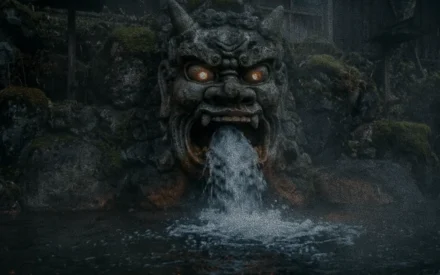
Knowledge of the mo reached Japan through Chinese books. By the end of the Muromachi period, a custom appeared of writing the character for baku on the sail in pictures of the takarabune (treasure ship), a New Year’s good-luck item, and in the Edo period, baku-fuda (baku charms) printed with the baku’s image or name circulated widely. “Baku pillows,” box pillows painted or carved with the baku, were also made. In a print from the late eighteenth century, it is drawn as a beast with an elephant-like head, tusks, a long trunk, horns, and tiger claws, showing that the Chinese “patchwork beast” character was carried over intact. Carvings of beasts that look like neither quite an elephant nor a baku appear on the kibana (the projecting beam ends) of temple and shrine buildings, and this is thought to be a remnant of this beast having been expected to “guard the entrance of bad things.”
Why Is It Said to “Eat Nightmares”?
The mo, a beast that warded off evil in China, changed its role in Japan to that of a keeper of dreams. To understand this change, we need to grasp what dreams meant to people in old Japan.
From ancient to medieval times, a dream was not merely an event in the brain but was received as a message from gods, buddhas, or the dead. People shut themselves in temples and shrines to await oracles in dreams, and what was seen in dreams was taken seriously as an omen of what might happen in reality. Good dreams bring luck, and bad dreams foretell disaster. For that very reason, good dreams were even bought and sold among people. A story in which, between sisters, one “bought” the other’s auspicious dream in exchange for a kimono or the like is still told as a famous anecdote of the Kamakura period. Dreams were something like property with an owner.
If dreams are property, a bad dream is a debt. Carrying a nightmare one has seen as it is would let the disaster come true. So people devised many ways to transfer bad dreams to something else or to cancel them: charms to “change” a dream by reciting a fixed poem; “dream flushing,” in which one lays a picture of the New Year’s treasure ship under the pillow and, if one has a bad first dream of the year, sends the picture down the river and the dream with it; and the custom of having the baku eat the dream. In the early modern period, this spread in the form of a child who woke from a bad dream reciting three times, “Mr. Baku, please eat this dream,” and it is said that until the early twentieth century it was not unusual for a household to place a baku charm at a child’s bedside.
A well-known saying even today is “A bad dream told to someone will not come true” and “A good dream told to someone will not be fulfilled.” Where it began is unclear, but it fits neatly with the idea of dreams as property. A good dream loses its value if spoken aloud and might be stolen by someone, so one keeps it quietly to oneself. A bad dream, by contrast, disappears from within you if you put it into words and let it out. Interestingly, the idea of letting a dream out and letting it go is not only Japanese. In some Polish households, it is said, one who tells bad thoughts or nightmares to flowing water will have the water carry them away. The forms differ, but the intuition that “a nightmare is something to put outside oneself” is shared across distant lands.
The baku was chosen as the receptacle for this “putting outside.” A beast that can crush even hard iron should be able to eat up any bad dream. We believe the “dream-eating baku” was born when the power of warding off evil that came from China met the Japanese need to deal with dreams.
Yuki Yoshida, a professional ghost-story collector, writes about strange happenings tied to mountains — a reference for our mountain haunted-spot articles.
Ghost Stories from the Mountain Behind the House (Yuki Yoshida / Yama-Kei Publishers)
We may earn a referral fee on purchases made through these links.
Present Day: The Cute Spirit Beast and the Zoo’s Tapir
The baku today is loved less as a fearsome patchwork beast than as a gentle guardian of dreams. As charms and figurines wishing for sound sleep, and as characters in picture books, manga, and anime, the baku has repeatedly changed shape. The phrase “let the baku eat the bad dream” is understood normally even by people who do not know its origins.
There is also confusion of names. Since the Meiji period, the real animal called the tapir, which lives in Southeast Asia and Central and South America, has been translated as “baku,” so that today, when Japanese people say “baku,” many picture the black-and-white Malayan tapir at the zoo. That this short-nosed animal came to inherit the name of the spirit beast said to have an elephant’s trunk was, though coincidence, a fitting match. The spirit beast baku set out from old descriptions reminiscent of the panda and in the end handed its name to a different black-and-white animal.
The custom of laying a picture of the New Year’s treasure ship under the pillow still continues faintly in some regions and households. Many people care about the luck of the first dream of the year, and the sense of reading good and bad omens in dreams, along with the saying “first Fuji, second hawk, third eggplant,” lives on today. Baku charms are rarely seen now, but the urge to tell someone “I had a scary dream” on the morning after a nightmare may not be far from the feeling of people long ago who offered their dreams to the baku.
KARASU CHANNEL’s Take: Why Did People Want to “Have Someone Eat” Their Nightmares?
What is easy to overlook in the baku story is that dreams were made to be “eaten,” not “forgotten.” A bad dream, left alone, is mostly forgotten. Even so, people of old took the trouble of setting up another party, the baku, handing over the dream, and having it crushed. Behind this may have been a fear that a dream is something one cannot erase by one’s own will, something that goes on remaining somewhere as a substance.
This is our own inference, but the sense of dreams as “property” and the idea of “having them eaten” seem to grow from the same root. Property, even if thrown away, lives on if someone picks it up. Nightmares are the same: merely forgotten, they may still be waiting somewhere, in shape, for a chance to come true. So to erase one for certain, one has to have someone take it over and digest it in its body. We see the baku’s “eating of nightmares” as a double procedure: transferring ownership of the nightmare and then ending its very existence.
Another thing to consider is that the baku’s form is “patchwork.” Elephant, rhinoceros, ox, tiger: not any single animal but a body assembled from scattered parts. There is even a tale told that the baku was made from the leftover parts after the gods made the other animals. In our view, this character of being “a beast made of leftovers” suits a receiver of nightmares. It is a beast born of the world’s leftovers that takes on the role of receiving what people do not want to see and do not want to hold, the leftovers of life. There is a somehow sad balance in that.
When you think about it, in the belly of a beast that keeps eating nightmares must lie the fear of humans for hundreds of years. How dark must the dreams have been that people saw in times of war, famine, and plague: the dream of a child who has lost a parent, of a merchant chased by debts, of a mother worried about her sick child. That baku charms sold well in Edo can also be said to show how many people were spending nights they could not carry on their own. The people who laid baku charms under their pillows may have been not so much believing in the baku as having no other way to get through that night. This too is only inference, but behind the baku’s cute appearance there seems to hide the weight of countless sleepless nights.
And the saying that “a bad dream told to someone will not come true” is also wisdom in which people play the baku’s role for one another. The one who is told a dream takes on, just a little, that fear. A person hears another’s nightmare and silently nods. That small exchange may be the most familiar baku of all.

A hands-free COB work light worn across the chest like a sash — unlike a headlamp, it puts no weight on your head, and the roughly 59–69cm strap adjusts to fit your build.
Takagi EARTH MAN LED COB Work Light 'Tebura' Shoulder-Strap Type WLT-10TLiA
We may earn a referral fee on purchases made through these links.
Engaging With This Legend
The baku remains tied to places of faith and prayer even now, in carvings on temple and shrine buildings and in good-luck items. When you see a carving or a charm, please respect the feelings of the people who have cherished it and avoid treating it as a joke.
Also, sayings about the good and bad omens of dreams are wisdom that our predecessors cultivated to live with anxiety. There is no need to conclude that something bad will actually happen because you had a bad dream, nor is it something to press on others by telling them “that dream is ominous.”
If nightmares continue for days, you become afraid to sleep, or your daytime life is affected, strong stress or a sleep disorder may be hiding behind it. In such cases, please consult a medical institution or a specialized service rather than relying only on sayings.
Frequently Asked Questions
Q. Was the baku originally an animal that ate nightmares in China?
A. The mo in old Chinese texts is depicted as a beast that warded off evil, and it is not written to eat dreams. The dream-eating trait is thought to have arisen after it came to Japan, mixing with Boqi and others said to be gods that devour dreams.
Q. How is the baku’s appearance described?
A. In the writing of Bai Juyi of Tang China, it is a beast with an elephant’s trunk, a rhinoceros’s eyes, an ox’s tail, and a tiger’s feet. In Japanese Edo-period prints as well, it was drawn as a combination of several animals, with an elephant-like head, long trunk, tusks, and tiger claws.
Q. What are baku-fuda and baku pillows?
A. They are Edo-period customs of trying to protect oneself from bad dreams by placing a charm printed with the baku’s image or name at the bedside or under the pillow, or by painting the baku on a box pillow. The custom of writing the character for baku on the sail in New Year’s treasure-ship pictures is also seen from the end of the Muromachi period.
Q. Is it true that “a bad dream told to someone will not come true”?
A. It has no scientific basis. It is one of the folk beliefs handed down from an age that regarded dreams as messages of good and ill fortune. Still, many people experience feeling lighter after telling someone about a scary dream, and the saying may reflect that working of the mind.
Q. Is there a connection between the zoo’s tapir and the spirit beast baku?
A. There is no direct connection. Since the Meiji period, the word “baku” was assigned as a translation for the real animal, the tapir, so they came to be called by the same name.
This saying can also be looked up in KARASU CHANNEL’s Superstition and Omen Dictionary. If you are curious about the meaning of the dream you had, please try Dream Interpretation as well.
Q. Has KARASU CHANNEL researched or filmed the baku on location?
A. No. We are not currently researching the baku, though we are considering doing so. Videos of our research into other haunted spots and ghost stories can be viewed on KARASU CHANNEL (YouTube).

Supervised by Suzuking.
Affiliation: KARASU CHANNEL
Occult & horror reporting: 7 years (since 2020)
Followers: YouTube 5,000+ / X 25,000+
On-site investigations: 30+
If this appeared in your dream
What it means to dream of something from this story, read through psychology and folklore in our Dream Dictionary.
- Dreaming of your HometownA return to roots or a need for a safe harbour.
- Dreaming of a BakuThe legendary beast said to eat bad dreams. Dreaming of one hints that worries or frightening memories are be…
Which story do you find the scariest?
If you think this story is the scariest, press the button below. One vote site-wide — you can change your vote for a different story anytime.
Was this article helpful?
Add this to your favorites to find it again anytime from your My Page.









Comments