The Curse of the Colonel: An Urban Legend Solved 24 Years Later
Supervised by Suzuking. (KARASU CHANNEL / Occult & horror reporting, 7 years)
Contents
View sources and last-checked date
- Source
- Wikipedia, “Curse of the Colonel Sanders” (Japanese)
- Source 2
- Nikkei, “Farewell to the Returned Colonel Doll” (Japanese)
- Last verified
- 2026-09-16
Dotonbori, the bustling entertainment district in Osaka’s Minami area, is still famous today for its eye-catching Glico sign. But this canal also gave birth to an urban legend that really did arise here, known as the “Curse of the Colonel Sanders.” It blamed nearly twenty years of slump by a professional baseball team on the wrath of a single doll, and it ranks among the best-known urban legends in the history of Japanese sports.
Origins — An Incident Born From Championship Fever in 1985
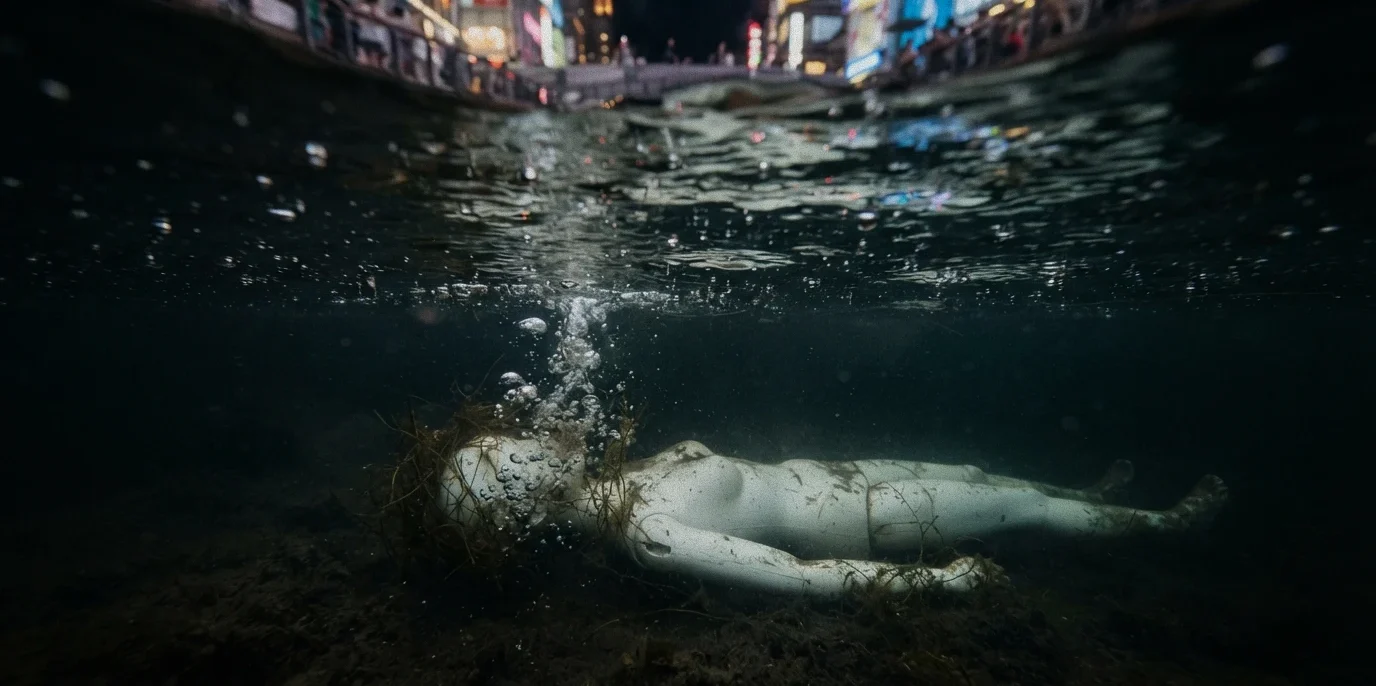
On October 16, 1985, the Hanshin Tigers clinched their first Central League pennant in 21 years. Huge crowds of jubilant fans flooded into Dotonbori, and the excitement gradually slipped out of control. The “Colonel Sanders statue” (a life-size figure modeled on the founder of KFC) standing at a KFC restaurant along the canal was taken by the crowd to stand in for Randy Bass, the star import player who had been the driving force behind the title, and it was carried out into the street. Despite the staff’s attempts to stop them, the doll was tossed in the air in a mock victory toss and then thrown straight into the Dotonbori River.
Twenty-Four Years Called a Curse
The year after the doll was thrown into the river, 1986, the Tigers slipped to third place. In 1987 they recorded a .331 winning percentage, the worst in the club’s history, and from 1987 through 2001, they finished dead last in ten of fifteen seasons, a severe and prolonged slump. This dramatic collapse eventually gave rise to the urban legend that “the missing Colonel doll might be cursing the team.” Fans made repeated attempts to search for and pull up the doll, but for a long time it was never found.

For checking an upper floor, a high spot, or the outside of a distant building at a ruin from a safe distance.
Vixen Binoculars 8x, 8x21, White, Compact & Lightweight 79491
We may earn a referral fee on purchases made through these links.
Current Conditions — Found After 24 Years, and the “End of the Curse”
The turning point came in March 2009. During a survey of obstacles for a waterside improvement project on the Dotonbori River by the city of Osaka, the doll’s upper body was found on the riverbed (at a depth of about two meters); the next day its lower body and right hand turned up, and nearly the whole figure was confirmed. After inspection and restoration by specialists, the doll was named “Okaeri! Colonel” (“Welcome back, Colonel!”); following a period of permanent display at a restaurant, it was moved to the headquarters of Japan KFC Holdings. The Tigers went on to win the Japan Series in 2023, and many fans at the time took it to mean “the curse is now fully over.” The recovered doll itself was respectfully laid to rest in March 2024 at Sumiyoshi Taisha Shrine in Osaka, in a ningyo kuyo, a Shinto rite of thanks and mourning for dolls that have served their purpose.
It is worth looking at the sequence of events a little more closely. On the night of October 16, 1985, when the Tigers clinched the pennant, some of the crowd gathered in Dotonbori shouted out players’ names in batting-order fashion and jumped into the river one after another. The number three hitter was Bass, but nobody resembled him, so no one jumped, and the Colonel Sanders statue standing in front of a nearby KFC was cast as Bass instead. The statue, carried off despite the staff’s attempts to stop the crowd, is said to have been thrown into the river after being tossed in the air. Destroying the statue was also a reckless excess lurking behind the celebration.
Surprisingly, the word “curse” is said not to have existed yet right after the incident. The 1986 season ended in third place amid a string of injuries to key players, but at the time it was not described as a “curse.” A major trigger for the legend taking hold is said to have been a Kansai television program in 1988 that took up a project to search for the statue sunk in the river. The program searched for the statue and also had a purification rite held at a shrine, but did not find it. In other words, the curse is a story that grew less out of the incident itself than out of being told through the media.
The doll was found in March 2009, about 23 and a half years after the incident. After restoration by a specialist institution it was named “Okaeri! Colonel,” and in June of that year it was shown to the public at Sumiyoshi Taisha. It was displayed permanently at the Hanshin Koshien store and lent to an exhibition at a university museum, then moved to a corporate headquarters in 2013 and later displayed at an office in Kansai. But as cracks and other signs of aging progressed and storage became difficult, it was announced that a doll-laying-to-rest rite had been held at Sumiyoshi Taisha on March 19, 2024. The journey of the doll from the riverbed was a long one.
The “curse” is said to have been lifted in name and in fact in 2023. The Tigers, under a manager who had been a member of the 1985 championship team, won the league pennant for the first time in 18 years and also won the Japan Series, taking their second Japan championship in 38 years, since 1985. Many voices among the fans reportedly said that “the curse has been lifted.” It is said that on that day a man in costume was tossed in the air and thrown into the Dotonbori River, but this is an extremely dangerous act. Jumping into the river can lead to accidents and, in some cases, to death, so please never imitate it.
Reflection — Whose Story Was the “Curse,” Really?
What we find interesting is not that this was mere superstition, but the very fact that it was seriously believed by many people and passed down for nearly twenty years. Looked at calmly, the team’s decline can be explained by many factors, such as the depth of the roster and management policy, and a direct causal link to a doll sunk in a river seems unlikely. And yet the story of the “curse” kept being told for so long. This is only our speculation, but perhaps it was because the fans themselves unconsciously carried a lingering guilt over what they had done in the heat of the championship: destroying a doll and throwing it into the river. By giving the result of the slump the easy-to-grasp story of a “curse,” the fans may have kept facing their own past actions. The curse story did not vanish even after the doll was found; it was only in 2023, when the Tigers took the Japan championship, that people felt “the curse has been lifted,” and the doll was laid to rest the following year. That sequence speaks eloquently about what this urban legend really was.
This too is only our imagination, but when the Colonel Sanders doll was finally pulled up from the riverbed after 24 years, it is said to have been missing its glasses, both ankles, and its left hand. For the twenty-odd years it lay on the dark riverbed without anyone noticing, the doll was simply letting time pass in silence. Being made to carry the story of a curse had nothing to do with the doll’s own will. Thinking of it that way, we believe there is room to see the doll not as the “master of the curse” but as a victim caught up in human fervor.
If we may add one more point from a religious angle, the fact that, after the doll was found, a memorial rite (ningyo osame) was held for it as something that had finished its role seems to express well the distinctive feeling the Japanese have toward objects. The idea that guilt over mistreating something shaped like a person is resolved not through apology or compensation but only through a religious procedure of memorial service shares its roots with doll memorial rites (ningyo kuyo) and the notion of tsukumogami (long-used objects that acquire a spirit). Although the Colonel Sanders doll is a character figure from overseas, the way its curse was settled was thoroughly Japanese.
One more thing we would like to note is how neatly this urban legend fits into the Japanese sports-culture pattern of the “jinx.” Similar stories exist abroad. In American Major League Baseball, for example, the “Curse of the Bambino” was told of a club that sold off a great player and then could not win a championship for many years. By tracing the reason for not winning to an inexplicable connection, fans find it easier to accept defeat. This is only our inference, but the story of a curse may also have been the fans’ wisdom for enduring long periods of losing. Talking about the curse together was also an act of turning frustration into laughter and solidarity.

Haunted-spot exploration tends to mean a lot of gear — flashlight, camera, bear bell, work gloves, insect repellent — and this tote's water-repellent paraffin canvas and large capacity, plus grommets for cinching the top shut, make it easy to carry your whole kit from car to site in one trip. Its box-like, self-standing shape also keeps the contents from tipping over in the car.
Takagi KANUCHI OUTDOOR Paraffin Canvas Large Tote Bag, Khaki
We may earn a referral fee on purchases made through these links.
Everyday Face — The Glico Sign and a City That Eats Itself Broke
Dotonbori, the setting of the legend of the sunken Colonel Sanders doll, is now a bustling entertainment district that serves as the face of Osaka tourism. The area in front of the giant glowing “Glico sign,” with its running figure, is a classic photo spot, and the canal is crowded with shops that embody the “kuidaore” (eat until you go broke) spirit, such as takoyaki and kushikatsu stands and the Kani Doraku crab sign. Tourists also ride the Tombori River Cruise to see the city from the water, and despite the memory of the urban legend, Dotonbori remains wrapped in cheerful energy today.
A Note on Visiting
Dotonbori remains a busy entertainment district full of people today, and it is not a dangerous place. Since the original doll has already been displayed at KFC’s headquarters and elsewhere and then laid to rest, please avoid searching around the Dotonbori River for traces of those days, and simply enjoy it as an ordinary tourist destination.
Frequently Asked Questions
Q. Where is the Colonel Sanders statue now?
A. After being found in the Dotonbori River in 2009, it was displayed at a restaurant and later moved to the company’s headquarters, and in March 2024 it was laid to rest in a ningyo kuyo ceremony at Sumiyoshi Taisha Shrine in Osaka.
Q. Was it really a curse?
A. It is an urban legend with no confirmed scientific causal link. The actual reasons for the team’s slump can be attributed to a variety of factors, such as roster depth and management policy.
Q. Has KARASU CHANNEL researched or filmed on location at Dotonbori?
A. No. We are not currently researching Dotonbori, though we are considering doing so. Videos of our research into other haunted spots and ghost stories can be viewed on KARASU CHANNEL (YouTube).

Supervised by Suzuking.
Affiliation: KARASU CHANNEL
Occult & horror reporting: 7 years (since 2020)
Followers: YouTube 5,000+ / X 25,000+
On-site investigations: 30+
If this appeared in your dream
What it means to dream of something from this story, read through psychology and folklore in our Dream Dictionary.
- Dreaming of an Urban LegendA sign you are swayed by rumours or baseless fears.
Which story do you find the scariest?
If you think this story is the scariest, press the button below. One vote site-wide — you can change your vote for a different story anytime.
Was this article helpful?
Add this to your favorites to find it again anytime from your My Page.

Comments