Sesshoseki — Why Did the Stone Sealing a Nine-Tailed Fox Crack Open in the Reiwa Era?
Supervised by Suzuking. (KARASU CHANNEL / Occult & horror reporting, 7 years)
Contents
View sources and last-checked date
- Source
- Wikipedia, "Tamamo-no-Mae" https://ja.wikipedia.org/wiki/玉藻前
- Source 2
- Wikipedia, "Sessho-seki (The Killing Stone)" https://ja.wikipedia.org/wiki/殺生石
- Source 3
- March 2022 news reports (Nlab/Livedoor News, and others)
- Last verified
- 2026-09-16
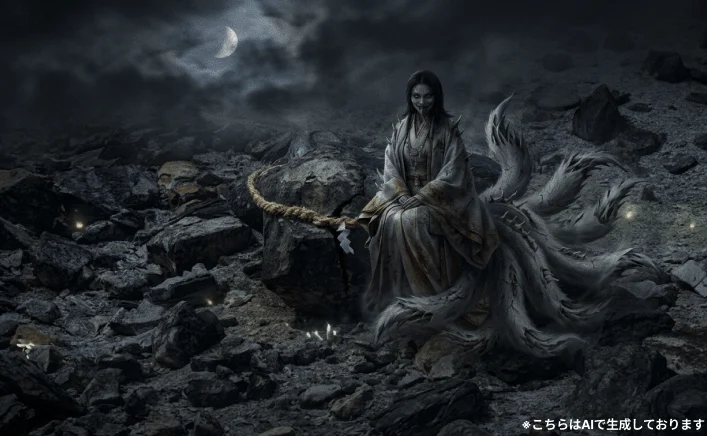
On the Nasu Highlands in Nasu, Tochigi Prefecture, in a bleak stretch of land heavy with the smell of sulfur, sits a rock known as Sesshoseki, the “Killing Stone.” This poisonous rock is said to have silently taken the lives of birds and insects that came near it, and at times even people, and it carries one of the most famous stories in all of Japanese yōkai folklore: that of a peerless beauty who bewitched the imperial court and turned out to be a nine-tailed fox spirit. Then, in 2022 (Reiwa 4), the stone that was supposed to have stood there for more than six hundred years split cleanly in two without warning.
Origins — The True Identity of the Beauty Who Bewitched an Emperor
According to legend, in the late Heian period, a court lady named Tamamo-no-Mae, gifted with both great beauty and great learning, served the retired emperor Toba. He quickly grew infatuated with her, but his health then began to decline for no apparent reason. When the onmyōji Abe no Yasunari divined the cause, he discovered that Tamamo-no-Mae’s true form was a nine-tailed fox that had committed misdeeds in India and China before crossing over to Japan. Once exposed, Tamamo-no-Mae fled the capital in fox form and went into hiding in the fields of Nasuno. A punitive army was raised to hunt down the fox spirit that had brought people harm, and warriors including Miura-no-suke and Kazusa-no-suke finally struck the nine-tailed fox down.
The Stone That Kept Killing Even After the Fox Was Slain
Even after the nine-tailed fox was slain, its grudge is said to have transformed it into a massive poisonous stone that went on silently claiming the lives of people, animals, and birds that came near it, one after another. People feared this rock and called it Sesshoseki. Later, in the Muromachi period, in 1385 (Shitoku 2), a Sōtō Zen monk named Gennō Oshō is said to have visited the site, struck the stone with his staff, shattered it, and led it to enlightenment. Incidentally, the Japanese word “gennō,” still used today for a type of hammer, is said to derive from this very episode of Gennō shattering the stone. The shattered fragments are said to have scattered across the country, each enshrined in its own locality — an unusual case of a single yōkai legend branching out into place names and local worship all across Japan.

Folds down to a compact roughly 12×19.5×6cm with a storage case, and assembles into a 3-way shovel, hoe, and pick. A portable shovel for freeing yourself from mud or snow on a mountain trail or around a ruin, or for clearing footing on an animal trail.
Takagi KANUCHI OUTDOOR 3-Way Portable Shovel with Storage Case, Black
We may earn a referral fee on purchases made through these links.
In 2022 (Reiwa 4), the Stone Split in Two
The main Sesshoseki rock on the Nasu Highlands, roughly 8 meters around and 2 meters tall, had long been a familiar local landmark, but on March 5, 2022, it was found split cleanly in two. Experts view this as a natural phenomenon caused by water seeping into cracks in the rock and repeatedly freezing and expanding through the winter cold. Even so, news that “the seal on the nine-tailed fox may have broken” became a major topic both in Japan and abroad, and the local Nasu Town Tourism Association held a memorial service and a prayer for peace later that same month. That two entirely different explanations — a yōkai legend and a geological natural phenomenon — can hold at once for this event shows that, even in the Reiwa era, this legend has not been dismissed as mere folklore.

A classic piece of ghost-hunting gear: an IC recorder for capturing on-site sound, also used for collecting EVP (electronic voice phenomena).
Sony IC Recorder 4GB, AAA Battery Compatible, ICD-PX240, USB 2.0
We may earn a referral fee on purchases made through these links.
Our Take — Why Did the Stone Splitting Become News?
From here on, this is our own view, mixed with speculation. A rock cracking from freezing and expansion is, geologically, not a particularly rare phenomenon in itself. And yet the news that Sesshoseki had split became such a topic that even foreign media picked it up — perhaps because many people could not entirely shake the feeling, somewhere in the back of their minds, that something might really have been sealed there. For more than 600 years since Gennō Oshō shattered the stone, people have continued to treat it as a “sealed yōkai.” When that stone, however natural the cause, actually split, the fact that people’s very first thought was the anxious question “could the seal be breaking now?” seems to us to show just how long, and how deeply, this legend has taken root in the imagination of the people of this land.
It is also interesting that the local tourism association responded not by simply dismissing the event as an “ill omen,” but with a memorial service and a “prayer for peace.” This suggests they continue to treat the nine-tailed fox — slain and sealed — not simply as a villain, but as a being still deserving of pacification and rest. In a sense, the nine-tailed fox may be a being that has, for nearly a thousand years, never stopped being “killed.”
What we find worth noting is that Gennō Oshō’s episode is passed down not as having “slain” or “sealed” the stone, but as having “led it to enlightenment.” Even though the nine-tailed fox was unambiguously an “evil” that had gone on killing people, the Japanese religious worldview did not simply treat it as an enemy to be destroyed. Offering a path to enlightenment even to a non-human, deeply sinful being, as an object of Buddhist salvation, seems to us to strongly reflect a Japanese way of thinking about pacifying spirits that prioritizes calming and purifying a grudge over merely settling the score against it. Read the other way, it also suggests just how powerful the nine-tailed fox’s grudge was believed to be — too strong to be quieted by half measures.
This is speculation, but we think there may be a basis beyond mere invention for the tradition that the rock called Sesshoseki actually took living creatures’ lives. The Nasu Highlands remain an active volcanic zone that still vents volcanic gas today, and depending on wind direction and terrain, toxic gas can pool, and it is still not unusual to find small animals and insects dead there. If people of an age without scientific explanation, confronted with an invisible force that took life, turned that into a story of a vengeful fox spirit, then the Sesshoseki legend can also be read as an ancestral warning device meant to keep people away from a dangerous place. A story of fear may, in the end, have protected human lives — and viewed that way, the fear this legend carries starts to look a little different from the fear of a simple invented tale.
In our view, the tradition that fragments of the stone scattered across the country and were enshrined in each locality carries an even deeper meaning. If the seal was not concentrated in a single place but managed in a distributed way across multiple sites, that may itself be a sign of just how overwhelming a presence it was — too much to be pacified in one place alone. The 2022 splitting of the main stone on the Nasu Highlands is, geologically, nothing more than a chance natural event. But placed within the context of this legend, it can also be read as a sign that one corner of a balance once distributed across the whole country has, after more than six hundred years, quietly begun to give way. This is, of course, nothing more than our own speculation, but perhaps it is in the margin that facts alone cannot fill that lies the reason this legend still continues to draw people in.
A Note on Visiting
The area around Sesshoseki remains an active volcanic zone that still vents volcanic gas. It is a designated Place of Scenic Beauty with a maintained walking trail, but access can be restricted depending on gas conditions. Please check the latest information with the Nasu Town Tourism Association or similar before visiting. This article is published to record this place, not to encourage going there.
Frequently Asked Questions
Q. Is it true that Sesshoseki split apart?
A. Yes. In March 2022, the stone was found split cleanly in two. Experts view it as a natural phenomenon caused by water freezing and expanding, but the story generated enough interest to be reported both in Japan and abroad.
Q. Can Sesshoseki still be visited today?
A. Yes. It is a maintained tourist walking trail on the Nasu Highlands, but because the area is an active volcanic zone that vents gas, access is sometimes restricted. Please check the latest information before visiting.
Q. Has KARASU CHANNEL filmed a report in Nasu?
A. No, we have not filmed there yet, though we are considering it. Other haunted-spot and kaidan field-report videos can be viewed on KARASU CHANNEL (YouTube).
Japanese horror 鴉番組

Supervised by Suzuking.
Affiliation: KARASU CHANNEL
Occult & horror reporting: 7 years (since 2020)
Followers: YouTube 5,000+ / X 25,000+
On-site investigations: 30+
If this appeared in your dream
What it means to dream of something from this story, read through psychology and folklore in our Dream Dictionary.
- Dreaming of the Nine-Tailed FoxThe legendary fox who seduced rulers: beware alluring offers, though it is also a symbol of great power.
- Dreaming of a YokaiA symbol of emotions you cannot handle or strange relationships. Befriending one hints you can accept what yo…
Which story do you find the scariest?
If you think this story is the scariest, press the button below. One vote site-wide — you can change your vote for a different story anytime.
Was this article helpful?
Add this to your favorites to find it again anytime from your My Page.









Comments