O-Inu-sama — Why an Extinct Wolf Is Still Worshipped as a God Today
Supervised by Suzuking. (KARASU CHANNEL / Occult & horror reporting, 7 years)
Contents
View sources and last-checked date
- Source
- Mitsumine Shrine oral tradition
- Source 2
- meguri-japan.com, "Mitsumine Shrine and the Goken'zoku (Wolf Spirit) Faith," and other local history sources
- Last verified
- 2026-09-16
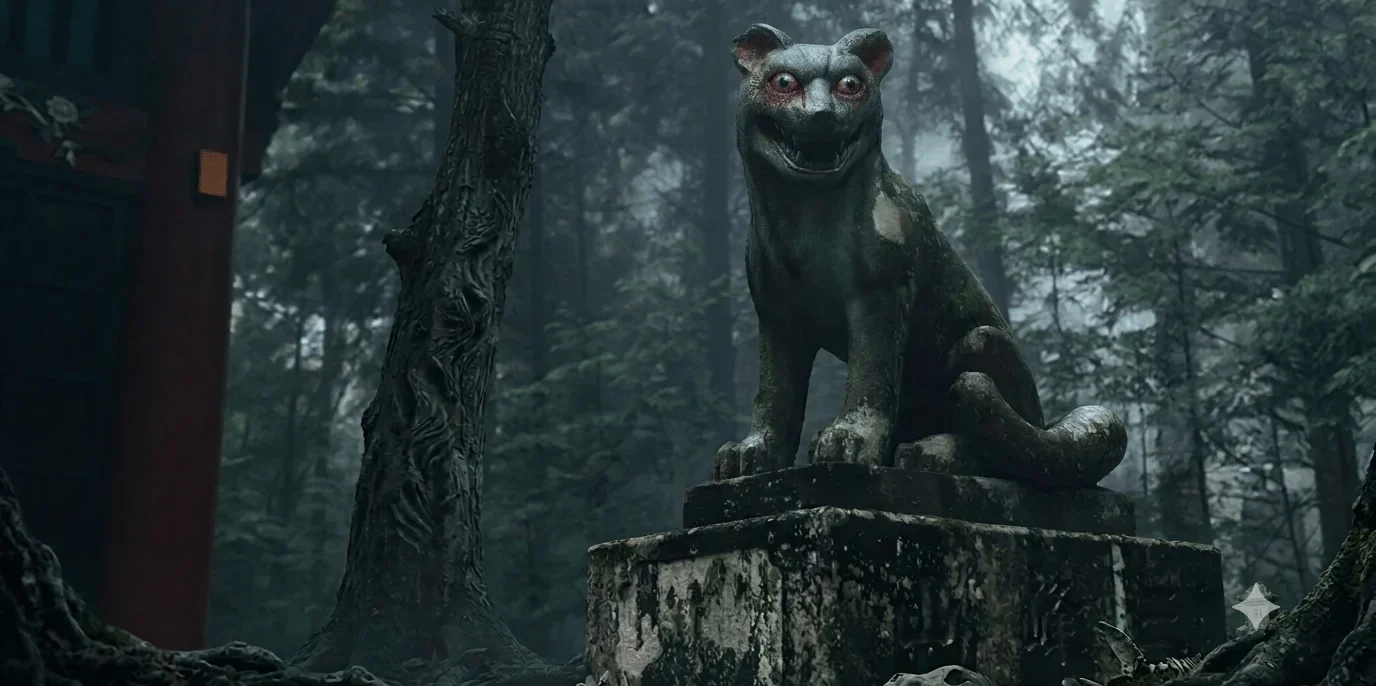
Mitsumine Shrine sits on a ridge 1,100 meters up in the mountains of Chichibu, Saitama Prefecture. Guarding its approach are not the usual komainu lion-dogs, but statues of a mountain dog called “O-Inu-sama” — the Japanese wolf. What is enshrined here is not some legendary spirit-beast, but an actual animal that once genuinely walked these mountains and is now believed to exist nowhere on Earth. People still put their hands together in prayer to a beast that is no longer there. We looked into why this shrine keeps worshipping an “absent god,” and where that stands today.
Origins — The Mountain Dog That Saved Yamato Takeru
The founding legend of Mitsumine Shrine is said to trace back to the eastern campaign of Yamato Takeru. According to tradition, when Yamato Takeru tried to cross the Kariyasaka Pass running northwest from this area, thick fog and poisonous vapors blocked his way and he lost his path. A mountain dog then appeared and, as if leading the way, guided his party out beyond the pass. Having escaped danger, Yamato Takeru is said to have thanked the mountain dog for its service and ordered that it be enshrined as this land’s divine messenger.
The mountains of Chichibu once overlapped with the range of the Japanese wolf, and the ecology of wolves — moving in packs rather than alone, and holding territory — likely made it easy for people to cast them as beings that “guide” or “protect” travelers. Ever since, Mitsumine Shrine has treated the wolf not as a mere wild animal, but as a sacred being carrying out the will of the mountain god.
“Goken-zoku Haishaku” — A Borrowing Tradition Begun in the Kyōhō Era
The O-Inu-sama faith was established as a formal practice much later than the age of legend — around 1720 (Kyōhō 5), in the mid-Edo period. A system called “goken-zoku haishaku,” said to have been started by a monk-administrator of the time, Nikkō Hōin, allowed worshippers to enshrine at home, for a set period, a talisman said to carry the power of O-Inu-sama, to protect the household from fire, theft, and illness, before returning it to the shrine.
The spread of this faith from Edo to farming villages across the greater Kantō region appears connected to the wolf’s actual behavior. Wolves bark fiercely and stay on guard against anything entering their territory, and to people of the time, that image easily overlapped with a “guard dog that chases off suspicious intruders and looters at a fire.” Here we can see a real animal’s ecology being linked to abstract blessings — protection from fire and theft.

For protecting your face and neck from mosquitoes and gnats at a mountain spot.
Benvo Insect Repellent Head Net, Mosquito Net for Fishing/Outdoor Use, Face Guard, 2-Pack, Gray
We may earn a referral fee on purchases made through these links.
Mitsumine Shrine Today — The Mountain Dog Is Already Gone
The established view today is that the Japanese wolf enshrined as a divine messenger at Mitsumine has gone extinct. The last confirmed capture on solid record was an individual taken in 1905 (Meiji 38) in Higashi-Yoshino, Nara Prefecture, and no reliable evidence of a surviving population around Chichibu has been confirmed since. In other words, this shrine has spent at least close to 120 years enshrining, as its divine messenger, an animal that no longer exists in this world.
Even so, the granting of goken-zoku haishaku talismans has continued without interruption to this day, and Mitsumine remains one of the Kantō region’s leading spiritual power spots, still drawing many worshippers. The mountain-dog statues placed throughout the approach, and the pair of O-Inu-sama guarding the shrine hall, can be seen as living monuments carrying the memory of a lost animal into the present.
An essay collecting strange stories tied to food — an easy reference to introduce alongside our kaidan columns.
Scary Foods (Tanishi Matsubara / Futami Shobo)
We may earn a referral fee on purchases made through these links.
Our Take — Why Do People Keep Worshipping an Absent God?
This is our own view, but we suspect that the reason Mitsumine’s faith has not faded lies precisely in the fact that its object went extinct. While wolves still ran through these mountains and fields, O-Inu-sama was, in a sense, an “unmanageable” neighbor, carrying both a real threat (livestock damage) and a real benefit (as a beneficial predator of pest animals and birds). But the moment that population vanished from the earth, O-Inu-sama turned into a being that could no longer talk back or betray anyone — shaped purely by human memory and human longing.
In our reading, this is also a textbook example of a pattern of religious psychology seen across Japan: the more something is extinct or lost, the more readily it tends to be deified. As a living predator, the wolf was an object of fear and vigilance, but after its extinction it was reinterpreted as a symbol of “the very order of the mountains that humanity has lost.” Many modern worshippers who receive a goken-zoku haishaku talisman may be seeking, less the wolf itself, than a share of the “inviolable sense of territory” the wolf is said to have embodied.
The fact that a shrine keeping an extinct animal as its divine messenger has not fallen into decline — and has, if anything, grown more popular as a spiritual power spot in recent years — shows that an object of faith can go on living on a timeline separate from biological life and death, even after science has proven the animal extinct. As a species, O-Inu-sama has perished; as a god, it has never once “retired.” We think this coexistence of two different timelines is both the strangest thing about Mitsumine Shrine and, at the same time, its greatest appeal.
One more point from a religious angle: we find a peculiar tension in the goken-zoku haishaku system itself. What worshippers take home is not a simple charm, but an act of temporarily “borrowing” the power of an animal that no longer has any physical existence. Custom dictates it be returned to the shrine within a set period, yet the wolf that is supposed to be the lender no longer exists in this world. No one will ever come to collect this borrowed item, and yet people have gone on faithfully returning it for close to 300 years. We think this structure quietly but clearly shows that faith, at bottom, is sustained by human awe and sincerity, regardless of whether the other party actually exists.
This is nothing more than our own speculation, but we suspect it is not so rare for a worshipper to suddenly sense the presence of a beast that should no longer exist, in the sound of wind sweeping across the 1,100-meter ridge, or in the flicker of light through the trees. Before the wolf went extinct, this mountain certainly held pack territories, laced with invisible boundaries only they could sense. If the individual wolves are gone but the memory of that territory — the feeling that “something is watching beyond this line” — has been left behind, still caught inside the vessel of the mountain itself… Perhaps the unfathomable depth of the O-Inu-sama faith lies not in the lost animal itself, but in the margin of possibility that the “territory of presence” the animal once staked out may still remain, somewhere on this mountain, even now.
A Note on Visiting
Mitsumine Shrine is an active shrine, a place still cherished by many people as an object of faith today. Please refrain strictly from visiting out of idle curiosity or as a dare, from touching the shrine hall or the messenger statues without permission, and from loud or disruptive behavior on the grounds. Because it sits high in the mountains, access to the approach and parking areas can be restricted by snow or icy roads depending on the season and weather. If you are planning a visit, please check the shrine’s official information for the latest transportation and weather conditions.
Frequently Asked Questions
Q. What is “O-Inu-sama” at Mitsumine Shrine?
A. It refers to the mountain dog — the Japanese wolf — enshrined as a divine messenger at Mitsumine Shrine in Chichibu, Saitama. Unlike the usual komainu lion-dogs, what makes it distinctive is that the object of worship is an actual animal that once really existed.
Q. Why did the wolf become a divine messenger?
A. It is based on the legend that Yamato Takeru lost his way here during his eastern campaign and escaped danger after being guided by a mountain dog. Ever since, the mountain dog has been regarded as Mitsumine’s divine messenger.
Q. What is “goken-zoku haishaku”?
A. It is a custom said to have begun around 1720 (Kyōhō 5) in the Edo period, in which worshippers borrow a talisman said to carry O-Inu-sama’s power for a set period, enshrine it at home as protection against fire and theft, and then return it to the shrine.
Q. Has the Japanese wolf gone extinct?
A. The last confirmed capture on solid record was in Higashi-Yoshino, Nara Prefecture, in 1905 (Meiji 38). No reliable evidence of a surviving population has been confirmed since, and extinction is the established view.
Q. Can Mitsumine Shrine still be visited today?
A. Yes. As an active shrine, worship, prayer services, and the granting of talismans continue as usual. Since this is a place of faith, it is important to visit with respect rather than idle curiosity.
We plan to also cover the O-Inu-sama faith and the traditions of Mitsumine Shrine in video form. Please also check out our YouTube channel.

Supervised by Suzuking.
Affiliation: KARASU CHANNEL
Occult & horror reporting: 7 years (since 2020)
Followers: YouTube 5,000+ / X 25,000+
On-site investigations: 30+
If this appeared in your dream
What it means to dream of something from this story, read through psychology and folklore in our Dream Dictionary.
- Dreaming of a ShrineA symbol of protection, cleansing and wishes. Praying at a shrine hints your wish will be heard.
Which story do you find the scariest?
If you think this story is the scariest, press the button below. One vote site-wide — you can change your vote for a different story anytime.
Was this article helpful?
Add this to your favorites to find it again anytime from your My Page.








Comments