Hokuriku Tunnel (Tsuruga City)
Supervised by Suzuking. (KARASU CHANNEL / Occult & horror reporting, 7 years)
Contents
View basic details of this location (address, history, status, etc.)
- Location
- Tsuruga City (the coordinates on the map are approximate)
- Built
- 1962 (opened as a double-track tunnel on the former Hokuriku Main Line)
- Closed / Decommissioned
- Not applicable (continues to be used as a working railway tunnel. Happy Line Fukui trains pass through)
- First Rumored
- November 1972 (when the train fire accident occurred)
- Current State
- A working railway tunnel used by the third-sector Happy Line Fukui, which succeeded the JR Hokuriku Main Line
- Access
- Entry not allowed (working railway land and inside the tracks. General entry on foot is not possible)
- Last Verified
- 2026.09.23
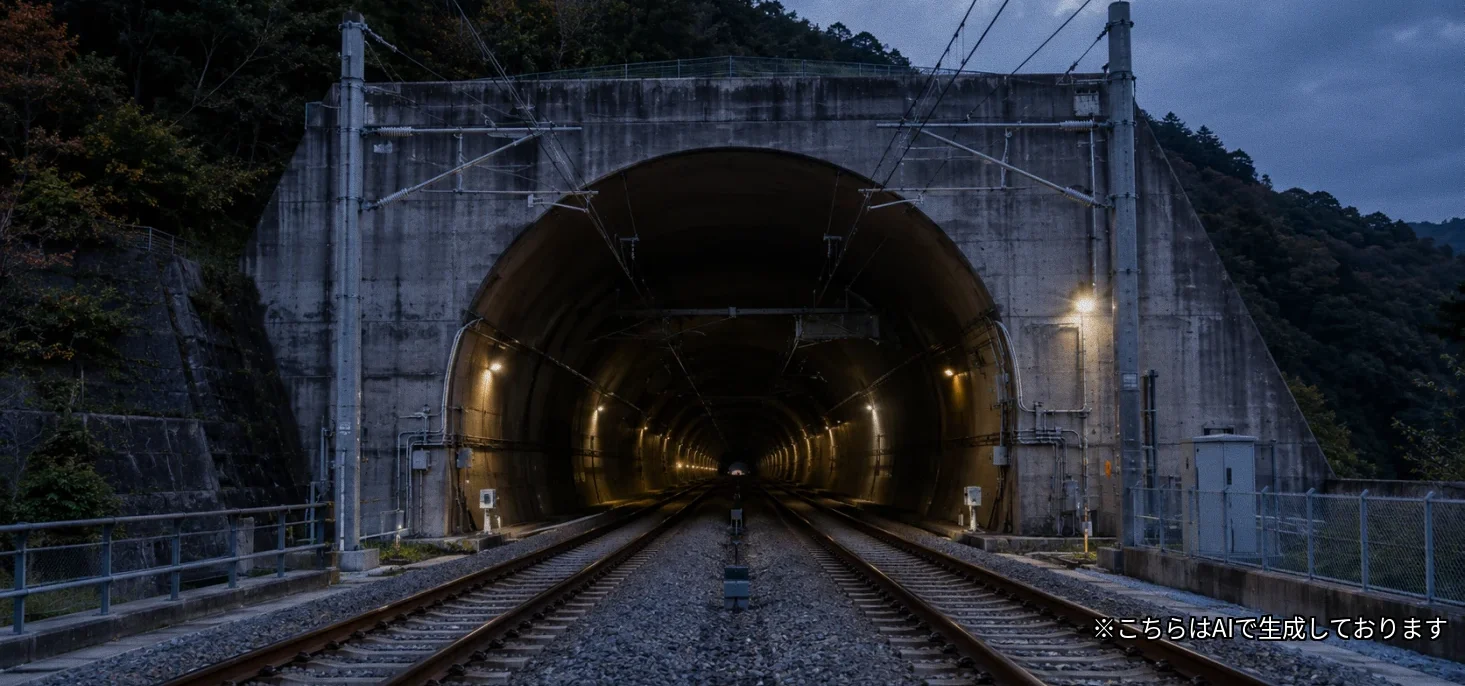
A working railway tunnel straddling Tsuruga City and Minamiechizen Town, known as the site of the train fire that broke out in November 1972.
What Is Said About It
It is a long tunnel of nearly 13 kilometers running from Kashimagari in Tsuruga City to Imajo in Minamiechizen Town. Late at night on November 6, 1972, a fire broke out inside a running express train, and 30 passengers and crew died. The inescapable setting inside a tunnel is said to have magnified the harm, and the accident also led to a review of fire-prevention standards for railway cars.
Rumors that the spirits of the dead wander the tunnel, or that a figure stands beneath the emergency lights, are told on internet haunted-spot sites. However, these are rumors that came to be told in later years because of the horror of the accident; no accounts of paranormal experiences are recorded in primary sources from the time.
What Happened on the Night of November 6, 1972
In the small hours of November 6, 1972 (Showa 47), the 15-car express “Kitaguni,” bound from Osaka for Aomori, left Tsuruga Station and entered the Hokuriku Tunnel. Around 1:08 a.m., a fire broke out near the smoking area of the third car, the dining car, and a passenger raised the alarm. The train made an emergency stop about 5.3 kilometers from the Tsuruga entrance and about 8.6 kilometers from the Imajo side.
The crew set about uncoupling the burning cars and finished separating the dining car and the car ahead of it at 1:34 a.m. But the fire caused an electrical short in the overhead wire and surrounding equipment, power was cut, and the train could no longer move under its own power. The tunnel filled with smoke, and passengers had to escape on foot through the long, dark bore. It took about ten and a half hours before everyone was rescued from the tunnel. The death toll was 30, most attributed to carbon monoxide poisoning, and 714 people were injured.
According to the expert opinion judged most reasonable at trial, the fire started from a faulty connection between an electric heater and the car’s wiring. Train vibration loosened the connection, electrical resistance rose, abnormal heat built up, and the wiring insulation melted and ignited. The dining car was said to be of a type with one of the lowest levels of flame resistance.
At the time, the prevailing belief inside the national railways was that “fires do not happen in electrified tunnels,” and the tunnel had no smoke-extraction or fire-fighting equipment and no separate escape route. The tunnel lights were also kept off in normal operation. After the accident, measures advanced such as making cars flame-resistant and non-combustible, lighting the whole tunnel at once, adding emergency telephones and stocking rescue equipment at the portals, and the operating rules were changed so that if a fire occurs in a tunnel, the train does not stop but runs through to escape.

A quick-dry cooling towel for bringing down body heat fast during midsummer ruin exploration or a haunted-spot tour. Just wet it and give it a shake for a lasting cool feeling, and it folds compact with a carry pouch so it won't take up much space in your bag.
LOGOS Quick-Dry Cooling Towel 81690140, Camping/Outdoor, Absorbent & Fast-Drying
We may earn a referral fee on purchases made through these links.
What the Record Tells Us
The Hokuriku Tunnel has continued to be used as a working railway tunnel while its equipment was renewed after the accident, and Happy Line Fukui trains still pass through it daily. Entry onto the tracks is prohibited by law, and one cannot visit it on foot as a haunted spot.
Our Reflection: “No Way Out” Breeds the Telling
The story that ghosts wander the Hokuriku Tunnel is not recorded in primary sources from the time of the accident. It is a rumor that came to be told in later years among people who learned how terrible the accident was. We believe that behind this rumor lies not only the tragedy itself but fear of the very situation of “having the way out taken away inside a long, dark tunnel.”
The assumption behind the accident, that “fires do not happen in electrified tunnels,” can also be seen, from another angle, as a record of human complacency in not imagining the worst case. The passengers who suffered were not at fault; the responsibility lay with the system. This is our own inference, but the pattern of having one’s life taken unreasonably, with no fault of one’s own, leaves the deepest fear and sorrow in people’s hearts. Ghost stories are often born around just such “deaths one cannot accept,” are they not?
In the rumor that “a figure stands beneath the emergency lights,” we see an echo of the situation at the time. The tunnel lights were off in normal operation, and passengers felt their way through the dark amid thick smoke. The sight of a figure rising in a dim space lit only by emergency lights may be a later generation’s imaginative reconstruction of what really happened that night. In our view, the rumor of the figure may be an unconscious transfer of memory onto the people who walked to escape.
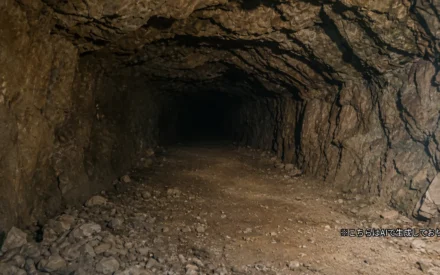
The tunnel, about 13.9 kilometers long, is darkness without end from entrance to exit. The moment you enter, the sounds and light of the outside world vanish and only the noise of the train echoes. That experience itself gives a feeling of being shut in. It is probably a place where many people feel a flicker of unease even just passing through by train.
Finally, we state our stance clearly. This accident is a real event in which 30 lives were lost. Consuming the grief of those who died as a “scary story” is not our intention. What should be passed down, we believe, is not rumors of ghosts but the fact that the accident became a lesson, fire-prevention standards were reviewed, and the lives of later passengers have been protected.
Nearby Recommended Spot: Kehi Jingu Shrine
In the center of Tsuruga City stands Kehi Jingu Shrine, known as the chief guardian shrine of the Hokuriku region. An ancient shrine said to have been visited by Matsuo Basho as well, its vermilion great torii is counted among the three great torii of Japan. The precincts are wrapped in quiet trees, and worshippers never cease through the four seasons. After visiting the tunnel, it may be good to go on to this shrine that conveys the history and faith of Tsuruga and calm the heart.
Notes for Visitors
This spot is the site of a railway accident in which 30 people actually died. We have no intention of treating the accident as entertainment and give priority to conveying it accurately as historical fact. Please refrain firmly from words and conduct lacking consideration for bereaved families and those concerned, and from entering the tracks. One can see the area near the tunnel entrance from a train window, but please do not do anything beyond that.

A handy pair for getting a closer look at a distant view or a dim, hard-to-see spot.
Ruxis Binoculars
We may earn a referral fee on purchases made through these links.
This article touches on accidents and death. If you are carrying painful feelings right now, please do not hold them alone; consider using a support service such as Yorisoi Hotline (0120-279-338 in Japan, 24 hours, free of charge, Japanese language).
Frequently Asked Questions
Q. Is the Hokuriku Tunnel still in use?
A. It is a working railway tunnel, and Happy Line Fukui trains pass through it daily. Entry onto the tracks is prohibited by law, and one cannot visit it on foot.
Q. Are the ghost rumors recorded in the records from the time of the accident?
A. No. They are rumors that came to be told in later years because of the horror of the accident, and accounts of paranormal experiences are not recorded in primary sources from the time.
Q. What was the 1972 accident?
A. Late at night on November 6, 1972, a fire broke out inside a running express train and 30 passengers and crew died. It is said to have led to a review of fire-prevention standards for railway cars.
Q. What caused the Hokuriku Tunnel accident?
A. According to the expert opinion judged most reasonable at trial, a faulty connection between the dining car’s electric heater and the car’s wiring was the cause. It is explained that vibration loosened the connection and abnormal heat started the fire.
Q. How did tunnel safety measures change after the accident?
A. Cars were made flame-resistant, tunnel lighting was changed to come on all at once, emergency telephones were added, and rescue equipment was stocked at the portals. The operating rules were changed so that, if a fire occurs in a tunnel, the train does not stop but runs through to escape.
Q. Has KARASU CHANNEL researched or filmed on location at the Hokuriku Tunnel?
A. No. We are not currently researching the Hokuriku Tunnel, though we are considering doing so. Videos of our research into other haunted spots and ghost stories can be viewed on KARASU CHANNEL (YouTube).

Supervised by Suzuking.
Affiliation: KARASU CHANNEL
Occult & horror reporting: 7 years (since 2020)
Followers: YouTube 5,000+ / X 25,000+
On-site investigations: 30+
Kaidan Tales from This Area

Which haunted location do you find the scariest?
If you think this location is the scariest, press the button below. One vote site-wide — you can change your vote for a different location anytime.
Was this article helpful?
Add this to your favorites to find it again anytime from your My Page.


Comments