Oigami Onsen — The Waters That Healed a Wounded God, and the War Between Nikkō and Akagi
Supervised by Suzuking. (KARASU CHANNEL / Occult & horror reporting, 7 years)
Contents
View sources and last-checked date
- Source
- SURF&SNOW https://surfsnow.jp/article/visit/detail/tonenumata007/
- Last verified
- 2026-09-16
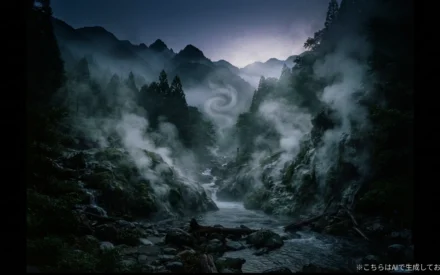
Oigami Onsen rises at the foot of Mount Akagi in Numata, Gunma Prefecture. Behind its unusual name, read “Oigami,” lies a vivid tradition of a ferocious battle fought to the death between the god of Mount Akagi and the god of Mount Nantai in Nikkō, and of a badly wounded god who soaked his injuries in these very waters to heal them.
Origins — The Great Serpent of Akagi, Struck by an Arrow
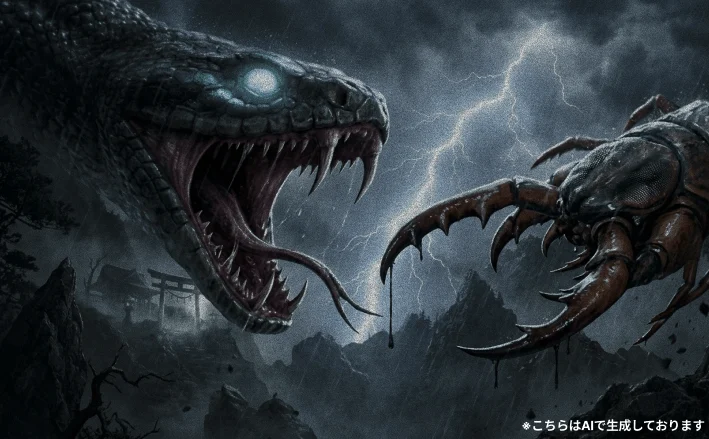
According to legend, far back in the age of the gods, the great serpent that was the god of Mount Akagi and the giant centipede that was the god of Mount Nantai in Nikkō fought fiercely over territory. An arrow loosed by the Nikkō side pierced deep into the great serpent’s eye, and, badly wounded, it withdrew to Mount Akagi. Enduring the pain, the wounded serpent pulled the arrow from its own body and drove it into the ground at the foot of the mountain. From that spot, hot water is said to have come welling up. The serpent soaked its wound in this water to heal it, and once it had recovered, drove off the pursuing centipede and defended Mount Akagi’s territory. The name “Oi-gami” — “the god who drove [the enemy] away” — is said to have shifted over time into the place name “Oigami.”
The “Winner” and “Loser” Swap Depending on Who’s Telling It
What makes this interesting is that the same legend of a battle between gods also survives on the Nikkō side, as the legend of an old battlefield called Senjōgahara. But in the version told in Nikkō, the roles are reversed exactly: the god of Mount Akagi is the giant centipede, and the god of Mount Nantai is the great serpent. In other words, while both places share the same basic story — “the gods of two mountains fought” — which side’s god is the victorious serpent and which is the defeated centipede swaps depending on where the story is told. On the Gunma side, home to Oigami Onsen, the tale is naturally passed down with their own god, the deity of Mount Akagi, as the brave serpent who healed its wounds and drove off the enemy.

Attach an AirTag to your car keys, bag, or the car itself before exploring an unfamiliar ruin or mountain haunted spot, and you can check its location in the Find My app if you forget where you parked or lose track of a bag in the dark. Even deep in the mountains with poor reception, its location updates via nearby Apple devices — a safety and anti-loss measure for solo exploration.
Apple AirTag (2nd Generation) Item Tracker, Find by Sound, Water & Dust Resistant, Works with Find My Network
We may earn a referral fee on purchases made through these links.
The “Great Serpent Festival,” Still Celebrated Today
At Oigami Onsen, a Great Serpent Festival based on this myth is still held every year on the second Friday and Saturday of May. Serpent-shaped floats paraded through the hot spring town run about 30 meters for the young men’s float and about 20 meters even for the children’s float, and once every twelve years, in the Year of the Snake, an especially massive float appears: 108 meters long and weighing roughly 2 tons. This Year-of-the-Snake serpent float was certified as a Guinness World Record in 2013, showing how a purely local legend still lives on today as an event that genuinely moves the whole community.

A portable shovel for clearing dirt from poor footing at a ruin or mountain haunted spot, or for digging a car out if it gets stuck in snow or mud.
CAPTAIN STAG Steel Folding Shovel with Bag M-3249, Portable, Outdoor/Camping/Car Use
We may earn a referral fee on purchases made through these links.
Our Take — Why Tell the Story with Your Own God as the Winner?
From here on, this is our own view, mixed with speculation. The fact that two regions tell the same myth’s outcome in reverse is too interesting to dismiss as a mere discrepancy in folklore. We think it likely that both regions have kept alive the story of their own mountain god as “the brave god who defeated the enemy” because doing so has supported the pride and solidarity of the people living there. Who wins and who loses in a myth may be less a matter of historical accuracy than a mirror reflecting how the people of a given place wish to take pride in their home.
Seen this way, there is a deeper meaning in Oigami Onsen’s own origin story as “the place where a wounded god was healed.” Precisely because this is a god who was once defeated and wounded, people may have come to believe that the waters which healed that god carry a special power. We think the reason this legend has been cherished for more than 700 years as a point of pride for this hot spring town lies not in a story of a flawless, unwounded victor, but in the story of a god who was once wounded, healed, and rose again.
From a religious perspective, too, it is suggestive that this legend installs a serpent as the guardian deity of the land. Across Japan, snakes have long been worshipped as water and dragon deities, tied to mountain worship as beings who govern rain-calling, flood control, and good harvests. Mount Akagi itself is a mountain of faith, long worshipped at several shrines including Akagi Shrine, and the great serpent legend can be read as more than a simple tale of martial valor — as a story that entrusts the very power of water and fertility said to dwell in this mountain to the figure of a serpent. The fact that the healing waters still flow today may have given both residents and visitors an ongoing sense that the mountain god’s power flows through this land not only within the legend, but at this very moment.
This is speculation, but we think the very act of parading a giant float during the Great Serpent Festival may conceal a religious structure beyond mere entertainment. Many Japanese festivals share a structure in which a god is temporarily lowered into a sacred vessel or float — a “yorishiro” — paraded through the community, and finally pacified and sent back. If the Great Serpent Festival at Oigami Onsen is likewise a ritual that invites this “raging god” — wounded, healed, and victorious in the myth — into the human town only for the duration of the festival, parades it, and then pacifies and returns it, then this can be read not as a mere tourist event, but as an ongoing rite of pacification and renewal. We are also struck by the fact that the float appearing in the Year of the Snake measures exactly 108 meters. The number 108 is known in Buddhism as the number of human worldly desires, and while this is likely just coincidence, we cannot help but feel a kind of narrative resonance between this god’s story of being wounded, healed, and rising again, and the number 108, said to represent the count of human confusion and suffering.
In our view, there is one more point too significant to overlook: this myth remains, even now, “unresolved.” As long as the Gunma side tells of the serpent as victor and the Nikkō side tells of the centipede as victor, neither tradition admits that its own god was the loser. In other words, this battle between gods was not fought once and settled within the myth — it can be said to continue today, invisibly, through the two places each continuing to tell their own version as the truth. Beyond the steam rising from Oigami Onsen, and beyond Nikkō’s Senjōgahara, two “stories of victory” that will never meet go on being told at the same time. Seen this way, even the peaceful scenery of this hot spring town seems to conceal, quietly, an unfinished rivalry between gods.
A Note on Visiting
Oigami Onsen is an active hot spring resort and tourist destination, and the Great Serpent Festival is a public celebration open to visitors. Please be considerate of the hot spring town and its residents when visiting. This article is published to record this place, not to encourage going there.
Frequently Asked Questions
Q. What is the origin of the name Oigami Onsen?
A. It is said to come from “Oi-gami” — “the god who drove [the enemy] away” — from the legend of the god of Mount Akagi (the great serpent) driving off the god of Nikkō (the giant centipede), which later shifted into “Oigami.”
Q. Can the Great Serpent Festival still be seen today?
A. Yes. It is held every year on the second Friday and Saturday of May at Oigami Onsen, and once every twelve years, in the Year of the Snake, a massive serpent float certified as a Guinness World Record appears.
Q. Has KARASU CHANNEL filmed a report at Oigami Onsen?
A. No, we have not filmed there yet, though we are considering it. Other haunted-spot and kaidan field-report videos can be viewed on KARASU CHANNEL (YouTube).
Japanese horror 鴉番組

Supervised by Suzuking.
Affiliation: KARASU CHANNEL
Occult & horror reporting: 7 years (since 2020)
Followers: YouTube 5,000+ / X 25,000+
On-site investigations: 30+
If this appeared in your dream
What it means to dream of something from this story, read through psychology and folklore in our Dream Dictionary.
- Dreaming of a Hot SpringA lucky symbol of healing and recovery; fatigue easing and relationships softening.
Which story do you find the scariest?
If you think this story is the scariest, press the button below. One vote site-wide — you can change your vote for a different story anytime.
Was this article helpful?
Add this to your favorites to find it again anytime from your My Page.








Comments